
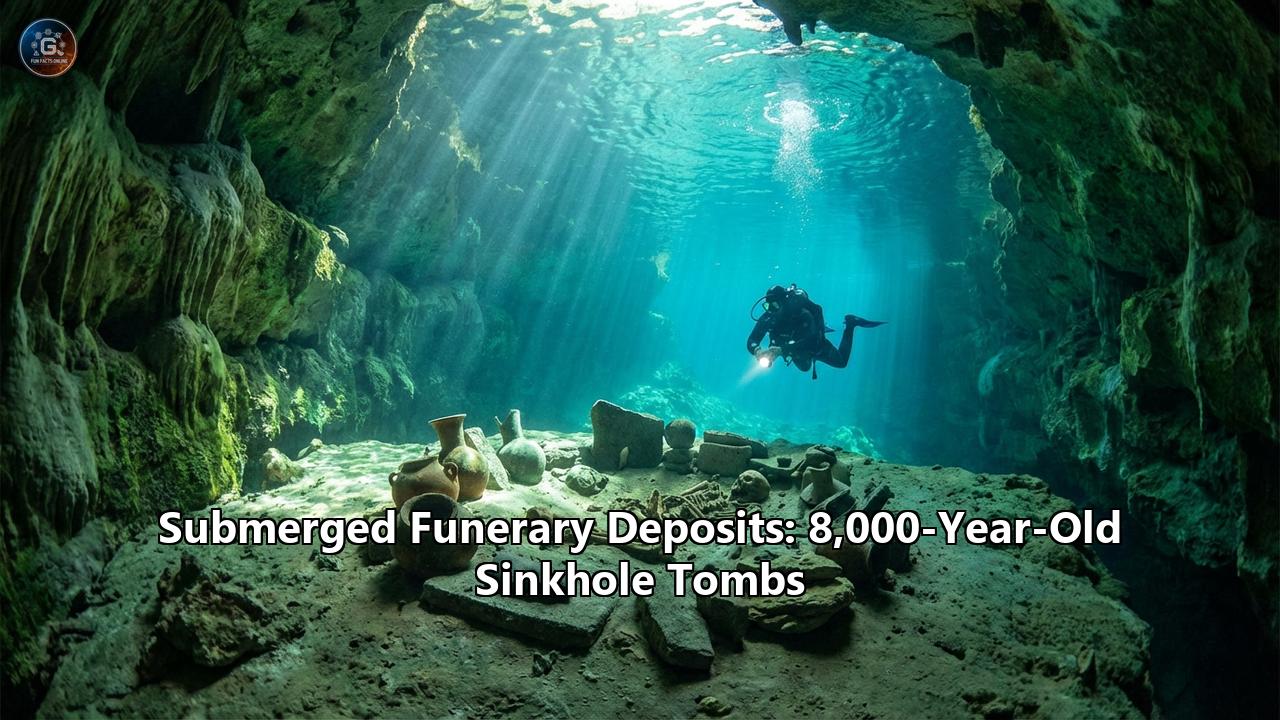
Deep beneath the surface of the Earth, shrouded in perpetual darkness and submerged in crystal-clear waters, lie some of the most profound time capsules known to humanity. These are not the golden tombs of pharaohs or the monumental pyramids of ancient empires. Instead, they are submerged funerary deposits—sinkholes, peat bogs, and flooded cave networks that cradle the delicate remains of our earliest ancestors. Preserved by the very waters that swallowed them at the end of the last Ice Age, these 8,000-year-old underwater graves are revolutionizing our understanding of prehistoric human migration, ancient rituals, and the dramatic climatic shifts that fundamentally reshaped our planet.
For early hunter-gatherers, the deep recesses of the earth were not just geological curiosities; they were sacred spaces, portals to the underworld, and the final resting places for their dead. Today, accessing these ancient sanctuaries requires navigating extreme environments that push the limits of modern science and human endurance. The breathtaking discoveries emerging from these aquatic underworlds—from the dense jungles of the Mexican Caribbean to the ancient peat bogs of Sweden and the submerged continental shelves of Florida—paint a vivid, global picture of how humanity honored its dead during a period of cataclysmic environmental change.
The Crown Jewel of the Yucatán: A Discovery in the DarkThe quiet, flooded depths of the Mexican Caribbean coast recently yielded a staggering discovery that has sent ripples through the archaeological community. In late 2025 and formally analyzed into early 2026, a team of cave-diving archaeologists working with Mexico's National Institute of Anthropology and History (INAH) uncovered the remarkably well-preserved skeleton of an early human. Resting exactly where it was intentionally laid 8,000 years ago, the skeleton was found deep within a sprawling network of cenotes and underground rivers situated between the bustling tourist hubs of Tulum and Playa del Carmen.
The expedition to reach the burial site was nothing short of treacherous. Led by veteran underwater archaeologist Octavio del Río, the team was forced to swim 656 feet (200 meters) through flooded, labyrinthine cave passages—a feat accessible only to elite cave divers utilizing specialized gas mixtures and life-support equipment. Approximately 26 feet (8 meters) below the surface, the divers entered a narrow space adjacent to an interior chamber. There, illuminated only by the sweeping beams of their dive lights, lay the skeletal remains.
Crucially, the skeleton was found resting atop a dune of sediments. The positioning of the bones provided immediate, vital insights into the nature of the site. "Given its location and depth, it could only have arrived there when the cave was dry," del Río noted. The deliberate arrangement of the remains in such a secluded, hard-to-reach alcove strongly suggests a funerary deposit. This was no accidental fall or a traveler losing their way in the dark; it was a ritualistic burial, an intentional farewell orchestrated by the region's early inhabitants.
This breathtaking find marks the 11th prehistoric human skeleton discovered in the Tulum area’s underwater cave systems over the past three decades. While some previous discoveries in the region—such as the famous "Naia" skeleton found in the Hoyo Negro cenote—date back more than 13,000 years to the late Pleistocene epoch, this 8,000-year-old individual offers a crucial puzzle piece regarding the populations that thrived during the transition into the Holocene.
A Vanished World: Ice Age Megafauna and the Great ThawTo understand how an 8,000-year-old tomb came to be perfectly submerged, one must look to the paleoclimate of prehistoric North America. The environment that these ancient peoples inhabited was radically different from the lush, tropical, and humid jungles that currently blanket the Yucatán Peninsula. During the Pleistocene epoch and into the early Holocene, the region was characterized by vast, arid open plains, deep canyons, and imposing limestone cliffs.
The sprawling cave networks beneath the peninsula, stretching for thousands of miles, were completely dry. They served as vital sanctuaries. For early human bands, these subterranean caverns provided shelter from the elements, natural reservoirs for fresh water, and, evidently, sacred sites for funerary rites. However, humans were not the only entities utilizing these caves. Underwater archaeologists exploring these systems continually discover the fossilized remains of extinct megafauna. The bones of giant ground sloths, formidable saber-toothed cats, and ancient bears share these dark chambers with their human counterparts, helping paleontologists piece together the complex food webs of vanished Ice Age ecosystems.
Around 8,000 to 10,000 years ago, the Earth underwent a period of rapid global warming. The colossal ice sheets that had locked up millions of cubic miles of freshwater began to melt, causing global sea levels to surge dramatically. In the Yucatán, the rising water table slowly inundated the limestone karst landscape. The dry caves filled with fresh and brackish water, sealing the ancient burials in a dark, aquatic, and low-oxygen environment. This process of inundation, while destroying the terrestrial landscape, acted as an extraordinary preservative. The cool, stable temperatures and lack of physical disturbance within the flooded chambers prevented the bones from weathering away, leaving them frozen in time for eight millennia.
A Global Phenomenon: Skulls on Stakes in a Swedish BogWhile the ancient inhabitants of the Americas were laying their dead to rest in limestone caverns, a vastly different, yet equally complex aquatic burial ritual was taking place roughly 8,000 years ago in Northern Europe. At the archaeological site of Kanaljorden in eastern-central Sweden, researchers uncovered a mysterious and macabre underwater graveyard that highlights the diverse ways prehistoric humans utilized aquatic environments for funerary practices.
During the Stone Age, the Kanaljorden site was a shallow lake. It was here that prehistoric hunter-gatherers constructed an enigmatic underwater platform. By tightly packing large stones and wooden stakes into the lakebed, they built a flat structure measuring approximately 39 feet by 46 feet (12 by 14 meters)—roughly the size of a school bus. Hidden beneath the water's surface, save for a few wooden stakes that may have broken the waterline, this submerged altar became the final resting place for at least 11 adults and one infant.
Unlike the carefully articulated skeleton found in the Mexican cenote, the Swedish site contained mostly disarticulated skulls and a few fragmented bones. The infant, who researchers believe was either stillborn or died shortly after birth, was the only individual whose nearly complete skeleton was present. The adult remains presented archaeologists with a chilling prehistoric mystery. Seven of the adults—including at least two of the females—showed clear signs of severe blunt-force trauma to their skulls.
However, forensic analysis revealed that these brutal blows were not the immediate cause of death; the bone tissue in the skulls showed clear signs of healing, indicating that the individuals had survived the violent encounters for some time before their eventual deaths. Even more baffling, two of the skulls were discovered with pointed wooden stakes driven directly through them. Furthermore, of the 11 adult skulls recovered, only one still had its jawbone attached.
"Even though we can't decipher the meaning of the ritual, we can still appreciate the complexity of it, of these prehistoric hunter-gatherers," noted archaeologist Fredrik Hallgren. The intentional curation of skulls, the removal of jawbones, and the mounting of heads on stakes in a submerged environment point to a highly structured and symbolic ritual. Over millennia, the shallow lake became overrun with reeds, transitioning into a peat bog, and eventually, a forest grew over it. The wet, anaerobic peat preserved the wooden stakes and the battered skulls perfectly, waiting 8,000 years to be unearthed by archaeologists conducting pre-construction surveys for a new railroad.
Submerged Ancestors: The Peat Ponds of FloridaThe phenomenon of 8,000-year-old submerged burials is not limited to cave systems and European bogs; it also extends to the continental shelves of North America. Just as sea-level rise flooded the Mexican cenotes, it also swallowed vast tracts of prehistoric coastline. Off the west coast of Florida, submerged beneath the choppy waters of the Gulf of Mexico, lies another extraordinary funerary deposit.
In 2016, a diver searching for fossils approximately an hour south of Tampa pulled a human jawbone from the seafloor. The jaw, containing a single tooth, was reported to the Florida Bureau of Archaeological Research, triggering an extensive underwater excavation. What researchers found was the Manasota Key Offshore archaeological site—a 7,000 to 8,000-year-old Native American ancestral burial ground submerged beneath 20 feet of ocean water.
Much like the early inhabitants of Sweden, the indigenous peoples of ancient Florida utilized shallow, peat-bottomed freshwater ponds as graveyards. At least six individuals were laid to rest in this specific pond. The deceased were sunk into the soft peat at the bottom of the water and pinned in place using sharpened wooden burial stakes, the tops of which would have originally protruded above the pond's surface to mark the graves.
At the time of these burials, the Florida coastline was miles further out than it is today, and the freshwater pond sat approximately nine feet above the ancient sea level. As the Ice Age thawed, the Gulf of Mexico crept inland, eventually completely enveloping the pond. According to conventional geological wisdom, a site like this should have been utterly obliterated. The relentless wave action, shifting ocean currents, and thousands of years of violent hurricanes should have scattered the remains into the abyss.
Astonishingly, the thick, gelatinous peat at the bottom of the ancient pond held fast. It acted as an impenetrable protective matrix. Not only did the peat keep the bones in place, but its oxygen-free properties also preserved extraordinary organic materials that usually rot away within decades. Underwater archaeologists excavating the site have recovered ancient fabric fragments woven by these early inhabitants, intact wooden stakes, and even preserved brain tissue within the skulls.
“Seeing a 7,000-year-old site that is so well preserved in the Gulf of Mexico is awe inspiring,” state officials remarked. Today, out of respect for the ancestors of the Seminole Tribe and to protect the site from looting, the long-forgotten underwater grave is marked only by warning buoys, instructing boaters and divers to leave the ancient dead in peace.
The Meticulous Science of Underwater ArchaeologyThe study of these submerged funerary deposits represents the absolute pinnacle of archaeological science, merging the traditional disciplines of anthropology and paleontology with the extreme logistics of technical diving. Excavating an 8,000-year-old tomb on land is a delicate process; doing so 26 feet underwater in a pitch-black cave, or beneath the murky peat of an oceanic shelf, is a monumental challenge.
In overhead environments like the Mexican cenotes, archaeologists face the constant threat of "silt-outs"—where a single misplaced fin kick can stir up centuries of fine sediment, reducing visibility to absolute zero in a matter of seconds. Because of these hazards, modern underwater archaeologists rely heavily on non-invasive digital preservation. Before a single bone is moved, dive teams use high-definition cameras and powerful strobes to capture thousands of overlapping images of the skeleton and its surroundings. Advanced software then stitches these images together through a process called photogrammetry, generating a millimeter-accurate, 3D digital twin of the burial site. This allows researchers around the globe to study the funereal deposit in virtual reality long after the physical dive has ended.
When physical remains are recovered, as with the 2025/2026 Yucatán skeleton, they are subjected to a battery of cutting-edge forensic tests. Radiocarbon dating of the bone collagen provides precise timelines of when the individual lived. Stable isotope analysis—examining the ratios of elements like carbon, nitrogen, and strontium locked in the tooth enamel—reveals incredible details about the person's life. It can tell scientists whether the individual's diet consisted mostly of terrestrial game or marine resources, and even track their migration patterns across the landscape from childhood to adulthood. Each new skeleton recovered provides invaluable data points, allowing researchers to trace the lineage and adaptational strategies of the populations that colonized the Americas.
A Legacy Under Threat: Conservation and the Modern WorldDespite surviving the wrath of the shifting climate, the melting of the ice caps, and the passage of eight millennia, these sacred submerged tombs face a new, unprecedented threat: modern human development. The pristine time capsules of the Yucatán Peninsula are currently caught in the crosshairs of rapid infrastructure expansion.
The most pressing danger comes from the construction of the Tren Maya (Maya Train), a massive railway project designed to connect tourist destinations across the region. The construction has required the clearing of vast swaths of virgin jungle directly above the fragile subterranean networks. Worse still, massive steel and concrete support columns have been driven deep into the earth to stabilize the railway, frequently puncturing the delicate limestone roofs of the cave systems. Ecologists and cave divers have documented these pillars directly penetrating the flooded caverns, warning that the construction is causing severe environmental damage, altering the flow of the underground rivers, and risking the contamination of these pristine aquatic environments.
The discovery of the 8,000-year-old skeleton in 2026 has galvanized conservation efforts. It serves as a stark reminder of what stands to be lost if the subterranean world is compromised. Amid the public outcry and the irrefutable evidence of the caves' archaeological significance, a coalition of Mexican officials, the Environment Ministry, and INAH researchers are aggressively pushing for new protective measures. They are actively working to designate the entire sprawling network of cenotes and underground rivers as a federally protected natural and cultural heritage area by the end of 2026. This designation recognizes the dual nature of the caves: they are simultaneously highly vulnerable ecological habitats and extraordinary museums of human history.
Echoes from the DeepThe submerged funerary deposits scattered across our planet—from the profound depths of Mexican sinkholes to the staked skulls of Swedish bogs and the inundated coastal ponds of Florida—serve as hauntingly beautiful reminders of our shared human heritage. They reveal an ancient people deeply intimately connected to the earth and its waters. To them, caves were not empty voids, and ponds were not merely resources; they were sacred thresholds where the living bid farewell to the dead.
As we continue to explore these sunken time capsules, every dive brings a forgotten voice back into the light. These 8,000-year-old skeletons do more than just rewrite the timelines of human migration or map the extinct megafauna of the Ice Age. They reflect the profound resilience of humanity in the face of planetary upheaval. Just as our ancestors navigated the dramatic climate shifts of the early Holocene—adapting as their hunting grounds turned to jungle and their coastal graves slipped beneath the rising tides—we are left to ponder our own relationship with a changing planet. The submerged tombs of the deep are not merely relics of the past; they are enduring monuments to the human spirit, preserved for eternity in the dark, silent waters of the underworld.
Reference:
- https://nz.news.yahoo.com/8-000-old-human-skeleton-132640213.html
- https://www.heritagedaily.com/2026/03/submerged-cave-remains-point-to-an-8000-year-old-burial-site/157164
- https://indiandefencereview.com/8000-year-old-skeleton-mexico-darkest-cave/
- https://ground.news/article/a-prehistoric-skeleton-found-deep-in-a-flooded-mexican-cave-was-likely-placed-there-in-a-ritual
- https://www.livescience.com/61736-ancient-heads-on-stakes.html
- https://www.atlasobscura.com/articles/florida-manasota-key-underwater-graves
- https://www.ctvnews.ca/sci-tech/article/ancient-burial-site-found-submerged-off-florida/