
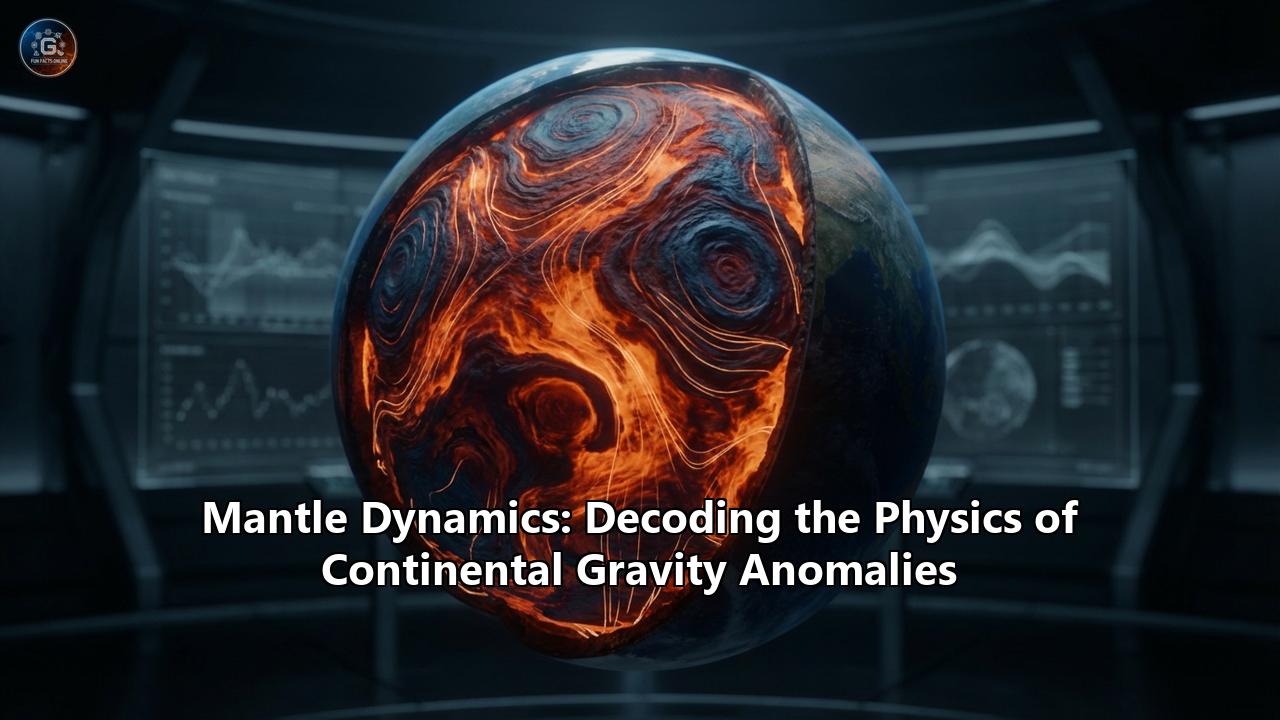
If you were to take a perfectly calibrated bathroom scale and travel across the globe, you would quickly discover a strange, unsettling truth: your weight is not constant. On a ship sailing just south of the Indian peninsula, you would find yourself infinitesimally lighter than you were a few weeks prior in the rugged highlands of the Andes or the icy expanses of Hudson Bay. This phenomenon is not due to a malfunction in your scale, nor is it a trick of the climate. It is a direct result of the fact that Earth is not a perfect sphere, and more importantly, its mass is not evenly distributed.
Beneath our feet, the planet is a churning, dynamic engine. The solid rock of the Earth's mantle flows like glacial ice over millions of years, driven by the intense heat of the core and the decay of radioactive isotopes. This slow-motion maelstrom redistributes millions of cubic kilometers of rock, creating massive subterranean mountains and deep, dense valleys of compressed silicates. The result? Variations in the Earth’s gravitational pull, known as gravity anomalies.
For decades, the physics behind continental and oceanic gravity anomalies represented one of the most enigmatic puzzles in geophysics. Today, thanks to advanced satellite gravimetry, seismic tomography, and supercomputer simulations of fluid dynamics, we are finally decoding the deep-earth forces that sculpt our planet's gravitational field.
To understand gravity anomalies, we must first dive into the abyss of mantle dynamics, exploring how the physics of viscous fluids, ancient sunken oceans, and the sheer weight of continents interact to warp the fundamental forces of physics on Earth's surface.
The Illusion of a Perfect Sphere: Understanding the Geoid
When we picture the Earth, we usually imagine a smooth blue marble. In reality, if we were to strip away the tides, currents, and weather, and allow the ocean to settle purely according to the pull of gravity and the rotation of the Earth, the planet would look remarkably like a lumpy potato. Geophysicists call this hypothetical undulating shape the geoid.
The geoid represents a surface of equal gravitational potential. Wherever there is a massive concentration of dense rock beneath the crust, local gravity is stronger, and the geoid bulges outward. Conversely, in regions where the mantle is relatively hot and less dense—or where mass is missing—gravity is weaker, and the geoid dips.
When mapping gravity across continents, scientists look at two primary types of anomalies:
- Free-Air Anomaly: This measures gravity while mathematically correcting for the observer's elevation above sea level, but it does not remove the mass of the terrain itself. It is highly sensitive to the dynamic "push and pull" of the mantle below.
- Bouguer Anomaly: This goes a step further by mathematically stripping away the gravitational pull of the mountains and valleys you are standing on. What remains is the gravitational signature of the deep crust and the mantle itself.
Over continents, Bouguer anomalies are almost always strongly negative over mountain ranges. This was the first major clue to understanding continental gravity. It led to the principle of isostasy—the idea that the Earth’s rigid outer shell (the lithosphere) floats on the denser, flowing mantle (the asthenosphere) like an iceberg in the ocean. A massive mountain range extending high into the sky must have an equally massive, low-density "crustal root" plunging deep into the mantle to support its weight. Because this deep continental root is less dense than the mantle rock it displaces, it creates a negative gravity anomaly.
But isostasy only tells half the story. To explain the vast, continent-spanning gravitational variations that don't correlate with surface mountains, we have to look past the passive floating of the crust. We have to look at the active, violent churning of the mantle.
The Rheology of the Deep: Physics of the Mantle
The Earth’s mantle is approximately 2,900 kilometers thick, comprising about 84% of the planet's total volume. A common misconception is that the mantle is a vast ocean of molten magma. In truth, aside from a few isolated pockets, the mantle is entirely solid rock. However, over geological timescales, this incredibly hot rock behaves like a highly viscous fluid.
The physics of mantle dynamics is governed by the Navier-Stokes equations for fluid flow, but with a twist: the mantle's viscosity is astronomical. Water has a viscosity of about 0.001 Pascal-seconds (Pa·s). The Earth’s mantle, by contrast, has a viscosity ranging from $10^{19}$ to $10^{23}$ Pa·s. Because the mantle is so viscous, inertial forces are entirely negligible. The fluid dynamics are dominated entirely by a delicate balance between pressure, viscous friction, and buoyancy.
This movement is driven by thermal convection. The core-mantle boundary sits at a blistering 3,500 to 4,000 degrees Celsius, heating the rock directly above it. As this deep mantle rock heats up, it thermally expands, its density drops, and it becomes buoyant. Slowly—at a rate of just a few centimeters per year—this hot rock rises toward the surface in massive columns known as mantle plumes. Simultaneously, at the Earth’s surface, old, cold, and highly dense tectonic plates (lithosphere) plunge back into the deep mantle at subduction zones, sinking like stones through thick honey.
The vigor of this convection is determined by the Rayleigh number, a dimensionless quantity in fluid dynamics that describes the ratio of buoyancy-driven forces to viscous resistance. In the Earth's mantle, the Rayleigh number is estimated to be around $10^6$ to $10^7$—well above the critical threshold for convection. This guarantees that the interior of our planet is locked in a state of perpetual, chaotic overturn.
Dynamic Topography: The Mantle's Invisible Hand
As these massive convection currents churn, they exert immense physical stress on the underside of the continental plates. This interaction gives rise to a phenomenon known as dynamic topography.
Imagine a raft floating in a swimming pool. If a diver swims directly upward beneath the raft, the upward rush of water will push the raft higher. If the diver swims rapidly downward, pulling water with them, the resulting suction will pull the raft down. The mantle does the exact same thing to the Earth's surface.
When a hot, buoyant mantle plume rises beneath a continent, it physically pushes the crust upward, creating regional uplift that is not supported by a deep crustal root. Because there is hot, low-density material pushing up from below, you might expect a lower gravity signal. However, the physical elevation of the surface pushes mass closer to the satellite measuring the gravity. The balance between the missing mass in the mantle and the extra mass raised at the surface determines the final gravity anomaly.
This relationship is measured by a metric called admittance—the ratio of the gravity anomaly to the topographic elevation. Recent advances in supercomputing have shown that the admittance is highly sensitive to the lateral viscosity variations (LVVs) in the mantle. The lithosphere isn't uniformly thick; ancient, stable parts of continents called cratons (like the Canadian Shield or the heart of Africa) have deep, cold, hyper-viscous keels that extend up to 250 kilometers into the mantle. When mantle flow hits these deep cratonic roots, the flow is deflected, altering the surface gravity anomaly in highly complex, unpredictable ways.
The Ghost of the Tethys: Decoding the Indian Ocean Geoid Low
To truly understand how deep mantle dynamics shape gravity on the surface, we must examine the most extreme gravity anomaly on the planet: the Indian Ocean Geoid Low (IOGL).
Discovered in 1948 by Dutch geophysicist Felix Andries Vening Meinesz, the IOGL is a massive "gravity hole" spanning 1.2 million square miles, centered just south of the Indian peninsula. In this region, the gravitational pull is so profoundly weakened that the actual sea level plunges up to 106 meters (348 feet) below the global average. For over seventy years, this massive depression in the geoid remained one of Earth science's greatest mysteries.
It wasn't until the 2020s, utilizing advanced 3D seismic tomography and time-dependent mantle convection simulations, that geophysicists finally solved the whodunit. The culprit was not a feature near the surface, but a complex, 140-million-year-old tectonic drama playing out nearly 3,000 kilometers deep.
The story begins during the Mesozoic era, when the supercontinent Gondwana was breaking apart. India detached from Madagascar and Antarctica and began an epic, high-speed migration northward toward Eurasia. Between India and Eurasia lay a vast body of water known as the Tethys Ocean. As India careened northward, the cold, dense oceanic crust of the Tethys was forced to subduct beneath the Eurasian plate.
Millions of cubic kilometers of this cold oceanic slab sank deep into the mantle. But subducted slabs do not simply melt away; they retain their thermal identity for hundreds of millions of years. The dense remnants of the Tethys Ocean plunged all the way to the core-mantle boundary.
When these cold slabs reached the bottom, they crashed into a preexisting structure: the African LLSVP (Large Low-Shear-Velocity Province), a massive, continent-sized blob of unusually hot rock sitting deep beneath the African continent. Like an avalanche of ice crashing into a pool of hot mud, the sinking Tethys slabs forcefully displaced the hot rock of the African LLSVP. This churning action squeezed plumes of hot, low-density material upward and eastward, driving them directly beneath the Indian Ocean.
Today, it is the presence of these hot, buoyant, low-density plumes—originating from a depth of 300 to 900 kilometers and spawned by the ghostly remnants of an ocean that no longer exists—that creates the massive mass deficit. The Indian Ocean Geoid Low is not just a statistical anomaly; it is a gravitational monument to the death of the Tethys Ocean.
Continental Gravity: Cratons, Ice, and Sinking Mantles
While the oceanic gravity holes are driven by deeply rooted mantle plumes, continental gravity anomalies often present a different kind of puzzle. Continents are vastly more complex than the ocean floor. The oceanic crust is young, constantly being created at mid-ocean ridges and destroyed at subduction zones. Continental crust, however, is old, buoyant, and heavily scarred by billions of years of tectonic collisions.
Consider the massive gravity low sitting over Hudson Bay in North America. For a long time, scientists attributed this entirely to Glacial Isostatic Adjustment (GIA). During the Last Glacial Maximum, some 20,000 years ago, Canada was crushed beneath the Laurentide Ice Sheet, a block of ice nearly three kilometers thick. The sheer weight of this ice physically bowed the continental crust downward into the mantle. When the ice melted, the crust began to rebound—a process that continues today at a rate of about a centimeter per year. Because the mantle rock hasn't fully flowed back in to replace the depression left by the ice, there is a mass deficit, resulting in a negative gravity anomaly.
However, recent gravimetric studies and global mantle flow models revealed a shocking discrepancy: the post-glacial rebound only accounts for a fraction of the observed free-air gravity low over Hudson Bay.
If the ice wasn't solely responsible, what was?
Seismic tomography provides the answer. Beneath the North American continent lies a massive, cold, highly viscous downwelling in the mantle. The mantle beneath Laurentia is literally sinking, pulling the continent down with it. This creates a massive dynamic topographic depression. The negative gravity anomaly is a superposition of two entirely different physical processes operating on vastly different timescales: the 20,000-year "quick" bounce-back from a melted ice sheet, and the 100-million-year, relentless downward tug of a cold mantle convection current.
The Role of Cratonic Keels
Furthermore, the ancient hearts of continents—the cratons—have a profound impact on how gravity is expressed. Because cratonic roots are cold and highly depleted in certain minerals, they are intrinsically less dense than the surrounding asthenosphere, giving them chemical buoyancy. Yet, they are also thermally cold, which should make them denser. This creates a delicate "isopycnic" (equal density) balance.
When mantle flow interacts with these deep roots, the lateral viscosity variations (LVVs) mentioned earlier come into violent play. The boundaries between the rigid cratons and the softer, flowing mantle represent zones of immense stress. Inversions of global mantle flow demonstrate that plate margins are substantially weaker than plate interiors, and gravitational signals here are heavily modified by these abrupt changes in rock strength. It is precisely these stresses that can occasionally transmit force deep into the continent, triggering mysterious, mid-plate earthquakes in places far from any active tectonic boundary, such as the New Madrid Seismic Zone in the United States or the forelands of the Algerian Atlas Mountains.
Seeing the Invisible: The Tools of the Gravimetric Trade
How do we know any of this? The mantle is impenetrable to direct observation. The deepest hole ever dug by humanity, the Kola Superdeep Borehole, barely scratched 12.2 kilometers into the crust—not even close to the 2,900-kilometer depths where these convection currents operate.
Our understanding of continental gravity anomalies and mantle dynamics relies on a symphony of high-tech indirect observations:
1. Satellite Gravimetry: GRACE and GOCE
The most revolutionary tools in studying gravity have been satellites, specifically the GRACE (Gravity Recovery and Climate Experiment) mission and its successor, GRACE-FO (Follow-On), alongside the European Space Agency's GOCE (Gravity Field and Steady-State Ocean Circulation Explorer).
GRACE operates using a simple but wildly effective concept. It consists of two identical satellites flying about 220 kilometers apart in the same orbit. As the leading satellite flies over a region of higher gravity (like a dense mountain range or an upwelling mantle plume), it is pulled slightly forward, increasing the distance between it and the trailing satellite. Microwave ranging instruments continuously measure the distance between the two satellites to the precision of a fraction of the width of a human hair. By mapping these minute accelerations and decelerations, scientists can build a highly accurate map of Earth's gravity field.
While GRACE is brilliant at measuring changes in gravity over time (such as the melting of ice sheets or depletion of aquifers), GOCE was designed to measure the static gravity field with unprecedented spatial resolution. GOCE flew at an incredibly low orbit and used a highly sensitive gravity gradiometer to measure the Earth's gravitational pull in three spatial dimensions, mapping the edges of continental roots and deep mantle density boundaries.
2. Seismic Tomography: Ultrasound for the Earth
If satellites provide the gravity map, seismic tomography provides the physical architecture of the deep Earth. When a large earthquake occurs, it sends seismic waves (P-waves and S-waves) traveling through the planet's interior. The speed at which these waves travel depends entirely on the temperature, density, and composition of the rock they pass through.
Waves travel faster through cold, dense rock (like a sinking tectonic plate) and slower through hot, less dense rock (like a rising mantle plume). By placing thousands of seismometers around the globe and analyzing the arrival times of earthquake waves, geophysicists use the exact same mathematical principles as a medical CT scan to build 3D models of the mantle. It was this technique that allowed scientists to "see" the ghostly remnants of the Tethys Ocean sinking beneath India and the sprawling hot mass of the African Superplume.
3. Computational Fluid Dynamics
Observing the anomalies is not enough; scientists must prove the physics. To do this, geodynamicists run massive computational models using specialized software (like ASPECT or CitcomS) on supercomputers. They simulate the Earth's mantle by solving the conservation of mass, momentum (Navier-Stokes), and energy for highly viscous, non-Newtonian fluids. By inputting the density anomalies derived from seismic tomography and applying the rules of mineral physics (including how latent heat is released when minerals undergo phase changes at different depths), they can mathematically predict what the gravity anomaly should be at the surface. When the computer's prediction matches the satellite data, scientists know they have cracked the code of that specific continental anomaly.
The Climate Connection: The Future of Gravity
While the mantle operates on timescales of millions of years, gravity is also deeply intertwined with humanity's most pressing short-term crisis: climate change.
Because gravity is entirely dependent on mass, the massive redistribution of water on Earth's surface due to global warming is actually altering the planet's gravitational field in real-time. As the massive ice sheets of Greenland and Antarctica melt, hundreds of billions of tons of water are transferred from the continents to the oceans.
This massive loss of ice mass reduces the gravitational pull of the polar regions. Counterintuitively, this means that as ice melts in Greenland, the sea level nearby actually drops, because the continent's gravitational grip on the surrounding ocean is weakened. The water sloshes toward the equator and the opposite hemisphere, exacerbating sea-level rise on coastlines thousands of miles away.
Furthermore, this rapid unburdening of the continents changes the stress field on the lithosphere. Just as the melting of the Laurentide ice sheet caused the crust to rebound, the rapid melting of modern ice sheets is expected to trigger micro-adjustments in the Earth's crust. In regions with existing tectonic stress—dictated by the deep, creeping flow of the mantle—these glacially-induced stress changes can be the proverbial straw that breaks the camel's back, potentially un-clamping ancient faults and triggering intraplate earthquakes.
A Unifying Perspective on a Dynamic Earth
The study of continental gravity anomalies is a masterclass in the interconnectedness of Earth's systems. A subtle dip in the ocean's surface off the coast of India is intrinsically linked to the continental drift of the Mesozoic era. The slow, creeping rebound of the Canadian tundra is locked in a tug-of-war with a sinking vortex of solid rock hundreds of miles below the surface. The weight of a mountain range is balanced not just by its roots, but by the relentless, invisible thermal convection of the planetary engine.
Gravity is not just a force that keeps us tethered to the ground; it is a profound communication channel. Through the subtle variations in its pull, the deep Earth whispers its history, its composition, and its future. By decoding the physics of mantle dynamics and dynamic topography, we do more than just map the underworld. We realize that the solid ground beneath our feet is merely the fragile, shifting skin of a living, breathing planet—a planet whose gravitational heartbeat is driven by the fire in its depths.
Reference:
- https://en.wikipedia.org/wiki/Indian_Ocean_Geoid_Low
- https://www.iisc.ac.in/scientists-find-out-the-cause-for-geoid-low-in-the-indian-ocean/
- https://seismo.berkeley.edu/wiki_cider/DYNAMIC_TOPOGRAHY
- https://meetingorganizer.copernicus.org/EGU23/session/46081
- https://www.researchgate.net/publication/307891614_Dynamic_topography_gravity_and_the_role_of_lateral_viscosity_variations_from_inversion_of_global_mantle_flow
- https://torontostarts.com/2025/12/09/gravity-hole-indian-ocean-mystery/
- https://mjhoggard.com/wp-content/uploads/2020/06/hoggard_etal_2016.pdf
- https://meetingorganizer.copernicus.org/EGU24/EGU24-6721.html
- https://economictimes.indiatimes.com/news/international/us/a-massive-gravity-hole-in-the-indian-ocean-is-finally-explained/articleshow/128743865.cms?from=mdr
- https://www.researchgate.net/publication/373811334_Impact_of_far-field_glacially-induced_stresses_on_fault_stability_in_the_eastern_Paris_Basin
- https://www.researchgate.net/publication/222418674_Effects_of_latent_heat_release_at_phase_boundaries_on_flow_in_the_Earth's_mantle_phase_boundary_topography_and_dynamic_topography_at_the_Earth's_surface
- https://www.researchgate.net/publication/251436121_Predicting_plate_motions_with_mantle_circulation_models
- https://www.researchgate.net/publication/362905152_Lithospheric_strength_and_stress_revisited_Pruning_the_Christmas_tree