
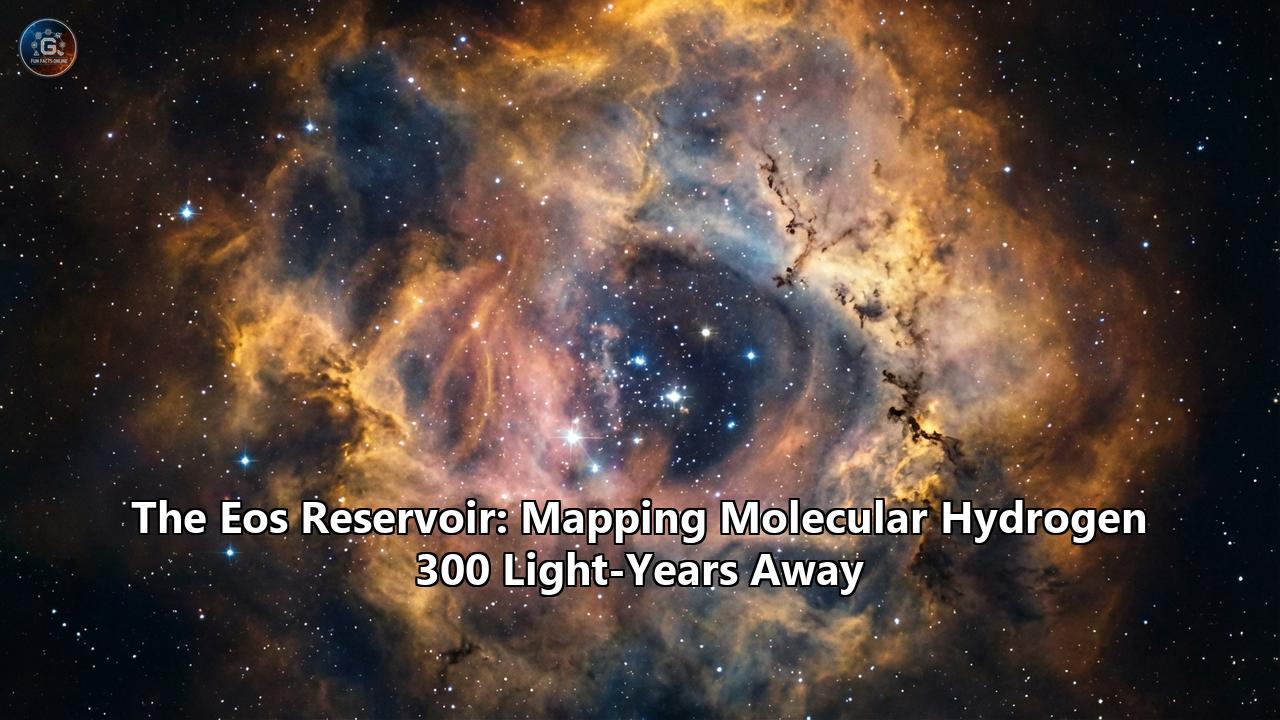
For decades, astronomers believed they had a reliable map of our galactic neighborhood. We knew the bright stars, the swirling dust lanes, and the stellar nurseries like the Orion Nebula. We thought we knew what lay in the empty spaces between them. But in 2025, that confidence was shattered—and then rebuilt into something far more wondrous—with the discovery of a leviathan hiding in plain sight.
It is called Eos, named after the Greek goddess of the dawn. It is a colossal cloud of molecular hydrogen, a reservoir of the raw stuff of stars, stretching across a swath of sky forty times wider than the full moon. It is massive, containing enough gas to build 3,400 Suns. And perhaps most unsettling of all, it is right next door.
Located just 300 light-years away, Eos is mere inches from us on the cosmic scale. Yet, until recently, it was completely invisible. It didn't block starlight like a dense dust cloud, nor did it emit the radio waves astronomers usually hunt for. It was a phantom, a "dark" reservoir floating at the edge of our own Local Bubble. Its discovery has not only rewritten the map of the solar neighborhood but has also pioneered a revolutionary new way to see the universe: by watching the darkness itself begin to glow.
The Problem of the Invisible Fuel
To understand why the discovery of Eos is so significant, one must first understand the "fuel crisis" of astronomy. We know that stars are born from collapsing clouds of molecular hydrogen ($H_2$). This simple molecule is the most abundant substance in the universe, the fundamental building block of galaxies. Without it, there are no stars, no planets, and no life.
However, molecular hydrogen is notoriously shy. It is a symmetric molecule, meaning it doesn't easily emit radiation that our telescopes can detect. In the cold depths of interstellar space, $H_2$ is effectively silent. For half a century, astronomers have relied on a proxy to find it: Carbon Monoxide (CO).
Carbon monoxide is the gregarious cousin of hydrogen. It almost always hangs out in the same clouds, and unlike $H_2$, it sings loudly in radio waves. Whenever astronomers saw CO, they assumed $H_2$ was there. Conversely, where there was no CO, they assumed the space was empty.
But for years, the math didn't quite add up. When astronomers calculated the rate of star formation in the Milky Way, there seemed to be more stars forming than the visible CO clouds could account for. There was a suspicion that a "dark gas" existed—reservoirs of pure hydrogen that lacked the carbon monoxide tracer, effectively invisible to our standard maps.
Eos is the smoking gun of this dark gas. It is a "CO-dark" cloud, so chemically pure or so diffuse that carbon monoxide hasn't formed in detectable quantities. It was hiding in the blind spot of modern astronomy.
The Goddess of the Dawn
The unveiling of Eos required a change in perspective—literally. Instead of looking for the radio "hum" of carbon monoxide, a team of researchers led by Dr. Blakesley Burkhart of Rutgers University and Dr. Thavisha Dharmawardena of NYU decided to look for the faint, ghostly glow of the hydrogen itself.
While $H_2$ doesn't emit radio waves, it does interact with ultraviolet light. When starlight from distant, massive stars hits a hydrogen molecule, the molecule absorbs the energy and then re-emits it as a specific frequency of Far-Ultraviolet (FUV) light. This process is called fluorescence.
Ideally, if you had a telescope sensitive enough to FUV light, you could see these clouds glowing faintly against the black of space. But FUV is notoriously difficult to work with; it is blocked by Earth's atmosphere and requires specialized detectors in space.
The researchers turned to archival data from a South Korean satellite mission, STSAT-1, which carried a sensitive instrument called FIMS (Far-Ultraviolet Imaging Spectrograph). Buried in the data, looking away from the bright galactic plane, they found it: a massive, crescent-shaped structure glowing faintly in the ultraviolet.
"The cloud is literally glowing in the dark," Dr. Burkhart noted upon the discovery. "It was hiding in plain sight all this time, waiting for us to look with the right eyes."
They named it Eos. In mythology, Eos is the goddess who opens the gates of heaven for the sun to rise. It was a fitting name for a cloud that represents the "dawn" of a new era in mapping the interstellar medium.
Anatomy of a ghost
Eos is a beast of a structure. If your eyes could see in the far-ultraviolet spectrum, looking up at the night sky would be a terrifying experience. Eos would dominate the view, a glowing, diffuse river of gas spanning nearly 40 degrees of the sky—dwarfing the constellations it passes through.
The Vital Statistics of Eos:- Distance: ~300 light-years (94 parsecs).
- Diameter: Approximately 80 to 85 light-years across.
- Mass: ~3,400 Solar Masses.
- Composition: Almost entirely molecular hydrogen ($H_2$), with trace amounts of dust, but significantly lacking in carbon monoxide.
- Shape: Roughly crescent or filamentary, seemingly draped over a cosmic boundary.
That boundary is the Local Bubble. The Solar System currently drifts through a cavity in the interstellar medium called the Local Bubble, a region of hot, low-density gas likely carved out by ancient supernovae millions of years ago. Eos sits right at the shell of this bubble, riding the shockwave where the bubble's expansion meets the denser resistance of the interstellar medium.
It is possible that the Eos reservoir is debris swept up by the expansion of the Local Bubble—a pile of cosmic leaves raked to the side of the yard by the supernovae explosions that cleared our immediate neighborhood.
A Laboratory for Life and Death
Eos is not just a static monument; it is a laboratory demonstrating the life cycle of the galaxy. Despite its massive size, Eos is not currently forming stars. It is too diffuse. Gravity has not yet won the battle against the internal pressure of the gas.
In fact, Eos is dying.
The same ultraviolet light that allows us to see Eos—the radiation from nearby stars—is also slowly destroying it. This process is known as photodissociation. The UV photons break the chemical bonds holding the hydrogen molecules together, stripping the cloud apart atom by atom.
Based on current models, the team estimates that Eos has only about 6 million years left to live. In cosmic time, this is a blink of an eye. It suggests that these "dark clouds" are transient, fleeting structures. They form, gather mass, and if they don't collapse into stars quickly enough, they evaporate back into the diffuse haze of the galaxy.
This transience explains why we haven't found them easily. We are catching Eos in a brief moment of existence between the "atomic fog" and the "stellar nursery" phases. It is a missing link in the evolution of matter.
The Broader Implications: A Galaxy Filled with Ghosts?
The discovery of Eos at such a close distance has unsettling implications for our understanding of the Milky Way. If a cloud as massive as 3,400 Suns could hide just 300 light-years away, how many tens of thousands of similar clouds are hiding in the distant reaches of the galaxy?
This "dark gas" could account for a significant portion of the missing mass in the interstellar medium. It solves the discrepancy in star formation rates: there is plenty of fuel, we just couldn't see it.
Furthermore, the technique used to find Eos—FUV fluorescence—is now a proven tool. Future missions, such as NASA's upcoming ultraviolet surveyors or specialized instruments on the James Webb Space Telescope (which has detected similar fluorescence in the distant universe), can now be calibrated to hunt for these ghosts. We are effectively putting on "night-vision goggles" for the galaxy.
Why It Matters to Us
300 light-years is effectively our backyard. To put it in perspective, the famous "Pillars of Creation" in the Eagle Nebula are 7,000 light-years away. The Orion Nebula is 1,300 light-years away. Eos is four times closer than Orion.
Its proximity means that the Solar System interacts with the environment Eos inhabits. While we are not on a collision course with the cloud, its presence at the edge of the Local Bubble tells us about the violent history of our neighborhood—the supernovae that blew the bubble and the walls of gas that constrain us.
Moreover, studying Eos allows astronomers to study the physics of star formation at a level of detail never before possible. Because it is so close, we can resolve the delicate filaments and turbulent eddies within the cloud. We can watch the tug-of-war between gravity (trying to make stars) and radiation (trying to destroy the cloud) play out in high definition.
Conclusion: The New Sky
The discovery of the Eos Reservoir is a humbling reminder of nature's ability to keep secrets. We look up at the night sky and see a void between the stars, but that void is an illusion of our limited biology. In reality, the space above us is thick with the glowing, swirling, breathing potential of future suns.
Eos stands as a silent sentinel at the gates of our solar neighborhood—a vast, invisible giant that has watched over Earth for millions of years, only revealing itself when we finally learned how to look. As we refine our ultraviolet eyes, we can expect the map of the Milky Way to fill up, transforming from a lonely archipelago of stars into a connected, glowing web of matter. The dawn has indeed arrived.
Reference:
- https://www.sci.news/astronomy/eos-cloud-13860.html
- https://www.techexplorist.com/eos-vast-cloud-hydrogen-solar-system/99175/
- https://www.sciencealert.com/huge-invisible-cloud-discovered-just-300-light-years-from-the-solar-system
- https://astrobiology.com/2025/04/astrochemistry-vast-molecular-cloud-discovered-near-our-solar-system.html
- https://www.nyu.edu/about/news-publications/news/2025/april/long-invisible-molecular-cloud-discovered-near-our-solar-system-.html
- https://www.sciencedaily.com/releases/2025/04/250428222137.htm
- https://www.skyatnightmagazine.com/news/eos-molecular-cloud-hydrogen
- https://mcdonaldobservatory.org/news/releases/20250428
- https://www.courthousenews.com/massive-glow-in-the-dark-cloud-of-star-forming-gas-found-hiding-near-solar-system/
- https://www.newsweek.com/astronomy-space-astrophysics-molecular-cloud-eos-hydrogen-2064868
- https://www.space.com/the-universe/scientists-find-giant-hidden-gas-cloud-only-300-light-years-away-this-cloud-is-literally-glowing-in-the-dark