
In the desolate, sun-scorched landscapes of southern Jordan, where the Great Rift Valley slices through the earth, archaeologists have unearthed a structure that defies our understanding of human history. Buried beneath the sands of Wadi Faynan, specifically at the site known as WF16, lies a massive, oval-shaped building reminiscent of a modern amphitheater. Dating back approximately 11,600 years (to the Pre-Pottery Neolithic A period), this discovery challenges the long-held belief that organized religion and complex society were the products of farming. Instead, the "Neolithic Amphitheater" suggests that community, ritual, and shared belief may have been the very spark that ignited the agricultural revolution.
The Discovery at Wadi Faynan 16 (WF16)
For years, the Neolithic period—the New Stone Age—was defined by a simple equation: humans invented farming, which created food surpluses, which then allowed them to settle down and build complex societies. But the excavation of WF16, led by Steven Mithen and Bill Finlayson, has turned this timeline on its head.
In the early 2010s, after years of digging through layers of history, the team exposed Structure O75. Unlike the small, cellular homes that dotted the settlement, O75 was monumental.
- Size and Shape: The structure is a vast oval, measuring roughly 22 by 19 meters (about 72 x 62 feet), making it the largest known building of its kind from this era in the southern Levant.
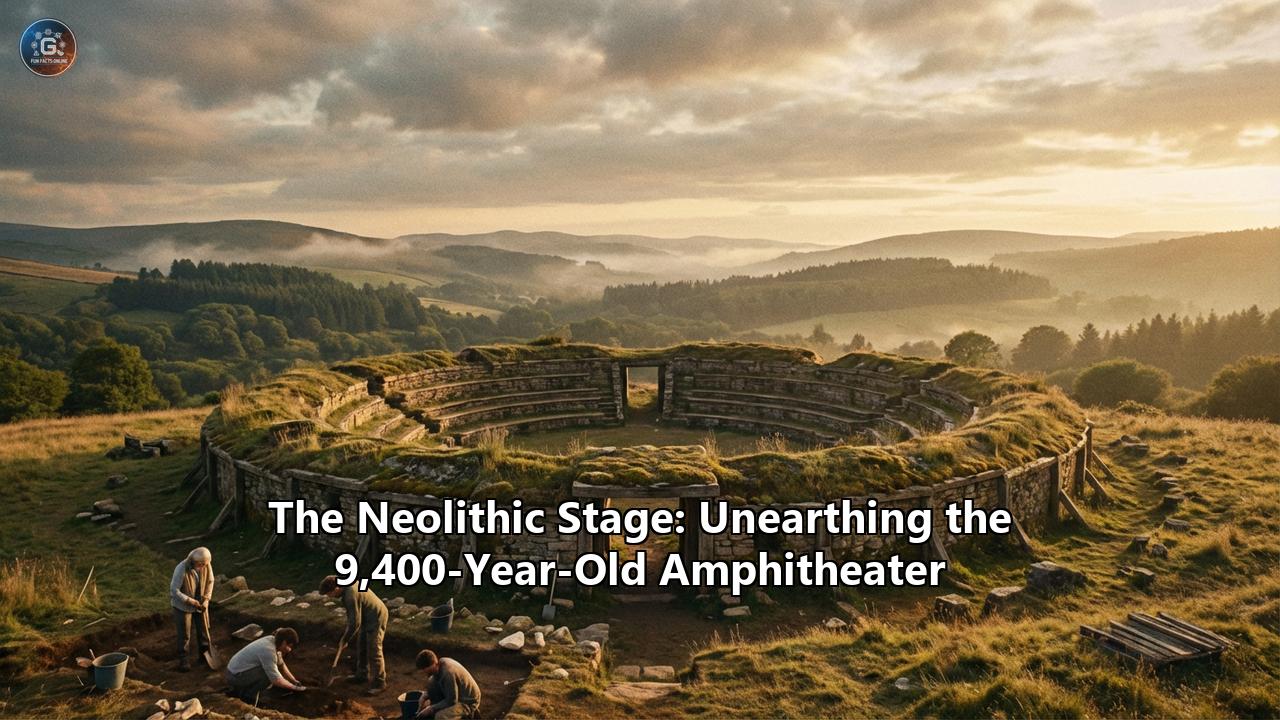
- The "Amphitheater" Design: The most striking feature is its seating. The central floor, made of smooth mud plaster, is surrounded by two tiers of benches. The lower bench is about a meter deep and half a meter high, while a second tier rises behind it. This arrangement was clearly designed to seat a large audience—perhaps the entire community—focused on a central stage.
- Decoration: The vertical face of the bench was not just functional; it was decorated with a wave-like pattern molded into the mud, a stylistic flourish that suggests an appreciation for aesthetics and symbolism.
- Construction: The walls were lined with a robust mixture of mud and stone, and massive postholes indicate that at least part of the structure was roofed, possibly to provide shade for the gathered crowd or to create a dramatic interplay of light and shadow during rituals.
A Stage for the Stone Age
What happened inside this 11,600-year-old arena? The architecture itself offers clues.
- The Central Stage: In the center of the structure, archaeologists found stone mortars set into raised platforms. These weren't just for grinding grain in the privacy of a home; they were theatrical. The act of processing food—likely wild barley, pistachios, or almonds—was elevated here to a public performance.
- Communal Feasting: The surrounding deposits were rich with the bones of wild cattle (aurochs), goats, and gazelles. This wasn't a place for everyday meals but for massive communal feasts. The community would gather to slaughter, cook, and consume large quantities of meat, bonding them together in an age before police, laws, or written contracts.
- Sound and Spectacle: The acoustics of such a sunken, bench-lined structure would have been impressive. One can imagine the rhythmic sound of pestles hitting mortars, the chanting of the crowd, and the flickering of firelight against the decorated benches. It was a sensory experience designed to forge a collective identity.
The "Headless Man" and the Rituals of Death
The site of WF16 wasn't just about the living; it was deeply intertwined with the dead. The Pre-Pottery Neolithic A (PPNA) people had complex, often macabre burial customs.
- Burial Beneath the Floor: The dead were often buried beneath the floors of their own homes, keeping the ancestors physically close to the living.
- Skull Cults: In a practice seen across the Levant (most famously at Jericho), skulls were sometimes removed from bodies, plastered to resemble faces, and kept as revered objects. At WF16, excavators found a headless skeleton in a burning building, hinting at a hasty or ritualized departure where the head was taken as a keepsake or totem.
- Green Stone and Beads: The site is littered with evidence of bead-making. Thousands of beads made from marine shells, imported obsidian, and a specific green stone (malachite or copper ore) have been found. These weren't just jewelry; they were likely markers of status, trade, or ritual participation, worn by the people sitting on those amphitheater benches.
Society Before Farming: A New Theory
The existence of the WF16 amphitheater supports a revolutionary theory in archaeology:social cohesion came before agriculture.
In the traditional view, people started farming to feed themselves, and the resulting population boom forced them to build villages and organize. But WF16, along with its northern cousin Göbekli Tepe in Turkey, suggests the opposite.
- The Need to Gather: Hunter-gatherers came together to build these monumental structures for rituals and social bonding.
- The Pressure to Feed: Gathering hundreds of people in one place for weeks at a time created a massive demand for food that hunting and foraging alone couldn't meet reliably.
- The Invention of Farming: To sustain these massive festivals and long-term gatherings, they began to experiment with cultivating wild grasses. They didn't farm to survive; they farmed to party.
The amphitheater at WF16 was likely a "parliament" of sorts—a place where localized disputes were settled, marriages were arranged, and the social fabric was woven tighter, allowing disparate bands of hunter-gatherers to merge into the world's first settled villagers.
A Window into the "Deep Past"
The discovery of the WF16 amphitheater is a reminder that the people of the Neolithic were not primitive "cavemen." They were sophisticated architects, artists, and politicians. They understood acoustics, stagecraft, and the power of shared experience.
Today, the site of Wadi Faynan is a quiet, arid landscape, but 11,600 years ago, it was a bustling hub of human innovation. The "amphitheater" stands as a testament to the moment humanity decided that sitting together, face-to-face, was the foundation of a new way of life—one that would eventually lead to the civilizations of today.
Key Facts at a Glance
- Site Name: Wadi Faynan 16 (WF16).
- Location: Southern Jordan, roughly halfway between the Dead Sea and the Red Sea.
- Age: ~11,600 years old (Pre-Pottery Neolithic A).
- Key Structure: Structure O75 (The "Amphitheater").
- Dimensions: ~22m x 19m (72ft x 62ft).
- Significance: Oldest known communal building in the southern Levant; evidence that ritual and community preceded agriculture.