
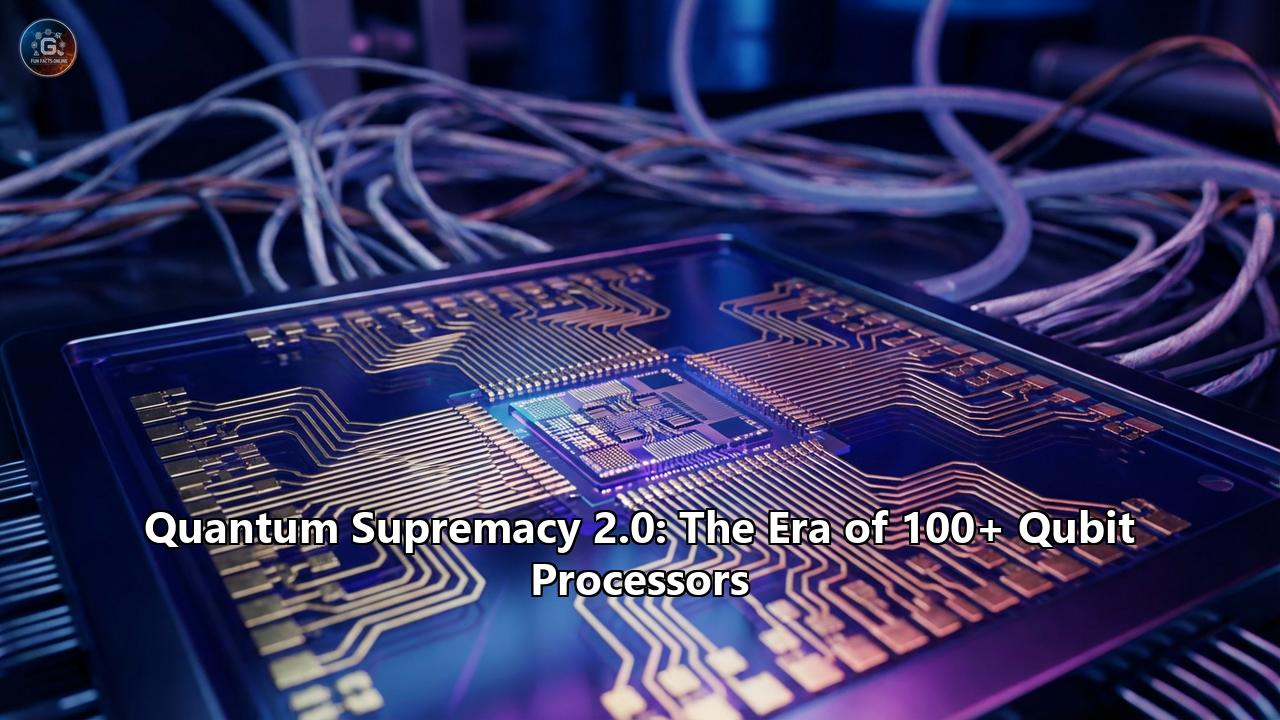
The "Quantum Supremacy" moment of 2019 was a Sputnik-like flash—a proof of concept that a quantum machine could technically outperform a supercomputer, even if the task (random number generation) was largely useless.
Quantum Supremacy 2.0 is different. We are no longer just trying to beat a classical computer at a parlor trick. We are entering the era of 100+ qubit processors that are stable, accessible, and beginning to tackle problems that actually matter to humanity—from modeling new battery materials to untangling protein structures for personalized medicine. This is the shift from "scientific curiosity" to "industrial utility."Here is a comprehensive guide to this new era.
Part I: The Threshold of Complexity
1. Why 100 Qubits? The Magic Number
For decades, quantum computers were toys for physicists, operating with 5, 10, or 20 qubits. You could simulate these machines easily on a standard laptop. But quantum power scales exponentially, not linearly.
- 2 qubits = 4 states.
- 10 qubits = 1,024 states.
- 50 qubits = 1.1 quadrillion states (roughly the limit of what a massive supercomputer can simulate).
- 100 qubits = $2^{100}$ states.
At 100 qubits, the computational space exceeds the memory capacity of all the classical computers on Earth combined. You cannot "simulate" a 100-qubit processor anymore; you have to build it. This is the event horizon where quantum computers stop being emulated experiments and start becoming instruments of discovery that have no classical equivalent.
2. Defining Quantum Supremacy 2.0
"Supremacy 1.0" (Google’s Sycamore, 2019) was about speed. It showed a quantum chip doing a useless task in 200 seconds that a supercomputer would take 10,000 years to do.
"Supremacy 2.0" is about utility and scale. It is defined by three new pillars:
- Volume: Exceeding 100 qubits regularly, not just in a one-off experiment.
- Coherence: Keeping those qubits alive long enough to run complex algorithms (not just short bursts).
- Error Mitigation: Using software and hardware tricks to get correct answers despite the inherent "noise" of quantum systems.
Part II: The Hardware Titans & The Race to Scale
The race to 100+ qubits has split into competing technological "tribes." Each has a different philosophy on how to build the ultimate machine.
1. The Superconducting Giants: IBM & Google
These chips look like golden chandeliers—cryogenic masterpieces chilled to near absolute zero. They use superconducting circuits to create qubits.
- IBM’s "Eagle" (127 Qubits) & "Osprey" (433 Qubits): IBM was the first to smash the 100-qubit barrier with the Eagle processor. Their strategy is modular scaling. They realized they couldn't just cram more qubits onto a single 2D chip without the wiring becoming a nightmare. They developed "multilayer 3D packaging"—hiding the wiring underneath the qubits so the processor can scale outward.
The Game Changer: IBM’s Heron processor (133 qubits) introduced "tunable couplers," which drastically reduce the interference (crosstalk) between qubits, a major killer of quantum calculations.
- Google’s "Willow" (105 Qubits): Google plays a different game. They focus less on raw count and more on quality. The Willow chip demonstrated a breakthrough in 2024/2025: exponential error suppression. For the first time, adding more physical qubits to form a "logical" qubit actually reduced the error rate. This is the "Holy Grail" of quantum engineering—proof that we can build reliable machines.
2. The Neutral Atom Rebels: Atom Computing & QuEra
While IBM and Google freeze circuits, these companies use lasers to trap individual atoms in a vacuum.
- Atom Computing: They shocked the industry by announcing a 1,000+ qubit system using neutral ytterbium atoms. Because atoms are identical by nature (unlike manufactured circuits, which have microscopic flaws), they are perfect qubits.
The Advantage: They don't need giant dilution refrigerators for every chip. They can pack thousands of atoms into a space smaller than a grain of sand using "optical tweezers" (focused laser beams).
- QuEra’s "Aquila" (256 Qubits): This machine is unique because it supports "analog" quantum computing. Instead of breaking a problem into digital gates (0s and 1s), it simulates the physics of the problem directly. It is already being used today to study new phases of matter that have never existed in nature.
3. The Ion Trappers: IonQ & Quantinuum
They use electromagnetic fields to trap charged atoms (ions).
- Quantinuum’s H2-1: Although it has fewer qubits (around 56), these qubits are of such high quality (fidelity) that they outperformed Google’s Sycamore in "supremacy" benchmarks by 100x in 2024. In the era of Supremacy 2.0, quality beats quantity. A 56-qubit machine with perfect accuracy is more useful than a 1,000-qubit machine that outputs noise.
Part III: The Great Filter – Noise and Error Correction
Having 100 qubits is like having a Ferrari engine. But if the steering wheel (control system) shakes violently (noise), you crash.
- The NISQ Reality: We are currently in the NISQ (Noisy Intermediate-Scale Quantum) era. Qubits are fragile. A cosmic ray or a slight temperature fluctuation can flip a 1 to a 0.
- Physical vs. Logical Qubits: This is the most important concept in Supremacy 2.0.
Physical Qubit: The actual hardware (the atom or circuit).
Logical Qubit: A group of physical qubits (e.g., 100 physical ones) working together to act as one perfect, error-free qubit. If one physical qubit fails, the others correct it.
- The Roadmap: IBM’s "Starling" and Google’s research suggest we need roughly 1,000 physical qubits to make 1 perfect logical qubit. The 100+ qubit processors we have today are the training grounds for this transition. We are learning how to use "error mitigation"—using software to guess where the errors likely occurred and correcting the final answer mathematically.
Part IV: Applications in the 100+ Qubit Era
We are done with random number generation. Here is what 100+ qubits are doing now:
1. Materials Science & Batteries
Simulating a caffeine molecule is hard. Simulating a lithium-sulfur battery electrolyte is impossible for classical supercomputers.
- The Breakthrough: IBM and Daimler have used quantum processors to simulate the dipole moment of molecules. With 100+ qubits, researchers can now model the ground states of complex polymers. This could lead to batteries that charge in minutes and last weeks, or solar panels with 40% efficiency.
2. Pharma & Drug Discovery
Proteins fold in complex 3D shapes. If they misfold, you get Alzheimer’s. Designing a drug to dock into a protein is a geometric nightmare.
- The Use Case: Companies like Roche and Pfizer are partnering with quantum firms. A 100-qubit machine can start to simulate the "binding affinity" of a drug molecule to a protein target with higher accuracy than classical approximation methods. This reduces the "hit-to-lead" time in drug discovery from years to months.
3. Finance & Optimization
The "Traveling Salesman Problem" is famous: find the shortest route between cities. Now imagine that for global logistics or portfolio balancing.
- Quantum Advantage: Banks like JPMorgan Chase are testing algorithms on these processors for "Option Pricing" and "Risk Analysis." A 100-qubit machine can analyze millions of market scenarios simultaneously (superposition) to find the optimal hedging strategy, something that takes a classical cluster overnight to approximate.
Part V: The Future – The "Middle Game" (2025–2030)
We are entering the "Middle Game" of quantum computing. The opening moves (Supremacy 1.0) are done.
- 2025-2026: We will see the first "Quantum Utility" demonstration—where a company uses a quantum computer to solve a business problem cheaper or faster than a classical computer. It won't be a scientific paper; it will be a quarterly earnings report.
- Hybrid Computing: The future isn't Quantum replacing Classical. It's Centaur Computing. A supercomputer (CPU/GPU) handles the big data and logic, and it "calls" the Quantum Processing Unit (QPU) via the cloud to solve a specific hard kernel of the problem, just like a CPU calls a GPU for graphics.
- The Quantum Internet: To scale beyond single chips, we will need to link them. IBM’s "System Two" is a modular quantum mainframe. We are seeing the birth of "quantum interconnects"—cables that can transmit quantum information between refrigerators without losing coherence.
Conclusion
Quantum Supremacy 2.0 is not a finish line; it is a departure gate. We have left the solid ground of classical binary logic and are sailing into the probabilistic ocean of high-dimensional computing. With 100+ qubit processors now online, we are no longer asking if quantum computers will work. We are asking what they will solve first. The era of simulation is over; the era of discovery has begun.
Reference:
- https://www.hpcwire.com/2025/01/01/quantum-computing-2025-is-it-turning-the-corner/
- https://zypa.in/what-is-quantum-computing/
- https://www.borntoengineer.com/quantum-supremacy-what-is-it-what-does-it-really-mean
- https://postquantum.com/industry-news/ibm-condor/
- https://www.quantamagazine.org/google-and-ibm-clash-over-quantum-supremacy-claim-20191023/
- https://en.wikipedia.org/wiki/Quantum_supremacy
- https://milvus.io/ai-quick-reference/what-is-the-concept-of-quantum-supremacy
- https://www.iankhan.com/quantum-supremacy-to-quantum-advantage-how-1000-qubit-processors-are-redefining-the-future-of-computing-12/
- https://www.tomshardware.com/news/google-claims-quantum-supremacy-sycamore-ibm
- https://milvus.io/ai-quick-reference/what-are-some-of-the-challenges-in-building-scalable-quantum-computers
- https://hackernoon.com/google-microsoft-and-ibm-are-fighting-for-quantum-supremacyheres-whos-winning
- https://www.spinquanta.com/news-detail/latest-quantum-computing-news-and-quantum-research
- https://singularityhub.com/2023/10/25/atom-computing-says-new-quantum-computer-is-first-to-hit-1000-qubits/
- https://www.quera.com/glossary/quantum-supremacy
- https://www.nextplatform.com/2025/06/20/quera-quantum-system-leverages-neutral-atoms-to-compute/
- https://www.youtube.com/watch?v=rHpj_nv3zj4
- https://quantumzeitgeist.com/amazon-braket-unveils-256-qubit-neutral-atom-quantum-computer-aquila-from-quera/
- https://quantumzeitgeist.com/2025-guide-to-quantum-computers/
- https://medium.com/@zagrebin.victor/when-will-the-era-of-quantum-supremacy-in-ais-computational-core-begin-e59bb63d7f12
- https://www.quantum-machines.co/blog/controlling-1000-qubits-how-to-scale-quantum-computing/