
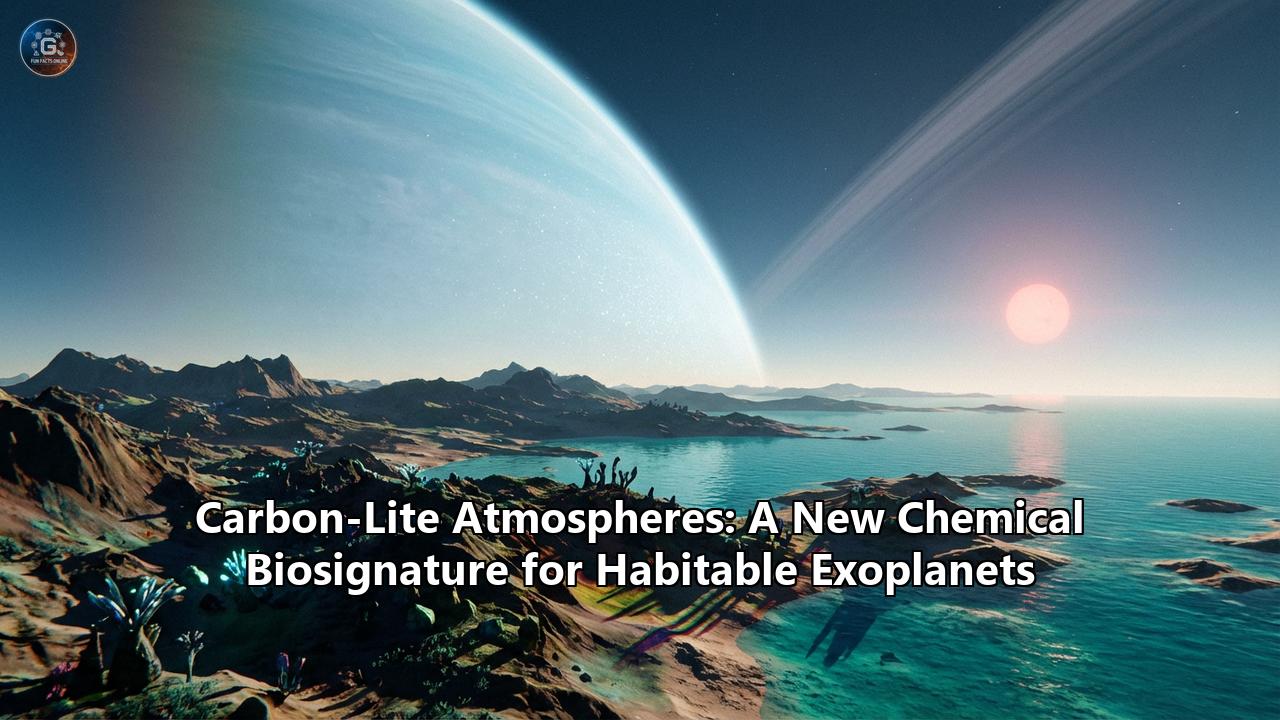
For decades, the search for extraterrestrial life has been a hunt for the "loud" signals: the spectral scream of oxygen, the sharp spike of methane, or the technological hum of radio waves. We have been looking for what life adds to a planet. But a paradigm-shifting study published in late 2023 by an international team of astronomers has flipped this logic on its head. The most potent sign of life on a temperate, rocky exoplanet may not be what is there, but what is missing.
This concept is the Carbon-Lite Atmosphere. It proposes that a significant depletion of atmospheric carbon dioxide (CO$_2$) in a terrestrial planet, relative to its neighbors in the same planetary system, is a "smoking gun" signal for liquid water oceans and potentially a biosphere. This biosignature, unlike the elusive oxygen line, is detectable now with the James Webb Space Telescope (JWST). This article explores the chemical, geological, and astronomical foundations of Carbon-Lite Atmospheres, detailing why "less is more" in the hunt for a second Earth.
1. The Biosignature Impasse: Why We Need a New Signal
To understand the revolutionary nature of the Carbon-Lite hypothesis, one must first appreciate the current bottleneck in exoplanet science. Since the discovery of the first exoplanet orbiting a main-sequence star in 1995, we have confirmed over 5,500 worlds. We have moved from simple detection ("it exists") to characterization ("what is it made of?").
The traditional "Holy Grail" biosignature has been molecular oxygen (O$_2$) combined with a reducing gas like methane (CH$_4$). On Earth, oxygen is a volatile, reactive gas that would vanish in a few million years if not constantly replenished by photosynthetic life. Therefore, finding O$_2$ and CH$_4$ together suggests a thermodynamic disequilibrium driven by biology.
However, detecting oxygen on a rocky, Earth-sized world is excruciatingly difficult. The prominent spectral features of oxygen (specifically the A-band at 0.76 microns) are easily drowned out by noise or clouds. Furthermore, accumulating enough oxygen to be detectable took Earth’s biosphere billions of years; looking for O$_2$ limits us to finding planets that are not just alive, but "advanced" in their evolutionary timeline.
The community faced a daunting reality: while JWST is a technological marvel, it might take hundreds of hours of observation time—years of the telescope's life—to confirm an oxygen atmosphere on a single Earth-like candidate like TRAPPIST-1e. We needed a signal that was stronger, clearer, and indicative of the conditions for life, rather than just the metabolic waste products of life.
Enter the Carbon-Lite Atmosphere.
2. The Theory of Carbon Depletion
The Carbon-Lite hypothesis was formalized in a seminal paper led by Amaury Triaud (University of Birmingham) and Julien de Wit (MIT), along with collaborators like geochemist Frieder Klein (Woods Hole Oceanographic Institution). Their insight was born not from looking at the stars, but by looking at our own Solar System.
2.1 The Solar System's "Peas in a Pod"
If an alien astronomer were to observe the Solar System from 40 light-years away, they would see three rocky planets in the "temperate" region of the Sun: Venus, Earth, and Mars. To a low-resolution telescope, these three worlds might look like siblings. They were formed from the same protoplanetary disk, roughly at the same time, from roughly the same materials.
However, a spectroscopic analysis of their atmospheres would reveal a stark anomaly:
- Venus: ~96.5% Carbon Dioxide (92 bar surface pressure)
- Mars: ~95.3% Carbon Dioxide (0.006 bar surface pressure)
- Earth: ~0.04% Carbon Dioxide (1 bar surface pressure)
Venus and Mars are dominated by carbon. Earth is carbon-depleted. Why?
It is not that Earth has less carbon total. In fact, Earth has a massive inventory of carbon, arguably comparable to Venus. The difference is where that carbon resides. On Venus, it is in the sky. On Earth, it is underground.
2.2 The Great Sequestration: Silicate Weathering
The mechanism responsible for Earth’s "missing" atmospheric carbon is the silicate weathering thermostat, a geochemical cycle that requires liquid water to function.
The process can be described by the Urey reaction, a simplified representation of silicate weathering. It begins with rain. In an atmosphere containing CO$_2$, rainwater absorbs the gas to form weak carbonic acid (H$_2$CO$_3$).
$$ \text{CO}_2 + \text{H}_2\text{O} \rightarrow \text{H}_2\text{CO}_3 $$
When this acidic rain falls on silicate rocks (continental crust, composed largely of minerals like CaSiO$_3$), a chemical reaction occurs that dissolves the rock and captures the carbon:
$$ \text{CaSiO}_3 + 2\text{H}_2\text{CO}_3 \rightarrow \text{Ca}^{2+} + 2\text{HCO}_3^- + \text{SiO}_2 + \text{H}_2\text{O} $$
The result is calcium ions ($\text{Ca}^{2+}$) and bicarbonate ions ($\text{HCO}_3^-$) dissolved in water. These ions wash into rivers and eventually the ocean. In the ocean, marine organisms (like corals, foraminifera, and coccolithophores) or abiotic precipitation convert these ions into calcium carbonate ($\text{CaCO}_3$)—limestone—which settles on the ocean floor.
$$ \text{Ca}^{2+} + 2\text{HCO}_3^- \rightarrow \text{CaCO}_3 + \text{CO}_2 + \text{H}_2\text{O} $$
The Net Result: For every molecule of silicate rock weathered, one molecule of atmospheric CO$_2$ is locked away in solid rock (limestone) for geological timescales.This process is a "one-way street" unless plate tectonics recycles the rock via subduction volcanoes. However, the standing inventory of carbon in the atmosphere remains low as long as liquid water oceans facilitate this weathering.
Therefore, a rocky planet with a Carbon-Lite atmosphere (relative to its neighbors) is a planet that possesses liquid water.3. The "Peas-in-a-Pod" Strategy
The brilliance of Triaud and de Wit's proposal is that it solves the problem of "cosmic variance." If you look at a single isolated planet and see low CO$_2$, it might just be formed from carbon-poor material. You wouldn't know if it was "depleted" or just "born empty."
This is why the strategy focuses on multi-planet systems, specifically those dubbed "peas in a pod"—systems where multiple rocky planets orbit the same star in a compact configuration. The TRAPPIST-1 system is the archetype.
TRAPPIST-1 hosts seven rocky planets. Planets b, c, and d are too close to the star; likely runaway greenhouse worlds (Venus analogs). Planets e, f, and g are in the habitable zone.
The Strategy:- Survey the hot planets (b, c): Measure their atmospheres. If they are carbon-rich (like Venus), we establish a "baseline" carbon inventory for the system.
- Survey the temperate planets (e, f): Measure their atmospheres.
- Compare: If Planet e has significantly less CO$_2$ than Planet b, that carbon must have gone somewhere. Since planets in the same system form from the same material, the carbon shouldn't just be missing from the start. The most likely sink for that missing carbon is the planetary crust, sequestered by liquid water.
This is a comparative planetology approach. We don't need to know the absolute abundance of carbon in the universe; we just need to know the relative abundance between siblings.
4. Biology’s Bonus: The "Habiosignature"
The Carbon-Lite signal indicates liquid water—a "habitability signature" or habsignature. But can it be a biosignature?
Yes. Life accelerates the carbon depletion.
On Earth, roughly 20% of the total carbon drawdown is attributed to the biological pump—marine biomass sinking to the ocean floor. Furthermore, biomass itself is a reservoir of carbon. A massive planetary biosphere captures carbon from the atmosphere and stores it in forests, soil, and peat.
If a planet is extremely depleted in carbon—even more so than simple inorganic weathering would predict—it suggests an active biosphere is aggressively scrubbing CO$_2$ from the air.
To confirm this, the researchers propose a secondary check: Ozone (O$_3$).
- Step 1: Detect Carbon Depletion (confirm water).
- Step 2: Detect Ozone.
Ozone is a proxy for oxygen, but it is much easier to detect because it has a strong absorption feature in the UV and infrared. If you see a Carbon-Lite atmosphere (water) and Ozone (oxygen source), the probability of life skyrockets. The combination of "Water + Oxygen" is chemically inconsistent without a biological driver.
5. Why JWST Loves Carbon Dioxide
The practical advantage of this biosignature is detectability. Carbon dioxide is the "loudest" molecule in the infrared spectrum.
The James Webb Space Telescope (JWST), specifically its NIRSpec Prism instrument, is sensitive to a wavelength range of 0.6 to 5.3 microns. Carbon dioxide has a massive, booming absorption feature at 4.3 microns. This feature is so strong that even a thin atmosphere with a small amount of CO$_2$ will show a dip in the spectrum.
Contrast this with water vapor or oxygen, which have "fluffy," broad features that can be hidden by clouds or hazes. The 4.3-micron CO$_2$ band is less affected by hazes because it sits at a longer wavelength (hazes scatter short wavelengths more, a phenomenon known as Rayleigh scattering).
The Observation Math:- Detecting an atmosphere: To just confirm an atmosphere exists on TRAPPIST-1e via CO$_2$ might take ~10 transits.
- Measuring depletion: To measure the abundance precisely enough to claim "depletion" might take ~40 transits.
- Detecting Ozone: This is the hardest part, potentially requiring ~100 transits.
While 40-100 transits is a large investment, it is feasible within JWST's lifetime. Attempting to detect the oxygen A-band directly on an Earth-like world with current technology would likely be impossible.
6. Case Study: A Theoretical Observation of TRAPPIST-1
Let us simulate how a Carbon-Lite discovery would play out over the next few years.
Year 1-2: The BaselinesAstronomers point JWST at TRAPPIST-1b and TRAPPIST-1c. These hot worlds are roasted by their star. The spectra come back showing deep absorption at 4.3 microns. Retrieval models indicate atmospheres composed of 90%+ CO$_2$ with pressures of 10-100 bar. We have confirmed the system is volatile-rich. The "siblings" have plenty of carbon.
Year 3-4: The CandidateThe telescope turns to TRAPPIST-1e. This planet sits squarely in the habitable zone.
- Scenario A (The Dead Rock): The spectrum returns a flat line. The planet has no atmosphere (stripped by stellar wind). Result: Not Habitable.
- Scenario B (The Venus Twin): The spectrum shows a massive 4.3-micron dip, identical to planets b and c. The atmosphere is 95% CO$_2$. Result: Runaway Greenhouse. Likely too hot.
- Scenario C (The Carbon-Lite World): The spectrum shows a CO$_2$ feature, but it is weak. Detailed modeling suggests the atmosphere is dominated by a transparent gas (like Nitrogen, which is spectrally invisible) with only 0.04% - 1% CO$_2$.
If Scenario C occurs, we ask: Where did the CO$_2$ go?
- Did it escape to space? Unlikely, because N$_2$ (lighter than CO$_2$) is still there. If CO$_2$ was stripped, N$_2$ should have been stripped first.
- Is it in the crust? The only known mechanism to bury that much carbon into the crust of a rocky planet is the Carbonate-Silicate Cycle.
- Conclusion: TRAPPIST-1e has liquid water oceans dissolving its atmospheric carbon.
7. False Positives and Negatives
No biosignature is perfect. We must play "Devil's Advocate."
False Positive: The Stripped CoreCould a planet lose its atmosphere physically rather than chemically?
If a giant impact blew away the primordial atmosphere, the planet might reform a thin secondary atmosphere that looks carbon-depleted but is just... empty.
- Counter-argument: This is why the Nitrogen detection is key. If we see a "bulking gas" like N$_2$ (inferred by pressure broadening of spectral lines) but low CO$_2$, physical stripping is less likely because it wouldn't selectively remove just the heavy CO$_2$.
A planet further out might condense CO$_2$ into dry ice caps (like Mars, but more extreme). If the CO$_2$ is frozen on the surface, it isn't in the atmosphere.
- Counter-argument: This depends on the planet's temperature. For a habitable zone planet, it should be too warm for massive global CO$_2$ collapse, unless the planet is already in a snowball state (which is technically "habitable" water, just frozen).
In the Archean Eon (3.8 - 2.5 billion years ago), Earth had life (microbes), but it also had much higher CO$_2$ levels than today (perhaps 10-100x current levels) because the sun was fainter and a stronger greenhouse was needed to keep water liquid.
If we saw Archean Earth from space, we might not see it as "Carbon-Lite" enough compared to a Venus analog to trigger the detection.
- Implication: The Carbon-Lite signature is best at detecting mature biospheres or planets with established geochemical cycles. It might miss "baby" Earths.
8. Beyond JWST: The Future of Carbon-Lite
The Carbon-Lite concept is not just for transiting planets. It is a foundational tool for the next generation of Direct Imaging telescopes.
NASA's future flagship mission, the Habitable Worlds Observatory (HWO), aims to take direct photos of Earth-like planets. When we look at a planet directly, we analyze the light reflected off its surface.
- A Venus-like world appears bright and featureless in the UV/Vis due to thick clouds.
- A Carbon-Lite world (like Earth) has a thinner, clearer atmosphere. We might see Rayleigh scattering (the blue sky) and potentially surface features.
The Carbon-Lite metric helps us prioritize targets. If HWO finds a system with a bright, carbon-rich inner planet and a dimmer, carbon-poor outer planet, the outer one becomes the primary target for deep integration to look for the "green" of chlorophyll or the absorption of oxygen.
9. Conclusion: The Sound of Silence
For too long, we have equated the search for life with the search for noise—chemical or spectral. The Carbon-Lite Atmosphere hypothesis reminds us that life is also a consumer. It eats entropy. It processes raw materials. It alters its environment by sequestering resources.
A habitable planet is a balanced planet. It is a world where the violent, volcanic outgassing of carbon is tamed by the soothing cycle of rain and rivers. When we look at the spectra of distant worlds, finding a massive gap where carbon dioxide should be might be our first indication that we are looking at an ocean, a water cycle, and perhaps, a home.
In the hunt for life, the most profound signal might just be the silence of the carbon that isn't there.
Reference:
- https://research.birmingham.ac.uk/en/publications/atmospheric-carbon-depletion-as-a-tracer-of-water-oceans-and-biom/
- https://astrobiology.com/2023/12/a-carbon-lite-atmosphere-could-be-a-sign-of-water-and-life-on-other-terrestrial-planets.html
- https://www.youtube.com/watch?v=cp5Y2LN3L4c
- https://www.ebsco.com/research-starters/environmental-sciences/planetary-atmospheres-and-evolution
- https://climate.sustainability-directory.com/term/silicate-weathering/
- https://www.silicatecarbon.com/science
- https://www.pbslearningmedia.org/resource/nvpe-sci-weatheringco2/weathering-earths-natural-carbon-dioxide-removal-process-polar-extremes/
- https://en.wikipedia.org/wiki/Carbonate%E2%80%93silicate_cycle
- https://en.wikipedia.org/wiki/Biosignature
- https://www.researchgate.net/publication/376941834_Atmospheric_carbon_depletion_as_a_tracer_of_water_oceans_and_biomass_on_temperate_terrestrial_exoplanets
- https://orca.cardiff.ac.uk/id/eprint/168859/3/stae1230.pdf
- https://arxiv.org/abs/2310.14987
- https://pmc.ncbi.nlm.nih.gov/articles/PMC5399744/
- https://astrobiology.nasa.gov/news/false-positives-false-negatives-the-world-of-distant-biosignatures-attracts-and-confounds/