
In the golden light of the Egyptian Delta, where the rich silt of the Nile has buried empires and memories for millennia, the sands have once again shifted to reveal a voice from the past. It is a voice of royal authority, priestly devotion, and scientific brilliance that has been silent for over two thousand years. In late 2025, archaeologists working at the site of Tell El-Fara’in—the ancient city of Buto—unearthed a discovery that has sent shockwaves through the world of Egyptology. They found a pristine, complete stela of the Decree of Canopus, issued by Pharaoh Ptolemy III Euergetes in 238 BC.
This discovery is not merely another museum piece; it is a "time capsule" of intellectual history. While the Rosetta Stone is the most famous of the Ptolemaic decrees, the Decree of Canopus is historically far more significant. It contains the ancient world’s first attempt to introduce a leap year to the calendar—a reform that, had it succeeded, would have aligned the seasons centuries before Julius Caesar. The newly discovered stela, unlike its predecessors, is inscribed entirely in Egyptian hieroglyphs, offering a pure, unadulterated window into the sacred language of the priesthood during the Hellenistic age.
This article delves deep into the story of the Euergetes Stela, the monarch it honors, the revolutionary science it proposed, and the dramatic circumstances of its rediscovery in the modern era.
Part I: The Resurrection of the Decree
The Discovery at the Hill of the Pharaohs
The archaeological site of Tell El-Fara’in, known to the ancients as Buto and later Imet, lies in the Kafr El-Sheikh Governorate (anciently part of the Sebennytic and later the Phthenotes nome). It was once the sacred capital of Lower Egypt, the counterpart to Nekhen (Hierakonpolis) in the south. For decades, missions have picked through its layers, finding temples to the cobra goddess Wadjet and remnants of the Saite period. But the Ptolemaic layers have always held a special allure, representing a time when Greek pharaohs sought to ingratiate themselves with the native Egyptian populace.
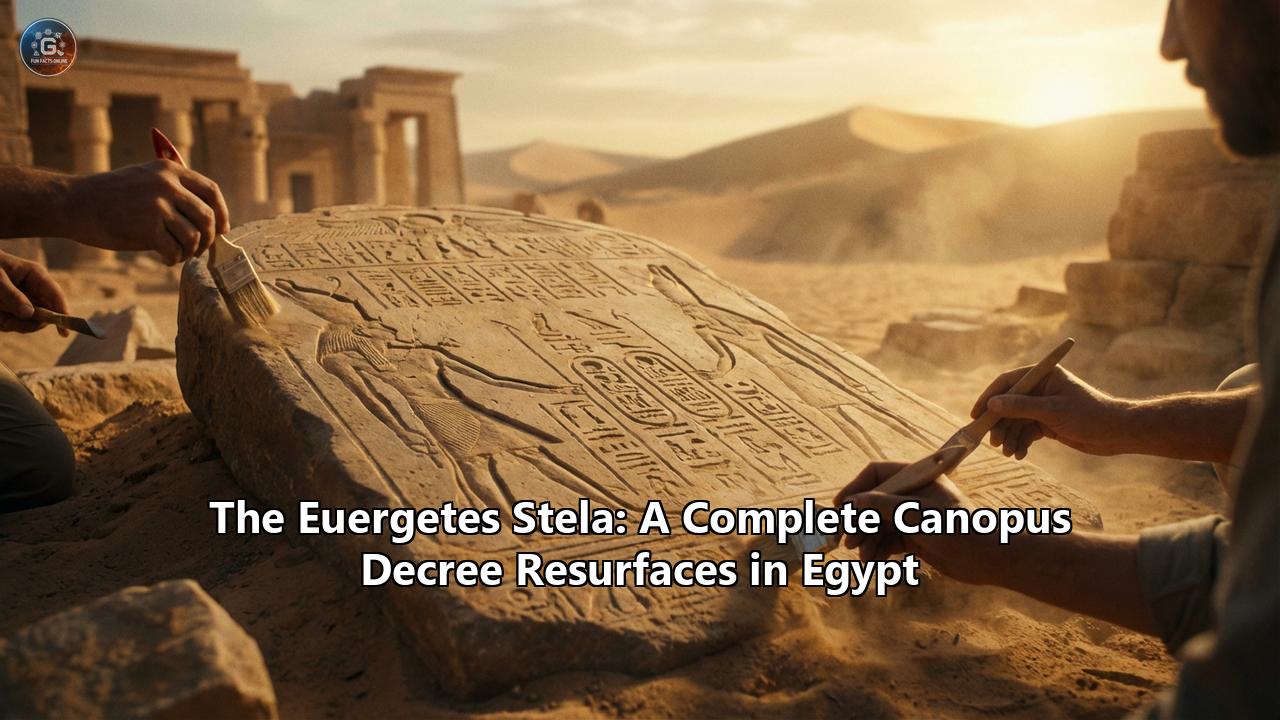
In September 2025, an Egyptian mission led by the Supreme Council of Antiquities was clearing an area near the temple precinct when they struck a large block of sandstone. As the brush cleared away the sand, the distinct, rhythmic beauty of a winged sun disk emerged—the symbol of Horus of Behdet, protector of the king. Below it, row upon row of perfectly preserved hieroglyphs began to appear.
Unlike the famous "Tanis Stela" discovered by Karl Richard Lepsius in 1866 (the first copy of the Canopus Decree found), which was a trilingual text in Hieroglyphs, Demotic, and Greek, this new find was unique. It was a monolingual stela, written solely in the sacred script of the Egyptian temples. Standing 127.5 cm tall and 83 cm wide, the stela was intact from its rounded lunette to its base.
Dr. Mostafa Waziri, announcing the find, described it as "the philological discovery of the century." For the first time, scholars possess a complete, undamaged hieroglyphic version of the text, free from the lacunae (gaps) and erosions that plague the other six known fragmentary copies. It provides a "control text"—a perfect standard against which all other Ptolemaic Egyptian language can be measured.
The Artifact: A Physical Description
The stela is carved from high-quality sandstone, likely quarried from Gebel el-Silsila in the south and transported down the Nile—a testament to the logistical capabilities of the Ptolemaic state.
- The Lunette: The curved top features the traditional winged sun disk. Flanking the disk are two uraei (cobras), one wearing the White Crown of Upper Egypt and the other the Red Crown of Lower Egypt, symbolizing the unification of the Two Lands. Between them is the inscription Di Ankh ("Given Life").
- The Text: The main body consists of 30 lines of deeply incised, blue-pigmented hieroglyphs. The preservation is such that the original draftsmanship of the scribes can be studied. The signs are "Ptolemaic" in style—slightly more crowded and elaborate than Pharaonic antecedents, reflecting a period when the script was becoming more esoteric.
The location of the find is significant. The decree text explicitly orders that copies be placed "in the first, second, and third rank temples" alongside the statue of the King. Finding this copy in Buto, a major cult center of the cobra goddess Wadjet, confirms the administrative efficiency of Ptolemy III’s government. The order was given in Canopus (near Alexandria), and stone masons in the Delta faithfully executed it, erecting this monument where it stood for centuries before toppling into the mud.
Part II: The King and the Context
To understand the stela, one must understand the man it honors. Ptolemy III Euergetes ("The Benefactor") was the third ruler of the Ptolemaic dynasty, the Greek family founded by Alexander the Great’s general, Ptolemy I Soter. By the time Euergetes took the throne in 246 BC, the dynasty was Egyptianizing. They were no longer just Macedonian warlords; they were Pharaohs.
The Third Syrian War and the Return of the Gods
The Decree of Canopus was issued in the ninth year of Ptolemy III’s reign (238 BC). The years leading up to it had been tumultuous. Immediately upon his accession, Ptolemy III launched a massive military campaign against the Seleucid Empire (based in Syria and Persia) to avenge the murder of his sister, Berenice Syra. This conflict, known as the Third Syrian War, was a resounding success.
Ptolemy III’s armies marched as far as Babylon. But his greatest propaganda victory—and the one celebrated on the stela—was the recovery of sacred Egyptian statues. Centuries earlier, the Persian invaders under Cambyses and Artaxerxes had looted Egyptian temples, carrying off statues of gods like Amun, Ptah, and various local deities to Persia.
The Decree states:
"He brought back the sacred images which had been carried off from the land of Egypt by the Persians, and restored them to the temples from which they had been taken."
This act earned him the immense gratitude of the Egyptian priesthood. For a foreign Greek king to care about the "captivity" of native Egyptian gods was a masterstroke of political theater. It legitimized him not as a conqueror, but as a restorer of Ma’at (cosmic order).
The Famine and the "Good Deity"
The stela also records a crisis. During the early years of his reign, the Nile inundation—the annual flood that watered Egypt’s fields—failed. In an ancient society, a low Nile meant famine, starvation, and typically, rebellion.
However, Ptolemy III and his wife, Queen Berenice II, intervened. Instead of hoarding wealth, they opened the royal treasuries. They used tax revenues to import grain from Syria, Phoenicia, and Cyprus to feed the Egyptian population.
The Decree praises them:
"When the Nile failed to rise... they remitted the taxes of the people... and imported corn from Syria, Phoenicia, and Cyprus, saving the inhabitants of Egypt."
This benevolence is why he was titled Euergetes—"The Benefactor." The stela is effectively a contract: the King protects the people and the gods; in return, the Priesthood guarantees his divine status and political legitimacy.
Part III: The Content of the Decree
The text of the Euergetes Stela is a fascinating blend of theology, politics, and advanced astronomy. It was drafted by a synod (assembly) of priests who gathered at Canopus, a port city near Alexandria, on March 7, 238 BC.
The content can be divided into four main sections:
- The Doxology: A litany of titles and praises for Ptolemy III and Berenice II, listing their military victories and acts of charity.
- The Honors: The priests decree that the King and Queen are to be worshipped as "The Benefactor Gods" (Theoi Euergetai) in all Egyptian temples. Their statues are to be paraded alongside the patron gods of every city.
- The Berenike Cult: The decree describes the tragic death of the royal couple's young daughter, Princess Berenike. The priests establish a specific cult for her, elevating her to the status of a goddess. They detail the rituals, including the baking of special loaves of bread shaped to honor her, and the singing of hymns by priestly choirs.
- The Calendar Reform: This is the most scientifically significant section, which distinguishes the Canopus Decree from all other ancient texts.
The Calendar Reform: A leap into the Future
Ancient Egypt used a "civil calendar" of 365 days: 12 months of 30 days, plus 5 "epagomenal" days (days added at the end of the year). This was remarkably advanced for the Bronze Age, but it had a flaw: the solar year is actually about 365.25 days long.
Because the Egyptian calendar was missing that quarter-day, it "wandered." Every four years, the calendar would slip back one day against the seasons. Over 1,460 years (a Sothic Cycle), the seasons would rotate completely through the calendar. This meant that a summer festival would eventually be celebrated in the dead of winter.
The priests at Canopus, likely in consultation with Greek astronomers from the Library of Alexandria, realized this drift was disrupting religious precision. The Decree states:
"In order that the seasons may not correspond to the ancient order of things... and that the festivals which are celebrated in the winter should not come to be celebrated in the summer... it is hereby decreed that one day, a festival of the Benefactor Gods, be added every four years to the five epagomenal days."
This was the invention of the Leap Year.
Ptolemy III attempted to fix the year to 365.25 days in 238 BC—two centuries before Julius Caesar introduced the Julian Calendar (45 BC) and nearly two millennia before Pope Gregory XIII perfected it (1582).
Why did it fail?Despite the decree being carved in stone and distributed, the reform did not stick. The Egyptian conservative tradition was too strong. The priesthood and the peasantry were accustomed to the wandering year; it was part of the rhythm of their lives. After Ptolemy III died, the "sixth day" was abandoned, and the Egyptian calendar continued to drift until the Roman conquest. The Euergetes Stela thus stands as a monument to a "premature" scientific revolution—a correct idea proposed before society was ready to accept it.
Part IV: Linguistic Significance and the "Rosetta" Connection
The discovery of the 2025 monolingual stela invites immediate comparison to the Rosetta Stone. Both are priestly decrees, both honor a Ptolemy, and both deal with temple exemptions and royal cults. However, for Egyptologists, the Canopus Decree is often considered the superior text.
The Rosetta Stone (Decree of Memphis, 196 BC):- Honors Ptolemy V.
- The hieroglyphic section is smashed and very incomplete (only the last 14 lines remain).
- It was the key to decipherment because it was the first bilingual text found.
- Honors Ptolemy III (older than Rosetta).
- The text is longer and much more detailed.
- The new copy is complete.
For linguists, the new hieroglyphic-only version is a treasure trove.
- Vocabulary: It allows scholars to see the "pure" Egyptian choices for words, without the interference of a side-by-side Greek translation potentially influencing the scribe's choice of signs.
- Grammar: The Ptolemaic script is notoriously difficult. It uses thousands of signs (unlike the ~700 of the Pharaonic period) and delights in puns and visual plays. A complete text helps "crack" the specific cryptographic games played by the priests of Buto.
- Dialect: By comparing this version (from the Delta) with the older copies found at Kom el-Hisn and Tanis, scholars can map out regional variations in how hieroglyphs were written across Egypt.
The "Tanis Stela" (found in 1866) was actually the document that confirmed Champollion’s decipherment of the Rosetta Stone. While Champollion had cracked the code in 1822, skeptics remained. When the Canopus Decree was found with a perfect Greek-to-Hieroglyph match, it proved undeniable that the system worked. The new 2025 discovery continues this legacy, offering the final piece of the puzzle: the visual perfection of the text.
Part V: The Future of the Past
The surfacing of the Euergetes Stela at Tell El-Fara’in acts as a beacon for future excavations. If a monument of this magnitude was lying just beneath the surface, what else remains at Buto? The city was inhabited from the Predynastic period through to the Roman era.
The stela has been moved to the Grand Egyptian Museum (GEM) in Giza, where it is currently undergoing conservation. It is set to be the centerpiece of a new exhibition titled "The Sun and the Scribe: Science and Religion in Ptolemaic Egypt," scheduled to open later in 2026.
Why does this matter to us today?The Euergetes Stela reminds us that the ancient world was not static. It was a place of innovation, debate, and sometimes, failure. The priests and the King tried to use science to rationalize their religion and their calendar. They failed to change the habits of the people, but they succeeded in leaving a record that has outlasted their civilization.
In the 30 lines of this sandstone block, we see the convergence of Greek philosophy and Egyptian theology. We see a king trying to feed his people and a father grieving his daughter. And in the sharp, clear chiseling of the hieroglyphs, we see the determination of the human spirit to be remembered—to speak across the millenniums and say, "We were here. We understood the stars. We honored our gods."
The resurrection of the Euergetes Stela is not just a win for archaeology; it is a victory for memory.
Reference:
- https://arkeonews.net/archaeologists-discover-unique-hieroglyphic-version-of-ptolemy-iiis-canopus-decree/
- https://wildhunt.org/2025/09/2247047.html
- https://archaeologymag.com/2025/09/complete-copy-of-the-canopus-decree/
- https://www.jpost.com/archaeology/article-868970
- https://www.discovermagazine.com/besides-the-rosetta-stone-other-stone-texts-have-interpreted-ancient-44258
- https://en.wikipedia.org/wiki/Decree_of_Canopus
- https://archaeology.org/news/2025/09/12/new-complete-copy-of-canopus-decree-recovered/
- https://www.earth.com/news/first-complete-copy-of-the-canopus-decree-in-hieroglyphics-found-egypt/
- https://www.labrujulaverde.com/en/2025/09/stele-with-a-complete-monolingual-version-of-the-canopus-decree-issued-by-pharaoh-ptolemy-iii-in-238-bc-discovered/
- https://en.wikipedia.org/wiki/Rosetta_Stone
- https://www.quora.com/Why-is-the-Rosetta-Stone-important-to-understanding-Ancient-Egyptian-hieroglyphs
- https://egyptianmuseumcairo.eg/artefacts/stela-with-canope-decree/
- https://www.britannica.com/topic/Decree-of-Canopus
- https://news.artnet.com/art-world/archaeologists-find-new-version-decree-of-canopus-hieroglyphics-2687455