
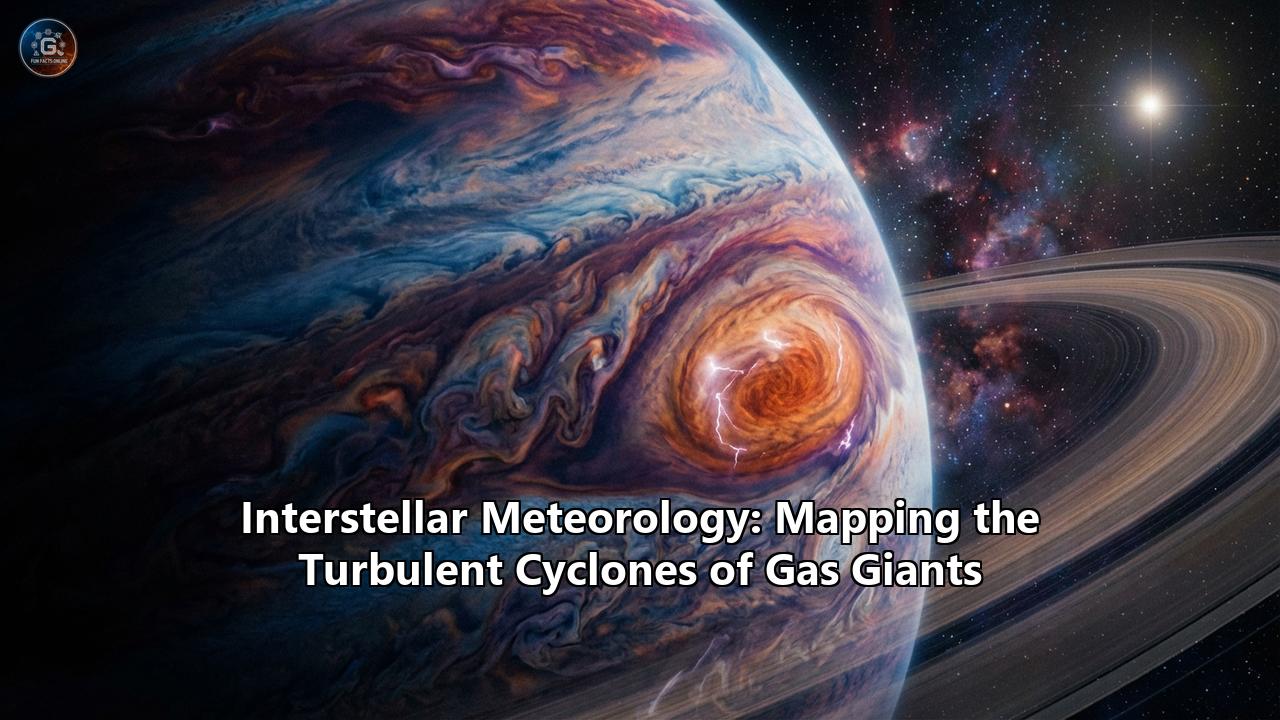
The wind does not merely blow on the giants; it screams, it sculpts, and it endures for centuries. In the vast, crushing theaters of the outer solar system, meteorology ceases to be a conversation about rain checks and umbrellas and transforms into a study of violent fluid dynamics on a planetary scale. Here, storms are not transient atmospheric hiccups but stable, geometric monuments constructed from hydrogen, helium, and methane, spinning at supersonic speeds.
We are currently living through the golden age of "Interstellar Meteorology"—a discipline that has evolved from grainy, two-dimensional snapshots taken by passing Voyager probes into a three-dimensional, deep-dive science. Thanks to the enduring vigil of the Hubble Space Telescope, the death-defying orbits of the Juno spacecraft, the archival treasure trove of Cassini, and the piercing infrared gaze of the James Webb Space Telescope (JWST), we are finally peeling back the cloud tops.
What we are finding is a universe of turbulent order. From the polar octagons of Jupiter to the vanishing dark spots of Neptune, and extending outward to the molten rain of distant exoplanets, we are mapping the weather of worlds that defy earthly logic.
The Physics of the Giants: A Unifying Theory of Wind
For decades, a fundamental schism puzzled planetary scientists: why do the winds of Jupiter and Saturn blow predominantly eastward at the equator, while the winds of their icy cousins, Uranus and Neptune, blow westward? These planets are all rapidly rotating fluid bodies; they all receive sunlight (albeit in diminishing amounts); they all possess internal heat sources. Yet, their atmospheric engines churn in opposite directions.
It was not until late 2025 that a unified model, developed by researchers at Leiden Observatory and SRON, finally offered a coherent explanation. The answer, it seems, lies in the depth.
The atmosphere of a gas giant is not a thin skin like Earth’s; it is a bottomless ocean of fluid that transitions smoothly from gas to liquid metal. The 2025 study utilized global circulation models to demonstrate a phenomenon known as "bifurcation." Under the extreme conditions of these outer worlds, the atmosphere can settle into one of two stable states, largely dictated by how deep the weather goes.
On Jupiter and Saturn, the weather is a "deep" phenomenon. The wind jets we see on the surface are the tips of cylinders that extend thousands of kilometers down, rooted in the metallic hydrogen interior. This deep anchoring allows the conservation of angular momentum to drive powerful eastward jets—super-rotation that outpaces the spin of the planet itself.
Conversely, on Uranus and Neptune, the weather appears to be "shallower," confined to a thinner outer shell relative to the planet's core size. In this regime, the turbulence of convection—the boiling motion of heat rising from the interior—interacts with the planet's rotation to drive the winds in the opposite direction: retrograde, or westward. This "conveyor belt" of rapidly rotating convection cells acts as the gear system of the giants, determining whether the equator races ahead of the planet or lags behind.
This discovery was a watershed moment. It moved us from simply cataloging wind speeds to understanding the hydraulic architecture of the solar system. It suggests that if we know the depth of an exoplanet’s atmosphere, we might predict its wind direction without ever seeing its clouds.
Jupiter: The Geometer of Chaos
Nowhere is the science of deep weather more evident than at the court of the King of Planets. Since its arrival in 2016, and through its extended mission phases in 2024 and 2025, NASA’s Juno spacecraft has rewritten the textbooks on Jovian physics.
Juno’s Microwave Radiometer (MWR) allowed scientists to peer below the opaque cloud decks, slicing through the ammonia ice to reveal the roots of the storms. The Great Red Spot, that eternal crimson eye watching the solar system for at least 350 years, is not a surface skim. Juno revealed it to be a towering column of storm activity extending nearly 500 kilometers (300 miles) into the planet. To put this in perspective, the International Space Station orbits Earth at roughly 400 kilometers. You could bury the entire orbital infrastructure of humanity inside the depth of the Great Red Spot.
But the most startling revelation from the Juno mission has been the geometry of the poles.
On Earth, a polar vortex is usually a single, wandering system of cold air. On Jupiter, the poles are occupied by "vortex crystals." At the North Pole, a single central cyclone is surrounded by eight circum-polar cyclones. At the South Pole, a central storm is ringed by five. These are not chaotic storms that merge and split like earthly hurricanes; they are arranged in precise, stable polygonal patterns—octagons and pentagons that have held their formation for years.
Why do they not merge? Fluid dynamics dictates that vortices rotating in the same direction should attract and combine, eventually forming one massive storm. Yet, Jupiter’s "crystals" are repelled by an invisible force.
A landmark study published in early 2026 by researchers at MIT provided the answer. Using a new generation of fluid models that incorporate "deep stratification," they found that the stability of these clusters is a product of the specific heat transfer from the "fuzzy core" of Jupiter.
Juno data had previously indicated that Jupiter does not have a hard, rocky nut at its center, but rather a diffuse, "fuzzy" core where heavy elements are dissolved into the metallic hydrogen, spreading out over half the planet's radius. The MIT study showed that the heat rising from this diffuse core creates a unique "shielding" effect around the polar cyclones. As the cyclones spin, they generate secondary "anticyclonic" rings (spinning in the opposite direction) that act as buffers, preventing the storms from merging. They are locked in a gravitational and fluid-dynamic standoff, a delicate equilibrium that creates the beautiful geometry we observe.
These storms are monsters. Each of the "smaller" polar cyclones is roughly the width of the United States. The wind speeds at their peripheries are ferocious, yet the arrangement is as still and precise as a stained-glass window.
Saturn: The Hexagonal Tower
If Jupiter is the master of polygons, Saturn is the lord of the Hexagon.
Discovered by the Voyager probes and immortalized by Cassini, the hexagonal jet stream at Saturn's north pole is perhaps the most famous fluid mystery in the solar system. It is a perfect six-sided shape, wider than two Earths, enclosing a massive central hurricane.
For years, scientists debated whether the Hexagon was a shallow feature or a deep one. Was it just a cloud pattern, or did it represent a fundamental structure of the planet?
Recent analysis of long-term data, combined with laboratory recreations in 2025, has confirmed that the Hexagon is a "towering" structure. It is not merely a line in the clouds; it is a vertical wall of wind that extends hundreds of kilometers upward into the stratosphere and thousands of kilometers downward into the pressurized dark.
The mechanism that sustains it is "wave evanescence." The Hexagon is essentially a trapped wave—specifically, a Rossby wave—that has achieved a resonance with the planet's rotation. The jet stream flows eastward, but the wave itself is stationary relative to the planet's rotation. It is a "standing wave," like the vibration on a guitar string that holds a specific note.
But why a hexagon? Why not a pentagon like Jupiter’s south pole, or an octagon like its north?
The answer lies in the "zonal jets." Saturn’s winds are faster and deeper than Jupiter’s. The specific velocity of the eastward jet at the north pole, combined with the viscosity of the hydrogen atmosphere, creates a "sweet spot" in the fluid equations where "wavenumber 6" is the most stable solution.
In 2025, physics labs managed to recreate this phenomenon in rotating water tanks. By carefully controlling the speed of a central ring and the viscosity of the fluid, they spontaneously generated stable hexagons, proving that this geometry does not require magical alien intervention or magnetic anomalies—it is a natural, inevitable product of fluid spinning at specific speeds. The universe, it turns out, prefers the hexagon when the conditions are just right.
Interestingly, the MIT study from 2026 that explained Jupiter’s clusters also addressed Saturn’s solitude. The difference comes down to "interior stratification." Saturn is less internally stratified than Jupiter at the poles; its energy cascades differently. On Jupiter, the energy breaks up into smaller, clustered eddies (the octagons). On Saturn, the energy channels into a single, dominant polar jet, which then buckles into the hexagonal shape. Two gas giants, similar in composition, yet their internal architectures dictate two completely different meteorological crowns.
The Ice Giants: Waking Up
For decades, Uranus and Neptune were dismissed as the "boring" planets. Voyager 2 flew past Uranus in 1986 and saw a featureless, pale blue billiard ball. It seemed inert, a frozen world with no weather to speak of.
We were wrong. We were simply looking at the wrong time.
Uranus is a planet of extreme seasons. It rolls on its side, its axis tilted 98 degrees. When Voyager passed, it was the solstice; the pole was pointing at the sun, but the atmosphere was stable. Now, as Uranus moves through its 84-year orbit, the viewing angle from Earth has changed, and the seasons have shifted.
In May 2023, and confirmed with higher fidelity in 2025, astronomers using the Very Large Array (VLA) in New Mexico made a stunning discovery: a polar cyclone on Uranus.
By looking at the radio waves emitted from the planet—which come from deeper below the clouds—they found a massive vortex at the North Pole. But unlike the storms of Earth which are fueled by water moisture, this cyclone is defined by a "warm, dry core." The air in the center of the vortex is subsiding (sinking) and warming up, creating a "hole" in the opacity that glows in radio wavelengths.
This confirms a universal truth of rotating planets with atmospheres: if it spins, it has polar cyclones. Rock or gas, hot or cold, the angular momentum forces the atmosphere to organize at the poles. Uranus is not dead; it was just sleeping. As it approaches its next equinox, we are seeing bright cloud features pop up, driven by the awakening solar heating.
Neptune, further out and windier, has always been more active. Voyager saw the "Great Dark Spot" in 1989. Hubble saw it disappear in 1994. Then a new one appeared.
Neptune’s storms are ghost ships. They are transient dark vortices that form in the mid-latitudes and drift. On Earth, the Coriolis force pushes hurricanes away from the equator. On Neptune, the wind shear often pushes these dark spots toward the equator, where the physical forces rip them apart. They are doomed storms, marching toward their own destruction.
However, in 2020, the Hubble Space Telescope watched a large Dark Spot drift south toward the "kill zone" at the equator, only to do something unprecedented: it stopped, executed a U-turn, and drifted back north to safety. At the same moment, a smaller "fragment" storm broke off and disintegrated. This behavior suggests that Neptune’s storms are more resilient and complex than we thought, capable of interacting with the planetary wind shear in non-linear ways.
Neptune holds the record for the fastest winds in the solar system, clocking in at over 2,000 kilometers per hour. These are supersonic winds. If you were a skydiver dropping into Neptune, you wouldn't just be blown away; you would be broken by the sound barrier-shattering wall of air. And yet, the energy source for these winds remains a paradox. Neptune receives 900 times less sunlight than Earth, yet its winds are nine times faster. The energy is not coming from the Sun; it is coming from the gravitational contraction of the planet itself—the "Kelvin-Helmholtz mechanism." Neptune is slowly shrinking, converting gravitational energy into heat, which boils the atmosphere from the bottom up, driving the frictionless, supersonic winds in the cold vacuum.
Exoplanetary Forecasts: The JWST Era
The study of interstellar meteorology is no longer confined to our solar system. With the launch of the James Webb Space Telescope (JWST), we have begun to read the weather reports of alien worlds.
The most spectacular of these early "exo-forecasts" came in 2024, with the mapping of WASP-43b.
WASP-43b is a "Hot Jupiter"—a gas giant that orbits its star so closely that a year lasts only 19 hours. It is tidally locked, meaning one side faces the star forever in eternal day, and the other faces the void in eternal night.
This configuration creates a weather system unlike anything in our solar system. The dayside roasts at 1,250 degrees Celsius—hot enough to melt lead, hot enough to vaporize rock. The nightside is a "cool" 600 degrees Celsius.
On Earth, temperature differences drive wind. On WASP-43b, the temperature difference between day and night is so extreme that it drives a supersonic equatorial jet that circles the planet at 9,000 kilometers per hour (5,000 mph).
JWST’s Phase Curve spectroscopy allowed scientists to map the temperature across the entire surface. They found that the "hot spot" (the hottest point on the planet) is not directly under the star (sub-stellar point) but is shifted eastward. Why? Because the ferocious wind is physically blowing the heat away, carrying the torched atmosphere toward the night side before it can cool down.
But the most alien feature is the clouds. On the night side of WASP-43b, the atmosphere cools enough for minerals to condense. These are not water clouds. They are clouds of enstatite and forsterite—rock. If you were floating on the night side of WASP-43b, you would not feel rain; you would be pelted by hail made of hot sand and liquid magnesium silicates.
These observations confirm that the laws of physics are universal, but their expressions are infinite. We see the same fluid dynamics—Rossby waves, Kelvin waves, advection—playing out with ingredients like molten iron and vaporized quartz.
The Unification of Chaos
When we look at the swirling clouds of Jupiter, the hexagonal walls of Saturn, the ghostly dark spots of Neptune, and the molten winds of WASP-43b, we are looking at the same equation written in different fonts.
It is the Navier-Stokes equation writ large. It is the story of heat trying to move from a hot place to a cold place, hindered by the rotation of a sphere.
On Earth, this struggle gives us the trade winds and hurricanes. On Jupiter, it gives us the Great Red Spot and the vortex crystals. On Hot Jupiters, it gives us global firestorms.
We have moved past the era of simply taking pictures of these planets. We are now running the numbers. We are building digital twins of these worlds in our supercomputers, feeding them the data from Juno and JWST, and watching as the simulations birth hexagons and octagons spontaneously.
The turbulent cyclones of the gas giants are not just storms; they are the visible fingerprints of the deep, hidden interiors of the planets. They are the surface tension of a mystery that extends thousands of miles down. And as we continue to map them, we are learning that in the cosmos, chaos is rarely messy. It is structured, it is geometric, and it is profoundly, terrifyingly beautiful.
The forecast for the outer solar system remains the same: High winds, heavy methane rain, and a chance of diamond hail, continuing for the next billion years.
Reference:
- https://www.universiteitleiden.nl/en/news/2025/10/new-model-explains-extreme-jet-streams-on-all-giant-planets
- https://universemagazine.com/en/unified-model-explains-extreme-winds-on-all-giant-planets/
- https://watchers.news/epicenter/polar-storms-at-jupiter-and-saturn-reveal-hidden-differences-deep-inside-the-planets/
- https://physicstoday.aip.org/news/uranuss-hidden-polar-cyclone-revealed
- https://www.techexplorist.com/first-observation-cyclone-north-pole-uranus/60715/
- https://www.youtube.com/watch?v=yta2f08g2WE
- https://en.wikipedia.org/wiki/Great_Dark_Spot
- https://www.ebsco.com/research-starters/earth-and-atmospheric-sciences/neptunes-great-dark-spot
- https://www.earth.com/news/juno-reveals-dancing-cyclones-on-jupiter-and-magma-on-its-fiery-moon/
- https://www.youtube.com/watch?v=M0_aEBerqIU
- https://science.nasa.gov/missions/hubble/dark-storm-on-neptune-reverses-direction-possibly-shedding-a-fragment/
- https://wasp-planets.net/2024/05/06/jwst-maps-the-weather-on-exoplanet-wasp-43b/
- https://www.space.com/james-webb-space-telescope-wasp-43b-weather
- https://www.mpg.de/21875918/0424-astr-jwst-wasp43b-clouds-150980-x
- https://science.nasa.gov/missions/webb/nasas-webb-maps-weather-on-planet-280-light-years-away/