
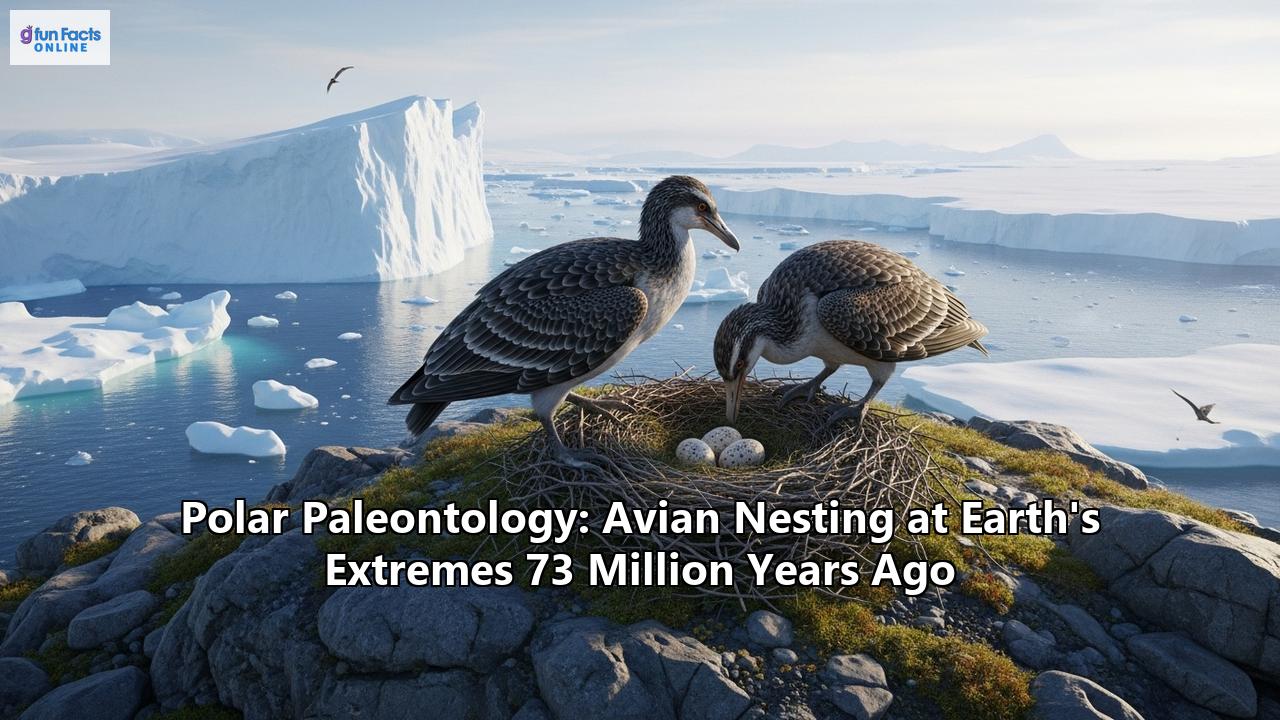
Imagine a world where the high Arctic, a land of stark beauty and unforgiving extremes, was a bustling nursery for ancient birds, all while colossal dinosaurs roamed the same frosty landscapes. This isn't a scene from a fantasy novel, but a remarkable reality unearthed by paleontologists, pushing back the known history of avian nesting at Earth's poles by a staggering 25 to 30 million years. Seventy-three million years ago, during the Late Cretaceous period, the Arctic was already a chosen breeding ground for a diverse array of bird species.
A Glimpse into an Ancient Arctic Nursery
For years, the sparse fossil record kept the origins of high-latitude nesting shrouded in mystery. Prior to recent groundbreaking discoveries, the earliest solid evidence of birds reproducing near the poles dated back to about 47 million years ago, well after the asteroid impact that wiped out roughly 75% of animal life on Earth, including non-avian dinosaurs. However, new research centered on the Prince Creek Formation in northern Alaska has dramatically rewritten this timeline.
This remote Alaskan site, which lay even further north during the Cretaceous at a paleolatitude of 80-85 degrees, has yielded an extraordinary collection of tiny fossilized bird bones and teeth. These weren't just any bones; among them were the delicate remains of embryos and hatchlings – perinatal fossils – providing the oldest direct proof of birds nesting and raising their young in a polar environment. Finding Cretaceous bird bones is a rare feat in itself, but discovering baby bird bones is almost unheard of due to their porous and fragile nature.
Lauren Wilson, a doctoral student at Princeton University and lead author of a pivotal study on these findings, emphasized the significance: "Birds have existed for 150 million years. For half of the time they have existed, they have been nesting in the Arctic." This means that for at least 73 million years, the Arctic has served as a critical nursery for avian life.
The Feathered Inhabitants of a Cretaceous Arctic
The fossil assemblage from the Prince Creek Formation reveals a surprisingly diverse avian community thriving alongside dinosaurs. Researchers have identified several types of birds:
- Diving birds resembling modern loons (Hesperornithes).
- Gull-like birds (Ichthyornithes).
- Several kinds of birds similar to modern ducks and geese, some of which may be early representatives of Neornithes, the group that includes all living birds.
These discoveries are particularly compelling because they suggest that the ancestors of modern birds, or ornithurines, had already developed sophisticated adaptations to survive and reproduce in these challenging high-latitude environments long before the end-Cretaceous mass extinction event. Some of these ancient birds even possessed toothless jaws, a characteristic feature of modern avians.
Life at the Extreme: Challenges and Adaptations
Life in the Late Cretaceous Arctic, while warmer overall than today, was no walk in the park. The region would have experienced months of continuous winter darkness, freezing temperatures, and snowfall. For tiny, freshly hatched birds, or even young fledglings facing their first migration, these conditions would have been incredibly demanding.
The presence of these nesting sites implies that these ancient birds had evolved remarkable strategies to cope. These could have included:
- Seasonal Migration: Traveling vast distances to escape the harshest winter conditions, a behavior common in many modern Arctic-nesting birds.
- Overwintering: Developing physiological adaptations to endure the cold and dark, such as specialized feathers for insulation or adjusted metabolisms.
- Precise Timing of Reproduction: Synchronizing hatching with the brief Arctic summer, a period of abundant food resources and continuous daylight.
The ability of these ornithurine birds to thrive in such an environment may have given them a crucial advantage. Notably, fossils of enantiornithines, another dominant bird group of the Cretaceous, are absent from these high-latitude Alaskan sites. Enantiornithines generally had slower developmental rates, which might have made it harder for them to succeed in the short Arctic breeding season. This suggests that the ancestors of modern birds were perhaps better equipped to handle the tough Arctic conditions, potentially contributing to their survival through the mass extinction event that wiped out enantiornithines and non-avian dinosaurs.
Significance of the Discoveries
These findings from the Alaskan Arctic have profound implications for our understanding of avian evolution and polar ecosystems:
- Early Adaptation: It demonstrates that complex behaviors like polar nesting and likely migration evolved much earlier in bird history than previously thought.
- Ecosystem Engineers: Birds have been integral components of polar ecosystems for tens of millions of years, playing roles in nutrient cycling and influencing the dispersal of other organisms. The Arctic has long been a "nursery for modern birds."
- Survival Advantage: The adaptations developed by these polar-nesting birds may have been key to their lineage surviving the Cretaceous-Paleogene extinction event, allowing them to diversify into the vast array of bird species we see today.
- Rewriting Paleontological Maps: Alaska is now recognized as one of the best places in the world for finding bird fossils from the age of dinosaurs, an area previously not on the radar for such discoveries.
The research highlights the value of meticulous paleontological work, often involving the screening of sediment under microscopes to find tiny but incredibly significant fossils. As Dr. Pat Druckenmiller, director of the University of Alaska Museum of the North, stated, "This pushes back the record of birds breeding in the polar regions by 25 to 30 million years."
Ongoing Research and Future Directions
While these discoveries are monumental, they also open up new avenues for research. Scientists are keen to find more complete skeletons to definitively place these ancient Arctic nesters within the avian family tree, particularly to confirm if some are indeed the oldest known members of Neornithes. Further investigation into the specific adaptations that allowed these birds to thrive in such extreme conditions will continue to shed light on the remarkable resilience and evolutionary journey of birds.
The discovery of these 73-million-year-old nesting sites paints a vivid picture of an ancient Arctic teeming with life, where the ancestors of modern birds carved out a niche for themselves at the very extremes of the Earth, a testament to their enduring ability to adapt and flourish. It underscores that the ecological strategies we observe in polar birds today have deep evolutionary roots, stretching back into the twilight of the dinosaur age.
Reference:
- https://www.sci.news/paleontology/cretaceous-bird-nesting-polar-latitudes-13949.html
- https://www.uaf.edu/news/study-finds-birds-nested-in-arctic-alongside-dinosaurs.php
- http://novataxa.blogspot.com/2025/05/avikarctic.html
- https://www.researchgate.net/publication/392200205_Arctic_bird_nesting_traces_back_to_the_Cretaceous
- https://pubmed.ncbi.nlm.nih.gov/40440391/
- https://www.reading.ac.uk/news/2025/Research-News/Ancient-birds-nested-in-the-Arctic-alongside-dinosaurs
- https://www.smithsonianmag.com/smart-news/scientists-find-the-first-evidence-of-birds-nesting-in-the-arctic-alongside-dinosaurs-180986720/
- https://bioengineer.org/ancient-birds-nested-in-the-arctic-during-the-cretaceous-predating-their-modern-descendants/
- https://www.montana.edu/news/24598/research-by-montana-state-alumna-reveals-birds-nested-in-the-cretaceous-arctic-alongside-non-avian-dinosaurs
- https://www.discovermagazine.com/the-sciences/birds-nested-alongside-dinosaurs-in-alaska-73-million-years-ago
- https://www.montana.edu/news/24599/research-by-montana-state-alumna-reveals-birds-nested-in-the-cretaceous-arctic-alongside-non-avian-dinosaurs
- https://scholarworks.alaska.edu/handle/11122/15196
- https://www.livescience.com/animals/birds/birds-have-been-nesting-in-the-arctic-circle-for-almost-73-million-years-newly-discovered-fossils-reveal
- https://www.eurekalert.org/news-releases/1085149