
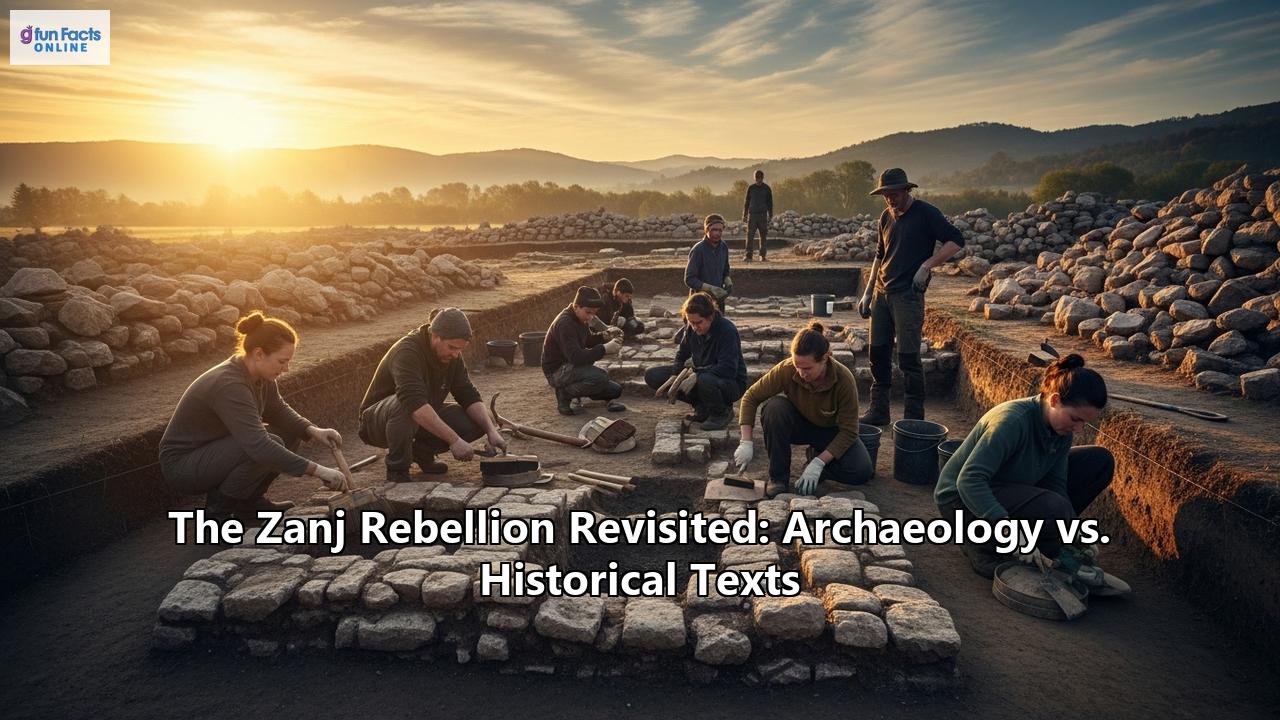
The Zanj Rebellion Revisited: A Clash of Narratives Between Ancient Texts and Modern Archaeology
In the annals of medieval history, few events are as dramatic, brutal, and enigmatic as the Zanj Rebellion. For fourteen years, from 869 to 883 CE, the mighty Abbasid Caliphate, the dominant power in the Islamic world, was shaken to its core by a massive uprising in the wetlands of southern Iraq. Led by the charismatic and enigmatic ‘Alī ibn Muḥammad, a coalition of enslaved Africans, known as the Zanj, and other disaffected locals waged a relentless guerrilla war that culminated in the sack of major cities and threatened the very heart of the empire. For centuries, our understanding of this monumental conflict has been shaped almost exclusively by the vivid, often horrifying, accounts of medieval Arab historians like al-Tabari and al-Mas'udi. Their texts paint a picture of apocalyptic destruction, of a land scarred and an economy shattered, from which the region of southern Iraq never truly recovered.
This narrative, of a slave revolt so devastating it caused the collapse of a sophisticated agricultural system, has been the accepted truth for over a millennium. However, deep within the very soil that once bore witness to this historic struggle, a different story is emerging. Recent, groundbreaking archaeological discoveries in the Shatt al-Arab floodplain are challenging the long-held historical consensus. Using the cutting-edge tools of satellite imagery, optically stimulated luminescence (OSL) dating, and radiocarbon analysis, scientists are now able to read the landscape itself as a historical document. What they have found suggests that the story of the Zanj Rebellion and its aftermath is far more complex than the chroniclers left us to believe. The spade and the spectrometer are in dialogue with the pen, and their conversation is forcing a radical reassessment of this pivotal chapter in world history. This is the story of the Zanj Rebellion revisited, a fascinating intersection where historical texts and archaeological evidence collide, converge, and ultimately, create a new, more nuanced understanding of the past.
The World of the Zanj: Slavery and Reclamation in the Marshes of Iraq
To understand the ferocious uprising, one must first understand the brutal reality of the world that birthed it. The 9th-century Abbasid Caliphate was a sprawling, cosmopolitan empire at the zenith of its power, with its capital in Baghdad (and later Samarra) acting as a global center of culture, science, and commerce. This prosperity, however, was built on foundations that included vast and exploitative labor systems.
In the southern part of modern-day Iraq, near the bustling port city of Basra, lay extensive salt marshes and floodplains. Wealthy investors and magnates had acquired vast tracts of this land with the understanding that they would make it arable and profitable. The process was grueling. It involved draining the swamps and, most arduously, removing the nitrous topsoil to expose the fertile land beneath, a process essential for the cultivation of lucrative crops like sugarcane and dates.
To perform this backbreaking labor, the Abbasid elite imported tens of thousands of enslaved people. The historical texts refer to these laborers as the "Zanj." Etymologically, the term is linked to the Swahili Coast of East Africa, and for a long time, historians assumed this was the exclusive origin of the enslaved workers. However, the precise identity of the Zanj is a subject of intense scholarly debate. The term may have been used more broadly by Arab writers to refer to Black people or Africans in general. Some modern scholars, citing the logistics of the slave trade and genetic studies, argue that many of the enslaved may have actually originated from West and Central Africa, brought to Iraq via the trans-Saharan trade routes.
What is undisputed is the inhumanity of their condition. The Zanj were organized into large work camps, sometimes numbering between 500 and 5,000 individuals. The medieval chroniclers, though often hostile to the rebels, provide glimpses of their misery. They describe a life of relentless toil under a punishing sun, with minimal sustenance and cruel treatment at the hands of overseers. This was not the domestic slavery common in urban households, but a form of large-scale agricultural servitude more akin to the Roman latifundia or the later plantations of the Americas. It was a tinderbox of human suffering, awaiting only a spark to ignite it.
The Spark of Rebellion: ‘Alī ibn Muḥammad and the Rise of an Army
That spark arrived in the form of ‘Alī ibn Muḥammad, a man of mysterious origins who would become the leader and figurehead of the revolt. Claiming descent from Ali ibn Abi Talib, the son-in-law of the Prophet Muhammad, he was likely a free Arab or Persian. He arrived in the region in 869 CE, possessing a potent combination of political acumen, religious fervor, and a keen understanding of the grievances of the oppressed.
Journeying into the slave quarters and work camps of the marshlands, ‘Alī began to mobilize the disenfranchised workers. His message was a powerful cocktail of social, economic, and religious promises. He denounced the cruelty of the slave masters, pointing out the gross injustice of their social position and promising freedom, wealth, and dignity. Al-Tabari records a powerful scene where ‘Alī confronts the slave owners directly in front of their captives, declaring: “I wanted to behead you all, for the way you have treated these slaves, with arrogance and coercion… In ways that Allah has forbidden.”
To bolster his appeal, he adopted the egalitarian ideology of the Kharijites, a dissident Islamic sect, proclaiming that the best person should rule, "even if he is an Abyssinian slave." This radical message resonated deeply with the Zanj and other marginalized groups, including local peasants, Bedouins, and even some defectors from the Abbasid army. The historical sources are clear that while enslaved Africans formed the core of the rebellion, especially in its initial stages, the movement was a diverse coalition of the downtrodden.
The rebellion began in September 869 with a series of daring raids. ‘Alī and his followers would ambush work gangs, overpower the overseers, and liberate the enslaved laborers, swelling their ranks with each successful operation. Employing masterful guerrilla tactics perfectly suited to the labyrinthine waterways and dense reed beds of the marshes, the Zanj army quickly became a formidable force. They learned to conduct swift night raids on towns and enemy camps, seizing weapons, food, and horses before melting back into the landscape.
A State within a State: The Zanj Polity and the Sacking of Basra
What began as a series of scattered uprisings soon coalesced into a highly organized and independent state. Deep within the inaccessible marshlands, the Zanj established a fortified capital city, which they named al-Mukhtara, "the Chosen." This stronghold, surrounded by canals, served as the nerve center of their operations. The rebels built a navy to navigate the region's rivers, constructed fortresses, collected taxes in the territories they controlled, and even minted their own currency.
The Abbasid Caliphate, weakened by internal power struggles and preoccupied with other conflicts, initially underestimated the threat. Early attempts to crush the revolt were disastrous failures. The Zanj defeated several Abbasid armies sent against them, in part by luring them into ambushes within the treacherous marshland terrain. Emboldened by their successes, the Zanj went on the offensive. They captured and sacked the key port city of al-Ubulla in 870 and took control of the Ahwaz region in southwestern Iran.
The rebellion reached its terrifying zenith in September 871 with the fall of Basra, one of the empire's most important commercial and intellectual hubs. After a prolonged blockade that led to starvation and disease within the city walls, the Zanj forces overwhelmed the defenders and poured into the city. The accounts of what followed are horrific. Medieval historians describe a days-long massacre and plunder. Al-Mas'udi's claim that 300,000 people were killed is likely an exaggeration, but modern historians estimate that tens of thousands of inhabitants perished. The city was burned, its wealth was looted, and its inhabitants were killed or enslaved by those who had once been enslaved themselves.
The sack of Basra sent a shockwave across the Islamic world. It was a profound humiliation for the Abbasid government and a stark demonstration of the Zanj's power. The rebellion had morphed from a localized labor dispute into a full-blown war that was destabilizing a vast and vital region of the caliphate.
The Pen is Mightier?: The Historical Narrative of Destruction
Our primary window into these events is the monumental work of Abū Jaʿfar Muḥammad ibn Jarīr al-Ṭabarī, whose "History of the Prophets and Kings" provides the most detailed surviving account of the rebellion. Al-Tabari was a contemporary of the events, living in Baghdad, and he constructed his narrative from eyewitness reports. His account, along with those of other chroniclers like al-Mas'udi, is unflinchingly hostile to the rebels. ‘Alī ibn Muḥammad is frequently referred to as "the enemy of God" or "the abominable one."
These texts portray the fourteen-year conflict as an unmitigated catastrophe for southern Iraq. They speak of widespread chaos, of cities and towns being burned and pillaged. They describe how the war fundamentally disrupted the region's economy, with advancing armies seizing food, trade routes being severed, and agricultural activity ceasing as lands were abandoned. A key part of this narrative is the destruction of the very infrastructure that the Zanj had been forced to build. The texts state that "irrigation systems were destroyed, and countless villages were abandoned." The impression given is one of total systemic collapse. The rebellion, in this telling, not only brought death and destruction but also irrevocably shattered the agricultural backbone of the region, leading to its long-term decline.
This narrative of sudden and lasting devastation has been incredibly powerful, shaping the historiography of the region for centuries. Historians have largely accepted that the Zanj Rebellion marked a definitive break, a point of no return after which the sophisticated, large-scale agriculture of the Basra hinterlands withered away, leaving behind a landscape of ruin and abandonment.
The Spade and the Sediment: Archaeology's Counter-Narrative
For over a thousand years, this text-based narrative stood largely unchallenged. There was little reason to doubt the accounts of contemporaries like al-Tabari. But history is recorded not only in ink but also in earth and sediment. In 2022 and the years following, a series of archaeological studies focused on the vast, enigmatic network of ancient ridges and canals in the Shatt al-Arab floodplain began to yield revolutionary data.
An international team of researchers used a combination of high-resolution satellite imagery and archaeological fieldwork to map and investigate this massive agricultural system, which consists of more than 7,000 linear earthen ridges spread across over 800 square kilometers. For decades, it had been assumed that these were the very structures built by the Zanj before their revolt and abandoned in the ensuing chaos. To test this, the research team employed optically stimulated luminescence (OSL) dating on soil samples taken from the core of four of the ridge features. This technique can determine when sediment grains were last exposed to sunlight, effectively dating when the earthworks were constructed or maintained.
The results were astonishing and directly contradicted the traditional historical narrative. Rather than showing a system built and abandoned in the 9th century, the OSL dates revealed a much longer and more complex story. The analysis showed that the agricultural ridges were not only in use after the Zanj Rebellion was crushed in 883 CE, but that they were actively maintained and expanded for centuries. Dates from the excavated ridges extended into the 11th, 12th, and even the 13th centuries.
This physical evidence strongly suggests that the economic impact of the Zanj Rebellion was not as decisive or as long-lasting as the historical texts claim. Instead of a catastrophic collapse, the archaeological data points to continuity and even resilience. The great agricultural machine of southern Iraq did not grind to a halt. While the revolt was undoubtedly brutal and destructive in the short term, causing the sacking of cities and immense loss of life, it does not appear to have permanently destroyed the region's capacity for large-scale, irrigated farming. Cultivation persisted and, in some areas, may have even been reorganized or intensified in the centuries following the rebellion.
Reconciling the Narratives: A More Complex History
How can we reconcile these two seemingly contradictory accounts? Was al-Tabari simply wrong? Or is the truth more nuanced?
It is crucial to remember the perspective of the chroniclers. Al-Tabari and his peers were writing from the perspective of the Abbasid elite in Baghdad. They saw the Zanj as heretical, brutal insurgents who had murdered thousands, destroyed property, and defied the authority of the Caliph. Their accounts naturally focused on the chaos, horror, and disruption of the war years. The burning of Basra and the slaughter of its inhabitants were real and traumatic events that would have loomed large in the psyche of the time. Their narrative is one of war and its immediate, violent consequences. They were chronicling the "shock and awe" of the rebellion, not conducting a long-term economic impact assessment.
Furthermore, the destruction they describe was likely real but localized and temporary from a landscape perspective. The rebels and the Abbasid armies both engaged in tactics that involved damaging infrastructure like bridges and canals for military advantage. But damaging a canal is not the same as erasing an entire agricultural system that had been built over generations.
The archaeology, on the other hand, reveals the slower, longer-term rhythms of life and labor. It shows that once the conflict ended, the fundamental economic activities of the region resumed. The demand for agricultural products to feed cities and for export did not simply vanish. The knowledge of how to manage the complex tidal irrigation system, which involved channeling fresh water from the Tigris and Euphrates during high tides, was not lost. Life, and the labor required to sustain it, went on. The archaeological evidence suggests that while the rebellion may have changed the political and perhaps even the social organization of labor, the system of cultivation itself endured for another 300 to 400 years.
The eventual abandonment of this vast agricultural landscape appears to have occurred much later, sometime between the 13th and 14th centuries. The reasons for this final decline are not yet known but may be linked to a combination of factors, including broader political and economic shifts in the Islamic world, climate change, or the devastating Mongol invasions of the 13th century, which had a far more permanent and destructive impact on the region's infrastructure than the Zanj Rebellion appears to have had.
The End of the Revolt and Its Enduring Legacy
The eventual defeat of the Zanj required a monumental effort from the Abbasid state. The Caliph's brother and de facto ruler, al-Muwaffaq, took personal command of the war effort. Beginning in 879, he led a massive, well-equipped army and fleet into the south. Instead of fighting the Zanj on their own terms in the marshes, al-Muwaffaq adopted a slow, methodical strategy of siege warfare. His forces gradually pushed the rebels back, retaking territory and eventually laying siege to their capital, al-Mukhtara, in 881.
Al-Muwaffaq also employed shrewd psychological warfare, offering amnesty and a place in the Abbasid army to any rebels who would defect. This offer proved highly effective, draining the Zanj of manpower and providing the Abbasids with experienced soldiers who knew the terrain. After a grueling two-year siege, al-Mukhtara finally fell in August 883. ‘Alī ibn Muḥammad was killed in the final battle, and his head was sent to Baghdad as proof of the rebellion's end.
The Zanj Rebellion was, by any measure, one of the most significant and bloody rebellions in the history of Western Asia. It cost tens of thousands of lives, laid waste to cities, and exposed the deep social and racial fissures within the Abbasid empire. But as modern archaeology now reveals, its ultimate legacy is more complex than the chronicles of its enemies suggest.
The rebellion did not shatter the agricultural economy of southern Iraq. Instead, the landscape itself bears witness to a surprising resilience, a continuity of life and labor that persisted for centuries after the last fires of the revolt were extinguished. The dialogue between the ancient texts and the new archaeological evidence provides a powerful lesson in historical inquiry. It shows that history is not a single, static story but an ongoing conversation between different forms of evidence. The voices of the chroniclers tell us of the fire and the fury of the moment, but the silent testimony of the soil reveals the deeper, more enduring story of human survival, adaptation, and the relentless will to cultivate life from the earth, even in the shadow of immense violence and upheaval. The Zanj Rebellion has not just been revisited; it is being rewritten.
Reference:
- https://archaeologymag.com/2025/08/zanj-rebellion-and-enslaved-africans/
- https://africaciviclens.com/2025/08/25/iraqs-forgotten-past/
- http://sciencythoughts.blogspot.com/2025/06/the-landscape-of-zanj-rebellion.html
- https://www.britannica.com/event/Zanj-rebellion
- https://en.wikipedia.org/wiki/Zanj_Rebellion
- https://archaeology.org/news/2025/06/05/enslaved-africans-built-ancient-agricultural-system-in-southern-iraq/
- https://www.ancient-origins.net/news-history-archaeology/zanj-rebellion-agriculture-0022386
- https://oxfordre.com/africanhistory/display/10.1093/acrefore/9780190277734.001.0001/acrefore-9780190277734-e-933?p=emailAY7pU8QqGVffE&d=/10.1093/acrefore/9780190277734.001.0001/acrefore-9780190277734-e-933
- https://www.google.com/search?q=time+in+%D8%A7%D9%84%D8%A8%D8%B5%D8%B1%D8%A9,+IQ
- https://en.wikipedia.org/wiki/Battle_of_Basra_(871))
- https://oxfordre.com/africanhistory/display/10.1093/acrefore/9780190277734.001.0001/acrefore-9780190277734-e-933?d=%2F10.1093%2Facrefore%2F9780190277734.001.0001%2Facrefore-9780190277734-e-933&p=emailAU3NknYtvWXgU
- https://books.google.com.hk/books/about/The_History_of_al_%E1%B9%ACabar%C4%AB_Vol_36.html?id=-ctgf6WSCPMC&redir_esc=y
- https://api.pageplace.de/preview/DT0400.9781438423043_A40634617/preview-9781438423043_A40634617.pdf
- https://www.cambridge.org/core/journals/antiquity/article/landscape-of-the-zanj-rebellion-dating-the-remains-of-a-largescale-agricultural-system-in-southern-iraq/8EFD7A767C88F526B45330E4AC4D309C
- https://www.anthropology.net/p/buried-grids-and-rebellious-ghosts
- https://oxfordre.com/africanhistory/display/10.1093/acrefore/9780190277734.001.0001/acrefore-9780190277734-e-933?p=emailAo02CjIVhoLJQ&d=/10.1093/acrefore/9780190277734.001.0001/acrefore-9780190277734-e-933