
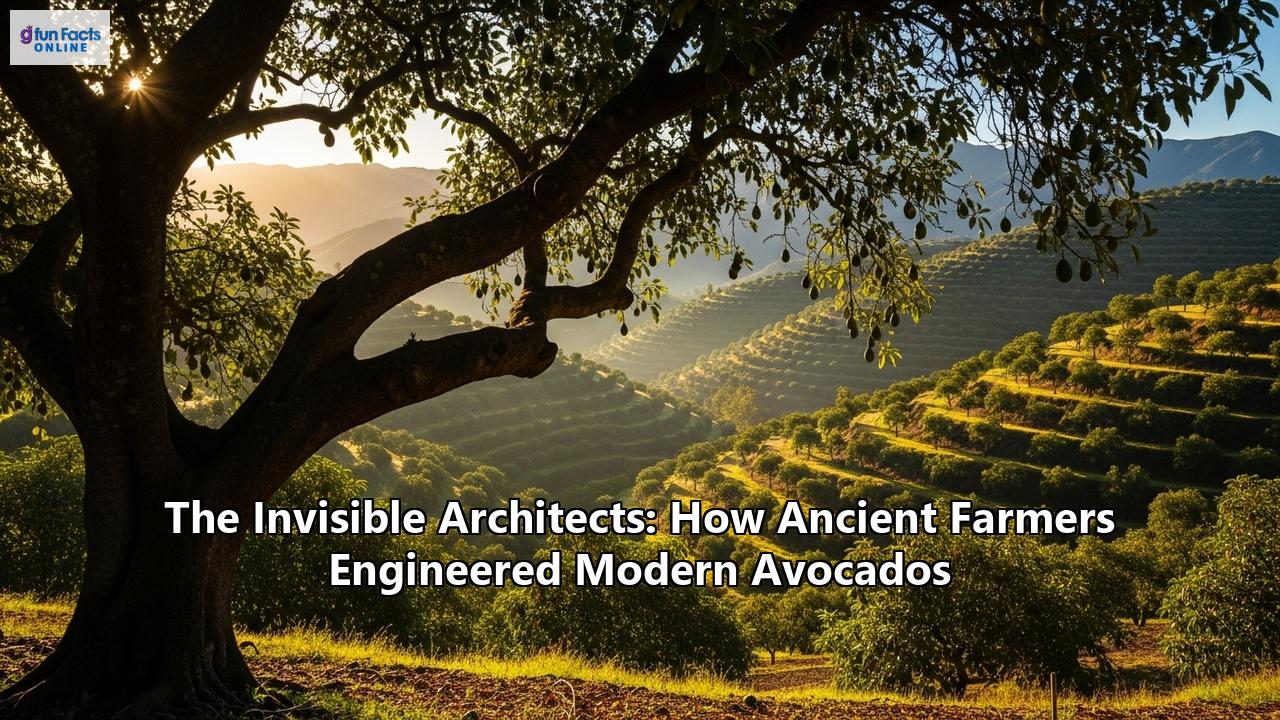
The Invisible Architects: How Ancient Farmers Engineered Modern Avocados
In the heart of every creamy, green avocado lies a story that stretches back not just thousands, but millions of years. It’s a tale of colossal beasts, of lost worlds, and most importantly, of the quiet, persistent ingenuity of ancient peoples who, through generations of careful observation and cultivation, transformed a wild, and at times unpalatable, fruit into the global culinary superstar we know today. These were the invisible architects of the avocado, the first farmers who saw potential in a perilous-looking fruit and, through their patient efforts, engineered a legacy that continues to grace our tables.
A Fruit of Giants: The Avocado's Prehistoric Past
Long before humans arrived in the Americas, the avocado tree, Persea americana, was already flourishing in the lush landscapes of what is now south-central Mexico and Guatemala. But these were not the avocados of our contemporary guacamole and toast. Wild avocados were often smaller, with a disproportionately large seed and a thin layer of flesh that could be bitter and unappealing.
The survival and propagation of the avocado in this prehistoric world were inextricably linked to a cast of now-extinct giants. The Pleistocene epoch, often referred to as the Ice Age, was a time of megafauna—massive creatures that roamed the land. Giant ground sloths, some as large as modern elephants, mammoths, and gomphotheres, a type of extinct elephant-like animal, were the original avocado aficionados. These colossal herbivores would consume the avocado fruit whole, its large seed passing undigested through their expansive digestive tracts. As these giants traversed vast territories, they would deposit the seeds, complete with a ready-made pile of fertilizer, far from the parent tree, ensuring the avocado's widespread dispersal.
This symbiotic relationship was a masterpiece of co-evolution. The avocado, with its large, calorie-dense fruit, provided a vital food source for these massive animals. In return, the megafauna served as the perfect, if unwitting, gardeners for the avocado tree. This evolutionary strategy, known as anachronism, highlights a plant that has outlived its primary seed dispersal partners.
Around 13,000 years ago, a dramatic shift occurred. The end of the Pleistocene brought with it a changing climate and the arrival of a new, highly effective predator: humans. The megafauna began to disappear, leaving the avocado in a precarious position. Without its giant partners to transport its large seeds, the avocado faced the threat of a severely limited range and, potentially, extinction. The seeds would simply fall and rot beneath the parent tree, creating a dense and competitive environment.
The Dawn of a New Partnership: Humans as Cultivators
Just as the giants faded from the landscape, a new and transformative relationship began to form. Early humans in Mesoamerica, hunter-gatherers at the time, discovered the nourishing properties of the wild avocado. Archaeological evidence from caves in the Tehuacan Valley in Puebla, Mexico, reveals avocado seeds dating back almost 10,000 years, indicating a long history of human consumption. Initially, these early interactions were likely opportunistic, with people gathering the fruit from wild trees.
However, over millennia, this relationship evolved from simple foraging to active management and, eventually, to deliberate cultivation. This was not a sudden revolution but a slow, patient process of observation and selection. These ancient people were the first to recognize that not all avocado trees were created equal. Some produced slightly larger fruits, some had creamier flesh, and others were perhaps less bitter.
Recent archaeological discoveries have shed remarkable light on this protracted process of domestication. At the El Gigante rockshelter in Honduras, a treasure trove of exceptionally well-preserved plant remains has provided a timeline of avocado cultivation spanning over 11,000 years. By analyzing hundreds of avocado pits and rinds, researchers have been able to trace the gradual but deliberate changes engineered by these ancient farmers.
The evidence suggests that as early as 11,000 years ago, the inhabitants of El Gigante were tending to wild avocado stands. By about 7,500 years ago, a clear pattern of selection emerges. The avocado pits found from this period are consistently larger than their wilder ancestors, and the rinds are thicker. This indicates that these early farmers were actively choosing fruits with more desirable traits—likely larger size and a more robust skin that would protect the fruit and make it easier to transport—and propagating them. This was a form of "domesticated forests," where people would manage and prune trees to encourage the growth of larger, more productive fruit.
This process of arboriculture, or tree cultivation, in Mesoamerica is particularly fascinating because it appears to have preceded the widespread cultivation of staple grain crops like maize in some regions. While the narrative of agriculture is often centered on the domestication of annual crops, the story of the avocado reveals a deep-seated tradition of forest management and tree cultivation that formed the basis of early agricultural systems in the Americas. These ancient Hondurans were already accomplished farmers, their expertise rooted in the patient cultivation of trees, long before maize became a dominant crop.
The Three Faces of the Avocado: The Landraces
Through thousands of years of this careful selection and cultivation, the ancient farmers of Mesoamerica didn't just create a single "domesticated" avocado. Instead, their diverse practices, spread across different geographic and climatic regions, gave rise to three distinct avocado landraces, each with its own unique set of characteristics. These are often referred to as the Mexican, Guatemalan, and West Indian varieties.
- The Mexican Race (Persea americana var. drymifolia): Hailing from the highlands of central Mexico, this variety is known for its resilience to colder temperatures. Its fruits are typically smaller, with thin, often purple-black skin, and the leaves of the tree carry a distinctive anise-like scent. The Aztecs referred to this variety as aoacatl.
- The Guatemalan Race (Persea americana var. guatemalensis): Originating in the highlands of Guatemala and southern Mexico, this landrace produces avocados that are larger than their Mexican cousins, with a characteristically thick and tough skin. They are adapted to medium elevations and have some degree of cold tolerance. The Aztec name for this variety was quilaoacatl. The archaeological evidence from El Gigante suggests that the avocados cultivated there were of the Guatemalan variety.
- The West Indian Race (Persea americana var. americana): Despite its name, this variety did not originate in the West Indies but was developed in the humid, lowland regions of the Mayan civilization in Central America. These avocados are the largest of the three and are well-suited to tropical climates, showing a tolerance for salt and certain soil nutrient deficiencies. They have a smooth, easy-to-peel green skin and a flesh that is often described as having a slightly sweet taste. The Aztecs called this type tlacacolaocatl.
The development of these distinct landraces is a testament to the sophisticated understanding of plant breeding and environmental adaptation possessed by these ancient farmers. They were, in essence, conducting a long-term, large-scale experiment in agricultural engineering, resulting in a diversity of avocados suited to a variety of ecological niches. This genetic diversity, fostered by millennia of seedling cultivation and selection, stands in stark contrast to the modern avocado industry's heavy reliance on a single cultivar, the Hass.
More Than Just Food: The Avocado in Mesoamerican Culture
For the ancient civilizations of Mesoamerica, the avocado was far more than just a source of sustenance. It was deeply woven into the fabric of their cultures, religions, and daily lives. The fruit held a powerful symbolic meaning, its presence felt in their art, their language, and their mythology.
The very name "avocado" is a legacy of this cultural significance. The word derives from the Nahuatl language of the Aztecs, ahuacatl. This word also meant "testicle," a reference likely inspired by the fruit's shape and its tendency to grow in pairs. This association was not merely a matter of appearance; the Aztecs believed that avocados possessed aphrodisiac qualities and imbued those who consumed them with strength and fertility. This belief was so potent that, according to some accounts, young women were kept indoors during the avocado harvest season. The shape of the avocado, resembling a uterus with the seed like a fetus, and its nine-month growth cycle from flower to fruit, further cemented its association with fertility and life.
The Maya also held the avocado in high esteem. The fourteenth month of their intricate calendar, K'ank'in, is represented by the glyph for the avocado. The fruit's importance is also evident in the name of the ancient Maya city of Pusilhá in modern-day Belize, which was known as the "Kingdom of the Avocado." Its rulers were referred to as the "lords of the avocado."
Avocado trees were also integral to the Mayan cosmology. They believed that ancestors were reborn as trees, and it was common practice to plant fruit trees, including avocados, in home gardens, sometimes over the graves of relatives. This is beautifully illustrated on the sarcophagus of the great Maya ruler Pakal the Great in Palenque. The intricate carvings depict his ancestors emerging from the earth, each accompanied by a fruit tree, including the avocado, symbolizing rebirth and the sacred connection between humans and the natural world.
In terms of cuisine, the avocado was a versatile staple. The Aztecs are credited with creating the precursor to modern guacamole, a dish they called ahuaca-mulli, which translates to "avocado sauce." This was made by mashing ripe avocados with other local ingredients like tomatoes and chili peppers. Beyond the fruit itself, the leaves of the avocado tree were also used, both for their medicinal properties and as a culinary spice. They were added to stews, soups, and used to wrap meats, imparting a subtle, anise-like flavor. Infusions of avocado leaves were used in traditional medicine to treat a range of ailments, from digestive issues to fevers. The avocado was also a form of tribute, with conquered regions paying taxes to the Aztec empire in the form of these prized fruits.
The Avocado's Journey to the World Stage
For thousands of years, the avocado remained a well-kept secret of the Americas. Its journey to global prominence began with the arrival of Spanish conquistadors in the 16th century. The Spanish were intrigued by this buttery, nutritious fruit. They recorded its various local names and the different varieties they encountered. Finding the Nahuatl "ahuacatl" difficult to pronounce, they adapted it to "aguacate," a term still used in many Spanish-speaking countries today. It was this Spanish word that would eventually be anglicized to "avocado."
The Spanish were responsible for introducing the avocado to Europe in the early 1600s, but it remained a rare and exotic fruit for centuries. It was also through the Spanish that the avocado was spread to other parts of the Americas.
The avocado's introduction to the United States occurred in the mid-19th century, with trees being planted in Florida and California. However, it was slow to gain widespread popularity. Its reputation as an aphrodisiac, a legacy of its Aztec roots, made it somewhat taboo in the more conservative American society of the time. For a period, it was even known by the rather unappetizing name "alligator pear."
It wasn't until the early 20th century that the avocado began to shed its exotic and somewhat scandalous reputation. A group of Californian growers, recognizing the fruit's commercial potential, rebranded it as the "avocado." This, coupled with marketing efforts, helped to spark a growing interest. By the 1950s, several varieties were being commercially grown, with the 'Fuerte' being the most popular.
The true game-changer, however, was the 'Hass' avocado. Discovered by a mailman named Rudolph Hass in La Habra Heights, California, in the late 1920s, the Hass was a chance seedling of uncertain parentage. Hass patented his tree in 1935, and it proved to be a prolific producer of a rich, nutty-flavored fruit with a thick, pebbly skin that turned from green to purplish-black when ripe, a convenient indicator of its readiness to eat. By the late 1970s, the Hass had surpassed the Fuerte to become the dominant avocado cultivar, and today it accounts for the vast majority of avocados grown and consumed worldwide. Every Hass avocado tree in the world is a descendant of that single "mother tree" from a Southern California backyard.
The Enduring Legacy of the Invisible Architects
From a wild fruit dependent on giant beasts for its survival to a global commodity, the story of the avocado is a powerful testament to the transformative power of agriculture. But at the heart of this story are the anonymous, "invisible architects" of ancient Mesoamerica. These were not scientists in white lab coats, but farmers with an intimate knowledge of their environment and a multi-generational vision.
Their patient selection for larger fruits, creamier textures, and more robust skins was a form of genetic engineering, carried out over thousands of years. They domesticated not just a plant, but an entire ecosystem, managing their forests to create a sustainable and nutritious food source. The diversity of landraces they created is a precious genetic resource, one that holds important lessons for our modern, monoculture-dominated agricultural systems, which are increasingly vulnerable to disease and climate change. The resilience of the avocado, its ability to adapt and thrive, is a direct result of the genetic diversity fostered by these ancient cultivators.
So, the next time you enjoy a slice of avocado toast or a spoonful of guacamole, take a moment to appreciate the long and fascinating journey of this remarkable fruit. It is a journey that spans epochs, from a time of giants to our modern world. But most importantly, it is a journey shaped by the hands and minds of ancient farmers, the invisible architects who saw the potential in a wild fruit and, through their quiet ingenuity, gave the world a gift that continues to be cherished. Their legacy is not carved in stone, but it is present in every delicious, creamy bite.
Reference:
- http://www.avocadosource.com/CAS_Yearbooks/CAS_81_1997/CAS_1997_PG_155-162.pdf
- https://www.quora.com/What-is-the-origin-behind-the-name-of-avocado
- https://www.smithsonianmag.com/arts-culture/why-the-avocado-should-have-gone-the-way-of-the-dodo-4976527/
- https://www.ripleys.com/stories/sloth-avocado
- https://medium.com/teatime-history/sloths-and-salad-a-history-of-avocados-ba092edd794b
- https://www.uv.mx/personal/megalindo/files/2010/07/galindotovar_325_334_v21.pdf
- https://www.avoseedo.com/the-aztecs-a-history-ripe-with-avocados/
- https://www.thoughtco.com/domestication-and-spread-of-avocado-fruit-169911
- https://avocadosfrommexico.com/avocados/history/
- http://www.avocadosource.com/wac6/en/Extenso/5b-233.pdf
- https://evolution.berkeley.edu/evo-news/what-happens-to-plants-that-cant-spread-their-seeds/
- https://foodispower.org/our-food-choices/the-problem-with-avocados/
- https://avocadotea.com/blogs/blog-1/discover-the-ancient-elixir-avocado-leaves-in-aztec-and-mayan-culture
- https://www.quora.com/How-were-avocado-seeds-dispersed-before-human-cultivation
- https://www.reddit.com/r/etymology/comments/1k0os1c/how_avocado_is_related_to_guacamole/
- https://digitalcommons.unl.edu/cgi/viewcontent.cgi?article=1046&context=nebanthro
- https://www.babbel.com/en/magazine/cultural-history-avocado
- https://blog.vibeadventures.com/aztec-food-chronicles/
- https://www.pnas.org/doi/10.1073/pnas.2417072122