
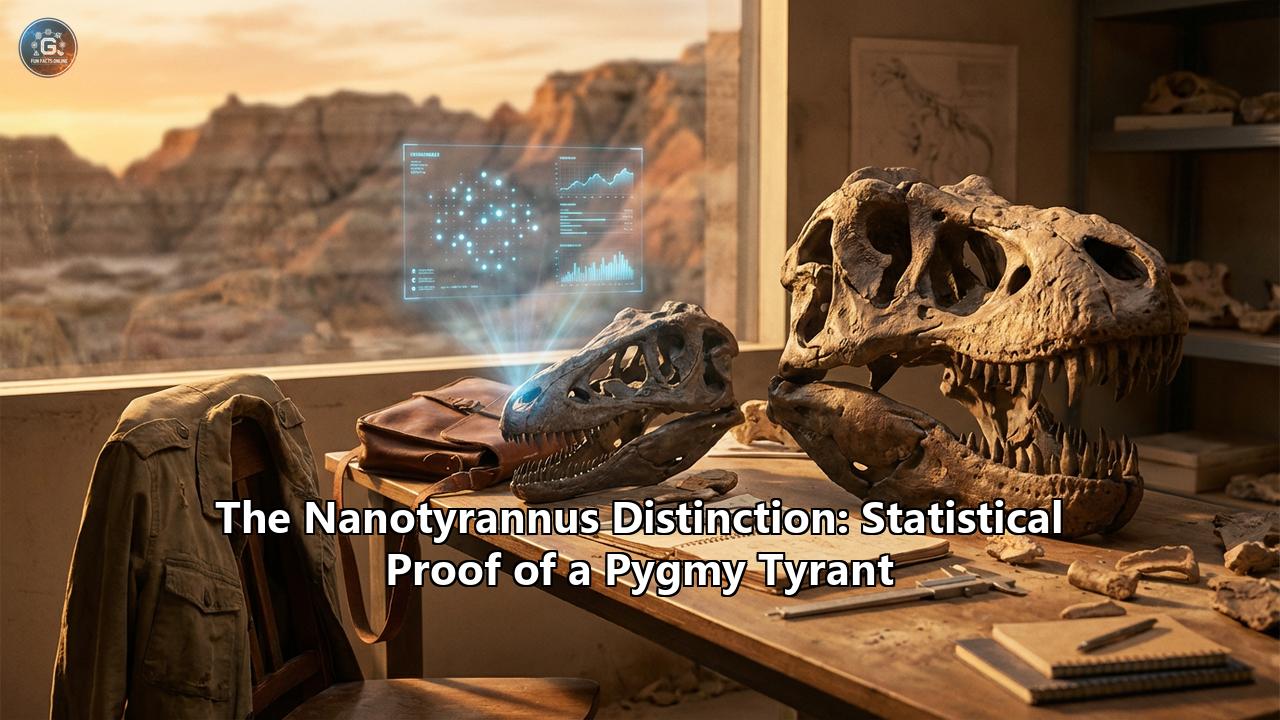
For decades, the dusty badlands of the Hell Creek Formation held a secret that divided the paleontological world. It was a riddle wrapped in stone, a ghost in the machine of dinosaur classification. Was the sleek, long-legged predator found in these Late Cretaceous rocks a "Pygmy Tyrant"—a distinct, agile species living in the shadow of the King? Or was it merely a teenage Tyrannosaurus rex, an awkward adolescent destined to bulk up into the most fearsome crusher the world had ever seen?
This debate, often acrimonious and always passionate, became known as the "Nanotyrannus Distinction." For nearly forty years, the pendulum swung toward the "Teen Rex" hypothesis. The idea was elegant: dinosaurs changed drastically as they grew, and the gracile Nanotyrannus was simply a snapshot of a T. rex before its growth spurt. But science is not about elegance; it is about evidence.
By early 2026, the pendulum shattered. A cascade of groundbreaking studies—anchored by the statistical rigor of Longrich and Saitta, and cemented by the sensational "Dueling Dinosaurs" analysis by Zanno et al.—has provided what many now consider irrefutable proof. Nanotyrannus lancensis is real. It is distinct. And it was not alone.
What follows is the comprehensive story of this scientific revolution. It is a tale of statistical smoking guns, microscopic growth rings, and a prehistoric ecosystem far more complex and terrifying than we ever imagined. This is the anatomy of the Pygmy Tyrant.
Part I: The History of a Ghost
To understand the magnitude of the recent revelations, one must first walk the winding path of the "Jane" controversy and the Cleveland skull. The story began in 1942, when a small, mysterious skull (CMNH 7541) was unearthed in Montana. Originally classified as a Gorgosaurus, a tyrannosaurid common in Canada, it sat in museum drawers until the late 1980s. It was then that paleontologist Robert Bakker, noticing the fused skull bones and unique teeth, re-christened it Nanotyrannus lancensis—the "Dwarf Tyrant of Lance."
Bakker’s argument was anatomical. The skull was long and low, the teeth were laterally compressed and blade-like (unlike the bone-crushing bananas of T. rex), and the braincase showed air sacs and nerve pathways that looked distinct. But the counter-argument, championed by heavyweights like Thomas Carr, was compelling in its simplicity: ontogeny.
Ontogeny is the study of an organism's development. We know that modern animals change shape as they grow; a human baby has a giant head relative to its body, distinct from an adult. Proponents of the "Teen Rex" hypothesis argued that Nanotyrannus was just a juvenile T. rex undergoing extreme morphological changes. They claimed the number of teeth decreased with age, the snout grew deeper and stronger, and the long, cheetah-like legs thickened into the pillars of an adult Tyrannosaurus. For decades, this view became the consensus. Nanotyrannus was effectively erased from the textbooks, relegated to a synonym for "immature T. rex."
But the fossils kept coming. The discovery of "Jane" (BMRP 2002.4.1), a beautifully preserved juvenile tyrannosaur skeleton, reignited the fire. Jane looked exactly like the Nanotyrannus holotype. If she was a T. rex, she was a very strange one. And then came the "Dueling Dinosaurs"—a fossil so spectacular it was locked in a legal battle for years before science could touch it.
When the dust settled and the new data from 2024 and 2025 emerged, the "Teen Rex" hypothesis didn't just stumble; it collapsed under the weight of statistical probability.
Part II: The Statistical Smoking Gun
The turning point came with the publication of a landmark study by Dr. Nick Longrich and Dr. Evan Saitta. Unlike previous studies that focused on a handful of traits, they took a "big data" approach. They didn't just look at the shape of the skull; they quantified the entire animal.
The core of their argument lies in a massive cluster analysis of 158 distinct morphological characters. In biological classification, if two specimens are the same species at different ages, you expect to see a smooth continuum of change—a "growth series." You should find fossils that are 50% Nanotyrannus and 50% T. rex. You should see the teeth thickening, the snout deepening, and the arms shortening in a linear fashion.
Longrich and Saitta found the opposite.
Their statistical models revealed two completely distinct clusters of data with no overlap. There were animals that looked like Nanotyrannus, and animals that looked like T. rex. There were no "hybrids." The "intermediate" fossils that the Teen Rex hypothesis predicted simply did not exist.
Furthermore, they identified 44 specific traits that are known to be "ontogenetically invariant" in other tyrannosaurs. These are features that do not change as an animal grows. For example, in Tarbosaurus (a close Asian cousin of T. rex), the number of teeth remains relatively stable, and the structure of certain air sacs in the skull is fixed from a young age. Nanotyrannus possessed features that were fundamentally incompatible with T. rex machinery.
The "Standard Deviation" of EvolutionTo appreciate the statistical weight of this, consider the variation within a single species. If you measure the arm length of 1,000 human adults, you get a bell curve. If you measure a Nanotyrannus arm and a T. rex arm, they don't fit on the same curve. The arms of Nanotyrannus were not just relatively longer; they were structurally massive for its size, with large, slashing claws. T. rex arms, famously vestigial-looking (though muscular), followed a completely different allometric growth trajectory.
For a Nanotyrannus to grow into a T. rex, it wouldn't just need to grow larger; it would need to shrink its arms, lose teeth, radically reorganize its braincase, and completely change the pneumaticity (air pockets) of its skull bones. The statistical probability of one species undergoing that many reversals and radical shifts during adolescence is vanishingly small.
Part III: The Testimony of the Rings
If statistics provided the map, histology provided the clock.
Histology involves cutting thin slices of fossilized bone and examining them under a microscope. Like trees, dinosaurs laid down "lines of arrested growth" (LAGs)—essentially growth rings—that mark each year of life. The spacing between these rings tells you how fast the animal was growing.
The "Teen Rex" hypothesis relied on the assumption that Nanotyrannus specimens were young, rapidly growing animals in the "exponential phase" of their development. A teenage T. rex should be putting on hundreds of kilograms a year, exploding in size to reach the 8-ton bulk of an adult. Its growth rings should be widely spaced, indicating rapid deposition of bone.
In late 2025, the results from the "Dueling Dinosaurs" specimen and the re-analysis of the "Jane" specimen shocked the community.
The Slow-Motion LifeThe growth rings in Nanotyrannus bones were closely packed. As they approached the outer surface of the bone, the rings became incredibly dense, a phenomenon known as an "External Fundamental System" (EFS). An EFS is the biological signal that growth has plateaued. It is the signature of adulthood.
The specimen known as the "Dueling Dinosaur" tyrannosaur was not a fast-growing 13-year-old. It was a young adult, roughly 20 years old, that had effectively stopped growing. It weighed perhaps 1,500 kilograms—heavy, but a featherweight compared to the 8,000-kilogram T. rex.
For Nanotyrannus to be a juvenile T. rex, it would have to be a 20-year-old "dwarf" that had somehow failed to grow for a decade, only to miraculously restart a massive growth spurt later in life. This defies everything we know about vertebrate physiology.
The Hyoid EvidenceAdding to this was a study led by Christopher Griffin published in Science. They looked at the hyoid bone—the small bone that supports the tongue and throat muscles. In many archosaurs (the group containing crocodilians and dinosaurs), the ossification and microstructure of the hyoid are excellent indicators of maturity.
The Nanotyrannus hyoid showed the dense, remodeled bone texture of a mature animal. In contrast, the few undisputed juvenile T. rex fossils we have (which look very different from Nanotyrannus) possess the spongy, porous bone texture typical of rapid growth. The "Pygmy Tyrant" was fully grown.
Part IV: The "Dueling Dinosaurs" and Nanotyrannus lethaeus
The final nail in the coffin came from the long-awaited analysis of the "Dueling Dinosaurs." This fossil, featuring a tyrannosaur buried together with a Triceratops, is one of the most complete ever found. For years, it was locked away in a private warehouse, a "Schrödinger's fossil" that everyone knew about but no one could study.
When Lindsay Zanno and her team at the North Carolina Museum of Natural Sciences finally published their data in Nature, the results were transformative.
Not only did the specimen confirm the distinct status of Nanotyrannus lancensis, but the analysis of its anatomy was so precise that it allowed researchers to identify subtle differences between it and the "Jane" specimen. The variation was significant enough that the team proposed a second species: Nanotyrannus lethaeus.
The name lethaeus references the River Lethe in Greek mythology, the river of forgetfulness—a poetic nod to how this species remained "forgotten" and hidden in plain sight for decades, masked by the "Teen Rex" dogma.
This revelation meant that the Hell Creek ecosystem was not ruled by a single tyrant. It was a two-tyrant system. Just as modern African savannas support both lions and leopards, the Late Cretaceous of North America supported the massive Tyrannosaurus rex and the agile, mid-sized Nanotyrannus.
Part V: Anatomy of a Pygmy Tyrant
So, if Nanotyrannus is not a baby T. rex, what is it?
Imagine an animal about 5 meters (16-17 feet) long, standing roughly head-to-head with a modern giraffe, but horizontal. It weighed between 900 and 1,500 kg (2,000–3,300 lbs). While this is small compared to T. rex, it is still a formidable predator, larger than a polar bear.
The Speed DemonThe most striking feature of Nanotyrannus is its cursoriality (adaptation for running). The lower leg bones (tibia and metatarsals) are exceptionally long compared to the femur. This ratio is a classic indicator of speed. While adult T. rex was a power-walker designed for distance and ambush, Nanotyrannus was a sprinter. It was likely one of the fastest large theropods in its ecosystem, capable of running down the swift ornithopods that a lumbering T. rex might miss.
The ArmsPerhaps the most vindicating discovery for Nanotyrannus supporters is the arms. T. rex is infamous for its small, two-fingered forelimbs. Nanotyrannus, however, had large, powerful arms with massive claws. The "Dueling Dinosaurs" specimen shows that the arms were not just vestigial leftovers but functional weapons. The shoulder girdle was robust, suggesting it could grapple with prey. This is a primitive trait, suggesting Nanotyrannus sits outside the family Tyrannosauridae proper, perhaps as a persistent cousin that retained the ancestral long arms of early tyrannosauroids.
The Skull and SensesThe skull of Nanotyrannus is distinctively narrow and gracile. It lacks the broad, expanded back of the head that gave T. rex its binocular vision and crushing bite. Instead, Nanotyrannus had a more laterally compressed snout, filled with many more teeth than T. rex.
The teeth themselves are telling. T. rex teeth are often compared to railroad spikes; they are thick, round in cross-section, and designed to puncture bone and withstand immense torsional stress. Nanotyrannus teeth are like steak knives—laterally compressed, sharp, and serrated. This implies a different feeding strategy: slicing flesh rather than pulverizing bone. Nanotyrannus was a "surgeon" where T. rex was a "demolitionist."
The BrainCT scans of the braincase reveal a distinct neurological footprint. The arrangement of the cranial nerves and the shape of the inner ear canals differ from T. rex. Specifically, the orientation of the semi-circular canals (which control balance) suggests an animal highly attuned to agile, horizontal movements of the head—consistent with a pursuit predator engaging in high-speed chases.
Part VI: The Ecological Landscape: Lion vs. Cheetah
The validation of Nanotyrannus forces a complete rewrite of our understanding of the Hell Creek ecosystem.
For years, the "Teen Rex" hypothesis created a paradox: Where were the mid-sized predators? In almost every modern ecosystem, you have a hierarchy of carnivores. You have small weasels, medium foxes/coyotes, and large wolves/bears. In the Jurassic, you had small coelurosaurs, medium Allosaurus, and massive Torvosaurus.
But in the Late Cretaceous, it seemed T. rex was alone. The "Teen Rex" theory tried to solve this by arguing that juvenile T. rex filled the medium-sized niche. This concept, known as "Ontogenetic Niche Partitioning," suggested that a T. rex changed its "job" as it grew, starting as a cheetah-like juvenile and ending as a lion-like adult.
While ontogenetic niche partitioning is real (crocodiles do it), the Nanotyrannus confirmation proves that the niche was actually filled by a separate specialist.
Niche Partitioning in Hell Creek- The Heavyweight Champion (T. rex): Specialized in hunting armored prey like Triceratops and Ankylosaurus. It used brute force, ambush tactics, and a bite force capable of crushing solid bone. It likely dominated the "carcass resource," scavenging when possible and using its size to intimidate rivals.
- The Middleweight Contender (Nanotyrannus): Specialized in hunting faster, agile prey like Thescelosaurus, Pachycephalosaurus, and young hadrosaurs. Its speed allowed it to pursue prey that would outrun a T. rex. Its slicing teeth were perfect for stripping flesh from these lighter animals.
This "two-tyrant" model makes the ecosystem much more stable and biologically realistic. It explains why we see different types of bite marks on bones. It also suggests that the competition between Nanotyrannus and juvenile T. rex would have been intense. A 15-year-old T. rex (just entering its growth spurt) and an adult Nanotyrannus would have been roughly the same size. This likely led to direct conflict, a "war of the tyrants" played out in the fern-choked floodplains of Montana.
Part VII: Why Did We Get It Wrong?
The "Nanotyrannus Distinction" serves as a humbling lesson for science. How did so many experts get it wrong for so long?
1. The Rarity of JuvenilesThe biggest culprit was the lack of true juvenile T. rex fossils. For years, because we labeled every small tyrannosaur as Nanotyrannus, we didn't know what a real baby T. rex looked like.
Now that we have separated the two, we can identify the true juveniles. And they are bizarre. A real juvenile T. rex (like the specimen detailed in the Longrich & Saitta study) has a short, deep snout even at a young age. It looks like a "pug-nosed" version of the adult. It does not look like the long-snouted Nanotyrannus. We were mistaking a greyhound (Nanotyrannus) for a puppy bulldog (T. rex) simply because both were smaller than an adult bulldog.
2. The Allure of SimplicityScience follows the principle of parsimony (Occam's Razor)—the simplest explanation is usually correct. Assuming one species changes shape is simpler than assuming two similar species live together. However, nature is rarely simple. The "Teen Rex" hypothesis became a dogma that required extraordinary evidence to overturn.
3. The "Lumper" MentalityPaleontology swings between "splitters" (who name new species for every variation) and "lumpers" (who group variations into single species). The late 20th and early 21st centuries were dominated by a "lumping" philosophy, partly as a correction to the reckless species-naming of the 1800s. The Nanotyrannus debate was a casualty of this over-correction.
Part VIII: The Broader Implications
The resurrection of Nanotyrannus has implications that reach far beyond one dinosaur.
Biodiversity EstimatesIf we missed a 1,500kg predator in the most well-studied rock formation on Earth, what else are we missing? It suggests that dinosaur diversity in the Late Cretaceous was significantly higher than we thought. The "decline" of dinosaur diversity before the asteroid impact may be an illusion caused by over-lumping species.
The "Plasticity" of GrowthThe debate forced us to refine our methods. We can no longer rely on shape alone to determine age. Histology—the destructive sampling of bones—has moved from a luxury to a necessity. We now know that "growth series" must be validated by internal bone structure, not just arranging skulls from small to large on a table.
Phylogenetic Shake-upIf Nanotyrannus is distinct, where does it fit? The new analyses suggest it might not be a "true" tyrannosaurid (the family of T. rex, Daspletosaurus, etc.) but a slightly more distant cousin, perhaps an albertosaurine or a survivor of an older lineage of tyrannosauroids. This paints a picture of North America as a melting pot of different predatory lineages, not a monolith ruled by one family.
Conclusion: The King and the Prince
The "Nanotyrannus Distinction" is no longer a debate; it is a distinction defined by data. The statistical probability of the "Teen Rex" hypothesis has collapsed. The growth rings have spoken. The anatomy has been mapped.
We can now look back at the Hell Creek Formation with fresh eyes. We see the ground tremble under the footfalls of Tyrannosaurus rex, the absolute ruler of raw power. But darting through the shadows, swift as a shadow and sharp as a scalpel, we see the Pygmy Tyrant. Nanotyrannus lancensis has returned from the dead, reclaiming its rightful place as the cheetah of the Cretaceous, the Prince of the Badlands.
The ghost is real. And it has teeth.
Reference:
- https://www.nationalgeographic.com/science/article/nanotyrannus-t-rex-dueling-dinosaur-fossil-debate
- https://www.nationalgeographic.com/history/article/dead-world-nanotyrannus-video
- https://blog.everythingdinosaur.com/blog/_archives/2024/01/03/nanotyrannus-is-a-valid-taxon.html
- https://www.youtube.com/watch?v=Y5EB6zcrCOU
- https://www.livescience.com/animals/dinosaurs/i-was-wrong-dinosaur-scientists-agree-that-small-tyrannosaur-nanotyrannus-was-real-pivotal-new-study-finds
- https://research.ncsu.edu/nanotyrannus-confirmed-dueling-dinosaurs-fossil-rewrites-the-story-of-t-rex/
- https://scitechdaily.com/decades-long-dinosaur-debate-settled-nanotyrannus-was-real/
- https://www.sci.news/paleontology/nanotyrannus-lancensis-14405.html
- https://www.miragenews.com/nanotyrannus-validated-fossil-changes-t-rex-1561161/
- https://statnano.com/world-news/105105/Nanotyrannus-is-Distinct-Species-of-Small-Tyrannosaur-Paleontologists-Say-%7C-SciNews
- https://www.mdpi.com/2813-6284/2/1/1
- https://www.researchgate.net/publication/377115558_Taxonomic_Status_of_Nanotyrannus_lancensis_Dinosauria_Tyrannosauroidea_-_A_Distinct_Taxon_of_Small-Bodied_Tyrannosaur
- https://maxs-blogo-saurus.com/2024/01/04/the-pipe-dream-of-nanotyrannus-reaches-new-heights-comments-on-longrich-saitta-2024/
- https://www.bath.ac.uk/announcements/new-research-shows-juvenile-t-rex-fossils-are-a-distinct-species-of-small-tyrannosaur/