
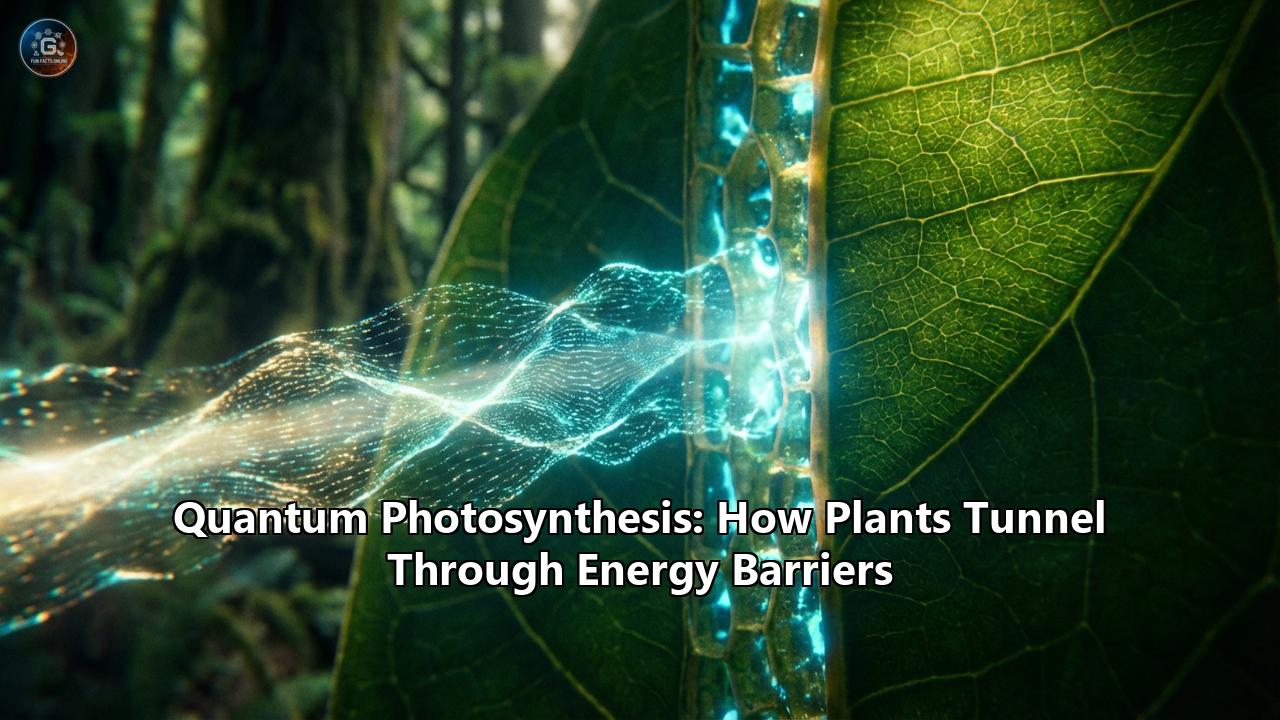
Prologue: The Impossible Journey
Consider a single photon. Born in the roiling nuclear furnace of the sun, it spends a million years fighting its way from the core to the surface, a chaotic pinball game of absorption and re-emission. Finally free, it screams across the vacuum of space for eight minutes, dodging dust and debris, until it strikes the upper atmosphere of Earth. It filters through the nitrogen and oxygen, survives the scattering of the clouds, and impacts a green leaf fluttering in a forest canopy.
This is where the story should end—classically speaking. The photon strikes a chlorophyll molecule, exciting an electron. This packet of energy, an exciton, must now navigate a labyrinth of proteins to reach the "reaction center"—the cellular battery where light becomes life. In the warm, wet, chaotic environment of a living cell, this energy should simply dissipate as heat. The exciton should bounce around randomly, getting lost or cooling down before it finds its target. The efficiency of this transfer should be low.
But it isn't. The efficiency is nearly 100%.
For decades, this "quantum efficiency" was a biological mystery that classical physics couldn't solve. Today, we know the answer lies in a realm that was once thought to be impossible in the messiness of life: the subatomic world of quantum mechanics. Plants are not just biological machines; they are quantum computers. They do not merely absorb light; they tunnel through the very barriers of thermodynamics, utilizing the ghostly states of superposition and entanglement to feed the world.
Part I: The Green Engine and the Efficiency Paradox
To understand why quantum effects are necessary, we must first look at the machinery of photosynthesis through the lens of classical biology.
The Architecture of Light HarvestingPhotosynthesis does not happen in a vacuum. It occurs within complex protein scaffolds called photosystems, embedded in the thylakoid membranes of chloroplasts. These systems are analogous to a satellite dish. The dish itself is the "Antenna Complex" (or Light-Harvesting Complex, LHC), composed of hundreds of pigment molecules—chlorophylls, carotenoids, and bilins—held in precise geometric arrangements by a protein skeleton.
When a photon hits a pigment in the antenna, it doesn't physically move to the center. Instead, it creates an exciton—a mobile state of excitation energy. This exciton must travel from the outer rim of the antenna to the central "Reaction Center" (RC). Once at the RC, the energy is used to strip an electron from a donor molecule (ultimately water), starting the chain reaction that produces ATP and sugar.
The Random Walk ProblemIn a classical view, the exciton moves via "Förster Resonance Energy Transfer" (FRET). Imagine a person (the energy) hopping from stone to stone (pigments) across a river. If the person hops randomly—forward, backward, left, right—they are performing a "random walk." In a large antenna complex with hundreds of pigments, a random walk is inefficient. The energy might hop in circles, get stuck in a "trap" (a low-energy pigment that isn't the reaction center), or simply decay as heat before it ever reaches the destination.
Given the speed of energy decay (nanoseconds), a random walk would result in a significant loss of solar energy. Yet, experiments consistently show that in the primary stage of photosynthesis—the transfer from antenna to reaction center—the quantum efficiency is almost perfect. Nearly every photon that is absorbed triggers an electron transfer.
Classical hopping could not explain this speed and precision. Nature had to be using a shortcut.
Part II: The Quantum Revolution in Biology
For most of the 20th century, physicists and biologists stayed in their lanes. Quantum mechanics was for the isolated, frozen, vacuum-sealed world of subatomic particles. Biology was for the warm, wet, massive world of cells and organisms. The prevailing wisdom was that "thermal noise"—the chaotic jiggling of atoms at physiological temperatures—would instantly destroy any delicate quantum states like superposition.
Schrödinger’s PredictionIn 1944, Nobel laureate Erwin Schrödinger wrote a seminal book, What is Life? He speculated that at the molecular level, living systems must rely on order maintained by quantum laws to resist the chaos of the second law of thermodynamics. It took 60 years for experimental evidence to catch up with his intuition.
The Engel Experiment (2007)The turning point came in 2007, with a paper published in Nature by Greg Engel and his team. They were studying the Fenna-Matthews-Olson (FMO) complex, a light-harvesting structure in green sulfur bacteria. Using a technique called "2D Electronic Spectroscopy" (which shoots femtosecond laser pulses to map energy flow), they observed something impossible.
They saw "quantum beats."
The signals oscillating in the data indicated that the energy wasn't hopping from pigment A to pigment B. It was in both places at the same time. The exciton was in a state of quantum superposition.
Part III: Coherence — The Superhighway
The concept of "coherence" is the heart of quantum photosynthesis. It is the mechanism that allows plants to bypass the "energy barriers" of space and time that would hinder a classical particle.
The Wave FunctionIn quantum mechanics, a particle is described by a wave function. When the wave function is "coherent," the waves are in sync, maintaining a phase relationship. In the FMO complex, the exciton acts not like a particle hopping, but like a wave washing over the entire complex.
Imagine a maze.
- Classical approach: You run down a corridor, hit a wall, turn back, try another path. You eventually find the exit, but it takes time and energy.
- Quantum approach: You turn into a mist. You float down every corridor simultaneously. The paths that hit walls cancel out (destructive interference), while the path that leads to the exit amplifies (constructive interference). You find the exit instantly.
This is what the exciton does. By existing in a superposition of all possible paths through the protein scaffold, it "computes" the most efficient route to the reaction center. It doesn't climb over energy barriers; it samples the landscape and flows through the path of least resistance.
The "Qx" BridgeRecent research (2024-2025) has added a new layer to this map. Scientists have identified the role of the "Qx" state in chlorophyll—a fleeting excited state that was previously thought to be irrelevant. We now understand that Qx acts as a quantum bridge, facilitating an almost loss-free transition between different energy levels within the molecule. This state exists for less than 30 femtoseconds, yet it is crucial for directing the "traffic" of energy with pinpoint accuracy, preventing backflow and ensuring the exciton moves strictly toward the reaction center.
Part IV: Tunneling — The Ghost in the Machine
While coherence explains how energy travels to the reaction center, Quantum Tunneling explains what happens once it gets there, and how the machinery of life operates at the atomic limit.
Tunneling is the phenomenon where a particle passes through a solid barrier that it effectively shouldn't have the energy to cross. Imagine rolling a ball up a hill. If you don't roll it hard enough, it rolls back. In the quantum world, the ball can disappear at the bottom and reappear on the other side of the hill, having "tunneled" through it.
1. Electron Tunneling in the Reaction CenterOnce the solar energy reaches the reaction center, it must perform "charge separation." It knocks an electron off a "Special Pair" of chlorophyll molecules. This electron must then move away rapidly to prevent it from falling back into the hole it left (recombination), which would waste the energy.
This electron transfer is a tunneling event. The electron instantly teleports across the gap between the chlorophyll and the next acceptor molecule (pheophytin or quinone). This process is described by Marcus Theory, but at its core, it relies on the electron's wave-like ability to exist on both sides of the energy barrier.
- Evidence: The rate of this electron transfer is temperature-independent in cryogenic conditions. Classical chemical reactions slow down when cold because molecules have less energy to climb barriers. Tunneling, however, depends only on the width of the barrier and the mass of the particle. The fact that photosynthesis still works at 4 Kelvin is proof that electrons are tunneling, not climbing.
It’s not just electrons. The enzymes involved in the later stages of photosynthesis (and respiration), specifically in the splitting of water, rely on the movement of protons (hydrogen ions). Protons are 2000 times heavier than electrons, so they tunnel less easily, yet evidence suggests that in specific "transition states," protons tunnel through activation barriers to speed up the reaction rates by factors of a million. Without tunneling, the enzymes that power life would be too slow to sustain us.
Part V: The "Warm, Wet" Problem and Vibronic Coupling
This brings us to the greatest controversy and the most elegant solution in quantum biology: Decoherence.
Quantum states are fragile. In a quantum computer, we must cool the chips to near absolute zero to prevent heat (vibration) from scrambling the qubits. A leaf is hot (300 Kelvin) and chaotic. How can quantum coherence last long enough (picoseconds) to be useful?
The Goldilocks PrincipleFor years, skeptics argued that the "beats" seen in the Engel experiment were just molecular vibrations, not electronic quantum states. The debate was fierce. However, the consensus has shifted to a beautiful middle ground known as Vibronic Coupling.
It turns out, the "noise" of the environment is not a bug; it's a feature.
- If the system were perfectly quiet (too cold), the exciton might get stuck in a "local minimum"—a single pigment that is slightly lower in energy than its neighbors but isn't the reaction center. It would be trapped in a mismatch of energy levels (Anderson Localization).
- If the system is too noisy, coherence is lost instantly.
Nature has evolved the protein scaffold to vibrate at specific frequencies that match the energy gaps between the pigments. These vibrations (phonons) shake the pigments just enough to bridge the energy differences, allowing the exciton to maintain coherence and flow smoothly. The protein "tunes" the noise to resonate with the quantum states. This is environmentally assisted quantum transport. The plant uses the chaos of heat to drive the efficiency of the order.
Part VI: Evolution and the Quantum Advantage
Why did nature go to the trouble of evolving quantum machinery?
1. The Low-Light EdgeGreen sulfur bacteria, the subjects of the original FMO experiments, live at the very bottom of the ocean, near hydrothermal vents. They receive almost no light—perhaps a few photons per minute. If they relied on classical "random walk" energy transfer, they would starve. They cannot afford to lose a single photon. Quantum coherence allows them to squeeze 100% efficiency out of a scarce resource.
2. Speed vs. DeathIn bright sunlight, the problem is different. An excited electron that hangs around too long becomes a "free radical," reacting with oxygen to destroy the cell (photo-inhibition). The speed of quantum tunneling and coherent transfer ensures the energy is processed faster than it can cause damage. Quantum mechanics is a safety mechanism.
3. Redox TuningRecent studies on cysteine residues in the FMO complex show that the protein can physically change shape based on the presence of oxygen (redox potential). This shape change "detunes" the quantum coherence, shutting down the energy highway when there is too much light, effectively creating a "quantum fuse" to protect the system.
Part VII: Beyond Plants – The Quantum Biological Universe
The discovery of quantum photosynthesis was the domino that toppled the wall. We now see quantum tunneling and coherence everywhere in biology:
- Avian Navigation: European Robins navigate migration routes using the Earth's magnetic field. The sensor is believed to be a protein called cryptochrome in the eye. A photon hits the protein, creating a "radical pair" of entangled electrons. The way these electrons tunnel and spin depends on the angle of the magnetic field, allowing the bird to "see" magnetic lines.
- Olfaction (Smell): The "Vibration Theory of Olfaction" suggests our nose doesn't just detect the shape of molecules (lock and key) but their vibration. Electrons tunnel across the odorant molecule, measuring its vibrational frequency. This explains why we can smell the difference between isotopes (molecules that are identical in shape but different in mass).
- Enzymatic Catalysis: Almost all enzymes may utilize proton tunneling to lower activation energy barriers, essentially allowing life to run chemical reactions at body temperature that would otherwise require a blowtorch.
Part VIII: Biomimetics – Designing the Future
If a leaf is a quantum machine, can we build one?
Quantum Solar CellsCurrent commercial solar panels (silicon) have an efficiency limit of around 20-25%. They rely on classical physics: a photon knocks an electron loose, and we hope to catch it.
Taking inspiration from the "vibronic coupling" of plants, scientists are designing Quantum Dot Photovoltaics. These materials are engineered to support long-lived coherence, allowing the excitation energy to flow to the collection wire without heat loss. By mimicking the specific vibrational frequencies of the protein scaffold, we can build solar cells that work efficiently even in diffuse light or high temperatures.
Room-Temperature Quantum ComputingThe Holy Grail of computing is a quantum processor that works at room temperature. Plants have solved this. They don't use vacuum pumps or liquid helium. They use "noisy" environments to their advantage. Analyzing the "dissipation-assisted transport" of photosynthesis is providing blueprints for quantum computer architectures that are robust against noise (decoherence-free subspaces).
Artificial PhotosynthesisWe are moving toward "bionic leaves"—artificial systems that split water into hydrogen fuel using sunlight. The efficiency of these systems depends entirely on optimizing the charge separation step. By engineering catalysts that maximize electron tunneling rates (optimizing the "Marcus Inverted Region"), we can create fuel directly from the sun with the efficiency of a bacteria.
Conclusion: The Quantum Vitalism
The study of quantum photosynthesis has fundamentally changed our understanding of life. We used to view life as "stuff that fights thermodynamics." We thought biology was macroscopic and messy, while physics was microscopic and pristine.
We now know that the distinction is an illusion. Life is not separate from the quantum world; it is built upon it. A blade of grass is a piece of nanotechnology far more advanced than anything in Silicon Valley, capable of manipulating the fundamental probabilities of the universe to capture a star.
When you walk outside and feel the warmth of the sun, look at a green leaf. You are not just looking at biology. You are witnessing a billions-of-years-old quantum computation, tunneling through the barriers of space and energy, weaving light into life in the quiet hum of a quantum superposition.
Reference:
- https://www.esalq.usp.br/lepse/imgs/conteudo_thumb/How-does-quantum-tunneling-work-in-photosynthesis.pdf
- https://www.ovid.com/journals/natr/abstract/10.1038/474272a~physics-of-life-the-dawn-of-quantum-biology?redirectionsource=fulltextview
- https://arxiv.org/pdf/2103.07457
- https://pmc.ncbi.nlm.nih.gov/articles/PMC6283985/
- https://www.cmdsonline.org/wp-content/uploads/2021/02/Greg-Engel-CMDS-Virtual-Talk.pdf
- https://pmc.ncbi.nlm.nih.gov/articles/PMC8670468/
- https://www.discovermagazine.com/physicists-see-quantum-effects-in-photosynthesis-37516
- https://news.uchicago.edu/story/design-principles-quantum-biology-could-open-path-new-solar-technology
- https://thedebrief.org/new-study-reveals-hidden-role-of-quantum-mechanics-in-photosynthesis-a-potential-breakthrough-for-clean-energy/
- https://pmc.ncbi.nlm.nih.gov/articles/PMC10399179/
- https://triphasictraining.com/quantum-tunneling-from-cells-to-systems-in-high-performance/
- https://www.youtube.com/watch?v=btc6_HdljJo