
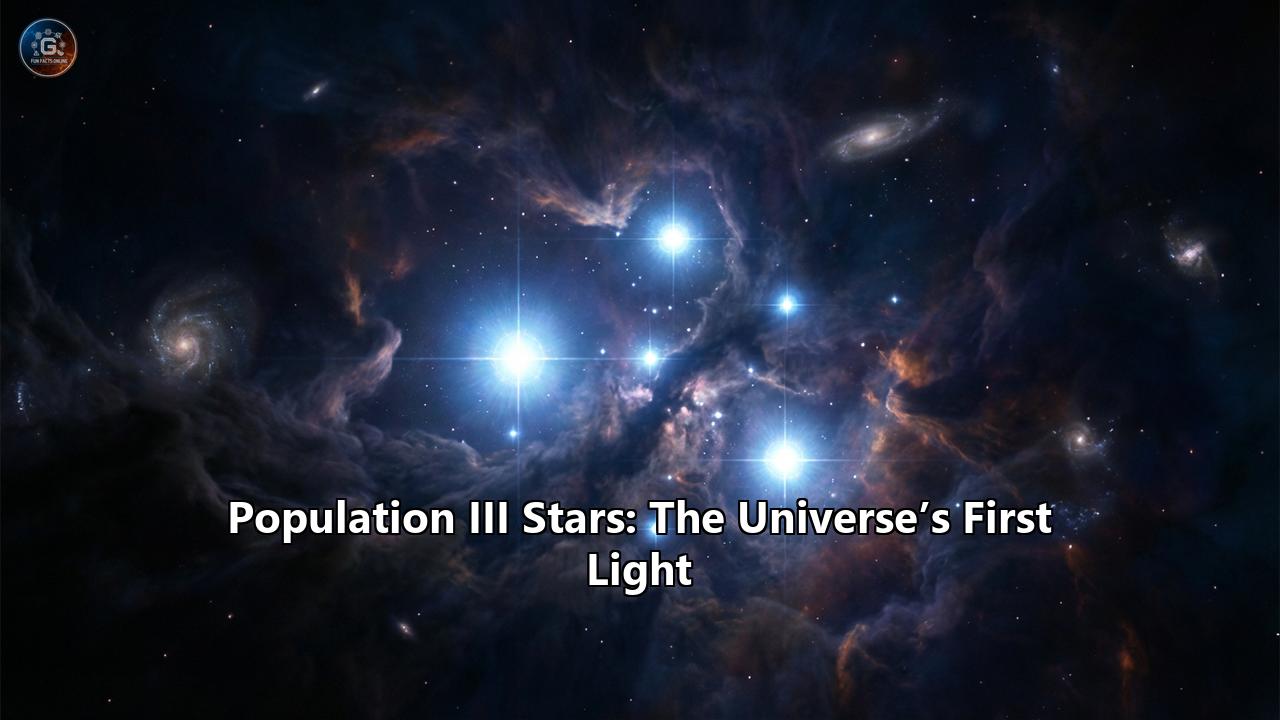
The Universe’s first stars—known as Population III stars—are the "holy grail" of modern astrophysics. Hypothetical for decades, these primordial giants are the bridge between the Big Bang’s smooth, dark aftermath and the complex, light-filled cosmos we inhabit today.
Writing from the perspective of late 2025, following a year of breakthrough candidates from the James Webb Space Telescope (JWST), here is a comprehensive guide to the first generation of stars.
The Cosmic Dawn: Awakening the Universe
For the first 100 to 200 million years after the Big Bang, the universe was pitch black. This era, known as the Cosmic Dark Ages, was dominated by a "fog" of neutral hydrogen gas. There were no galaxies, no quasars, and no light—only the invisible pull of dark matter slowly shepherding gas into the first clumps.
Population III (Pop III) stars were the spark that ended this darkness. They did not just light up the universe; they fundamentally broke it and rebuilt it. Their intense ultraviolet radiation burned through the neutral hydrogen fog, initiating the Epoch of Reionization, while their violent deaths seeded the cosmos with the first heavy elements—carbon, oxygen, iron—that would eventually make up planets and life.
Why "Population III"?
The naming convention is counterintuitive, a relic of stellar archaeology:
- Population I (Pop I): Young, metal-rich stars like our Sun.
- Population II (Pop II): Old, metal-poor stars found in galactic halos and globular clusters.
- Population III (Pop III): The first generation. Composed entirely of primordial hydrogen and helium (with traces of lithium), they had zero metallicity.
The Physics of Primordial Formation
Star formation today is driven by dust and heavy elements, which cool gas clouds by radiating away heat, allowing them to collapse. Pop III stars didn't have this luxury.
- H2 Cooling: In the absence of dust, the only way for primordial gas to cool was through molecular hydrogen (H2). This process is incredibly inefficient compared to modern dust cooling.
- Minihalos: Formation occurred in small dark matter pockets called "minihalos" ($10^5$ to $10^6$ solar masses).
- The Result: To overcome thermal pressure without dust, Pop III stars had to be massive. While the Sun formed from a relatively small clump, Pop III stars are predicted to have been monsters, ranging from 10 to 500 solar masses, with surface temperatures reaching 100,000 Kelvin (compared to the Sun’s 5,800 K).
The "Dark Star" Hypothesis: A 2024–2025 Plot Twist
Recent observations have reignited interest in a fascinating sub-theory: Dark Stars.
Standard models assume Pop III stars were powered by nuclear fusion. However, in the ultra-dense centers of early minihalos, Dark Matter density was immense. If dark matter consists of WIMPs (Weakly Interacting Massive Particles), they would be their own antiparticles.
- The Mechanism: As gas collapsed, WIMPs would annihilate inside the protostar, providing a heat source before fusion could ignite.
- The "Fluffy" Giant: This dark matter heating would prevent the star from collapsing down to a fusion core, keeping it puffy and cool (surface temp ~10,000 K) but titanic in size—potentially 10 AU across (the size of Saturn’s orbit) and weighing up to 1 million solar masses.
- Observational Status: In 2024 and 2025, candidates like JADES-GS-z14-0 showed spectral features (such as a specific helium absorption dip at 1640 Angstroms) that fit the "Dark Star" profile better than standard galaxy models. If confirmed, these would not just be the first stars, but a new state of matter entirely.
Chemical Archaeology: Finding the Fingerprints
Since Pop III stars lived fast and died young (within 2–5 million years), none are expected to survive to the present day (unless they are low-mass survivors, which is debated). Instead, astronomers hunt for their "ghosts" in the chemistry of the next generation.
1. The "Odd-Even" Effect
When massive Pop III stars exploded as Pair-Instability Supernovae (PISN)—a cataclysmic event where the entire star is blown apart with no remnant—they created a very specific ratio of elements. They produced huge amounts of "even" atomic number elements (Sulfur, Silicon, Argon) but very little of the "odd" elements (Sodium, Aluminum, Phosphorus). Finding a star today with this "odd-even" imbalance is considered a smoking gun of Pop III ancestry.
2. CEMP-no Stars
The most reliable fossil records are Carbon-Enhanced Metal-Poor (CEMP) stars, specifically a subclass called CEMP-no (no heavy neutron-capture elements like Barium).
- The Theory: A massive Pop III star explodes, ejecting carbon and iron but locking away heavier metals. A nearby small gas cloud is polluted by this debris and forms a low-mass star.
- The Evidence: That low-mass star, still alive in our Milky Way halo today, carries the chemical DNA of its Pop III parent. These are the stars astronomers study in the "stellar archaeology" surveys.
The New Frontier: Discoveries in the JWST Era
The James Webb Space Telescope was built specifically to find the "First Light." As of late 2025, we are tantalizingly close to a confirmed direct detection.
The LAP1-B Candidate (2025)
One of the most discussed targets this year is the star cluster in the lensed galaxy LAP1-B.
- The Signal: JWST detected an incredibly strong HeII 1640 emission line—a signature of helium being ionized by something hotter than 80,000 degrees.
- The Implication: Normal stars can't get this hot. Only Wolf-Rayet stars (which have metal lines, absent here) or Pop III stars can produce this hard UV radiation.
- Nebular Gas Outshining Stars: In these candidates, we don't see the stars themselves; we see the surrounding gas cloud glowing brilliantly, energized by the hidden Pop III cluster.
GN-z11 and "Pristine" Pockets
The galaxy GN-z11, once the distance record holder, has shown regions of remarkably low metallicity. It suggests that Pop III star formation wasn't a single "event" but a process that continued in pockets of pristine gas even as other parts of the universe became enriched.
The Final Fate: Black Hole Seeds
What did Pop III stars leave behind?
- Black Holes: Stars between 40–140 solar masses likely collapsed directly into black holes.
- PISN: Stars between 140–260 solar masses exploded completely, leaving nothing.
- Direct Collapse Black Holes (DCBH): In rare cases where a Pop III star's formation was suppressed by radiation from a neighbor, the gas cloud might have collapsed directly into a massive black hole ($10^5 M_\odot$).
These remnants are the "seeds" that grew into the Supermassive Black Holes (quasars) we see dominating the universe less than a billion years later. We are not just studying the first stars; we are studying the ancestors of the monsters at the center of every modern galaxy.
Summary of Key Stats
| Feature | Population III | Population I (Modern) |
| :--- | :--- | :--- |
| Composition | H, He, trace Li (Zero Metal) | H, He, 2-4% Metals |
| Typical Mass | 10 – 1000 $M_\odot$ | 0.1 – 100 $M_\odot$ |
| Lifespan | ~2–5 Million Years | Billions of Years |
| Cooling | H2 (inefficient) | Dust/CO (efficient) |
| Primary Death | Pair-Instability Supernova / Black Hole | Core-Collapse Supernova / White Dwarf |
The hunt for Population III stars is no longer just theory. With the data arriving from high-redshift surveys, we are finally reading the first chapter of our cosmic history.
Reference:
- https://arxiv.org/pdf/2302.10210
- https://academic.oup.com/mnras/article/502/1/1/6061376
- https://academic.oup.com/mnras/article/526/3/4467/7291941
- https://pirsa.org/17050095
- https://astronomy.stackexchange.com/questions/50205/do-pop-iii-stars-undergo-supernova-or-direct-collapse
- https://en.wikipedia.org/wiki/Direct_collapse_black_hole
- https://www.port.ac.uk/news-events-and-blogs/news/astronomers-find-first-direct-evidence-of-monster-stars-from-the-cosmic-dawn
- https://jila.colorado.edu/news-events/articles/seeds-creation-monster-stars-or-quasistars