
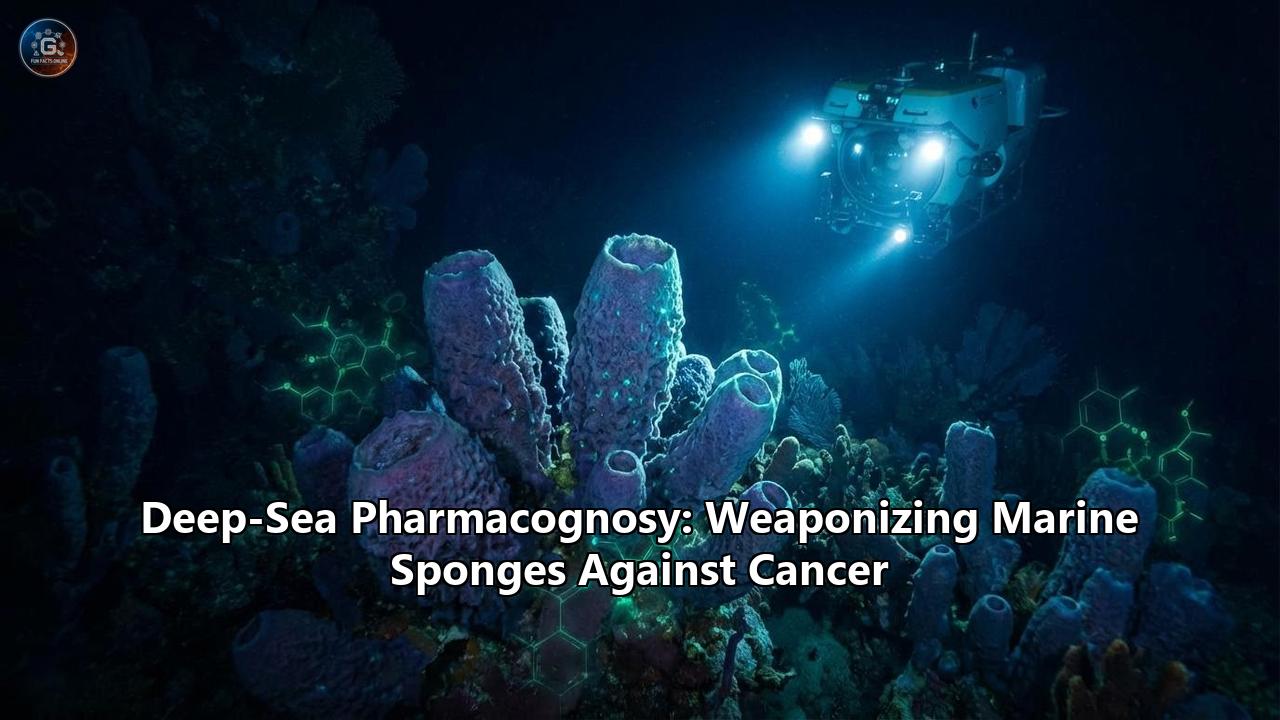
Imagine plunging into the abyssal depths of the ocean, a realm devoid of sunlight, subjected to crushing pressures, and seemingly inhospitable to life. Yet, in this alien and quiet landscape, a silent, invisible war has been raging for hundreds of millions of years. This is the theater of deep-sea pharmacognosy, a cutting-edge scientific frontier where researchers are prospecting the ocean's darkest corners for the next generation of life-saving medicines. At the center of this medical revolution sits an unlikely hero: the marine sponge. Simple, brainless, and permanently anchored to the sea floor, these ancient organisms have evolved into some of the most prolific biochemical factories on the planet. Today, the potent chemical weapons they use to survive their brutal environment are being harnessed by human science to fight one of humanity's most relentless adversaries—cancer.
To understand why marine sponges (phylum Porifera) are an unparalleled treasure trove of anti-cancer compounds, we must look at their evolutionary biology. Sponges are some of the oldest multicellular organisms on Earth, having first appeared over 600 million years ago. Unlike many marine animals, sponges are sessile invertebrates; they lack an innate immune system, armor, shells, or the ability to flee from predators. To survive in densely populated, highly competitive ecosystems like shallow coral reefs and deep-sea vents, they had to develop a different kind of defense mechanism: chemical warfare.
Over eons of an evolutionary arms race, sponges have developed the ability to synthesize an astonishing array of secondary metabolites. These are complex organic molecules specifically designed to deter predators, fight off pathogenic microbes and viruses, and prevent other organisms from encroaching on their physical territory. Furthermore, a marine sponge is not just a single organism but a complex "holobiont." A significant portion of a sponge's biomass is made up of symbiotic bacteria, fungi, and archaea. This rich microbiome acts in concert with the sponge to produce highly toxic, biologically active compounds. What is toxic to a predatory sea slug or a competing coral often turns out to be extraordinarily effective at disrupting the uncontrolled cellular replication that characterizes human cancer.
Today, over 5,300 different known metabolites have been isolated from sponges and their associated microorganisms, contributing to roughly 30% of all marine natural products discovered to date. Because the marine environment is so vastly different from the terrestrial world—characterized by high salinity, extreme pressure, and low oxygen—the chemical structures of these marine metabolites are wholly unique. They offer molecular blueprints that terrestrial botanists and laboratory chemists could never have dreamed up.
The story of marine pharmacognosy began in the 1950s in the shallow waters of the Caribbean. Researchers Werner Bergmann and Robert Feeney extracted unusual nucleosides from the sponge Tethya crypta. These compounds eventually led to the development of Cytarabine (Ara-C), a cornerstone chemotherapy drug used to treat acute myeloid leukemia, as well as the antiviral medication Vidarabine, and even paved the way for AZT, a breakthrough drug for HIV. This monumental discovery proved that the ocean was a viable pharmacy. However, it took decades for deep-sea exploration technologies—like remotely operated vehicles (ROVs) and advanced scuba systems—to catch up and unlock the true potential of the deep ocean. As scientists ventured deeper, they discovered that the compounds grew more complex and vastly more potent. Deep-water sponges, living in extreme conditions, yield metabolites with extraordinarily high cytotoxicity (the ability to kill cells), which is precisely what oncologists look for when hunting for new chemotherapies.
No discussion of marine pharmacognosy is complete without the fascinating tale of Halichondria okadai, a sponge found off the coast of Japan. In 1985, researchers Hirata and Uemura isolated a highly complex macrocyclic polyether from this sponge, which they named halichondrin B. In laboratory tests, halichondrin B demonstrated exceptionally potent cytotoxicity against murine melanoma and leukemia cells. However, this miraculous discovery presented a massive logistical nightmare. The concentration of halichondrin B in the wild sponge was infinitesimally small. To harvest enough of the natural compound to treat even a single patient, let alone conduct global clinical trials, would require harvesting tons of marine sponges, threatening marine ecosystems with ecological devastation. The compound's molecular structure was also notoriously complex, possessing a massive molecular weight that made it a "Mount Everest" for synthetic chemists.
The breakthrough came in 1998 when Dr. Yoshito Kishi and his team at Harvard University achieved the total chemical synthesis of a halichondrin B analog. They discovered that the molecule's potent cancer-killing ability resided in its macrocyclic lactone C1-C38 moiety. By cleaving away the unnecessary parts of the parent molecule, they created a simplified, synthetically viable analog known as eribulin mesylate.
In 2010, the U.S. Food and Drug Administration (FDA) officially approved eribulin (marketed as Halaven) for the treatment of metastatic breast cancer in patients who had previously received anthracycline- and taxane-based therapies. Its approval was later expanded to treat advanced liposarcoma, offering a life-saving option for patients with soft tissue tumors. Eribulin’s mechanism of action is a marvel of microscopic engineering. Cancer cells multiply through a process called mitosis, which relies on the continuous assembly and disassembly of internal cellular structures called microtubules. Think of microtubules as tiny, dynamic scaffolding or springs that pull the dividing cell apart. Eribulin binds specifically to the "plus end" of these growing microtubules, freezing them in place. Without the ability to complete mitosis, the cancer cell is thrown into prolonged mitotic blockage and ultimately triggers its own programmed self-destruct mechanism, a process known as apoptosis. Furthermore, recent studies have revealed that eribulin is not just a cytotoxic killer; it also possesses immunomodulatory properties. It can actively reprogram the tumor microenvironment and promote the infiltration of cancer-killing immune cells into the tumor.
While eribulin is the most famous success story, it is just the tip of the iceberg. Marine sponges produce an astonishing diversity of chemical classes, including alkaloids, terpenoids, polyketides, macrolides, and cyclic peptides. Researchers are actively building a rich pipeline of experimental drugs derived from these deep-sea sentinels.
Collected from a deep-water marine sponge off the coast of Fort Lauderdale, Florida, by scientists at the Harbor Branch Oceanographic Institute, a compound called leiodermatolide is proving to be a highly potent natural product. Research has demonstrated that extremely low concentrations of this compound can induce programmed cell death in pancreatic cancer cells. Pancreatic cancer is notoriously aggressive and highly resistant to traditional therapies, with patients often facing a survival rate of less than seven percent within five years of diagnosis, making this discovery particularly critical. In in vivo studies, leiodermatolide has successfully reduced pancreatic tumor size, and it also exhibits inhibitory effects on metastatic melanoma, colon cancer, lymphoma, and glioblastoma (a deadly form of brain cancer).
Another powerful compound, discodermolide, found in deep-sea sponges of the genus Discodermia, is an incredibly potent immunosuppressive and anti-cancer agent. Like eribulin, it targets the microtubule network of cancer cells, but it acts by hyper-stabilizing the microtubules rather than preventing their growth, leading to immediate cell cycle arrest and proving highly effective against breast cancer models.
In a collaborative research initiative in Toulouse, scientists recently engineered a new generation of anti-cancer agents inspired by polyacetylenic lipids found in the marine sponge Petrosia. In the wild, these lipids harbor a unique toxic activity. By synthesizing over 150 analogs, researchers developed a compound 1,000 times more cytotoxic than the natural sponge product. The brilliance of this compound lies in its "enantiospecific bioactivation." The lipids remain relatively harmless until they encounter a specific cellular enzyme that is overexpressed in certain cancer cells. Once bioactivated by the tumor's own enzymes, the lipids transform into highly reactive species that attach to essential proteins, disrupting the cancer cell's function and triggering targeted cell death.
Other promising sponge derivatives include makaluvamines, which are alkaloids derived from the marine sponge Zyzzya that have demonstrated promising cytotoxic activity against colon and breast cancer cell lines by inhibiting tumor growth. Meanwhile, agelasine B, a toxin isolated from the Agelas clathrodes sponge, effectively targets breast and prostate cancer cells. It works by forcing the release of calcium ions from the endoplasmic reticulum, which initiates DNA fragmentation and apoptosis within the malignant cells. Localized environments are also yielding global solutions. Off the coast of Western Australia, marine chemists exploring the artificial reefs beneath the Busselton Jetty are screening over 20 species of marine sponges. Compounds like Phorboxazole A, discovered in these regional sponges, have exhibited exceptionally high biological activity against cancer cells.
The true value of marine sponge compounds lies not just in their ability to kill cancer, but in how they do it. Cancers are notorious for developing resistance to standard chemotherapies, which is why oncologists desperately need drugs with novel mechanisms of action. Sponge-derived compounds interact with molecular targets that terrestrial drugs often miss. Over 60 compounds obtained from sea sponges have demonstrated the ability to directly induce apoptosis in tumor cells. They achieve this by dysregulating the mitochondrial pathway, activating executioner caspases, or upregulating death-signaling receptors on the cell surface. By directly triggering apoptosis, these compounds bypass many of the common resistance mechanisms that tumors use to survive and reduce overall drug toxicity. Many sponge metabolites also inhibit Nuclear Factor-kappa B (NF-kB), a protein complex that controls DNA transcription and is frequently hyperactive in cancer, driving inflammation and tumor survival. Others target Hypoxia-Inducible Factor-1 (HIF-1), preventing tumors from adapting to low-oxygen environments, or inhibit P-glycoprotein, a cellular "pump" that cancer cells use to eject chemotherapy drugs. By jamming these pumps, sponge-derived molecules can chemosensitize cancer cells, making them vulnerable to traditional therapies once again.
Despite the staggering potential of deep-sea pharmacognosy, the journey from ocean floor to pharmacy shelf is fraught with monumental challenges. The most glaring obstacle is the "supply problem". The concentration of active metabolites in marine sponges is usually vanishingly low. Harvesting wild sponges for global drug production is ecologically disastrous and entirely unsustainable. To bypass this roadblock, science has turned to chemical synthesis, as pioneered by the creators of eribulin. However, many sponge molecules possess such intense stereochemical complexity that they are prohibitively expensive to synthesize from scratch.
Enter the era of synthetic biology and molecular aquaculture. Because many of these bioactive compounds are actually produced by the symbiotic bacteria living inside the sponge, scientists are developing techniques to sequence the microbiomes of these sponges. By identifying the specific gene clusters responsible for synthesizing the anti-cancer compound, researchers can extract that DNA and insert it into easily cultivable laboratory bacteria. This process, known as heterologous expression, effectively turns vats of lab bacteria into microscopic factories that pump out sponge medicine, leaving the wild sponges untouched on the ocean floor. Alternatively, marine biologists are pioneering sponge aquaculture—growing fragments of high-yield sponges in controlled, artificial marine environments to ensure a renewable supply of biomass.
The cruel irony of deep-sea pharmacognosy is that just as we are beginning to decode the life-saving secrets of marine sponges, human activity is threatening to wipe them out. Sponges are highly sensitive to changes in their environment. Ocean warming, driven by climate change, has already triggered mass mortality events among sponge populations in the Mediterranean and the Caribbean. Terrestrial runoff containing agricultural pollutants and new strains of bacteria can decimate sponge populations, altering their delicate microbiomes and halting the production of the very chemical compounds we seek to harvest. When a species of deep-sea sponge goes extinct, it takes its unique chemical library with it. If we do not actively protect marine biodiversity, the next cure for pancreatic cancer, leukemia, or triple-negative breast cancer could be lost forever before it is even discovered.
The integration of marine biology, synthetic chemistry, and oncology has birthed a golden age of drug discovery. As remotely operated vehicles map the abyssal plains and artificial intelligence algorithms rapidly screen marine extract libraries for bioactivity, the pace of discovery is accelerating exponentially. We are moving beyond brute-force cytotoxic chemotherapy toward highly targeted, bio-inspired smart drugs. Currently, numerous sponge-derived compounds and their synthetic analogs are advancing through pre-clinical and clinical trials. Researchers are also investigating targeted drug delivery systems—such as liposomal encapsulation—that could deliver these highly toxic sponge metabolites directly to the tumor site, minimizing collateral damage to healthy human tissue.
The transition of a defense chemical from a stationary, brainless organism at the bottom of the sea to an FDA-approved infusion saving a patient’s life is one of the most profound testaments to the interconnectedness of life on Earth. The deep-sea sponge is no longer just an ecological curiosity; it is a vanguard in the war against cancer. By weaponizing the evolutionary ingenuity of the ocean, science is offering new hope to millions of patients worldwide. Yet, this pharmaceutical bounty comes with a profound responsibility. The ocean is not just an infinite resource to be exploited; it is a fragile sanctuary that must be preserved. The future of human medicine may very well depend on the health of our deep seas.
Reference:
- https://www.nhm.ac.uk/discover/can-sponges-cure-cancer.html
- https://pmc.ncbi.nlm.nih.gov/articles/PMC5666418/
- https://pubmed.ncbi.nlm.nih.gov/29027954/
- https://www.eurekalert.org/news-releases/707801
- https://www.mdpi.com/1660-3397/22/3/101
- https://www.tandfonline.com/doi/full/10.1080/10286020.2014.970535
- https://www.ipbs.fr/marine-sponges-inspire-a-new-family-of-anticancer-agents/
- https://busseltonjetty.com.au/news/busselton-jettys-marine-sponges-could-unlock-new-cancer-treatments/
- https://www.researchgate.net/publication/277407950_Anti-Cancer_Products_from_Marine_Sponges_Progress_and_Promise
- https://pmc.ncbi.nlm.nih.gov/articles/PMC3961871/
- https://taylorandfrancis.com/knowledge/Medicine_and_healthcare/Pharmaceutical_medicine/Halichondrin/
- https://www.mdpi.com/1660-3397/22/9/426
- https://www.researchwithrutgers.com/en/publications/marine-sponge-derived-eribulin-in-preclinical-and-clinical-studie/
- https://www.halaven.com/metastatic-breast-cancer/mbc-blog/blog-post-2
- https://pmc.ncbi.nlm.nih.gov/articles/PMC6356258/