
Introduction: The Silent Arms Race
We are standing on the precipice of a cryptographic collapse. For decades, the digital world has rested on a foundation of mathematical assumptions—specifically, that factoring large prime numbers is too difficult for computers to achieve in a reasonable timeframe. This assumption secures your bank account, protects national secrets, and safeguards the global power grid. But as we move deeper into 2026, that foundation is showing hairline fractures. The rise of "Cryptographically Relevant Quantum Computers" (CRQCs) is no longer a question of if, but when.
The threat is known as "Harvest Now, Decrypt Later" (HNDL). Adversaries are currently scraping petabytes of encrypted traffic—diplomatic cables, intellectual property, financial records—and storing them in massive data centers. They are waiting for the day, perhaps only a few years away, when a sufficiently powerful quantum computer comes online to shatter today’s RSA and ECC encryption in seconds, laying bare the secrets of the past decade.
In response, a quiet but frantic revolution is taking place, not in software, but in hardware. The shield against this quantum sword is Quantum Key Distribution (QKD), a technology that uses the immutable laws of physics, rather than math, to secure data. And crucially, this technology is migrating from the size of a refrigerator to the size of a fingernail.
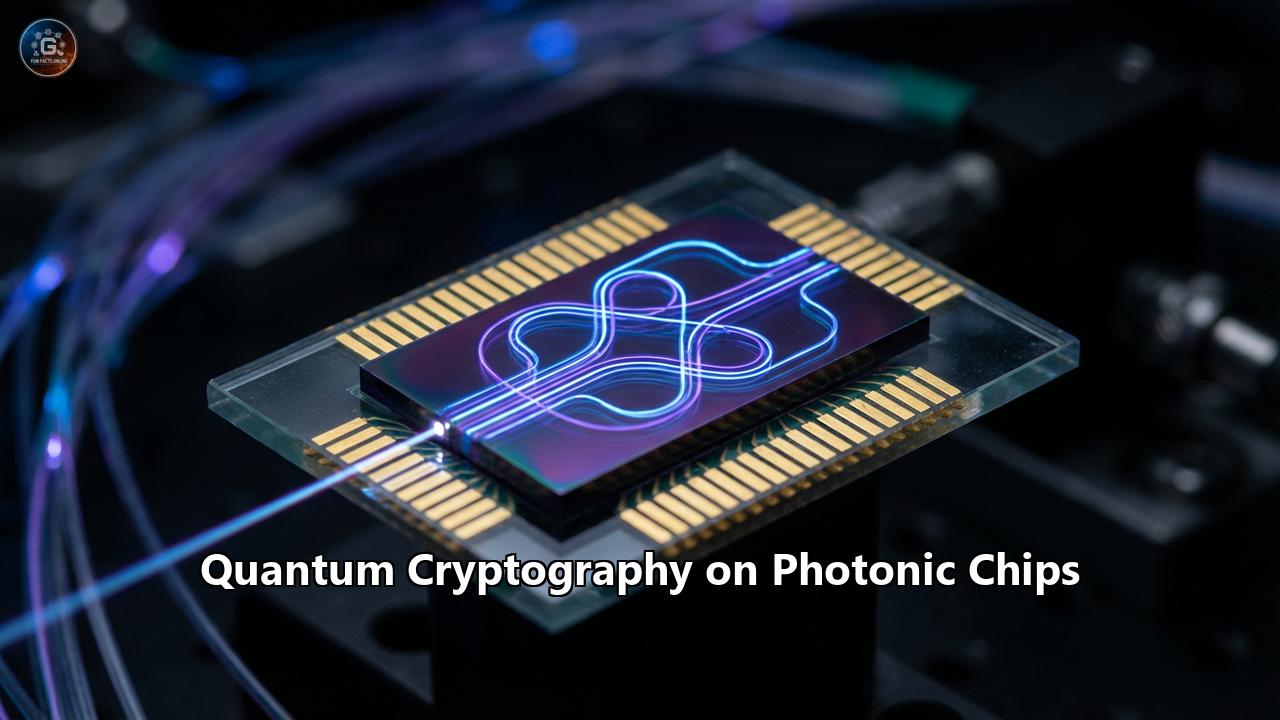
This is the story of Quantum Cryptography on Photonic Chips: the engineering marvel that is shrinking quantum security down to the microscale, making it deployable, affordable, and ubiquitous. From the server racks of Paris to the fiber networks of Tokyo, light-based chips are beginning to weave a new, unbreakable fabric for the internet.
Part 1: The Physics of the Unbreakable
To understand why a chip no larger than a grain of rice can protect a nation’s secrets, we must first understand the physics it harnesses. Classical cryptography relies on complexity; quantum cryptography relies on reality itself.
The Quantum Sentinel: Heisenberg and No-Cloning
At the heart of QKD lies the Heisenberg Uncertainty Principle. In the classical world, you can measure a tennis ball's position and speed without disturbing it. in the quantum world, this is impossible. The act of measurement fundamentally alters the state of the particle.
Imagine Alice wants to send a secret key to Bob. She encodes this key into the quantum states of single photons—particles of light. She might use the polarization of the photon (horizontal vs. vertical) or the time it arrives (early vs. late). If an eavesdropper, Eve, tries to intercept these photons to read the key, she must measure them. Due to the laws of quantum mechanics, her measurement inevitably disturbs the photons, introducing errors into the stream.
Alice and Bob, by comparing a small subset of their data, can detect these errors. If the error rate is above a certain threshold, they know Eve is listening. They discard the key and try again. If the error rate is low, they know the channel is secure, and they can use the shared key to encrypt their message with absolute, mathematically provable secrecy. This is the No-Cloning Theorem in action: you cannot create a perfect copy of an unknown quantum state. Eve cannot "photocopy" the photon and pass the original to Bob; she must destroy the original to read it, leaving her fingerprints on the data stream.
The Protocols: BB84 and E91
While there are many "dialects" of QKD, two primary protocols dominate the landscape, both of which are now being hard-coded into photonic chips.
1. Decoy-State BB84
Proposed in 1984 by Bennett and Brassard, this is the workhorse of the industry. Alice sends photons in one of two "bases" (e.g., rectilinear or diagonal). Bob measures them randomly in one of the two bases. Only when their bases match do they share a bit.
- The Chip Implementation: In modern chips, this is often implemented using "Time-Bin Encoding" rather than polarization, as polarization is easily scrambled in optical fibers. A photon is passed through an interferometer (a split path) on the chip. It can take the "short" path (representing a 0) or the "long" path (representing a 1).
2. E91: The Entanglement Protocol
Proposed by Artur Ekert in 1991, this protocol is the "holy grail" of quantum security. Instead of Alice sending a photon to Bob, a source (which can be untrusted) generates a pair of entangled photons. These twin particles share a spooky connection; measuring one instantly determines the state of the other, no matter the distance.
- The Chip Implementation: An on-chip "Spontaneous Parametric Down-Conversion" (SPDC) source splits a high-energy pump photon into two daughter photons. One goes to Alice, one to Bob. They measure their particles. The security is guaranteed not just by error checking, but by the violation of Bell's Inequalities—a statistical test that proves the correlations are truly quantum and not the result of some hidden variable Eve manipulated. E91 is particularly powerful because it allows for "device-independent" security—even if the chip manufacturer is malicious, the protocol can detect it.
Part 2: The Architecture of Light (Photonic Integrated Circuits)
For decades, QKD systems were bulky optical tables filled with mirrors, lenses, and lasers. They were sensitive to vibration, expensive (costing over $100,000 per link), and impossible to scale. The breakthrough has been the move to Photonic Integrated Circuits (PICs).
Just as electronic integrated circuits (microchips) replaced rooms full of vacuum tubes, PICs print optical components directly onto a wafer. This miniaturization reduces cost, size, and power consumption by orders of magnitude (CSWaP: Cost, Size, Weight, and Power).
The Material Battlegrounds
Different materials are used to build these chips, each with unique superpowers.
1. Silicon Photonics (SiPh)
Silicon is the giant of the industry. Because we can use the same massive foundries that build computer chips (CMOS compatibility), silicon photonics is incredibly cheap and scalable.
- Pros: High refractive index contrast (allows tight bending of light), mature manufacturing ecosystem.
- Cons: Silicon cannot generate light (it has an indirect bandgap). You need to glue a laser onto the chip. It also absorbs light at certain wavelengths.
- Role: The passive "plumbing"—waveguides, splitters, and interferometers.
2. Indium Phosphide (InP)
InP is the "active" powerhouse. Unlike silicon, it can emit light.
- Pros: Can monolithically integrate the laser, modulators, and amplifiers on a single chip.
- Cons: More expensive and brittle than silicon.
- Role: The engine—generating the photons and high-speed pulses.
3. Lithium Niobate (LiNbO3)
The rising star. Thin-film Lithium Niobate (TFLN) offers superior electro-optic properties.
- Pros: Extremely fast modulation (changing the photon's state). It changes its refractive index instantly when a voltage is applied, allowing for ultra-fast encoding of keys.
- Role: The high-speed "writer" of the quantum information.
Anatomy of a QKD Chip
Let’s take a "Fantastic Voyage" style tour inside a typical 2026-era QKD transmitter chip.
- The Source (The Heart): An external or bonded InP laser fires a continuous beam of light at 1550nm (the standard telecom wavelength).
- The Pulse Carver (The Gate): A Mach-Zehnder Modulator (MZM) slices this continuous beam into faint pulses, running at speeds of 2.5 GHz or higher.
- The Attenuator (The Whisperer): A Variable Optical Attenuator (VOA) dims the pulses until they contain, on average, less than one photon per pulse. This is crucial; if a pulse has two photons, Eve can steal one and let the other pass (a "Photon Number Splitting" attack).
- The Encoder (The Pen): This is the brain of the chip. A complex nest of interferometers splits the photon into different paths (time-bins) or rotates its phase. In a "Universal Encoder" design, heaters or electro-optic electrodes apply precise voltages to change the phase of the light, encoding the "0" or "1" bit and the chosen basis.
- The Egress (The Launchpad): A grating coupler or edge coupler shoots the photon out of the chip and into the optical fiber, beginning its journey to the receiver.
The receiver chip (Bob) is essentially the reverse: a set of interferometers to analyze the state, followed by Superconducting Nanowire Single-Photon Detectors (SNSPDs)—the "eyes" that can register the impact of a single particle of light with near-100% efficiency.
Part 3: The Breakthroughs of 2024–2026
The last 18 months have seen the transition of this technology from "lab curiosity" to "commercial necessity." Several landmark events have defined the 2024-2026 period.
1. The Toshiba & KDDI Multiplexing Milestone (March 2025)
For years, QKD required a "dark fiber"—a dedicated optical cable just for the quantum signal. This was prohibitively expensive. In March 2025, Toshiba and KDDI Research shattered this barrier. They successfully demonstrated multiplexing of QKD signals alongside massive 30 Terabits-per-second (Tbps) data streams on a single fiber over 80km.
- How they did it: They assigned the fragile quantum keys to the C-band (where fiber loss is lowest) and pushed the noisy classical data to the O-band. This "spectral coexistence" means telecom operators don't need to lay new cables; they can upgrade existing networks to quantum-safe status simply by plugging in new transceiver chips.
2. The Launch of "Orange Quantum Defender" (June 2025)
In a major commercial deployment, Orange Business and Toshiba launched the first commercially available quantum-safe network in Paris. This wasn't a test; it was a product.
- Significance: It serves the "La Défense" business district, protecting financial data for major French banks. The system uses a Hybrid Architecture, combining QKD (physics-based) for the core network with Post-Quantum Cryptography (math-based) for the "last mile." This "Defense-in-Depth" strategy is becoming the industry standard in 2026.
3. The IonQ & ID Quantique Merger (Early 2025)
In a move that stunned the industry, IonQ (a leader in trapped-ion quantum computing) acquired ID Quantique (the Swiss pioneer of quantum networking).
- The Vision: This signals the convergence of computing and communication. It is no longer enough to build a quantum computer; you must be able to network them. ID Quantique's patent portfolio for chip-based QRNG (Quantum Random Number Generators) and QKD is now being integrated into IonQ's roadmap to build the "Quantum Internet."
4. The KETS Quantum Security Miniaturization (April 2025)
Bristol-based startup KETS Quantum Security, utilizing funding from Innovate UK, delivered a breakthrough in size. They successfully packaged a full QKD transmitter/receiver system into a form factor small enough to fit inside standard consumer electronics and telecommunications gear.
- The Tech: By utilizing a monolithic Indium Phosphide platform, they eliminated the need for complex active alignment of components, paving the way for mass production similar to standard computer chips.
Part 4: The Applications and the "Q-Day" Timeline
Why are governments and corporations pouring billions into this? Because the timeline to "Q-Day"—the day a quantum computer breaks RSA—is shrinking.
The Banking Sector: The First Movers
According to a 2026 report by Citi Global Perspectives, the financial sector faces a $3 trillion risk from a single-day quantum attack.
- JPMorgan Chase & HSBC: These giants are leading the charge. By 2025, they had moved from "exploring" to "piloting." The "Orange Quantum Defender" network in Paris is largely subscribed by financial entities.
- The Use Case: They are not encrypting every credit card swipe with QKD yet. Instead, they are securing "High-Value Settlement Systems"—the massive backend transfers between banks where trillions move daily.
Critical Infrastructure and Defense
In October 2025, the US Air Force awarded a contract to Qunnect to deploy a metro-scale entanglement-based network.
- The Goal: To secure drone feeds and command-and-control links. The "Harvest Now, Decrypt Later" threat is most acute here; a diplomatic cable stolen today might still be relevant in 10 years when it can be decrypted. QKD renders this strategy useless—if you don't have the key now, you can never decrypt the message, no matter how powerful your computer becomes in the future.
Space: The Final Frontier
Ground-based QKD is limited by fiber loss to about 100-150km without trusted nodes. To span oceans, we need satellites.
- IonQ/Capella Space: Following their acquisition of Capella Space in May 2025, IonQ announced plans for a space-based QKD network. Satellites act as "trusted couriers," catching photons from New York and beaming new ones down to London, bridging the Atlantic gap.
Part 5: Challenges and The Road Ahead
Despite the triumphs of 2025, significant hurdles remain.
1. The "Trusted Node" Problem
Currently, to go further than 150km, you need a repeater. But unlike a classical repeater that just boosts the signal, a quantum repeater is incredibly difficult to build (it requires "quantum memory" to store light). Current networks use "Trusted Nodes"—secure buildings where the key is decrypted and re-encrypted. This is a security risk; you have to trust the building.
- The Solution: Chip-based Quantum Repeaters are the next holy grail. Companies like MemQ and Qunnect are working on chips that can "hold" a photon in a crystal lattice for milliseconds, allowing for true long-distance entanglement swapping.
2. Integration and Cost
While chips are cheap, packaging them is not. getting a single photon from a fiber core (9 microns wide) into a silicon waveguide (0.4 microns wide) with low loss is an engineering nightmare. "Packaging costs" currently account for 80% of the device cost.
- The 2026 Trend: "Co-packaging." Moving the laser, modulator, and electronics onto a single hybrid substrate to reduce the number of fiber couplings.
3. Standardization (NIST vs. QKD)
In August 2025, NIST finalized the FIPS 203, 204, and 205 standards for Post-Quantum Cryptography (software algorithms). Some argue that PQC is enough and QKD is too expensive.
- The Hybrid Consensus: The industry has largely settled on a hybrid approach. PQC is for the masses (your smartphone app); QKD is for the critical core (the bank's backbone). The "Orange Quantum Defender" model proves that these two technologies are friends, not enemies.
Conclusion: The Photon Age
We are witnessing the dawn of the "Photon Age" in cybersecurity. The transition from electronic methods to photonic methods is not just an upgrade; it is a fundamental shift in how we define secrecy. We are moving from security based on complexity (hoping the math is hard enough) to security based on physics (knowing the universe prohibits the theft).
The chips being fabricated today in the foundries of Europe, Asia, and the US are the first bricks in the foundation of the Quantum Internet. They are small, silent, and unassuming, but they carry the weight of the digital world on their beams of light. As we look toward 2030, the question is no longer "Will quantum cryptography work?" but rather "Is your network ready for the light?"
Reference:
- https://postquantum.com/post-quantum/cryptography-pqc-nist/
- https://www.youtube.com/watch?v=1gJ9caPA4Zk
- https://capacityglobal.com/news/uk-startup-kets-delivers-miniaturized-quantum-security-for-telecom-networks/
- https://www.global.toshiba/ww/news/digitalsolution/2025/03/news-20250326-01.html
- https://newsroom.orange.com/orange-business-and-toshiba-partner-to-launch-first-commercial-quantum-safe-network-service-in-france/
- https://www.toshiba.eu/quantum/
- https://www.eenewseurope.com/en/ionq-buys-id-quantique-in-quantum-networking-patent-boost/
- https://www.cyberark.com/resources/blog/nist-s-new-timeline-for-post-quantum-encryption
- https://www.iotworldtoday.com/quantum/jpmorgan-chase-hsbc-lead-banks-adopting-quantum-report
- https://techinformed.com/global-banks-embrace-quantum-technology-race/
- https://www.toshiba.eu/quantum/news/toshiba-breakthrough-on-national-quantum-networking/
- https://www.qunnect.inc/press-releases/2025-10-09
- https://investors.ionq.com/news/news-details/2025/IonQ-Announces-Plans-for-First-Space-Based-Quantum-Key-Distribution-Network/default.aspx