
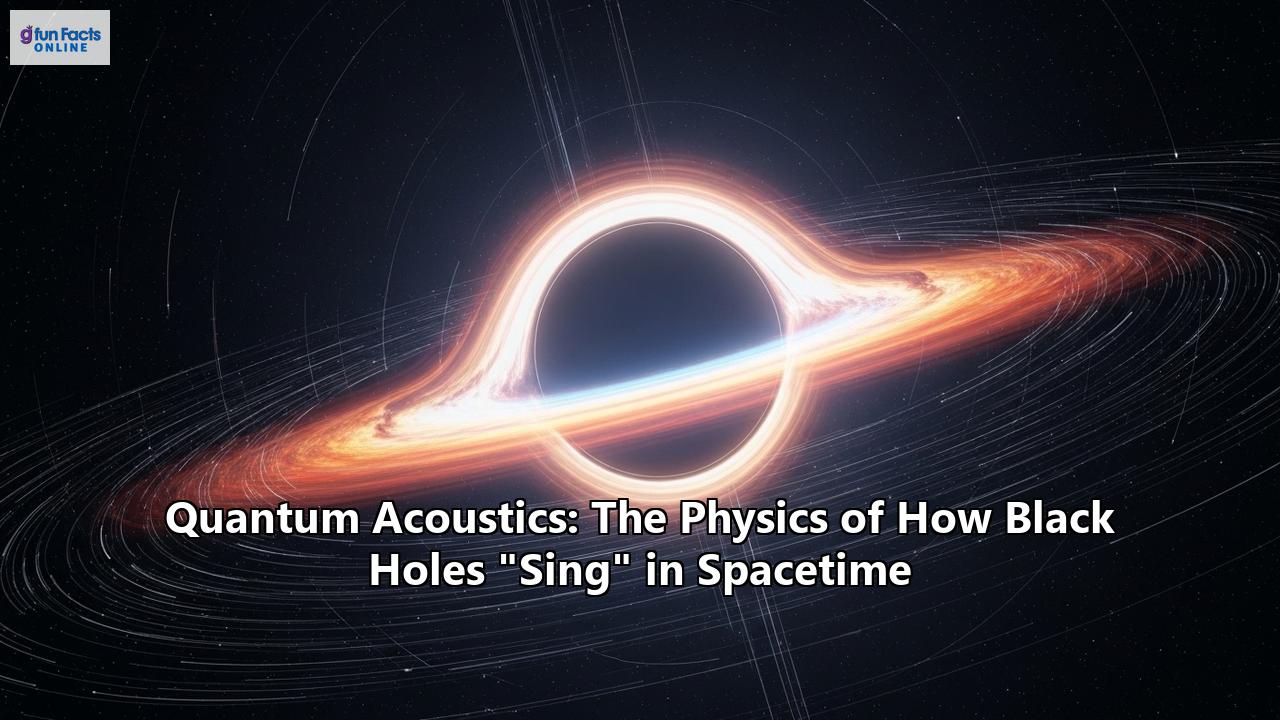
In the vast, silent expanse of the cosmos, a profound and ancient music resonates. It is a symphony not of air and vibration, but of spacetime itself being plucked, struck, and warped by the most enigmatic objects in the universe: black holes. This is the domain of Quantum Acoustics, a field that listens to the "songs" of black holes to decode the fundamental laws of reality. These cosmic melodies, carried across billions of light-years as gravitational waves, are more than just celestial curiosities; they are a direct line to the heart of Einstein's theories and a tantalizing glimpse into the quantum realm.
The Voice of Spacetime: Gravitational Waves
To understand how a black hole can "sing," one must first appreciate the stage on which this performance unfolds: spacetime. Albert Einstein's theory of general relativity revealed that space and time are not a static backdrop but a dynamic, interwoven fabric. Massive objects warp this fabric, creating the phenomenon we experience as gravity. When truly colossal events occur, such as the cataclysmic merger of two black holes, they don't just bend spacetime—they send ripples surging through it. These are gravitational waves.
For decades, these waves were purely theoretical. That changed on September 14, 2015, when the Laser Interferometer Gravitational-Wave Observatory (LIGO) detected them for the first time. The signal, originating from two black holes each about 30 times the mass of our sun, was the sound of their final, violent embrace.
Scientists have translated these gravitational wave signals into sound waves, a process called sonification, to make them accessible to human ears. The result is a sound that has been aptly named a "chirp." As two black holes spiral violently towards each other, their speed and the frequency of the gravitational waves they emit increase dramatically. This crescendo, a rapid rise in pitch and volume, is the characteristic chirp that announces a cosmic merger. For the first time, as physicist David Reitze of Caltech put it, "the universe has spoken to us with gravitational waves."
The Ringdown: A Black Hole's Signature Tune
The "chirp" is the dramatic prelude, but the main performance begins the moment the two black holes coalesce into one. The newly formed, larger black hole is initially distorted and unstable. To settle into its final, stable state, it sheds excess energy by vibrating, much like a bell that has been struck. This process is known as the "ringdown," and it radiates its own distinct pattern of gravitational waves.
These vibrations are not random; they occur at a specific set of frequencies and decay rates known as quasinormal modes (QNMs). Think of these modes as a black hole's unique musical fingerprint. Each QNM is characterized by a complex frequency: the real part represents the "note" of the vibration, while the imaginary part dictates how quickly that "note" fades away.
The profound importance of QNMs lies in what they reveal. According to theory, a black hole is defined by just three properties: its mass, its spin (angular momentum), and its charge. All other details of the matter that formed it are lost forever—a concept known as the "no-hair theorem." The frequencies of the ringdown, the QNMs, are predicted to depend only on the mass and spin of the final black hole. By measuring these "songs," scientists can directly test the predictions of general relativity in the most extreme gravitational environments and confirm the fundamental nature of these cosmic behemoths. The detection and analysis of QNMs are therefore no longer just a theoretical exercise; they are a crucial tool for understanding the universe.
However, calculating these vibrations is a formidable challenge. Physicists employ sophisticated mathematical techniques, such as the Wentzel-Kramers-Brillouin (WKB) approximation and its more recent, powerful extension, the "exact WKB analysis," to decode the intricate patterns of a black hole's ringdown. These methods have begun to unveil a rich, hidden structure in the way black holes vibrate, revealing patterns that had been missed for decades.
From Spacetime to the Lab: The Rise of "Quantum Acoustics"
While observing the skies provides one avenue to hear black holes, another revolutionary approach is unfolding in laboratories on Earth. This is the field of analogue gravity, which simulates the physics of black holes using other physical systems. This has given rise to the concept of acoustic black holes, also known as sonic black holes or dumb holes.
Imagine a fluid flowing, its speed steadily increasing. At a certain point, the fluid is moving faster than the local speed of sound within it. This creates a sonic "event horizon": any sound wave (a phonon) created in the supersonic region is trapped, unable to travel upstream against the flow, just as light is trapped by the gravitational pull of a real black hole.
Scientists have successfully created these acoustic black holes in laboratory settings using ultra-cold atomic clouds called Bose-Einstein condensates. In these experiments, phonons behave like a massless scalar field in an emergent acoustic metric that is analogous to the spacetime around a real black hole. This remarkable achievement opens a window into some of the most elusive and profound quantum phenomena predicted to occur at the edge of black holes—phenomena that are practically impossible to observe directly across the vastness of space.
The Quantum Whispers: Hawking Radiation and the Unruh Effect
One of the most startling predictions of theoretical physics is that black holes are not completely "black." In 1974, Stephen Hawking combined quantum mechanics and general relativity to show that black holes should emit a faint, thermal glow, now known as Hawking radiation. This radiation is believed to arise from quantum fluctuations at the event horizon, a constant fizz of "virtual particles" popping into and out of existence from the vacuum of space.
Directly detecting Hawking radiation from an astrophysical black hole is beyond our current technological capabilities due to its extreme faintness. However, acoustic black holes offer a viable alternative. In these lab-based analogues, the theory predicts the emission of a phononic version of Hawking radiation. The sonic event horizon is expected to convert the quantum vacuum fluctuations of the fluid into real, detectable sound particles, or phonons. In 2014, researchers reported the observation of stimulated Hawking radiation in one such system, followed by observations of spontaneous, quantum Hawking radiation.
Closely related to Hawking radiation is the Unruh effect. This principle suggests that an accelerating observer will perceive an empty vacuum not as empty, but as a warm bath teeming with particles. Like Hawking radiation, the Unruh effect is a deep prediction at the intersection of quantum theory and relativity, but it is far too subtle to be measured directly with current technology. Acoustic analogues, where a detector can be "accelerated" through the silent phonon vacuum of the condensate, provide a promising platform to finally witness this phenomenon by observing the detector "hear" sound that is generated purely by its acceleration.
The Deeper Harmony: Unifying Gravity and Quantum Mechanics
The study of black hole acoustics—both cosmic and lab-grown—is ultimately part of a grander quest: the search for a unified theory of quantum gravity. General relativity describes the universe on the largest scales, while quantum mechanics governs the smallest. These two pillars of modern physics work perfectly in their own domains, but they break down in regions where extreme gravity and quantum effects collide, such as the singularity at the center of a black hole.
Listening to the "songs" of black holes pushes these theories to their absolute limits. The precise details of the gravitational waves from a merger's ringdown could hold subtle clues about quantum gravity effects. Some theories even propose that the curvature of spacetime itself, so prominent around black holes, might alter the fundamental rules of quantum mechanics. Experiments using networks of highly precise atomic clocks are being designed to test how gravity might introduce nonlinear effects into quantum theory.
Furthermore, some physicists speculate that the merger of two black holes might create not just a larger black hole, but also secondary, temporary black holes with masses close to the Planck mass—the scale at which quantum gravity is expected to dominate. While a highly speculative idea, it highlights how black hole mergers are becoming a laboratory for exploring the most fundamental questions in physics.
Beyond the Chirp: The Low Hum of the Cosmos
While the "chirps" and "ringdowns" of gravitational waves represent one form of black hole song, another, entirely different acoustic phenomenon has been discovered. Astronomers studying the Perseus galaxy cluster, located about 240 million light-years away, found that the supermassive black hole at its center is generating immense pressure waves in the surrounding hot gas.
These ripples are, in essence, true sound waves traveling through a medium. NASA was able to translate these pressure waves into a note. The result is an impossibly deep hum, measured to be about 57 octaves below middle C—a frequency quadrillions of times lower than the limits of human hearing. This "singing" is caused by the black hole periodically releasing vast amounts of energy in bursts, which ripple through the galaxy cluster's gas like cosmic drum beats. This discovery provides a novel way to study how supermassive black holes interact with and shape their galactic environments.
Conclusion: The Future of Cosmic Listening
The universe is far from silent. It sings with the voices of its most extreme inhabitants. From the violent, chirping crescendo of two black holes spiraling to their doom, to the pure, ringing tones of a newly formed event horizon settling into equilibrium, and the deep, resonant hum propagating through galactic gas, these cosmic sounds are a rich source of information.
Quantum Acoustics provides the framework for interpreting this symphony. By listening to gravitational waves, we are testing the limits of Einstein's gravity and charting the demographics of black holes across the cosmos. By creating acoustic analogues in the lab, we are probing the quantum weirdness of Hawking radiation and the Unruh effect. Together, these parallel fields of inquiry are guiding us toward the ultimate prize: a unified understanding of gravity and the quantum world. The era of gravitational wave astronomy is still in its infancy, but as our detectors become more sensitive and our analogue systems more sophisticated, we can only expect the cosmic symphony to grow louder, revealing new melodies and deeper harmonies that will continue to reshape our understanding of the universe.
Reference:
- https://www.h-its.org/2023/07/31/set-black-holes-sound/
- https://www.livescience.com/53694-sound-of-merging-black-holes.html
- https://www.ligo.caltech.edu/video/ligo20160211v2
- https://www.nasa.gov/universe/new-nasa-black-hole-sonifications-with-a-remix/
- https://www.ligo.caltech.edu/video/ligo20160615v2
- https://dailygalaxy.com/2025/08/black-holes-singing-scientists-know-lyrics/
- https://en.wikipedia.org/wiki/Quasinormal_mode
- https://www.phys.sinica.edu.tw/~heptheory/img/activity/Black-Hole-Quasinormal-Modes.pdf
- https://pmc.ncbi.nlm.nih.gov/articles/PMC5253841/
- https://diposit.ub.edu/dspace/bitstream/2445/170927/1/CAMPRUBI%CC%81%20I%20PEIRO%CC%81%20ANDREU_1338739_assignsubmission_file_TFG-Camprubi%CC%81-Peiro%CC%81-Andreu.pdf
- https://www.sciencedaily.com/releases/2025/08/250801021010.htm
- https://arxiv.org/abs/2409.15403
- https://scitechdaily.com/combining-quantum-physics-and-the-theory-of-relativity-sound-waves-from-a-quantum-vacuum-at-the-black-hole-laboratory/
- https://journals.aps.org/prd/abstract/10.1103/PhysRevD.71.064019
- https://en.wikipedia.org/wiki/Sonic_black_hole
- https://scitechdaily.com/earths-gravity-might-be-warping-quantum-mechanics-say-physicists/
- https://arxiv.org/pdf/1806.02979
- https://www.youtube.com/shorts/44sGbcpcOKo?app=desktop
- https://www.youtube.com/watch?v=Z13SgTvq5Yc