
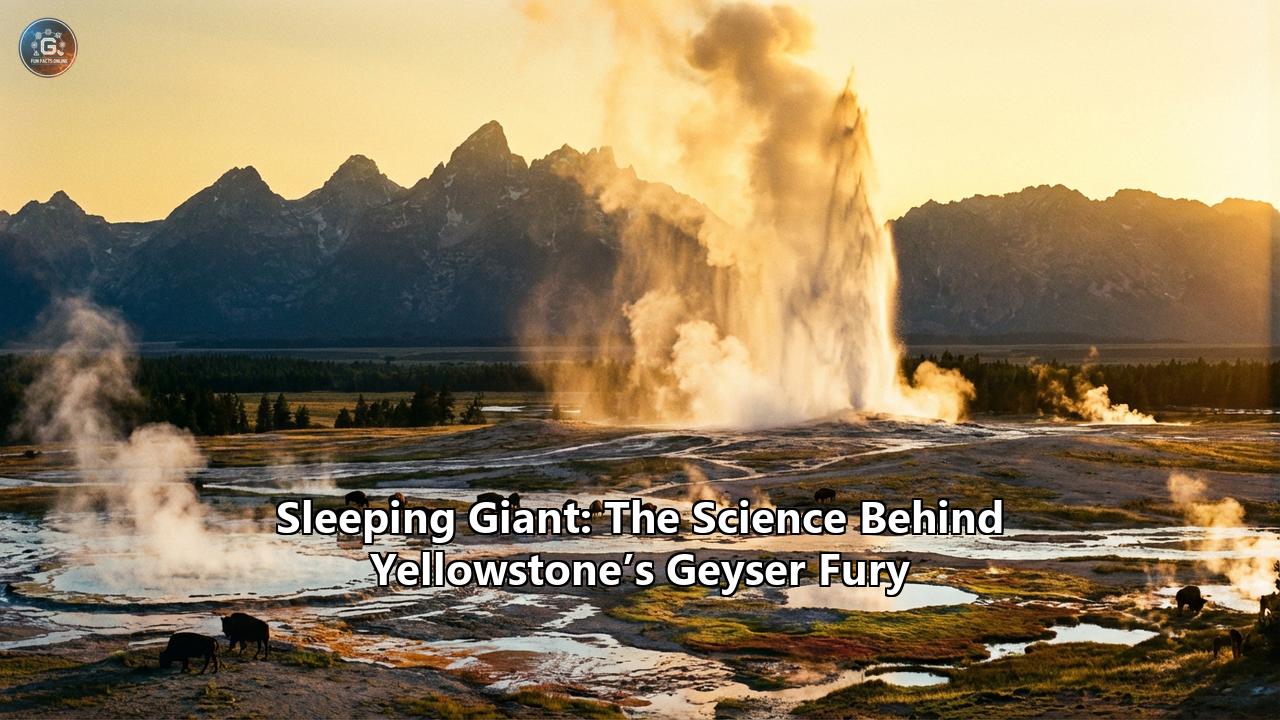
The wooden boardwalk shudders beneath your feet, a rhythmic thumping that seems to emanate from the very core of the Earth. around you, the air is thick with the scent of sulfur—rotten eggs to the uninitiated, but the perfume of creation to the geologists who flock here from every corner of the globe. A plume of steam, blindingly white against the cobalt Wyoming sky, hisses violently from a jagged vent in the sintered crust, rising hundreds of feet before dissipating into the thin mountain air. You are standing atop the Yellowstone Plateau, a landscape of surreal beauty and terrified power, where the ground itself is alive, breathing, and occasionally screaming.
This is not merely a national park; it is a roof over a hellish kitchen, a thin veneer of rock separating the surface world from a churning, molten engine of planetary destruction and creation. To the casual tourist, the geysers are a spectacle, a clockwork amusement to be captured on a smartphone and posted to social media. But to the scientist, they are the exhaust pipes of a sleeping giant, the visible manifestations of a colossal thermodynamic machine that has shaped the North American continent for millions of years.
The fury of Yellowstone is not random. It is a precise, mathematically governable chaos driven by specific laws of physics and chemistry. It is a story of heat transfer, fluid dynamics, microbial evolution, and tectonic violence. To truly understand the "geyser fury," we must look past the postcards and peer into the plumbing, stripping away the landscape to reveal the intricate, terrifying, and awe-inspiring machinery that lies beneath. This is the science of the Sleeping Giant.
Part I: The Engine in the Basement
To understand the geyser, one must first understand the fire that feeds it. Yellowstone is not a volcano in the traditional sense of a conical mountain spewing lava. It is a "caldera"—a massive cauldron formed when the ground collapses into an emptied magma chamber. But even this definition is too small. Yellowstone is a "supervolcano," a term that, while often sensationalized by media, describes a geological reality of terrifying scale.
The engine driving this system is a "hotspot"—a plume of superheated rock rising from the mantle-core boundary, some 1,800 miles beneath the surface. Picture a blowtorch held stationary under a moving sheet of metal. The "sheet" is the North American tectonic plate, drifting slowly southwest at a rate of about one inch per year. The "blowtorch" is the Yellowstone hotspot. As the plate moves, the hotspot burns a hole through the crust, creating a chain of dead volcanoes stretching across southern Idaho, the scars of the giant’s past tantrums.
Today, that blowtorch is directly under the park.
The Magma Reservoir: A Crystal MushFor decades, scientists imagined a vast, sloshing ocean of liquid magma beneath the park. Recent advancements in seismic tomography—effectively a CT scan of the Earth using earthquake waves—have refined this picture into something more complex and perhaps more unsettling.
We now know the magmatic system is composed of two distinct reservoirs. The shallower one, the one that directly fuels the geysers, sits a mere 3 to 10 miles beneath the surface. It is massive, roughly 55 miles long and 25 miles wide. But it is not a tank of liquid. It is a "crystal mush"—a sponge-like matrix of solid rock crystals with pockets of molten magma occupying the pore spaces.
Think of a snow cone. The ice is the solid crystal, and the syrup is the melt. In 2022 and 2023, cutting-edge studies revealed that the "melt fraction" (the amount of liquid syrup) in this upper reservoir is between 16% and 20%, significantly higher than the 10% previously estimated, but still far below the 50% threshold usually required for a cataclysmic eruption. This mush is hot, viscous, and incredibly pressurized. It acts as the primary heat source, radiating temperatures exceeding 800°C (1,472°F) into the rock above it.
Below this, at a depth of 12 to 30 miles, lies a second, larger reservoir containing basaltic magma—hotter, more fluid, and originating directly from the mantle plume. This lower reservoir acts as the furnace, transferring heat and gases to the upper mush, keeping it alive.
The Breathing EarthThis system is not static. The ground at Yellowstone literally breathes. Sensitive GPS stations and satellite radar (InSAR) constantly measure the elevation of the caldera floor. In some years, the ground rises by several inches as fresh magma or pressurized hydrothermal fluids inject themselves into the system. In other years, it subsides as gases escape and fluids cool.
This "resurgence" is the heartbeat of the giant. Between 2013 and 2014, the ground uplifted significantly, likely due to a deep injection of magma. In 2025, subtle uplift was detected again along the north caldera rim. This flexing crust fractures the rock, creating a labyrinth of cracks and faults that serve as the highways for the park’s water. Without this constant tectonic kneading, the plumbing would seal up, and the geysers would die.
Part II: The Plumbing of the Gods
If the magma is the engine, the water is the coolant. The sheer volume of water moving through Yellowstone’s subsurface is staggering. It begins as snow. The high plateau receives massive snowfall—up to 400 inches in the mountains. This snow melts, and the water percolates down through the fractured rhyolite rock.
It is a long, slow journey. The water erupting from Old Faithful today likely fell as snow nearly 500 years ago, perhaps around the time Columbus was sailing the Atlantic. It sinks deep, typically to depths of 1 to 2 miles, where it approaches the hot rock capping the magma reservoir.
Here, the physics of water changes dramatically.
The Superheated FluidAt sea level, water boils at 212°F (100°C). But deep underground, crushed by the immense weight of the rock above, the pressure is hundreds of times higher than atmospheric pressure. This allows the water to remain liquid at temperatures far exceeding its normal boiling point—often reaching 400°F (204°C) or more. This is "superheated" water. It becomes less dense, more buoyant, and significantly more chemically aggressive.
As it heats, it begins to rise, convecting upward through the path of least resistance—the faults and fractures created by the "breathing" ground. But it doesn't rise alone. It dissolves silica from the surrounding volcanic rock, becoming a hot, mineral-rich soup.
The Architecture of a GeyserWhy do some features become tranquil hot springs while others become explosive geysers? The secret lies in the shape of the plumbing.
A hot spring has an open, unrestricted plumbing system. The superheated water rises, cools slightly as it nears the surface, and circulates freely. Convection currents act like a pot of boiling water on a stove: hot water rises, cools, and sinks, maintaining a steady, non-explosive temperature.
A geyser, however, requires a specific geological accident: a constriction. Somewhere in the geyser’s throat, usually near the surface, the channel narrows. This bottleneck prevents the free circulation of convection currents.
Consider the mechanics of Old Faithful:
- The Filling Phase: After an eruption, the underground reservoirs are empty. Groundwater trickles back in, filling the complex system of chambers and conduits. The water at the bottom is heated by the surrounding rock.
- The Heating Phase: Because of the constriction, the hot water deep down cannot easily rise to mix with the cooler water on top. The water in the lower chamber becomes superheated, trapped under the pressure of the cooler, heavy water column above it. It is a pressure cooker with the lid locked down.
- The Trigger: Eventually, the temperature at the bottom rises so high that even the immense pressure cannot keep it liquid. Bubbles of steam begin to form. These bubbles rise and accumulate in the "bubble traps"—nooks and crannies in the plumbing.
- The Pre-Play: As steam bubbles crowd into the narrow conduit, they displace some water, pushing it out of the vent. You see this at the surface as splashing or "pre-play."
- The Unzipping: This is the critical moment. When that splash of water leaves the vent, the weight of the water column suddenly decreases. Less weight means less pressure. With the pressure drop, the superheated water deep below instantly "flashes" into steam. Since steam takes up 1,600 times more volume than liquid water, this expansion is explosive. It forces more water out, dropping the pressure further, causing more water to flash. The chain reaction unzips the water column from top to bottom, roaring out of the ground at supersonic speeds.
The geyser is not just water; it is also rock. Remember the dissolved silica? When the superheated water flashes to steam or cools at the surface, it can no longer hold the silica in solution. The mineral precipitates out, coating the plumbing with a hard, watertight rock called "geyserite" or siliceous sinter.
This is crucial. If the plumbing were made of porous rock, the pressure would leak out into the surrounding soil. The geyserite seals the system, creating a pressure-tight vessel capable of withstanding the violent forces of the eruption. It is a self-building machine.
Part III: The Titans—Old Faithful and Steamboat
While the physics are universal, every geyser has a unique personality dictated by the geometry of its plumbing.
Old Faithful: The Steady HeartbeatOld Faithful is the poster child of geyser science because of its simplicity. Its plumbing is relatively straightforward—a deep, vertical pipe with a few large side chambers. This simple geometry allows it to recharge and heat in a predictable cycle.
Scientists have found that the interval between eruptions is controlled by the duration of the previous eruption. A short eruption (less than 2.5 minutes) means the reservoir wasn't fully emptied. The next eruption will come sooner (in about 60 minutes). A long eruption (over 4 minutes) drains the system completely, requiring more time to refill and reheat (about 90 minutes).
However, even Old Faithful is changing. Decades of seismic activity have slightly altered its plumbing, lengthening the average interval between eruptions. It is a reminder that even the most "faithful" features are subject to the shifting geology of the caldera.
Steamboat Geyser: The Unpredictable MonsterIf Old Faithful is a metronome, Steamboat Geyser is a roulette wheel. Located in the Norris Geyser Basin—the hottest and most seismically active part of the park—Steamboat is the world's tallest active geyser, capable of shooting water 300 to 400 feet into the air.
Steamboat’s plumbing is a chaotic mess of fractures. It doesn't just have a reservoir; it likely draws from a vast, interconnected network that links to nearby Cistern Spring. When Steamboat erupts, Cistern Spring drains completely, a testament to their subterranean connection.
Steamboat goes through phases of dormancy and hyperactivity that baffle scientists. It was virtually asleep from 2014 to 2018. Then, in March 2018, it woke up.
- 2018: 32 major eruptions.
- 2019: 48 major eruptions (a record).
- 2020: 48 major eruptions.
- 2021-2023: A gradual decline.
- 2024-2025: The giant began to nod off again, with only a handful of eruptions.
Why? Recent research suggests that Steamboat's "trigger" is extremely sensitive to groundwater levels and subtle changes in pore pressure caused by distant earthquakes or seasonal snowmelt. One 2023 study solved a long-standing mystery: why Steamboat's seismic signal seemed to vanish in winter. It wasn't the geyser changing; it was the deep snowpack dampening the ground vibrations, effectively muting the "roar" of the plumbing to the sensors.
Steamboat’s unpredictability highlights a key scientific truth: we are still amateurs in understanding the chaotic fluid dynamics of the deep Earth.
Part IV: The Hidden Danger—Hydrothermal Explosions
When people worry about Yellowstone, they worry about the "Big One"—a magmatic super-eruption that blankets the US in ash. While possible, the probability of this in our lifetime is vanishingly small (about 1 in 730,000 in any given year).
The real danger, the one that keeps park geologists up at night, is the hydrothermal explosion.
On July 23, 2024, tourists at Biscuit Basin were treated to a terrifying display of this phenomenon. Without warning, Black Diamond Pool exploded. It wasn't a geyser eruption; it was a bomb. A column of mud, boiling water, and boulders the size of microwaves was blasted hundreds of feet into the air. The boardwalk was obliterated. Miraculously, no one was killed.
The Physics of the BlastA hydrothermal explosion differs from a geyser eruption in its mechanism of confinement.
- Geyser: The restriction is open enough to allow periodic release.
- Explosion: The plumbing becomes completely sealed.
Silica is constantly depositing, clogging the cracks and vents. Over time, a "cap" forms. Beneath this cap, the water continues to heat. It turns to steam, but the steam has nowhere to go. The pressure builds exponentially, far exceeding the rock's strength.
Finally, the seal fails. It might be triggered by a small earthquake, a drop in atmospheric pressure, or simply the material limit of the rock. When it breaks, the sudden depressurization causes the water in the ground to flash to steam instantly and violently. It doesn't just eject water; it excavates the earth. The energy released can equal tons of TNT.
The crater at Mary Bay, on the north shore of Yellowstone Lake, is 1.5 miles wide—the scar of a massive hydrothermal explosion that occurred 13,000 years ago. The 2024 Biscuit Basin event was a firecracker compared to that, but it served as a violent reminder that the "sleeping" giant twitches in its sleep.
New monitoring equipment installed in 2025—infrasound arrays, rapid-deploy seismometers, and thermal cameras—is now focused on identifying the subtle "huffing and puffing" frequencies that might precede these blasts. Scientists are listening for the sound of a tea kettle about to burst.
Part V: Life in the Boiling Pots
The fury of the geysers has created one of the most unique biological habitats on Earth. For a century, scientists believed life could not exist in water above 160°F. Yellowstone proved them wrong.
The ThermophilesThe brilliant colors of the hot springs—the emerald greens, sunset oranges, and rusty browns—are not minerals. They are mats of living microorganisms called thermophiles (heat-lovers).
These organisms are relics of the early Earth, thriving in conditions that resemble the planet 3 billion years ago: high heat, low oxygen, and chemical toxicity. They are zoned by temperature like a topographic map.
- The Center (Blue): In the hottest water (above 167°F), only Archaea and some bacteria like Thermus aquaticus can survive. They are often colorless or pale yellow, so the water appears crystal blue due to light scattering.
- The Yellow Band: As water cools to ~160°F, Synechococcus takes over. These cyanobacteria photosynthesize, turning the sun's energy into sugar.
- The Orange/Brown Band: In the "cool" water (below 140°F), a diverse community of bacteria forms thick, leathery mats.
In 1966, microbiologist Thomas Brock discovered Thermus aquaticus in Mushroom Spring. This humble bacterium contained an enzyme, Taq polymerase, that could replicate DNA at high temperatures without breaking down. This discovery revolutionized genetics. It enabled Polymerase Chain Reaction (PCR)—the technology used for everything from DNA fingerprinting at crime scenes to COVID-19 testing. The multi-billion-dollar biotech industry stands on the shoulders of a bug found in a Yellowstone puddle.
Metabolic SorceryRecent research has revealed that these microbes are metabolic wizards. Some switch pathways between day and night. Synechococcus, for instance, photosynthesizes during the day, producing oxygen. But at night, it switches to nitrogen fixation, a process usually poisoned by oxygen. It manages this by rhythmically consuming its own oxygen inventory at dusk, clearing the way for the night shift.
Scientists are also investigating "chemotrophs" in the deep plumbing that eat hydrogen gas produced by the magma. These organisms live in total darkness, completely disconnected from the sun, offering a model for what life might look like on Europa or Enceladus—the icy moons of Jupiter and Saturn.
Part VI: The Winter Refuge
The geyser fury shapes the macro-world as well. In the dead of winter, when the park is buried under ten feet of snow and temperatures plunge to -40°F, the hydrothermal basins become islands of survival.
Bison and elk congregate in the geyser basins. The heated ground melts the snow, exposing the dried grasses of the previous summer. It is a desperate trade-off. The food is meager, and the air is filled with high concentrations of silica and fluoride gas.
- The Fluoride Trap: The volcanic gas settles on the grass. When elk eat it, the fluoride makes their teeth brittle. They wear down faster, leading to shorter lifespans for the "thermal herds" compared to their counterparts who migrate out of the park.
- The Bobby Socks: You will see ghost forests of lodgepole pines with their bases bleached pure white. These trees absorbed the silica-rich thermal water through their roots. The silica hardened inside the wood cells, effectively petrifying the bottom of the tree while it was still standing, choking off its nutrients. These "bobby sock trees" are the tombstones of a shifting hydrothermal system.
Yet, without the heat, many animals would not survive the winter. The geysers provide a thermal refuge, a steam-heated microclimate in a frozen wilderness. Wolves know this, too. They patrol the edges of the basins, knowing the elk are trapped between the deep snow and the boiling pools.
Part VII: Mapping the Underworld
How do we know all this? We cannot drill into the geyser plumbing—it would destroy the pressure seal and kill the feature. Instead, scientists must use "non-invasive" surgery.
The Great Scan of 2022In a landmark study published in Nature, scientists used a helicopter-borne electromagnetic system (SkyTEM) to map the plumbing of the entire park. They flew a giant hexagonal hoop over the landscape, pulsing electromagnetic waves into the ground.
- Resistivity: Cold, fresh water resists electricity. Hot, salty, mineral-rich water conducts it. Clay (the product of rock cooked by acid) conducts it even better.
The resulting 3D images were breathtaking. They showed "fingers" of low-resistivity thermal fluids rising along vertical faults, hitting the surface, and then spreading out horizontally through the gravel layers. It confirmed that the geyser basins are not isolated; they are connected by vast, subsurface rivers of hot water flowing miles laterally before emerging.
The "Spider Web" NetworkWe now understand that the plumbing is incredibly fragile. Distant earthquakes—even those as far away as Denali, Alaska—can shake the bubbles loose in Yellowstone’s plumbing, triggering eruptions or changing geyser intervals. The 2002 Denali earthquake (magnitude 7.9) caused small geysers in Yellowstone to erupt immediately, despite being 2,000 miles away. The seismic waves jiggled the "soda bottle," releasing the gas.
Conclusion: The Balance of Power
Yellowstone is a paradox. It is ancient, yet constantly renewing itself. It is a place of violent destruction that harbors the most delicate forms of life. It is a "sleeping" giant that is actually an insomniac, tossing and turning, scratching at the crust, and muttering in steam and ash.
The science behind the geyser fury is not just about understanding a park; it is about understanding the fundamental volatility of our planet. It teaches us that the ground beneath our feet is not solid. It is a crust, floating on a sea of heat.
As you stand on the boardwalk at sunset, watching the Great Fountain Geyser erupt in a golden spray of diamonds, you are witnessing the Earth exhaling. The science tells us how it happens—the pressure, the constrictions, the silica, the magma. But knowing the mechanics does not diminish the magic. If anything, knowing that a chamber of crystal mush and a 500-year-old snowflake conspired to create this moment makes it all the more miraculous.
The Giant sleeps. But he dreams in fire and water. And for now, we are lucky enough to watch him breathe.
Reference:
- https://www.usgs.gov/observatories/yvo/news/yellowstones-magma-reservoir-comes-sharper-focus
- https://www.usgs.gov/observatories/yvo/news/new-views-how-magma-stored-beneath-yellowstone-provided-hundreds-seismic
- https://www.seequent.com/the-plumbing-beneath-yellowstones-famous-geysers/
- https://www.colorado.edu/coloradan/2022/11/07/alum-leads-study-mapping-yellowstones-plumbing
- https://www.usgs.gov/observatories/yvo/news/insights-eruptions-steamboat-geyser
- https://icjs.us/thermophilic-life-in-yellowstone-national-park-challenges-the-physical-and-chemical-limits-of-survival/
- https://www.usgs.gov/observatories/yvo/news/wildlife-yellowstone-national-parks-thermal-basins
- https://www.yellowstonenationalparklodges.com/connect/yellowstone-hot-spot/how-yellowstones-wildlife-adapts-to-winter/
- https://www.nationalparkstraveler.org/2026/01/top-yellowstone-geological-stories-2025
- https://grokipedia.com/page/Steamboat_Geyser
- https://en.wikipedia.org/wiki/Steamboat_Geyser
- https://cowboystatedaily.com/2025/12/06/steamboat-geyser-the-worlds-tallest-may-not-blast-off-again-for-decades/
- https://news.mongabay.com/2006/01/hot-spring-bacteria-have-two-metabolic-pathways/