
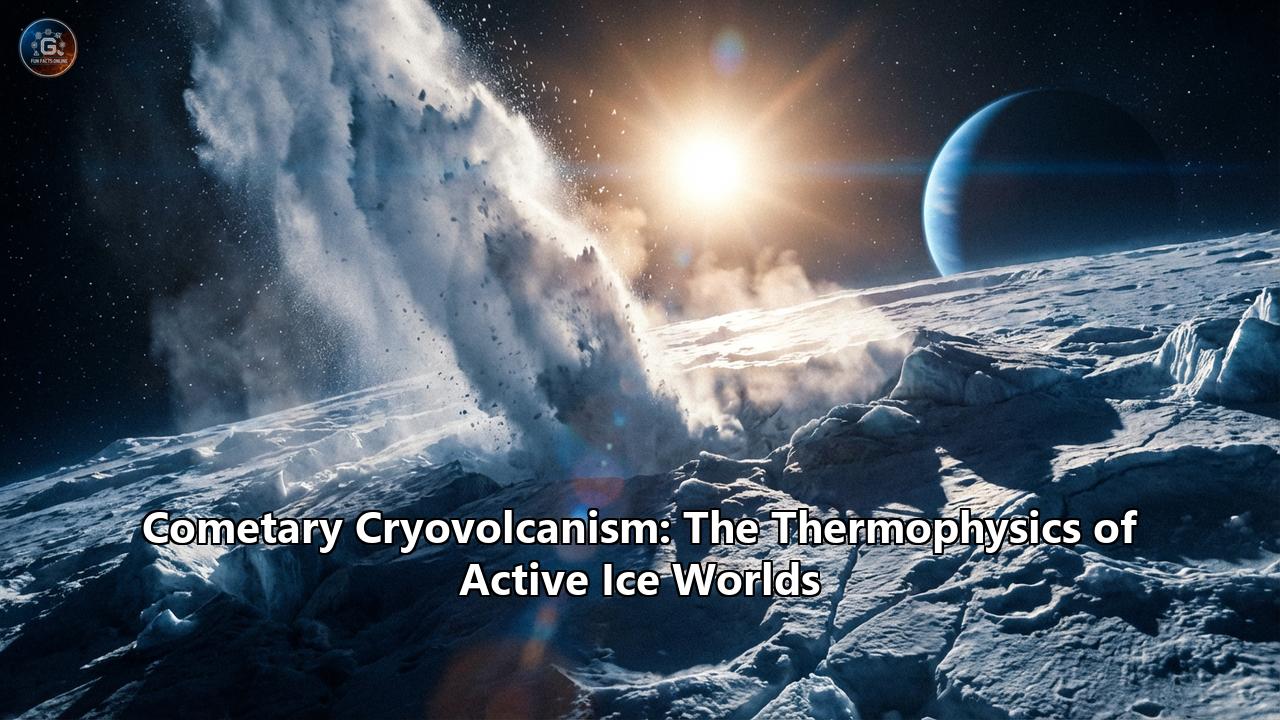
The cosmos is often viewed as a silent, static void, punctuated only by the steady orbits of dead rock and ice. But in the cold reaches of our Solar System, a class of celestial bodies defies this stillness. They are not merely dirty snowballs tumbling through the dark; they are geologically dynamic, explosive, and thermally complex worlds. These are the cryovolcanic comets—active ice worlds that blur the line between inert asteroids and living planets.
With the recent, groundbreaking observations of the interstellar object 3I/ATLAS in late 2025, and the persistent, violent outbursts of the "space volcano" 29P/Schwassmann-Wachmann, the scientific community has been forced to rewrite the book on cometary physics. We now know that these bodies are powered by exotic thermophysical engines—mechanisms of heat, pressure, and phase transitions that can tear a comet apart from the inside out.
This exploration delves into the heart of Cometary Cryovolcanism, dissecting the thermal physics that turns frozen drifters into erupting geysers of gas, dust, and—as we have recently discovered—exotic metallic vapors.
1. Beyond the "Dirty Snowball": Defining Cometary Cryovolcanism
Traditionally, cometary activity was described as simple sublimation: sunlight warms the surface ice, turning it directly into gas (outgassing), which drags dust along with it to form a tail. This is a passive, surface-level process.
Cryovolcanism is fundamentally different. It is an endogenic (internal) process. It requires:- Internal Pressure Build-up: Gas accumulating beneath a sealed or semi-permeable crust.
- Structural Failure: The pressure exceeding the tensile strength of the overlying material.
- Explosive Release: A violent ejection of material (cryomagma) which, in the vacuum of space, consists of gas, ice crystals, and dust.
While a terrestrial volcano erupts molten silicate rock driven by buoyancy and dissolved gas, a cometary cryovolcano erupts volatiles—water ($H_2O$), carbon monoxide ($CO$), carbon dioxide ($CO_2$), and nitrogen ($N_2$)—driven by the thermodynamics of phase changes in a vacuum.
2. The Thermophysics Engine: What Powers the Eruption?
Comets are small (kilometers in scale) and cold, lacking the radioactive core heat of a planet like Mars or Earth. So, where does the energy for a violent explosion come from? The answer lies in a combination of solar insolation, chemical potential energy, and phase transition physics.
A. The Amorphous Ice Battery
The most potent energy source hidden within a comet is Amorphous Water Ice (AWI). formed in the frigid, pre-solar nebula (below 100 K), water molecules in AWI are randomly arranged, like glass, rather than ordered in a crystal lattice.
When AWI is heated—even slightly—it undergoes an irreversible phase transition to Crystalline Water Ice (CWI). This transition is exothermic; it releases heat.
- The Chain Reaction: As a heat wave from the Sun penetrates the comet's crust, it triggers this crystallization. The heat released by the transition warms the adjacent ice, triggering more crystallization. This creates a self-sustaining "crystallization front" that propagates inward.
- Gas Release: AWI has a sponge-like ability to trap hyper-volatiles like $CO$ and $N_2$ within its disordered matrix. When it crystallizes, the lattice tightens, expelling these trapped gases instantly.
- The Explosion: The sudden release of trapped gas creates a massive spike in localized pressure deep underground. If the crust above is sealed, the comet becomes a pressure cooker. When the pressure breaks the surface limit, the crust blows open.
B. Sublimation Pressure in "Sealed Cavities"
Not all outbursts require the exotic AWI transition. Simple sublimation can turn explosive if the geometry is right.
- The Sealed Pocket: Imagine a subsurface cavity filled with volatile $CO_2$ ice, covered by a layer of non-volatile dust or water ice sintered by solar heating.
- The Greenhouse Effect: The dark, dusty surface of a comet absorbs sunlight efficiently (low albedo). This heat conducts downward. If the volatile ice sublimates into gas faster than it can diffuse through the pores of the crust, pressure builds.
- Tensile Failure: Cometary material is incredibly weak—often described as having the consistency of dried cigar ash or meringue. It takes very little pressure (a few kilopascals) to shatter the crust, resulting in a collimated jet of debris.
3. Chemical Complexity: The Ingredients of an Outburst
The "lava" of a comet is a frigid slurry of gas and solids. However, recent discoveries have expanded our understanding of this chemical inventory.
- The Standard Volatiles ($H_2O, CO, CO_2$): These are the drivers. Water drives activity near the Sun (within 3 AU), while $CO$ and $CO_2$ drive activity in the distant solar system (out to Neptune's orbit).
- The Super-Volatiles ($N_2, O_2, Ar$): Found in pristine comets from the Oort cloud. These sublimate at incredibly low temperatures (~40-50 K), allowing comets to erupt even when they are as far away as Pluto.
- The New Frontier: Organometallics:
The 2025 analysis of interstellar object 3I/ATLAS shocked the world by detecting Nickel Tetracarbonyl ($Ni(CO)_4$). This volatile compound creates a form of "metallic cryovolcanism." It sublimates at low temperatures, carrying heavy metal atoms into the coma. This suggests that in some alien solar systems, comets are not just icy dirtballs, but chemical factories processing complex ores.
4. Case Studies of Active Ice Worlds
To understand the physics, we must look at the monsters of the midway.
29P/Schwassmann-Wachmann: The Gateway Centaur
Orbiting between Jupiter and Saturn, 29P is a "Centaur"—a refugee from the Kuiper Belt transitioning into the inner solar system. It is the most volcanically active body of its size class.
- Behavior: It does not have a tail in the traditional sense. Instead, it brightens by factors of 100 to 1000 in mere hours.
- Physics: 29P is likely in a state of "runaway crystallization." Its large nucleus (~60 km) retains enough internal heat to keep the amorphous-to-crystalline front moving. The 57-day periodicity of its outbursts suggests a link to its slow rotation, where the "day" side bakes long enough to trigger deep thermal pulses.
- Recent Activity: The "super-outbursts" of the mid-2020s have ejected millions of tons of mass, suggesting large-scale crustal collapse into evacuated magma chambers below.
12P/Pons-Brooks: The "Devil Comet"
Returning to the inner solar system every 71 years, 12P made headlines in 2024 for its "horned" coma.
- The Mechanism: The "horns" were actually the shadows of a massive block of crust blocking the outflow of a specific cryovolcanic vent.
- Thermophysics: Unlike 29P, 12P dives close to the Sun. Its outbursts are driven by intense solar heating creating "pressure bombs" where pockets of liquid hydrocarbons and waxes (predicted by some models) or super-heated sub-surface ices vaporize instantly upon crustal failure.
67P/Churyumov-Gerasimenko: The Rosetta Standard
The Rosetta mission (2014-2016) gave us the most detailed look at cryovolcanism at the micro-scale.
- Pits and Vents: Rosetta observed deep, circular pits (Seth, Ma'at regions) that were not impact craters but collapse features. These are sinkholes formed when subsurface volatiles vent away, leaving a void.
- Cliff Collapse: We witnessed the Aswan cliff collapse—a landslide triggered by thermal stress. The exposure of fresh, bright ice to sunlight caused an immediate, localized outburst—a "dry" landslide triggering a "wet" eruption.
3I/ATLAS: The Metallic Anomaly (2025)
The detection of 3I/ATLAS has introduced a new variable: Exotic Compositional Thermodynamics.
- The Discovery: Spectroscopic analysis revealed a coma rich in atomic nickel and carbon monoxide, with a distinct lack of water compared to solar comets.
- The Theory: This object likely formed in a carbon-rich, oxygen-poor protoplanetary disk. Its cryovolcanism is driven by the sublimation of Nickel Tetracarbonyl, a highly volatile liquid/gas that forms from the reaction of CO with nickel grains. This "toxic volcanism" operates at different pressure/temperature regimes than water ice, allowing for sustained jets even at large heliocentric distances.
5. The Life Cycle of a Cryovolcanic Vent
How does a cometary volcano die? The thermophysics dictates a cycle of activation, erosion, and dormancy.
- Activation: Thermal waves reach a pocket of volatile ice (or AWI). Pressure builds.
- Eruption: The crust fails. Gas expands supersonically into the vacuum, accelerating dust grains to hundreds of meters per second.
- Collimation: The walls of the vent act like a rocket nozzle, focusing the jet.
- Erosion: The jet scours the walls of the vent, widening it. Eventually, the "nozzle" becomes too wide to maintain pressure.
- Quenching: As the volatile fuel is exhausted or the vent widens enough that sublimation cools the remaining ice (evaporative cooling), the eruption ceases. The vent fills with fallback dust, becoming a "smooth terrain" trap, waiting for the next thermal trigger.
6. Implications: Why It Matters
Understanding the thermophysics of these active worlds is about more than just curious explosions.
- Planetary Formation: The energy released by AWI crystallization might have been enough to melt water on larger Kuiper Belt Objects (like Pluto or Charon) early in history, potentially allowing for ancient subsurface oceans.
- The Origin of Life: Cryovolcanism is the delivery mechanism. It dredges up material from the deep, protected interior of a comet—where complex organics, amino acids, and prebiotic molecules are shielded from radiation—and sprays them into space. If a comet strikes a planet, it is this cryovolcanic payload that seeds the surface.
- Resource Utilization: For future space explorers, a cryovolcanic vent is a resource tap. It is a natural concentrator of volatiles (fuel) and, in the case of objects like 3I/ATLAS, potentially refined metals suspended in the gas flow.
Conclusion
Comets are not dead. They are thermodynamic machines, ancient batteries slowly discharging the energy stored during the birth of the solar system. From the nitrogen geysers of the outer rim to the metallic breath of interstellar visitors, the phenomenon of cometary cryovolcanism reveals a universe where ice is as dynamic as fire. As our telescopes improve and our probes venture closer, we are learning that to understand the origins of our hot, living world, we must first understand the physics of these cold, exploding ones.
Reference:
- https://www.davidmaiolo.com/2024/11/17/unveiling-mysteries-29p-cryovolcanic-comet/
- https://en.wikipedia.org/wiki/29P/Schwassmann%E2%80%93Wachmann
- https://www.inkl.com/news/3i-atlas-update-rare-metal-composition-hints-at-hidden-cryovolcanism
- https://www.ibtimes.co.uk/3i-atlas-update-rare-metal-composition-hints-hidden-cryovolcanism-1759356
- https://www.livescience.com/cryovolcanic-comet-29p-erupts
- https://www.livescience.com/space/interstellar-comet-3i-atlas-is-erupting-in-ice-volcanoes-new-images-suggest
- https://ntrs.nasa.gov/citations/20220019101