
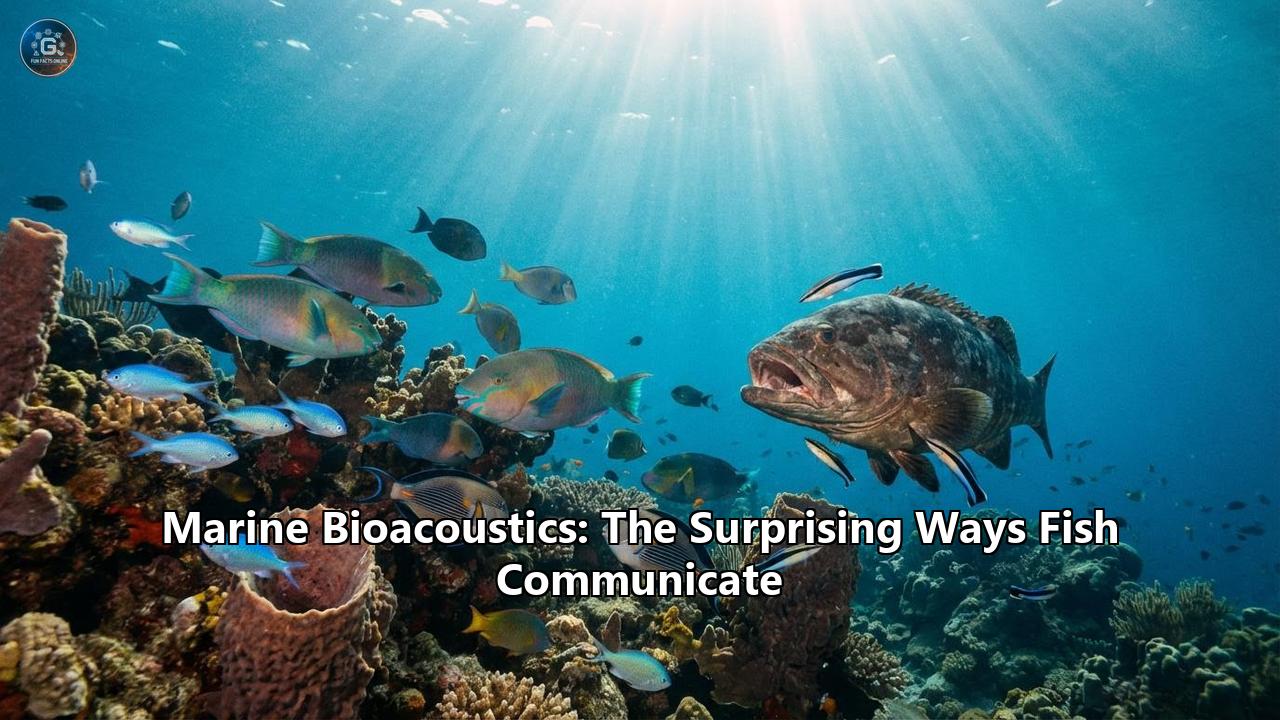
For decades, human beings have gazed out at the ocean and imagined a realm of profound, meditative silence. In 1953, the legendary oceanographer Jacques Cousteau even famously titled his documentary The Silent World. But if you were to submerge a specialized underwater microphone—a hydrophone—into a thriving coral reef or a dense kelp forest, you would quickly realize that Cousteau was wrong. The ocean is not silent. It is a bustling, raucous, and symphonic environment, and some of the most prolific contributors to this underwater cacophony are fish.
Welcome to the captivating field of marine bioacoustics, a scientific discipline that studies how marine life produces and perceives sound. While the haunting, melodic songs of humpback whales and the rapid-fire clicks of dolphins have long dominated the public's imagination, fish have been quietly—or rather, quite loudly—communicating beneath the waves for millions of years. From grinding teeth to vibrating bladders, the methods fish use to "talk" are as bizarre as they are fascinating.
The Physics of an Underwater Symphony
To understand why fish rely so heavily on sound, we must first look at the physics of their environment. In the ocean, visibility is often strictly limited. Light rapidly attenuates in water, meaning that below a certain depth, or in murky coastal waters and rivers, vision becomes practically useless. Chemical signals (pheromones) are helpful but rely on ocean currents to carry them from one fish to another.
Sound, however, is the ocean's ultimate medium. Because water is much denser than air, acoustic waves travel approximately 4.5 times faster underwater than they do above the surface, and they can carry over vast distances with very little loss of energy. In an environment where you cannot always see your predator, your prey, or your potential mate, hearing them is a matter of survival.
An Ancient Heritage: 155 Million Years of Conversation
The ability of fish to vocalize is not a rare evolutionary quirk; it is a fundamental pillar of aquatic life. A groundbreaking 2022 study analyzing the evolutionary history of the ray-finned fishes (Actinopterygii)—a massive clade comprising over 34,000 species, or 99% of all known fish—revealed that acoustic communication is staggeringly common.
Researchers discovered that sound production likely evolved at least 155 million years ago, long before mammals even walked the earth. Even more astonishing is the fact that the ability to make sound evolved independently at least 33 separate times across the fish family tree. To put this in perspective, acoustic communication in terrestrial tetrapods (four-limbed animals, including humans) is thought to have evolved only a handful of times. Today, scientists estimate that nearly two-thirds of all ray-finned fish species are capable of producing sound, transforming our understanding of marine ecosystems from a silent void into an ancient, buzzing metropolis.
The Biological Instruments: How Fish Make Sound
Unlike humans and other terrestrial mammals, fish do not have vocal cords. They cannot push air through a larynx to sing or shout. Instead, over millions of years of evolution, fish have transformed their own bodies into biological instruments, utilizing a variety of highly specialized physiological mechanisms to generate acoustic signals.
The Percussionists: Swim Bladders and Sonic Muscles
The most common and arguably the most powerful method of fish sound production is "drumming". Most bony fish possess a swim bladder (or gas bladder), an internal gas-filled organ primarily used to maintain buoyancy so the fish does not sink or float uncontrollably. However, many species have repurposed this organ as an acoustic resonator.
In these species, highly specialized "sonic muscles" are attached to or located near the swim bladder. These muscles are among the fastest-contracting muscles known in any vertebrate. When a fish wants to communicate, it contracts these sonic muscles at blinding speeds, causing the swim bladder to vibrate rapidly. This action produces a rhythmic drumming, thumping, or croaking noise.
The oyster toadfish (Opsanus tau) is a famous example. During mating season, the male toadfish contracts its sonic muscles up to 200 times per second to produce a loud, low-frequency "boat whistle" sound to attract females. Other well-known drummers include the croakers and drums (family Sciaenidae), whose sheer volume during spawning season can be so deafening that it has been known to keep people awake on houseboats. In some marine catfishes, a modified swim bladder mechanism known as the "elastic spring apparatus" uses thin, elastic bones to beat against the bladder, producing thumps, purrs, and knocks.
The String and Scratch Section: Stridulation
If drumming is the percussion section of the fish orchestra, "stridulation" is the string and scratch section. Stridulation is the act of rubbing hard skeletal parts together to produce sound, much like a cricket rubbing its wings together.
Many fish create noise by grinding their pharyngeal teeth—a secondary set of jawless teeth located deep in the throat. Marine grunts (family Haemulidae) earned their namesake from the pig-like grunting noises they make by grinding these teeth together; the sound is then amplified by the adjacent swim bladder acting as a resonance chamber.
Other fish use different skeletal structures. Catfish, for example, can produce a loud, squeaking noise by locking and rotating their pectoral fin spines against their shoulder girdles—a sound often deployed as a fright response to deter predators when the fish is caught or threatened. Seahorses, despite their delicate appearance, are also stridulators; they produce high-pitched clicks by rubbing the bony ridge on the back of their skull (the supraoccipital bone) against a groove in their star-shaped coronet.
Wind Instruments and Fluid Dynamics
Some of the most peculiar acoustic methods involve manipulating air or water movement. A highly documented, albeit comical, example is found in the Pacific and Atlantic herring. These fish produce high-frequency sounds known as FRTs (Fast Repetitive Ticks). They generate this sound by forcefully expelling air from their anal duct. Unlike human flatulence, which is a byproduct of digestion, herring "farts" are a deliberate form of communication, primarily used at night to help the school stay tightly packed together in the dark without alerting predators, as most predatory fish cannot hear at such high frequencies.
Additionally, fish can generate hydrodynamic sounds simply by swimming. When schooling fish rapidly change direction, the synchronized movement of their bodies displaces water, creating low-frequency acoustic cues that help the group move in seamless, instantaneous unison.
The Anatomy of Underwater Hearing
Communication is a two-way street; making a sound is useless if no one is around to hear it. While fish do not have external ears like mammals, their internal auditory systems are incredibly sophisticated.
Deep inside a fish's skull sits the inner ear, which is equipped with dense, calcium carbonate structures called otoliths, or "ear stones". Because a fish's body is mostly water, sound waves pass right through their tissues. However, the dense otoliths move at a slightly different rate than the rest of the fish's body when struck by an acoustic wave. This microscopic difference in movement bends tiny hair cells lining the inner ear, which in turn send electrical impulses to the brain, registering as sound.
Many species have evolved anatomical bridges to enhance their hearing. The Weberian apparatus is a complex chain of tiny bones that connects the swim bladder directly to the inner ear. In this setup, the swim bladder acts like a biological microphone, picking up pressure waves in the water and transmitting them directly to the ear, granting these fish an incredibly acute sense of hearing.
Furthermore, fish possess a "sixth sense" known as the lateral line. This is a visible line of sensory pores running along the sides of a fish's body, from the gills to the tail. The lateral line detects subtle changes in water pressure, vibrations, and low-frequency sounds, allowing fish to "feel" the acoustic and hydrodynamic movements of everything around them. This dual-system of the inner ear and the lateral line makes fish highly receptive to the acoustic nuances of their environment.
The Dictionary of Fish: What Are They Saying?
The sounds fish produce are not random background noise; they convey vital, life-or-death information. Researchers have categorized fish vocalizations into several distinct behavioral contexts.
1. Romance and ReproductionThe most common reason fish "talk" is to find a mate. Acoustic courtship is a high-stakes performance. For instance, the plainfin midshipman fish hums a continuous, low-frequency drone that can last for an hour to woo females to his nest. In species like the Atlantic cod, males and females are generally silent throughout the year, only breaking their vow of silence during the spawning season. Researchers believe this seasonal vocalization is a mechanism used to precisely synchronize the release of sperm and eggs, maximizing the chances of successful fertilization.
2. Turf Wars and Territorial DefenseIn the crowded neighborhoods of a coral reef or a rocky riverbed, real estate is at a premium. Fish frequently use sound to establish dominance and defend their territory without resorting to physical violence, which could result in lethal injuries. Damselfish and croaking gouramis are notorious for their aggressive acoustic displays, producing rapid bursts of pops and clicks to warn rival males to back off. It is the underwater equivalent of a dog growling at a fence.
3. Group Cohesion and NavigationFor schooling fish, staying together is a matter of survival. But how do you stay in a tight formation when swimming through a pitch-black abyss or a murky estuary? Sound provides the anchor. A 2014 study revealed that even in their earliest stages of life, fish larvae emit subtle knocks and growls to help one another stick together in the dark, improving their group cohesion, swimming speed, and navigation as they drift through the open ocean.
4. Alarm and DistressWhen danger approaches, fish will sound the alarm. Many species will emit sudden, sharp noises to startle a predator or to alert nearby conspecifics of an impending threat. When a predator strikes, the chorus of the reef often falls silent, only to be replaced by specific warning chirps.
The Intruders: The Crisis of Anthropogenic Noise
For over 150 million years, the acoustic environment of the ocean was dominated by the sounds of breaking waves, cracking ice, snapping shrimp, singing whales, and chattering fish. But since the onset of the Industrial Revolution, humans have introduced a new, pervasive, and deadly pollutant into the marine ecosystem: anthropogenic (man-made) noise.
The modern ocean is an acoustic nightmare. The persistent, low-frequency rumble of commercial shipping vessels, the deafening thud of pile driving for offshore wind farms and harbors, the explosive blasts of seismic airguns used in oil and gas exploration, and the piercing pings of military sonar have fundamentally altered the marine soundscape. According to studies, underwater ambient noise levels have risen by almost 30 decibels in the frequency range where most fish produce and detect sound.
This noise pollution has devastating consequences for fish. The most immediate impact is "masking". Just as it is impossible to hold a conversation with a friend at a loud rock concert, fish are finding it increasingly difficult to hear one another over the roar of human industry. Masking shrinks the communication space of fish, meaning a mating call that once traveled hundreds of meters might now only be audible from a few feet away.
But the damage goes far beyond simple miscommunication. Chronic noise exposure causes severe physiological stress in fish. Research has shown that social interactions occurring in noisy conditions become disjointed and less effective. In territorial disputes, males become distracted and stressed, leading to prolonged fights. More alarmingly, noise pollution directly impacts reproduction. In studies of painted gobies, females were found to be significantly less likely to spawn in environments polluted by continuous noise. If females do lay eggs, the stress of noise can hinder maternal care; researchers have noted that females exposed to high noise levels are more likely to cannibalize or prematurely release their young.
Juvenile fish exposed to chronic noise during their development suffer from stunted growth rates, higher mortality, and altered startle behaviors, making them easy prey. Because sound is deeply integrated into a fish's neurobiology, an ocean choked by noise is an ocean where fish struggle to feed, breed, and survive.
Listening to the Future: The Rise of Conservation Bioacoustics
As the threats to marine environments mount, scientists are turning to the very sounds fish make to help save them. Marine conservation bioacoustics is a rapidly growing field that leverages acoustic data to monitor and protect ecosystems non-invasively.
In the past, studying fish populations required dropping nets, pulling fish to the surface, and handling them—processes that are stressful and sometimes lethal to the animals. Today, researchers utilize Passive Acoustic Monitoring (PAM). By dropping hydrophones into coral reefs, kelp forests, and deep-sea trenches, scientists can eavesdrop on the ecosystem 24/7 without ever disturbing it.
Historically, assigning a specific sound to a specific fish species was incredibly difficult—akin to identifying an individual voice at a crowded, dark party. However, revolutionary new technologies are solving this "ventriloquist" problem. Innovations like the UPAC-360° (Underwater Passive Acoustic Camera) and multi-hydrophone triangulation systems combine omni-directional audio and visual recordings. These devices can pinpoint the exact origin of an underwater sound and record the fish making it on video. During a recent deployment in Curaçao, one such camera allowed scientists to successfully identify the specific sounds of 46 different fish species in their natural habitat, marking a massive leap forward in compiling an acoustic dictionary of the reef.
By decoding these underwater languages, conservationists can monitor the health of an ecosystem. A loud, diverse soundscape indicates a healthy, thriving reef, while a quiet, homogenous soundscape may signal ecological collapse. Bioacoustics allows scientists to track the migration patterns of threatened species, identify critical spawning habitats that require legal protection, and measure the real-time recovery of marine protected areas (MPAs).
The Hidden Voice of the Tides
The study of marine bioacoustics forces us to look—and listen—to the ocean in an entirely new way. It shatters the human-centric bias that vocal communication is a strictly terrestrial privilege. Beneath the rolling waves, in the dark, cold depths and the vibrant sun-dappled reefs, an ancient and complex dialogue is taking place.
From the tiny, croaking larvae fighting to stay together in the vastness of the sea, to the rhythmic, thumping choruses of massive groupers echoing through the water column, fish are far from silent. They are a vital part of the earth's natural symphony. Recognizing, understanding, and ultimately protecting the acoustic environment of the ocean is not just about saving fish; it is about preserving the ancient, unseen heartbeat of the blue planet.
Reference:
- https://academic.oup.com/fisheries/article-abstract/49/1/28/7810803
- https://www.sci.news/biology/fish-sound-communication-10501.html
- https://www.fisheyecollaborative.org/faq
- https://www.fisheyecollaborative.org/research/uncovering-150-million-years-of-fish-sounds
- https://www.ecowatch.com/fish-communication-sounds.html
- https://a-z-animals.com/blog/how-do-fish-communicate/
- https://www.fishsens.com/aquatic-chatterboxes-how-fish-communicate/
- https://www.youtube.com/shorts/gWswJArDuq8
- https://scholarscompass.vcu.edu/cgi/viewcontent.cgi?params=/context/biol_pubs/article/1069/&path_info=2022_Fine_and_Parmentier_Fish_Sound_Production_The_Swim_Bladder.pdf
- https://dosits.org/animals/sound-production/how-do-fish-produce-sounds/
- https://www.researchgate.net/publication/274374503_Mechanisms_of_Fish_Sound_Production
- https://journals.biologists.com/jeb/article/220/13/2306/17893/Acoustic-communication-in-terrestrial-and-aquatic
- https://pmc.ncbi.nlm.nih.gov/articles/PMC6849755/
- https://repository.lsu.edu/gradschool_dissertations/5086/
- https://research.ulusofona.pt/en/publications/noise-can-affect-acoustic-communication-and-subsequent-spawning-s/
- https://academic.oup.com/beheco/article/25/5/1022/215541
- https://news.mongabay.com/2025/12/new-underwater-acoustic-camera-identifies-individual-fish-sounds-helping-track-threatened-species/
- https://www.researchgate.net/publication/379510149_Introduction_to_the_special_issue_on_fish_bioacoustics_Hearing_and_sound_communicationa
- https://www.timescolonist.com/islander/bc-scientists-eavesdropping-on-fish-to-fathom-their-underwater-secrets-6964892