
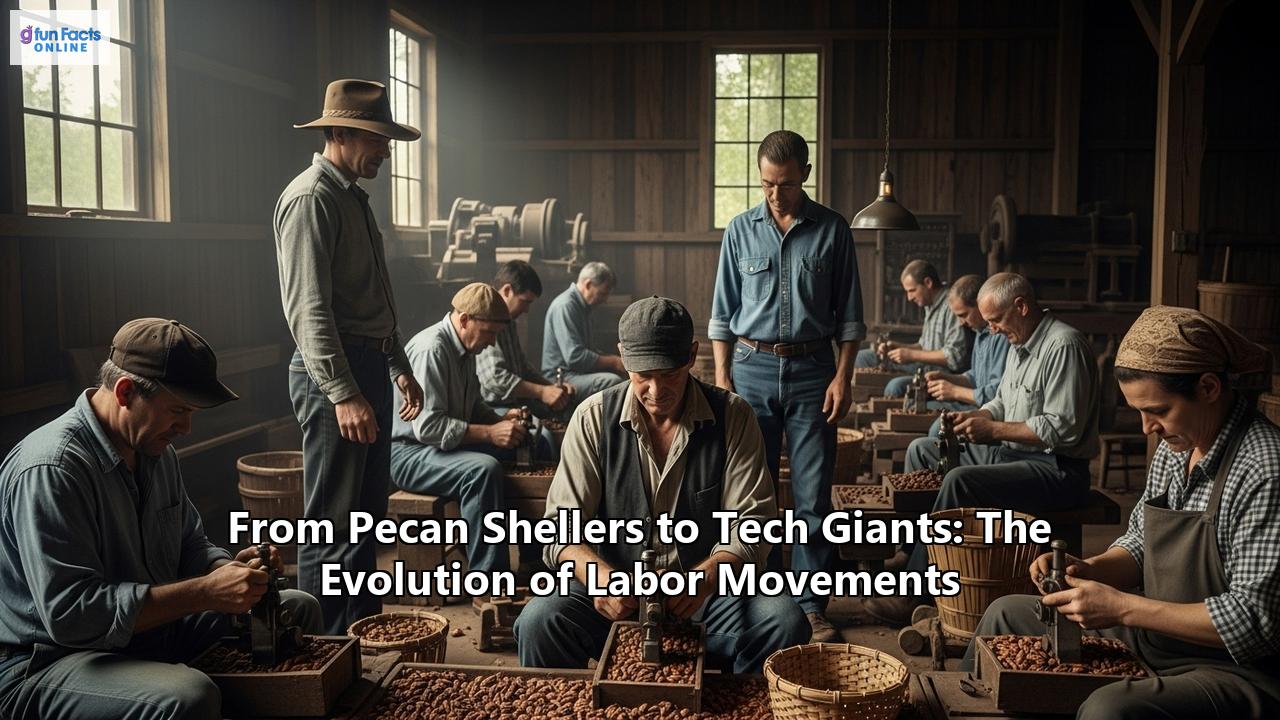
From Pecan Shellers to Tech Giants: The Unceasing March of Labor Movements
The fight for workers' rights is a story as old as industry itself, a continuous thread woven through the fabric of social and economic change. It's a narrative that stretches from the dusty, oppressive workshops of the early 20th century to the gleaming, algorithm-driven campuses of today's tech behemoths. By examining the stark realities of the 1938 pecan shellers' strike and juxtaposing them with the nascent, yet powerful, labor movements within companies like Google, Amazon, and Apple, we can trace the remarkable evolution of the struggle for dignity, fairness, and a voice in the workplace.
The Grime and Grit of San Antonio: The 1938 Pecan Shellers' Strike
In the 1930s, San Antonio, Texas, was the heart of the nation's pecan industry, processing about half of the entire U.S. crop. This industry was built on the backs of an estimated 12,000 workers, the vast majority of whom were Mexican American women. These were not the idyllic workplaces often depicted in pastoral fantasies of American industry. The pecan shellers toiled in deplorable conditions, working more than 10 hours a day, seven days a week, for a meager weekly wage of $2 to $3. The air in the cramped, poorly ventilated shelling plants was thick with fine, brown pecan dust, a constant irritant that contributed to San Antonio's alarmingly high rate of tuberculosis. Bathroom facilities were often nonexistent, and the work itself was grueling, performed by hand for the sake of profit, as company owners found human labor cheaper than mechanized shelling.
The catalyst for the historic 1938 strike was a sudden wage cut announced by the Southern Pecan Shelling Company and other major players in the local industry. The pay for shelled pecan halves was slashed from seven cents a pound to six, and for pieces, from six cents to five. This seemingly small reduction was a breaking point for a workforce already pushed to the brink of survival.
On January 31, 1938, an estimated 12,000 pecan shellers walked out of the factories in a spontaneous act of defiance. The strike quickly gained momentum and leadership under the guidance of Emma Tenayuca, a fiery and passionate labor activist known as "La Pasionaria." Though not a pecan sheller herself, Tenayuca was a well-known advocate for the city's working poor through her work with the Texas Workers Alliance. Her involvement, however, also brought the specter of "red-baiting," as city officials and company management sought to discredit the strike by labeling it a communist plot.
The response from the city's power structure was swift and brutal. The San Antonio police, under the direction of Chief Owen Kilday, moved to crush the strike, arresting hundreds of peaceful picketers and confining them in overcrowded and unsanitary jails. Soup kitchens were closed to the strikers, further tightening the screws on the already impoverished workers. The city government and local press largely sided with the pecan companies, downplaying the strike's significance and vilifying the strikers.
Despite the intense opposition, the pecan shellers held firm for three months. Their plight eventually drew the attention of Texas Governor James Allred, who ordered an investigation into the civil liberties violations committed by the San Antonio police. The Texas Industrial Commission ultimately deemed the police response excessive.
After 37 days of protest, both sides agreed to arbitration. The arbitration board ruled in favor of the strikers, ordering higher wages and officially recognizing the International Pecan Shellers Union No. 172. The victory, however, was tragically short-lived. The passage of the Fair Labor Standards Act on October 24, 1938, established a national minimum wage of 25 cents per hour. Faced with this new wage requirement, the pecan companies, which had long relied on the exploitation of cheap labor, chose to mechanize their operations rather than pay the mandated wage. In the end, an estimated 10,000 pecan shellers, the very workers who had fought so bravely for their rights, lost their jobs. The Pecan Shelling Workers Union No. 172, born out of a desperate struggle for dignity, soon faded into history.
The story of the pecan shellers is a poignant reminder of the immense courage required to challenge entrenched power and the often-unforeseen consequences of technological disruption on the lives of working people. It is a story that finds surprising echoes in the most modern of industries: the tech sector.
The Digital Picket Line: Labor's New Frontier in Silicon Valley
For decades, the tech industry seemed immune to the currents of the labor movement that had swept through other sectors of the economy. The image of the well-compensated, intellectually stimulated "tech bro" working in a campus-like environment with free food and nap pods stood in stark contrast to the gritty, industrial settings that had birthed traditional unionism. However, beneath this polished veneer, a different kind of labor struggle has been brewing, one that shares more with the pecan shellers of San Antonio than one might initially assume.
The Early Stirrings of Tech Activism
The roots of tech worker organizing can be traced back further than many realize. As early as 1974, the United Electrical, Radio and Machine Workers of America (UE) established the Electronics Organizing Committee to address the concerns of plant workers at semiconductor firms like Intel and National Semiconductor. In the 1980s, the Communications Workers of America (CWA), a union that would become a major force in tech organizing, made attempts to unionize workers at IBM. While a formal union did not materialize at the time, groups like IBM Workers United kept the spirit of activism alive, publishing newsletters and advocating for better wages and working conditions.
A significant moment in early tech organizing came in 1998 with the formation of the Washington Alliance of Technology Workers (WashTech) at Microsoft. This effort was driven by the plight of so-called "permatemps," contract workers who performed the same jobs as full-time employees but with significantly lower pay and no benefits. WashTech, which affiliated with the CWA, never achieved formal union recognition for the entire workforce, but its advocacy led to improved conditions and the permanent hiring of many temporary workers. The group also attempted to organize call center workers at a young Amazon in 1999, an effort that was abruptly ended when the company outsourced the jobs to India.
A New Era of Organizing: Beyond Wages and Hours
The contemporary tech labor movement has evolved beyond the traditional focus on wages and benefits. While these issues remain important, a new wave of activism is increasingly driven by concerns over workplace culture, ethical considerations, and the societal impact of the technologies being built. A pivotal moment in this shift was the "Never Again" pledge in 2016, in which thousands of tech workers vowed not to participate in the creation of databases that could be used to target specific populations. This was followed by a series of high-profile walkouts and protests at major tech companies.
In 2018, over 20,000 Google employees worldwide walked out to protest the company's handling of sexual harassment allegations against executives. This unprecedented display of collective action demonstrated the power of a united workforce, even in a company long considered "unorganizable." The walkout's demands included an end to forced arbitration in cases of harassment and discrimination, a commitment to pay and opportunity equity, and a publicly disclosed sexual harassment transparency report.
This new era of tech activism has also seen workers challenging their employers' business decisions on ethical grounds. Employees at Amazon have protested the company's contracts with Immigration and Customs Enforcement (ICE) and its sale of facial recognition technology to law enforcement. Similarly, workers at Salesforce and Microsoft have organized against their companies' work with government agencies.
The Rise of Tech Unions: Alphabet, Amazon, and Apple
This groundswell of activism has led to the formation of new unions and organizing committees at some of the biggest names in tech.
Alphabet Workers Union (AWU): In January 2021, after years of grassroots organizing, workers at Google's parent company, Alphabet, announced the formation of the Alphabet Workers Union (AWU). Affiliated with the CWA, the AWU is a "minority union," meaning it doesn't have the majority support needed to force the company to the bargaining table for a traditional contract. Instead, it focuses on building power through a "wall-to-wall" model, welcoming all Alphabet workers, including full-time employees, temporary workers, vendors, and contractors.The goals of the AWU are notably broad, extending beyond traditional labor concerns. Their mission statement emphasizes creating a workplace where "our working conditions are inclusive and fair," "perpetrators of harassment, abuse, discrimination, and retaliation are held accountable," and workers have the "freedom to decline to work on projects that don't align with our values." The union has been involved in a wide range of campaigns, from fighting for better pay and benefits for contract workers to advocating for data privacy and speaking out against the company's role in developing artificial intelligence for military applications. They have also campaigned for job security in the face of layoffs and challenged the company's performance review system. The AWU's strategy relies heavily on direct action, public pressure, and filing unfair labor practice charges to protect workers and win concessions.
Amazon Labor Union (ALU) and the Teamsters: The struggle to unionize Amazon's vast network of warehouses has been a long and arduous one. The company has a well-documented history of aggressive anti-union tactics, including surveillance, intimidation, and the use of anti-union consultants. Despite these challenges, in April 2022, workers at the JFK8 warehouse in Staten Island, New York, achieved a historic victory, voting to form the Amazon Labor Union (ALU), the first successful unionization effort at an Amazon facility in the United States.The ALU, an independent, worker-led union, faced an uphill battle in its fight for a contract. In 2024, in a significant development, the ALU voted to affiliate with the 1.3-million-member International Brotherhood of Teamsters, a move that provides the fledgling union with much-needed resources and organizational support. The Teamsters have also been actively organizing Amazon's delivery drivers, who are often employed through third-party contractors known as Delivery Service Partners (DSPs). The National Labor Relations Board has ruled that Amazon is a "joint employer" of these drivers, a decision that could pave the way for broader unionization efforts among this segment of the workforce. The fight at Amazon highlights the challenges of organizing in the gig economy and the importance of solidarity between different types of workers.
Apple Retail Union: The organizing wave has also reached the sleek, minimalist retail stores of Apple. In 2022, workers at an Apple store in Towson, Maryland, became the first in the U.S. to vote to unionize, joining the International Association of Machinists and Aerospace Workers (IAM). Later that year, workers at a store in Oklahoma City also voted to unionize with the CWA. These efforts have been driven by concerns over wages that have not kept pace with the cost of living, unpredictable scheduling, and a desire for a greater voice in their working conditions.Apple, like Amazon, has responded with strong anti-union tactics, including hiring a notorious anti-union law firm and holding captive audience meetings to discourage workers from organizing. The unionized stores are still fighting for their first contracts, a process that has been slow and contentious. The organizing at Apple underscores that even in a company with a strong brand and a reputation for being a good employer, workers are increasingly demanding more than just a paycheck; they are seeking respect and a meaningful say in their work lives.
The Enduring Struggle: Common Threads and Modern Challenges
While the settings have changed dramatically—from the grime of a pecan shelling plant to the pristine aesthetic of an Apple Store—the fundamental struggles of workers remain strikingly similar. The pecan shellers fought for a living wage in the face of abject poverty; today's tech workers, even those with high salaries, are fighting for pay equity and a share in the massive profits their labor creates. The pecan shellers fought for basic safety and sanitation; tech workers are fighting for a workplace free from harassment and discrimination, and for a say in the ethical implications of the products they build. Both historical and contemporary movements are, at their core, a demand for human dignity and a rejection of the idea that labor is merely a commodity to be bought and sold at the lowest possible price.
However, the modern labor movement in the tech sector also faces a unique set of challenges and opportunities shaped by the forces of globalization and automation.
Globalization's Double-Edged Sword
Globalization has had a profound impact on labor markets, creating both new opportunities and significant challenges for workers. The ability of companies to move operations and jobs across borders has, in some cases, weakened the bargaining power of unions in developed countries. The threat of offshoring, as seen in the early days of WashTech's organizing at Amazon, can be a powerful tool for companies seeking to suppress unionization efforts. Global supply chains, while creating economic growth, have also raised concerns about labor rights and working conditions in countries with weaker labor protections.
At the same time, globalization and the digital tools that enable it have also created new avenues for international solidarity among workers. Tech workers are increasingly organizing across borders, sharing information and strategies, and supporting each other's struggles. The Alphabet Workers Union, for example, is part of a growing global movement of tech workers seeking to hold multinational corporations accountable.
The Specter of Automation
The fear that machines will replace human labor is not new. The pecan shellers of 1938 experienced this firsthand when their hard-won victory for a living wage was swiftly undone by the introduction of shelling machines. Today, the rapid advancements in artificial intelligence and automation are raising similar concerns across a wide range of industries, including the tech sector itself. A report by the McKinsey Global Institute estimated that up to 800 million jobs could be displaced by automation by 2030.
This technological disruption is a central concern for the modern labor movement. Unions are increasingly focused on negotiating protections for workers whose jobs are threatened by automation, including demands for retraining programs and a say in how new technologies are implemented. Some unions are also pushing for greater transparency and accountability in the use of AI-powered surveillance and algorithmic management in the workplace. The goal is not to halt technological progress, but to ensure that the benefits of automation are shared broadly and that workers are not left behind in the transition to a more automated future.
The Unfinished March
The evolution of labor movements, from the pecan shellers' dusty picket lines to the digital activism of today's tech workers, is a testament to the enduring power of collective action. The specific battles may change, the tools of organizing may evolve, but the fundamental human desire for dignity, respect, and a fair share of the wealth we create remains constant.
The struggles of the pecan shellers, though they ended in a bittersweet victory, laid the groundwork for future generations of activists. They demonstrated the power of a united workforce, even in the face of overwhelming opposition. Today, as tech workers grapple with the complexities of a globalized, automated economy, they are building on this legacy, forging a new kind of labor movement for the 21st century. It is a movement that is not only fighting for better pay and benefits, but for a more just and equitable world, both inside and outside the workplace. The march for workers' rights is far from over; it has simply found a new, and critically important, front in the heart of the digital age.
Reference:
- https://www.forbes.com/sites/jackkelly/2021/01/04/a-new-union-is-starting-up-at-google-with-the-goal-of-protecting-alphabet-workers-our-global-society-and-our-world/
- https://appleretailunion.org/
- https://en.wikipedia.org/wiki/Apple_Inc._and_unions
- https://www.searchenginejournal.com/google-workers-form-a-union/391534/
- https://uniglobalunion.org/news/u-s-alphabet-workers-unionize-to-make-company-more-ethical-equitable-and-just-2/
- https://workerorganizing.org/premajority-unionism/case-studies/alphabet-workers-union/
- https://news.bloomberglaw.com/daily-labor-report/apple-store-union-movement-stalls-as-tech-titan-strikes-back
- https://en.wikipedia.org/wiki/Amazon_and_trade_unions
- https://cwa-union.org/news/releases/apple-retail-workers-bethesda-md-file-union-election-communications-workers-america
- https://www.alphabetworkersunion.org/our-campaigns
- https://utaw.tech/campaigns/apple
- https://georgetownlawtechreview.org/google-employees-form-first-of-its-kind-silicon-valley-union/GLTR-01-2021/
- https://workerorganizing.org/alphabet-workers-union-exemplifies-the-vibrancy-and-power-of-pre-majority-union-organizing-8201/
- https://www.epi.org/publication/corporate-union-busting/
- https://apnews.com/article/amazon-union-election-teamsters-2ec167dda2e327b40c8505f30066de31
- https://inequality.org/article/the-campaign-to-unionize-amazon-gains-momentum/
- https://www.numberanalytics.com/blog/globalization-and-labor
- https://www1.aucegypt.edu/src/globalization/labor_Market.htm
- https://www.myoneflow.com/blog/the-impact-of-technology-on-the-labor-movement
- https://blogs.psico-smart.com/blog-the-impact-of-automation-on-labor-relations-12248
- https://www.numberanalytics.com/blog/future-of-labor-automation
- https://www.americanprogress.org/article/unions-give-workers-a-voice-over-how-ai-affects-their-jobs/
- https://www.yalejreg.com/bulletin/belaboring-the-algorithm-artificial-intelligence-and-labor-unions/