
Fire has long been humanity’s most transformative tool, a primal force that provided warmth, defense, and the energy to digest cooked foods. Yet, beyond its utilitarian functions, fire has also served as a profoundly spiritual medium—a conduit between the tangible world of the living and the ethereal realm of the dead. Deep in the heart of northern Malawi, beneath the imposing shadow of a granite mountain, archaeologists have unearthed a layer of ash that profoundly rewrites the timeline of human mortuary practices. Dating back approximately 9,500 years—bridging the end of the Pleistocene epoch and the dawn of the Holocene—this ancient hearth reveals the world’s oldest known in situ cremation pyre containing the remains of an adult.
This groundbreaking discovery, centered on a Stone Age hunter-gatherer woman, challenges long-held assumptions about the social complexity, ritualistic behavior, and communal labor capacities of prehistoric nomadic societies. Through a stunning synthesis of forensic bioarchaeology, radiocarbon dating, and geospatial analysis, an international team of researchers has resurrected the story of a mesmerizing "pyrotechnological spectacle". It is a narrative of grief, meticulous preparation, and enduring social memory that echoes across millennia.
A Monument in Stone: The Landscape of Mount Hora
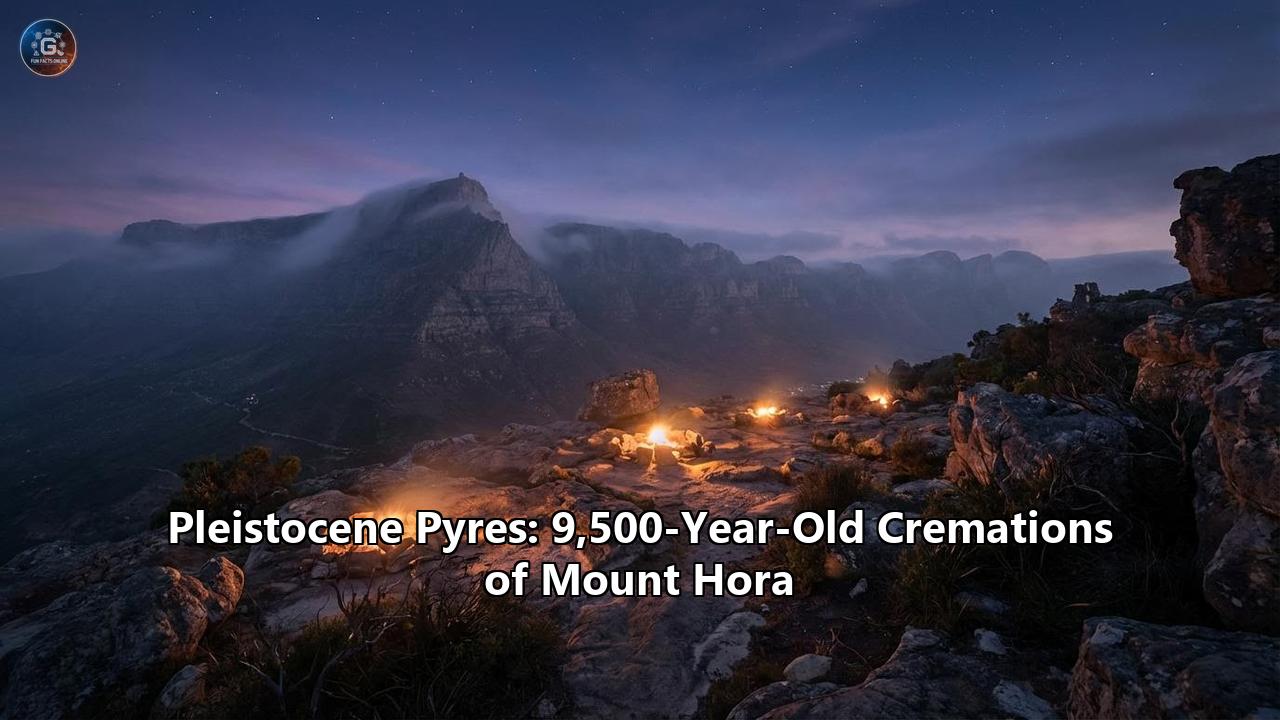
To understand the magnitude of this 9,500-year-old cremation, one must first look at the geographical theater in which it took place. The site is located in the Mzimba District of northern Malawi, anchored by Mount Hora—a massive granitic inselberg (an isolated rock hill or mountain) that rises sharply, several hundred feet above the surrounding Kasitu River Valley. For prehistoric communities, such towering geological formations were not mere backdrops; they were monumental landmarks deeply imbued with navigational importance and, likely, spiritual resonance.
At the base of this prominent mountain lies a natural rock shelter known to archaeologists as Hora 1 (or HOR-1). Shielded by a massive stone overhang, this sheltered enclave provided a safe haven from the elements, drawing human habitation for tens of thousands of years. Excavations and research led by Dr. Jessica Thompson of Yale University, who has studied the site since 2016, have revealed a staggering timeline of human occupation spanning approximately 21,000 years.
Hora 1 was more than just a campsite; it functioned as a sacred prehistoric cemetery. Between 16,000 and 8,000 years ago, hunter-gatherer groups repeatedly used the soft earth of the shelter to bury their dead. Previously, every individual unearthed from this period had been subjected to traditional inhumation—buried whole, their skeletons largely complete and unaltered by fire.
That established pattern made the recent discovery of a massive, queen-size-bed-proportioned layer of compacted ash all the more shocking. Embedded within this dense, striped matrix of charcoal and sediment were 170 highly fragmented, calcined human bones. It was a glaring anomaly in the archaeological record of Hora 1, marking a radical, singular departure from the site's standard mortuary practices.
The Enigma of 'Hora 3': Who Was the Cremated Woman?
Bioarchaeological analysis of the 170 charred bone fragments—comprising mostly limb bones, phalanges, and pieces of the pelvis and vertebrae—allowed researchers to piece together a physical profile of the deceased. Designated by researchers as "Hora 3," the remains belonged to an adult woman. Based on skeletal markers, she was estimated to be between 18 and 60 years old at the time of her death, and stood remarkably petite at just under five feet tall (roughly 1.45 to 1.5 meters).
Despite her small stature, evidence points to a life of robust physical activity, typical of the demanding hunter-gatherer lifestyle of the era. However, it is not how she lived that has captivated the scientific community, but rather the highly unusual, heavily orchestrated manner in which her body was treated immediately following her death.
By examining the fracturing and color patterns of the thermally altered bones, forensic anthropologists determined that the woman was cremated while her body was still "fleshed"—meaning the cremation took place shortly after her death, long before the natural processes of decomposition could take hold. But her body was not simply laid upon the pyre untouched.
Microscopic examination of the surviving arm and leg bones revealed deliberate incisions and cut marks made by stone tools. These marks clearly indicate that portions of the woman's flesh were intentionally removed, or her body partially disarticulated, before or during the burning process. Even more mysterious is the glaring absence of her cranium. Among the 170 fragments sifted from the ash, archaeologists found absolutely no trace of a skull or teeth. Because dental enamel and thick cranial bone are generally highly resilient to fire and usually preserve well in cremations, researchers concluded that the woman’s head was deliberately removed before her body was subjected to the flames.
Why would a community deflesh a companion and remove her head before an elaborate cremation? According to Dr. Elizabeth Sawchuk, a curator of human evolution at the Cleveland Museum of Natural History and co-author of the study, the missing elements might have been taken as "tokens for curation or reburial elsewhere". Lead author Dr. Jessica Cerezo-Román of the University of Oklahoma notes that while such hands-on manipulation—cutting flesh and taking a skull—may sound gruesome to modern sensibilities, these acts were likely deeply rooted in "remembrance, social memory, and ancestral veneration".
The Pyre: Anatomy of a Prehistoric Spectacle
The act of cremation is an incredibly labor-intensive endeavor, which is precisely why it is exceedingly rare among ancient, and even modern, hunter-gatherer societies. Nomadic groups are generally defined by their mobility; expending massive amounts of time, energy, and localized fuel for a single mortuary event runs counter to the typical resource management of a foraging lifestyle. Yet, the community at Mount Hora chose to invest heavily in this specific farewell.
Constructing the pyre was a monumental communal effort. Geospatial and botanical analysis of the ash bed indicates that the prehistoric mourners gathered at least 66 pounds (30 kilograms) of fuel. Microscopic evidence of fungal and termite damage on the charcoal confirms that they specifically sought out large quantities of deadwood, which they supplemented with native grasses and leafy plants to build a stable, highly combustible structure.
Once the headless body of the woman was placed upon the pyre, the fire was ignited and maintained with relentless dedication. Thermodynamics dictate that turning a human body into calcined bone and ash requires sustained, intense heat. Microscopic analysis of the pyre's sediments proves the fire was carefully controlled and constantly stoked, reaching blistering temperatures well over 500 degrees Celsius (932 degrees Fahrenheit).
This was not a brief blaze. The community likely remained at the rock shelter, tending to the inferno for hours or even days. Color gradients on the surviving bone fragments indicate that the body was shifted, stirred, and manipulated as the fire roared, exposing different parts of the skeleton to varying intensities of heat and oxygen. Amidst the ashes, researchers also discovered stone tools that showed signs of burning. Whether these tools were utilized during the pre-cremation dismemberment and cast into the fire, or whether they were deliberately placed alongside the woman as funerary offerings, they add yet another layer of ritual complexity to the event.
"Not only is this the earliest cremation in Africa, it was such a spectacle that we have to rethink how we view group labor and ritual in these ancient hunter-gatherer communities," Dr. Thompson observed.
A Paradigm Shift in Global Archaeology
The January 2026 publication of these findings in the prestigious journal Science Advances sent shockwaves through the archaeological community, effectively rewriting the history of human mortuary behavior. To appreciate the true magnitude of the Mount Hora discovery, it must be placed within the broader context of ancient cremations worldwide.
Prior to this excavation, the earliest definitive evidence of intentional cremation in Africa dated back a mere 3,300 to 3,500 years. Those remains were found in Kenya and were associated with Pastoral Neolithic herders—societies that engaged in early food production. Historically, anthropologists have posited that complex mortuary rituals like cremation only became common after the agricultural revolution, when food-producing societies established permanent settlements, developed complex technologies, and had the surplus labor required for such elaborate rites.
There is evidence of burned human remains at a 7,500-year-old site in Egypt, but researchers note these are not associated with intentionally constructed pyres and therefore do not represent deliberate, ritualistic cremation. By pushing the continent's cremation record back by over 6,000 years, the Mount Hora pyre shatters the assumption that elaborate, energy-heavy funerary rites were strictly the domain of settled agrarian or pastoral societies.
On a global scale, the discovery is equally historic. While the oldest evidence of burned human remains dates to approximately 40,000 years ago at the famed Lake Mungo site in Australia, that body was not entirely consumed by fire, and crucially, no in situ pyre structure was ever discovered. The earliest confirmed evidence of an in situ pyre—where the ashes, fuel structure, and remains are found exactly where the cremation took place—was discovered at the Xaasaa Na' (Upward Sun River) site in Alaska, dating to about 11,500 years ago. However, that Alaskan pyre was utilized for the funerary rites of a three-year-old child.
Consequently, the 9,500-year-old site at Mount Hora holds the distinct title of being the world's oldest known in situ cremation pyre containing the remains of an adult. As Dr. Joel Irish, a professor of anthropology and archaeology, noted, the sheer antiquity of the site, combined with the transient nature of the hunter-gatherers who built it, is nothing short of amazing. "They clearly had advanced belief systems and a high level of social complexity at this early date," he remarked.
Echoes in the Ash: Social Memory and Sacred Geography
Perhaps the most haunting aspect of the Mount Hora cremation is the evidence of its enduring legacy within the collective consciousness of the ancient people who lived there. Radiocarbon dating of the deep stratigraphy at the Hora 1 rock shelter revealed a fascinating chronological pattern of fire usage at the exact spot where the woman was burned.
Researchers discovered traces of massive, roaring bonfires lit at this precise location approximately 700 years before the woman's cremation. Even more astonishingly, generations of hunter-gatherers returned to the shelter and lit equally massive pyres at the same spot roughly 500 years after the cremation took place.
Yet, in all those subsequent "pyrotechnological spectacles," not a single other human being was cremated.
This revelation implies a profound level of generational social memory. Mount Hora was not just a convenient campsite; it functioned as a symbolic, collective memorial. The fact that people repeatedly returned to this specific geographical coordinate over centuries to light massive, labor-intensive fires—without the practical need to dispose of a body—suggests they were keeping the memory of the original ritual alive. "It seemed as if the people had returned, still carrying the communal memory of what had happened there, and reenacted the ritual again," noted one researcher.
This leaves a lingering, perhaps unanswerable, question: Why her?
At a site where countless individuals were respectfully buried whole over an 8,000-year span, why was this petite, headless woman singled out for an unprecedented ritual of fire and dismemberment? Was she a revered spiritual leader, a feared outcast, or the victim of a unique circumstance of death? "There must have been something specific about her that warranted special treatment," ponders Dr. Thompson. "Whether something positive, whether something negative, we just don't know, but that's also what makes this discovery really spectacular," adds Dr. Sawchuk.
The flames that consumed Hora 3 may have died out 9,500 years ago, but the cultural illumination they provide burns brighter than ever. The Mount Hora pyre serves as a powerful testament to the emotional depth and social sophistication of our Stone Age ancestors. It paints a vivid picture of a prehistoric community that did not merely survive the harsh realities of a changing epoch, but one capable of deep mourning, elaborate symbolism, and the creation of sacred landscapes that held their memories for generations. In the silent, striped layers of ash beneath an African mountain, we find undeniable proof that the human need to honor, remember, and find meaning in death is as old as humanity itself.
Reference:
- https://www.smithsonianmag.com/smart-news/archaeologists-say-this-9500-year-old-burial-is-the-oldest-known-evidence-of-intentional-cremation-discovered-in-africa-180987945/
- https://www.cmnh.org/news/press-room/2026/01/01/research-spotlight-groundbreaking-discovery-reveals-africas-oldest-cremation-pyre-and-complex-ritual-practices
- https://archaeologymag.com/2026/01/africa-s-oldest-cremation-9500-year-old-pyre/
- https://medium.com/the-academic/recent-study-finds-the-worlds-oldest-cremation-pyre-in-malawi-5603aa5ce4c2
- https://www.iflscience.com/9500-year-old-headless-skeleton-is-new-worlds-oldest-known-cremated-adult-82092
- https://en.clickpetroleoegas.com.br/Mystery-at-Mount-Hora%3A-Africa%27s-oldest-cremation-defies-science-sima00/
- https://www.sciencealert.com/archaeologists-discover-the-earliest-confirmed-adult-cremation
- https://www.theguardian.com/science/2026/jan/01/cremation-pyre-in-africa-thought-to-be-worlds-oldest-containing-adult-remains
- https://www.ou.edu/news/articles/2026/january/africas-oldest-cremation-pyre-complex-ritual-practices
- https://www.livescience.com/archaeology/9-500-year-old-cremation-pyre-of-a-hunter-gatherer-woman-is-the-oldest-of-its-kind-in-the-world
- https://www.techexplorist.com/archaeologists-uncover-africa-earliest-cremation-site/101608/