
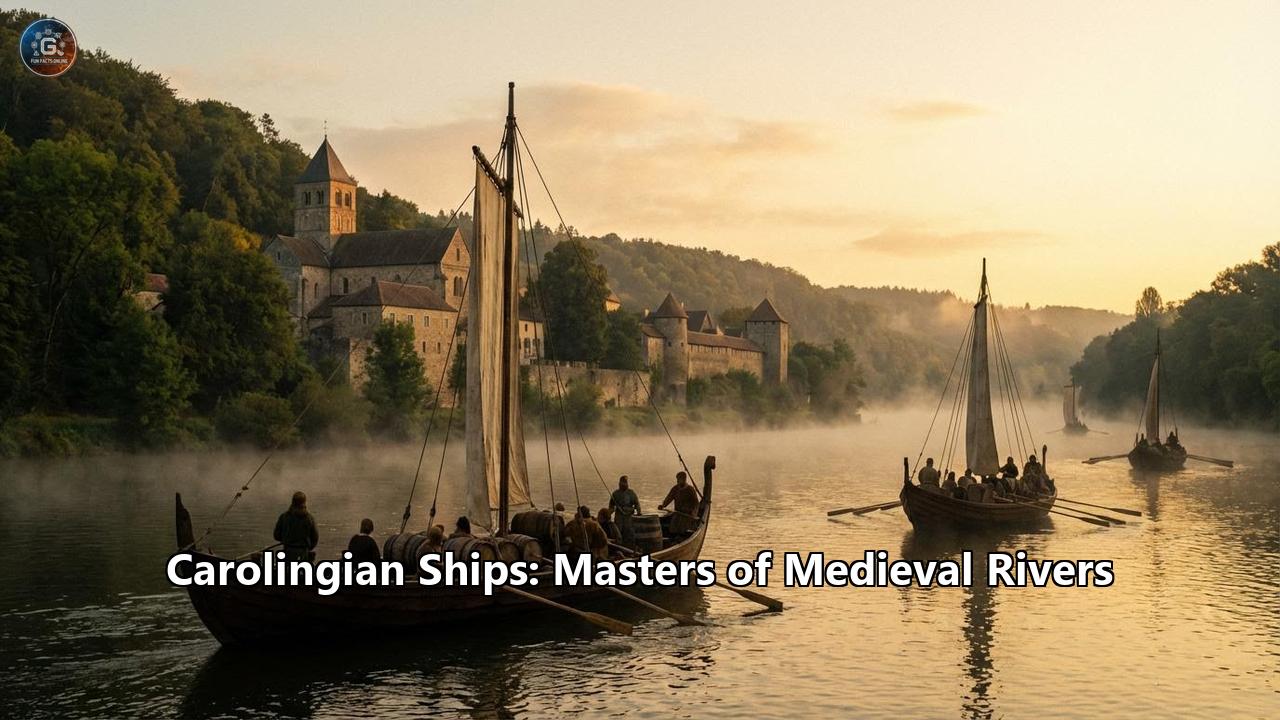
When we envision the Carolingian Empire—the vast early medieval realm that united much of Western Europe under Charlemagne—we often picture armored knights on horseback, towering stone cathedrals, and scholars toiling in candlelit scriptoria. Yet, the true lifeblood of this sprawling 8th- and 9th-century empire was not its deteriorating network of old Roman roads. It was water. The rivers of Europe—the Rhine, the Meuse, the Seine, the Loire, and the Garonne—served as the superhighways of the Dark Ages. And mastering these waterways required a highly specialized, surprisingly sophisticated feat of engineering: the Carolingian river ship.
Far from the sleek, predatory longships of their Viking contemporaries, Frankish ships were the unglamorous, heavy-lifting workhorses of medieval Europe. They were built for burden, designed to navigate shallow, shifting riverbeds, and engineered to transport the massive wealth of an expanding empire. From hauling giant barrels of Rhenish wine and heavy volcanic quern-stones to deploying Charlemagne’s armies across a continent, Carolingian watercraft were the unsung technological marvels that made the empire's dominance possible.
The Arteries of the Carolingian World: Why Rivers Mattered
To understand the design and purpose of Carolingian ships, one must first understand the logistical nightmare of the early medieval landscape. Following the collapse of the Western Roman Empire, the famous Roman road networks fell into severe disrepair. Without a centralized bureaucracy to pave and maintain them, overland travel became treacherous, painfully slow, and prohibitively expensive. Moving bulk goods over land by ox-drawn carts could easily cost more than the value of the goods themselves.
Rivers, however, provided a frictionless alternative. The Carolingian Empire was perfectly situated over a web of navigable waterways that connected the deep interior of the European continent to the North Sea, the English Channel, and the Mediterranean. Traveling downstream was a matter of riding the current; traveling upstream involved rowing, utilizing favorable winds with square sails, or employing teams of men and draft animals to tow the barges from the riverbanks.
Through this aquatic capillary system, the Carolingian economy boomed. A bustling network of river-bound merchants emerged, connecting the dense inland forests of Germany and Francia with the maritime trade routes of the Anglo-Saxons and Scandinavians. But this required a specific type of vessel—one that could carry massive tonnage, survive the hazards of submerged logs and sandbars, and dock easily without the need for deep-water stone piers.
Anatomy of a Carolingian River Boat: Built for Burden, Not for Speed
When comparing a Carolingian river boat to a Norse longship, the contrast in naval philosophy becomes starkly apparent. Viking ships were masterclasses in flexibility and speed; their clinker-built hulls (where thin planks overlapped) allowed the ship to bend and twist with the harsh ocean waves. They were the sports cars of the early medieval world.
The Carolingian river boat, conversely, was an armored transport truck. Operating primarily on inland waterways and along safe coastal routes, Frankish shipwrights prioritized structural integrity, cargo capacity, and a shallow draft.
Flat-Bottomed Design: The most distinct feature of the Carolingian river barge was its flat bottom. Lacking a deep, protruding keel like ocean-faring vessels, these ships could glide over shallow river shoals and be easily beached on muddy riverbanks for loading and unloading. This was essential in an era before advanced, deep-water harbor infrastructure was widespread. Massive Framing: Unlike the delicate, shell-first construction of Scandinavian ships, Frankish river boats were heavily timbered. The internal ribs (or frames) of the vessel were essentially raw, hewn tree limbs, chosen for their natural curvature to match the shape of the hull. These massive oak ribs were placed remarkably close together, creating a nearly solid wooden skeleton. This added immense weight to the vessel, but it provided the incredible sturdiness needed to support tons of cargo—such as stacked barrels of wine, heavy timber, and stone—without the hull buckling under the pressure. Planking and Fastenings: The outer hull, known as strakes, was typically joined flush edge-to-edge rather than overlapping. To hold this massive assembly together, Carolingian shipwrights relied on heavy iron rivets, wooden pegs known as treenails, and complex mortise-and-tenon joints. The gaps between the thick planks were tightly caulked using a mixture of animal hair, moss, and natural pine tar, ensuring a waterproof seal that actually improved over time as the wood swelled and the tar cured.Archaeological Breakthroughs: The Garonne Vessel and Dorestad Timbers
For decades, historians had to rely on fragmented textual sources and rare coin depictions to understand Carolingian ships. However, recent archaeological breakthroughs have pulled these vessels out of the mud and into the light.
In June 2022, the National Institute for Preventive Archaeological Research (INRAP) unearthed the spectacular remains of a massive riverboat buried south of Bordeaux, near the Garonne River. Dating to the 7th or 8th century, the vessel is a perfect surviving specimen of early Frankish naval architecture. Measuring an impressive 50 feet long by 20 feet wide, the Garonne ship perfectly illustrates the "crude but sturdy" ethos of Carolingian design. The ship features tightly packed, massive wooden ribs flattened just enough to attach thick floorboards and hull strakes. It is a vessel designed purely to haul immense weight along the regional river networks.
Further north, in March 2026, routine sewer replacement works in the Dutch town of Wijk bij Duurstede led to another sensational discovery. A vigilant volunteer spotted a massive protruding timber, which archaeologists quickly identified as a 3.2-meter-long, 30-centimeter-thick beam belonging to an early medieval ship. Featuring cut notches, shaping marks, and worked surfaces consistent with 8th-century shipbuilding techniques, the timber offers a rare, tangible link to the golden age of Carolingian shipping. Wijk bij Duurstede is no ordinary town; it sits directly atop the ruins of ancient Dorestad, the most important trading port of the Frankish Empire.
The Twin Jewels of Frankish Trade: Dorestad and Quentovic
The Carolingian river fleets were only as important as the destinations they served. In the north, the empire’s economic might flowed through two legendary emporia (trade towns): Dorestad and Quentovic.
Dorestad – The Emporium of the North: Located at the fork of the river Rhine and the river Lek in the modern-day Netherlands, Dorestad was the undisputed shipping hub of north-western Europe. Between the late 7th and mid-9th centuries, it was a booming metropolis by medieval standards, boasting an estimated population of up to 3,000 people. Dorestad featured wooden wharves that stretched for over a kilometer along the riverbank.Here, Carolingian river barges coming downstream from Germany unloaded their goods to be transferred onto hardier coastal ships heading for Scandinavia and Britain. The docks were piled high with luxury and staple goods: fine glass drinking vessels from the Rhineland, large barrels of Frankish wine from Mainz, expertly crafted swords, and massive lava quern-stones from the Eifel mountains used for grinding grain. In exchange, the Franks imported English lead, tin, high-quality wool, and amber from the Baltic.
Quentovic – The Gateway to Britannia: While Dorestad handled the North Sea trade, Quentovic was the crown jewel of the English Channel. Situated near the mouth of the Canche River in modern northern France, Quentovic was the primary departure point for merchants and diplomats traveling to the Anglo-Saxon kingdoms, particularly the Kingdom of Kent.Because these emporia were the bottlenecks through which all wealth flowed, the Carolingian kings maintained tight control over them. In Quentovic, merchants were subjected to indirect taxes and royal tolls that could reach up to 10% per exchange. The massive revenue generated by these river-borne trade hubs was the primary economic engine that funded Charlemagne’s relentless military campaigns across Europe.
Coinage and Commerce: The Ship Denier of Louis the Pious
The importance of shipping to the Carolingian mindset is perfectly immortalized in their currency. While early medieval coins often featured religious iconography or the stark profiles of kings, Charlemagne’s son and successor, Emperor Louis the Pious, minted a highly specific and fascinating coin: the "Ship Denier".
Minted primarily in the great port cities of Dorestad and Quentovic, the reverse side of this silver denier explicitly depicted a Carolingian ship. The imagery is striking—a deeply curved hull with a distinct mast, representing the commercial lifeblood that kept the empire afloat. The fact that the highest authority in Europe chose to brand his royal currency with the image of a merchant vessel underscores a profound historical reality: the Carolingians knew that their power was inherently tied to the mastery of the waterways.
Charlemagne’s Blue-Water Navy: The Forgotten Mediterranean Fleets
While the Carolingians are best remembered for their flat-bottomed river barges, it is a historical misconception that they entirely lacked a sea-faring navy. While they struggled to match the naval prowess of the Scandinavians in the treacherous North Sea, Charlemagne successfully constructed a "blue-water" navy in the south to project power across the Mediterranean and the Adriatic.
By the end of the 8th century, the southern coasts of the Carolingian Empire were under constant threat from Muslim corsairs and Saracen fleets operating out of Al-Andalus (Islamic Spain) and North Africa. In response, Charlemagne ordered the fortification of western Mediterranean ports from Rome to Barcelona and commissioned the construction of war fleets.
These southern Carolingian ships were likely influenced by residual Roman and contemporary Byzantine galley designs—sleeker, oar-powered, and capable of ramming and boarding. The results were highly successful. In 799, a Frankish fleet decisively defeated a Muslim flotilla off the coast of the Balearic Islands, securing Carolingian rule over the archipelago. Between 806 and 810, Charlemagne’s Adriatic fleets repeatedly engaged the powerful Byzantine navy with considerable success, and subsequent Frankish naval victories were recorded off the coasts of Corsica (806), Sardinia (807), and Majorca (813). Charlemagne clearly understood that continental dominance required control of the adjacent seas.
The Viking Asymmetry: Heavy Barges vs. The Dragon Ships
If the Carolingians were so capable on the water, why did their empire ultimately fall victim to the devastating Viking raids of the 9th century? The answer lies in naval asymmetry.
The Carolingian maritime apparatus was designed primarily for predictable, high-volume river trade and traditional Mediterranean galley warfare. When the Norsemen arrived in the north, they brought a disruptive technology: the longship. The Viking longship was a masterwork of clinker-built engineering—incredibly light, shockingly fast, and possessing a draft so shallow (often less than a meter) that it could sail directly from the open ocean deep into the shallowest Frankish rivers.
A Carolingian river barge, heavy with thick oak ribs and cargo, simply could not pursue a Viking longship. The Franks could not catch them on the open water, nor could they outmaneuver them in the estuaries. Realizing that engaging the Norsemen in ship-to-ship combat in the North Sea was a losing proposition, the Carolingians stuck to what they did best: heavy engineering.
Charlemagne and his successors responded to the Viking threat by attempting to blockade the river highways. They built heavily fortified stone and timber bridges across the Seine and the Loire, deliberately designed to sit too low for Viking ships to pass beneath. They stationed garrisons at the mouths of rivers and ordered the construction of specialized defense fleets at Boulogne and Ghent.
Despite these massive engineering efforts, the sheer speed and numbers of the Viking incursions overwhelmed the defenses. The great emporia were completely exposed. Dorestad was sacked by Vikings repeatedly starting in 834. Quentovic suffered a devastating sack in 842, marking a turning point that crippled Frankish maritime trade. Unable to defend the open river ports, the Carolingian economy was forced to retreat inland behind massive stone walls, shifting commerce from open emporia to fortified towns (burhs and bourgs).
The Craft of the Early Medieval Shipwright
To truly appreciate the Carolingian ship, one must strip away the modern concept of manufacturing. These massive vessels were constructed entirely without power tools, standardized parts, or modern synthetic sealants. The early medieval shipwright—often called a treewright—was an absolute master of geometry, metallurgy, and natural materials.
Sourcing the Timber: Building a single river barge required dozens of mature oak trees. The wood had to be felled by hand during the winter months when the sap was low, preventing the wood from rotting. Shipwrights did not use large saws to create planks; instead, they used iron wedges to split the logs along their natural grain, ensuring maximum strength and preventing the wood from splintering under stress. The Tool Kit: The primary tool of the Carolingian shipwright was the adze—a specialized cutting tool with a blade set at a right angle to the handle. With the adze, a skilled builder could shape a raw, twisted tree branch into a perfectly flush hull frame. Broadaxes were used for hewing logs, while T-shaped hand augers were used to bore hundreds of holes through the thick timber for the insertion of wooden pegs (treenails) and iron rivets. Iron and Fire: The iron fastenings used in these ships were handcrafted by local blacksmiths. Because the iron was repeatedly heated and hammered by hand, it developed a dense, crystalline grain structure that was highly resistant to rust and corrosion in the harsh, wet environments of the rivers.To shape the massive hull planks, the shipwrights would suspend the wood over carefully controlled open fires or steam pits. The heat and moisture softened the lignin in the wood, allowing it to be slowly bent into the sweeping, curved shape required for the ship's bow and stern. Once cooled, the wood locked into its new shape permanently.
The Legacy of Carolingian Shipping: Paving the Way for the Cog
By the late 9th and early 10th centuries, the Carolingian Empire began to fracture due to internal civil wars and external pressures from Vikings, Magyars, and Saracens. The golden age of Dorestad and Quentovic faded into memory, their wooden wharves rotting away and their exact locations lost to time until modern archaeologists rediscovered them.
However, the legacy of the Carolingian river ship did not die; it evolved. The heavy, sturdy, flat-bottomed design of the Frankish barges laid the architectural groundwork for the most important trading vessel of the High Middle Ages: the Cog.
As the Viking Age ended and northern European trade began to centralize under the powerful Hanseatic League, merchants needed ships that combined the open-sea capabilities of a Norse longship with the massive, bulky cargo capacity of a Carolingian river barge. The resulting Cog utilized the heavy, frame-first construction methods pioneered by the Franks, adopting the flat bottom to navigate tidal flats and shallow estuaries, while incorporating high, castle-like sides to defend against piracy.
The mighty Carolingian ships were the unsung heroes of early medieval Europe. They did not conquer foreign shores with the terrifying speed of the dragon ships, nor did they sail across oceans to discover new worlds. Instead, they performed the quiet, monumental task of holding an empire together. They moved the stone that built the churches, carried the wine that graced the emperor's table, and forged the economic arteries that pulled Western Europe out of the shadow of Rome and into a new medieval dawn.
Reference:
- https://en.wikipedia.org/wiki/History_of_France
- https://en.wikipedia.org/wiki/Dorestad
- https://www.8thcentury.com/a-frankish-river-boat/
- https://www.quora.com/Why-did-Charlemagne-never-conquer-Denmark
- https://www.quora.com/How-was-Denmark-spared-from-being-conquered-and-absorbed-by-the-Holy-Roman-Empire
- https://ealdlar.com/early-medieval-trade
- https://www.reddit.com/r/AskHistory/comments/qwtbfo/could_boats_sail_up_rivers_in_medieval_times/
- https://www.rmg.co.uk/stories/maritime-history/shipbuilding-800-1800
- https://www.youtube.com/watch?v=zO7arTARNbY
- https://en.wikipedia.org/wiki/Ancient_shipbuilding_techniques
- https://en.wikipedia.org/wiki/Quentovic
- https://en.numista.com/343634
- https://arkeonews.net/viking-era-ship-timber-discovered-in-the-netherlands-during-sewer-works/
- https://woodcentral.com.au/1200-year-old-ship-timber-found-at-frankish-empires-greatest-port/
- https://www.culturefrontier.com/dorestad/
- https://lamaisondequentovi.wixsite.com/quentovic/story-of-quentovic
- https://dokumen.pub/after-romes-fall-narrators-and-sources-of-early-medieval-history-0802007791.html
- https://www.1066.co.nz/Mosaic%20DVD/library/Medieval%20Shipping.pdf
- https://www.historyatlas.com/events/danish-vikings-sack-quentovic-a-frankish-emp/
- https://arkeonews.net/viking-era-ship-timber-discovered-in-the-netherlands-during-sewer-works/