
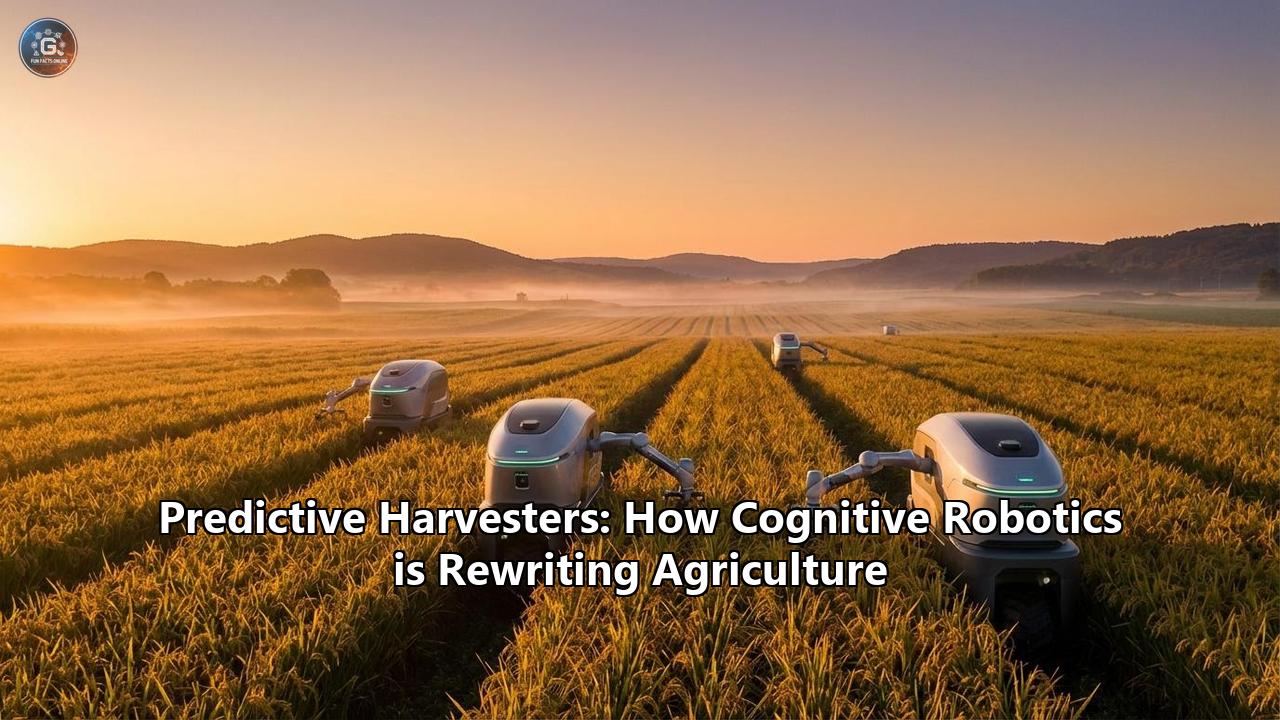
The agricultural industry is standing at the precipice of the most profound transformation since the invention of the motorized tractor. For generations, farming has been a delicate dance with the unpredictable—weather patterns, labor availability, and the biological whims of the crops themselves. Today, however, the variables that once defined the immense risks of farming are being systematically decoded by artificial intelligence. At the vanguard of this revolution is a new breed of technology: the predictive harvester, driven by the principles of cognitive robotics.
No longer are we simply talking about automation—the blind, repetitive execution of pre-programmed tasks. We are entering the era of cognitive agriculture, where machines can see, think, learn, and act with a level of precision and intuition that rivals, and in some cases surpasses, human capability. By merging computer vision, advanced machine learning, and soft robotics, these systems are fundamentally rewriting the rules of crop production, yield optimization, and sustainability.
To understand the magnitude of this shift, one must delve into the mechanics, the algorithms, and the real-world applications of cognitive robotics in the fields. This comprehensive exploration will dissect how predictive harvesters are built, how they think, and why they are the ultimate answer to the existential challenges facing modern agriculture.
The Breaking Point of Traditional Agriculture
To appreciate the necessity of cognitive robotics, we must first examine the compounding crises that have brought traditional agriculture to its breaking point. The global population is expanding, demanding a staggering increase in food production. Simultaneously, climate change is altering growing seasons, intensifying droughts, and making traditional farming calendars obsolete.
However, the most acute pain point for the agricultural sector in recent years has been the severe and worsening shortage of manual labor. Harvesting delicate, high-value crops—such as strawberries, tomatoes, and tree fruits—has historically been completely reliant on human hands. Unlike wheat or corn, which can be aggressively collected by massive, indiscriminate combine harvesters, soft fruits require a gentle touch and a discerning eye. A human picker knows instinctively whether a strawberry is perfectly red or still slightly green, and can intuitively navigate around stems and leaves to extract the fruit without bruising it.
When human labor becomes scarce, crops rot in the fields. The industry attempted to solve this with early-generation automated harvesters, but these machines were rudimentary. They were essentially mechanical algorithms: "move forward, extend arm, close gripper, retract." If a fruit was obscured by a leaf, the robot failed. If the fruit was unripe, the robot picked it anyway. If the plant was swaying in the wind, the robot missed its target entirely. The limitations of blind mechanization became glaringly obvious. The industry didn't just need machines that could move; it needed machines that could think.
Enter Cognitive Robotics: The "ABC" Paradigm
The solution to the limitations of traditional automation lies in a multidisciplinary approach often referred to as the "ABC" paradigm—Agricultural, Biological, and Cognitive robotics. This framework represents a departure from purely mechanical engineering, focusing instead on endowing robots with high-level capabilities inspired by biological systems and human cognition.
- Agricultural Context: The machine must be rugged enough to survive the dirt, moisture, and thermal extremes of a working farm or greenhouse.
- Biological Inspiration: The robot must understand the biological realities of the crop—how it grows, how it responds to touch, and how it is clustered. It also involves bio-inspired physical designs, such as soft, pneumatic grippers that mimic the delicate grasp of human fingers.
- Cognitive Processing: This is the game-changer. Cognitive robots are equipped with higher-level reasoning. They can perceive their environment dynamically, reason about uncertainties, make autonomous decisions, and learn from their mistakes.
A cognitive harvester does not operate on a fixed loop. When it approaches a vine, it assesses the situation as a unique problem to be solved. It analyzes the spatial relationship between the fruit, the stem, and the trellis. It predicts the behavior of the plant, anticipates obstacles, and calculates the optimal trajectory for extraction. This is the essence of cognitive robotics in agriculture: the marriage of perception and action through intelligent reasoning.
Demystifying Predictive Harvesting
The true power of cognitive robotics is fully realized when it transitions from reactive operation to proactive strategy. This is the domain of predictive harvesting.
Predictive harvesting goes far beyond the physical act of picking a fruit. It is an overarching, data-driven methodology that anticipates crop readiness, optimizes harvest timing, and predicts yield with astonishing accuracy. By continuously analyzing historical data, real-time sensor inputs, weather forecasts, and soil conditions, AI algorithms can predict precisely when a specific zone of a field or greenhouse will reach peak maturity.
The Mathematics of Growth: Markov Chain Vegetation Cycle Models
To predict the future of a crop, machines rely on highly sophisticated mathematical models. One of the most groundbreaking approaches involves the use of Non-Stationary Markov Chain Vegetation Cycle Models, particularly in the cultivation of covered crops like strawberries in greenhouses or foil tunnels.
A Markov chain is a stochastic model describing a sequence of possible events, where the probability of each event depends only on the state attained in the previous event. In the context of agriculture, researchers have calibrated these models using real-life observations of strawberry variant growth, factoring in dynamic variables such as insolation (sunlight exposure), ambient temperature, and humidity.
Because a greenhouse environment is dynamic, the Markov chain is "non-stationary"—meaning the transition probabilities between different stages of plant growth shift as environmental conditions change. This vegetation cycle model is deeply embedded into a broader crop simulation system. As autonomous robots patrol the greenhouse, they don't just harvest; they scan and record data on all the fruits they encounter, including those left on the gutters.
The application uses this massive influx of visual and environmental data to calculate the exact sites within the greenhouse that possess the highest expected density of ripe fruit. Instead of wandering aimlessly or following a rigid row-by-row schedule, the robotic fleet is dynamically deployed each morning to the most profitable zones. This multicriteria optimization maximizes harvest yield and efficiency while minimizing the mass of ripe fruits that are missed and left to rot.
AI-Powered Crop Yield Prediction
Predictive harvesting is inherently tied to crop yield prediction. Advanced machine learning algorithms, including complex regression models and deep neural networks, analyze vast datasets to forecast the quantity and quality of agricultural produce.
These AI models ingest a symphony of data points:
- Satellite Imagery and Drone Footage: Multispectral and hyperspectral imaging can detect chlorophyll content and leaf area index, providing a macro-view of crop health before symptoms are visible to the naked eye.
- Micro-climate Data: Soil moisture sensors, localized weather stations, and ambient temperature gauges feed the algorithms with the exact conditions experienced by the plants.
- Historical Yields: The AI learns from the successes and failures of previous seasons, identifying hidden patterns in big data that human analysts might miss.
By 2026, the integration of these AI methodologies allows farmers to make highly informed decisions regarding resource allocation. If the predictive harvester's network indicates a massive, accelerated ripening event due to an unexpected heatwave, the farm can preemptively deploy its robotic fleet and schedule logistics and cold-storage transport well in advance, preventing catastrophic supply chain bottlenecks.
The Eyes of the Machine: Advanced Vision Systems
For a cognitive robot to make decisions, it must first perceive the world with extreme clarity. The vision systems of modern predictive harvesters are marvels of optical engineering and artificial intelligence.
360-Degree LiDAR and Spatial Awareness
Navigation in an agricultural setting is notoriously difficult. Fields are unstructured environments filled with changing terrain, moving equipment, human workers, and unpredictable obstacles. To solve this, leading agricultural robotics companies have equipped their harvesters with advanced 360-degree LiDAR (Light Detection and Ranging) systems.
These LiDAR units generate real-time, three-dimensional maps of the fields, plants, and all surrounding objects. This dense point-cloud data allows a massive robotic strawberry harvester, for instance, to navigate precisely down narrow rows without colliding with growing plants, human supervisors, or other obstructions.
Hyperspectral Imaging and Ripeness Detection
While LiDAR handles spatial awareness, the actual identification of the crop relies on high-resolution, multi-camera arrays augmented by AI vision models. When a robotic harvester approaches a plant, it captures 360-degree images of the foliage and the fruit.
Deep learning algorithms analyze these images in milliseconds. They evaluate the intensity of color (e.g., the precise wavelength of redness in a strawberry), the size, and the shape of the fruit. More advanced systems utilize hyperspectral imaging, which captures data across the electromagnetic spectrum, far beyond what the human eye can see. This allows the robot to detect subtle chemical changes in the fruit, identifying not only if it is ripe, but also assessing its sugar content, detecting early signs of disease, or spotting parasite infestations.
Infected or rotten fruits pose a severe risk to the rest of the crop. Advanced predictive systems are designed to detect these biological hazards so that specialized robots, equipped with specific grippers and disinfection capabilities, can safely remove the compromised fruit, halting the spread of disease.
The Brain of the Machine: "Harvest-Ease" and Oscillation Prediction
Perceiving a ripe fruit is only half the battle; successfully extracting it from a complex biological structure requires immense cognitive processing.
The "Harvest-Ease Estimation" Breakthrough
A profound leap forward in cognitive agricultural robotics occurred with the development of "harvest-ease estimation" systems. Traditional harvesting robots operated on a binary logic: "Is the fruit ripe? If yes, pick it." This often led to failure if the fruit was tangled in stems or hidden behind thick leaves.
Researchers at Osaka Metropolitan University revolutionized this process by training robots to "think before they act." Instead of merely identifying a ripe tomato, the AI evaluates how easy the tomato will be to harvest. The system combines image recognition with statistical analysis to evaluate visual details: the orientation of the tomato, the thickness of its stem, and whether it is obstructed by adjacent unripe fruit or leaves.
Based on these inputs, the robot calculates the "harvest-ease" and autonomously decides the optimal angle and approach to pick the fruit. If a tomato is deemed too difficult from the current vantage point, the robot dynamically switches angles on the fly. This cognitive strategy dramatically boosted harvesting success rates to 81%, representing a monumental shift from blind automation to intelligent adaptation.
Taming the Chaos: The ARIMA-EEMD-LSTM Model
One of the most frustrating challenges in robotic harvesting is dealing with movement. When a robot touches a plant, or when the wind blows, the entire structure sways. For crops like trellised tomatoes grown in greenhouses, the flexible elasticity of hanging vine ropes induces persistent, nonlinear oscillations.
Historically, harvesting robots lacking efficient prediction algorithms were forced to simply stop and wait for the plant to stop swinging before attempting a pick. This waiting period severely curtailed operational efficiency, making the robots economically unviable.
To solve this, researchers developed highly sophisticated physics-based predictive models, most notably combining visual sensing with a hybrid AI model known as ARIMA-EEMD-LSTM (Autoregressive Integrated Moving Average - Ensemble Empirical Mode Decomposition - Long Short-Term Memory).
This deep learning framework acts as a physics engine within the robot's brain. By analyzing the initial movement of the vine, the LSTM neural network can accurately predict the exact trajectory and future position of the oscillating tomato in real-time. The model achieves astonishing precision, predicting the spatial position of swinging fruits with an error margin of merely fractions of a millimeter (e.g., an RMSE of 0.1008–0.2429 mm under single-fruit oscillation).
Armed with this cognitive foresight, the robotic arm does not have to wait for the plant to settle. It anticipates where the tomato will be a second later and moves its gripper to intercept it mid-swing, vastly increasing harvest speed and success rates.
The Hands of the Machine: Bio-Inspired Gripping Mechanisms
The most advanced brain and eyes are useless if the machine destroys the crop upon contact. The development of biologically inspired gripping mechanisms has been critical to the viability of cognitive harvesters.
Traditional mechanical claws are too rigid for soft fruits like berries, peaches, or tomatoes. Applying too much pressure results in bruising, rendering the fruit unsellable. Applying too little pressure causes the fruit to drop and perish.
To solve this, the robotics industry has turned to soft robotics and impedance control. Modern end-effectors are often made of food-safe silicones and pneumatically driven soft plastics that mimic the compliance of human skin. Some systems utilize a targeted suction mechanism that gently pulls the fruit into a soft cup, while a specialized micro-blade snips the stem, ensuring the delicate flesh of the fruit is never actually squeezed.
Furthermore, cognitive robots utilize haptic feedback loops. As the gripper closes around a piece of produce, micro-sensors measure the resistance. The AI instantly processes this tactile data, adjusting the grip strength in real-time to match the specific density of that individual fruit. This level of delicate manipulation, once the exclusive domain of human laborers, is now being executed by machines at a rate of thousands of times per hour.
Real-World Titans of 2026: Case Studies in the Field
The concepts of cognitive robotics and predictive harvesting are not confined to academic papers or laboratory prototypes. By 2026, these technologies have been unleashed on commercial farms globally, reshaping entire agricultural sectors.
1. The Autonomous Grain Armadas: Cognitive Pilot
While soft fruit harvesting requires delicate dexterity, broad-acre farming requires massive scale and situational awareness. In the vast wheat fields spanning from Eastern Europe to the Russian Far East, fleets of autonomous combine harvesters have been deployed, driven by AI systems like the Cognitive Agro Pilot.
Unlike older automated tractors that rely entirely on GPS (which can lose signal or lack centimeter-level accuracy for edge cases), the Cognitive Agro Pilot operates primarily through computer vision. The system's "brain" processes live video feeds from a single camera ("one-eyed Vasya") to understand the field exactly as a human driver would.
These colossal machines drive themselves, maintaining precise distances between crop rows to minimize gaps and maximize yield. The cognitive AI continuously scans for obstacles—whether it's a large rock, a ditch, or moving machinery. If it detects a moving obstacle, the system categorizes it, forecasts its trajectory, and makes an autonomous decision to slow down, maneuver around it, or alert a human supervisor. Furthermore, these combines communicate dynamically with grain trucks, coordinating complex formations on the fly to unload grain while moving, ensuring the harvest never stops. By acting as a highly resilient, vision-based network, these systems have revolutionized grain economics, vastly outperforming the 20-hectare-per-shift limit of human-driven combines.
2. The Multi-Armed Strawberry Leviathans
The $24 billion global strawberry market has been heavily targeted by robotics companies due to its extreme reliance on manual labor. Modern predictive strawberry harvesters are modular, autonomous vehicles that function as roving factories.
A single machine often features up to 16 independently working robotic arms, all orchestrated by a central AI brain. As the massive vehicle slowly straddles the plant beds, its dual-camera vision systems capture and process 360-degree imagery in real-time. The system targets ripe berries, computes their coordinates, and dispatches a picking claw—all within seconds.
But the process doesn't end with picking. Immediately after extraction, the berry is passed through an onboard secondary inspection system. Using advanced neural networks, the harvester analyzes a 360-degree view of the harvested berry and grades it for "fresh pack" or "processing" within 15 milliseconds. This automated grading and packing process replaces dozens of human laborers and ensures a perfectly consistent product reaches the supermarket.
3. AI Land's "Davegi": The Holistic Micro-Farm Robot
While massive machines dominate large commercial operations, cognitive robotics is also transforming smaller-scale, diverse vegetable farming. A prime example is "Davegi," an award-winning semi-mobile agricultural robot developed by the start-up AI Land (rooted in the Institute for Mobile Autonomous Systems and Cognitive Robotics at Aachen University).
Davegi is not just a harvester; it is an end-to-end cognitive farming system. Designed to operate autonomously on 2,500 square meter plots, it seamlessly transitions between ploughing, sowing, watering, fertilizing, and harvesting up to ten different varieties of vegetables.
What sets Davegi apart is its self-sufficiency and environmental integration. The robot is topped with eight solar modules and continuously circles the fields. By constantly moving, it acts as a dynamic agri-photovoltaic system, generating solar energy to power itself without casting permanent, harmful shadows over the crops. The developers assert that this cognitive routing allows for a 50 percent more efficient use of parallel energy and vegetable production compared to stationary solar setups. In a single day, Davegi can autonomously fill 60 crates with 600 pieces of precisely harvested vegetables, tailored to the specific needs of each individual plant.
4. Precision Legume Harvesters via Deep CNNs
Legume crops (such as soybeans and dandelions) present their own unique visual challenges due to heavy foliage occlusion. To harvest these effectively, researchers have deployed highly specialized, AI-powered robotic systems relying on 4-layer Convolutional Neural Networks (CNNs).
Through extensive training datasets and transfer learning methods, these models have achieved an astonishing overall accuracy of 99.71% in detecting and classifying target legumes amidst chaotic backgrounds. Once the crop is identified, reinforcement learning algorithms guide the robotic arm, dynamically learning the optimal tactics to retrieve the crop efficiently without destroying the surrounding plant structure. Field tests have confirmed that these AI-powered systems meet or exceed the quality requirements of traditional hand-harvesting, proving their viability in standard agricultural setups.
Economic Impact: The $17 Billion Boom
The rapid adoption of predictive harvesters is triggering an economic seismic shift in the agricultural sector. The global market for crop harvesting robots is experiencing explosive growth, projected to hit $17.73 billion by the late 2020s, driven by a staggering Compound Annual Growth Rate (CAGR) of 41.9%.
This massive influx of capital is not speculative; it is a vital response to the economics of survival.
- Labor Cost Mitigation: The most immediate ROI (Return on Investment) for a farm deploying cognitive robots is the drastic reduction in labor costs. With automated harvesters reducing labor needs by up to 40% in advanced operations, farms can insulate themselves from the volatility of migrant labor availability and rising minimum wages.
- Yield Maximization and Waste Reduction: Conventional farming suffers from massive shrinkage due to poor harvest timing. A crop picked too early is rejected by buyers; a crop picked too late rots in transit. By leveraging predictive algorithms, farms ensure that produce is harvested at peak market value. The multi-criteria optimization of Markov Chain models ensures that virtually no profitable fruit is left behind.
- 24/7 Operations: Human pickers require rest, daylight, and safe weather conditions. Cognitive robots equipped with LiDAR and localized illumination can harvest 24 hours a day, slicing through the night to ensure highly perishable crops are extracted exactly when their sugar content and firmness are optimal.
- Data Monetization: The data collected by predictive harvesters is intrinsically valuable. Detailed, plant-by-plant analytics can be integrated with overarching farm management software, allowing agribusinesses to precisely calibrate fertilizer and water purchasing for the following season.
A Catalyst for Sustainable Agriculture
Beyond economics, the transition to AI-powered predictive harvesting is a major victory for environmental sustainability. The traditional model of agriculture is resource-heavy, relying on blanket applications of water, pesticides, and fertilizers, combined with heavy diesel machinery that compacts soil and emits high levels of greenhouse gases.
Cognitive robotics flips this paradigm to a model of extreme precision.
- Chemical Reduction: Because cognitive robots analyze the health of crops at an individual plant level, they enable micro-targeted spraying. If the hyperspectral sensors detect a fungal infection on a single cluster of vines, the robot applies fungicide only to that specific area, rather than blanketing the entire 100-acre field. This drastically reduces chemical runoff into local water tables.
- Water Optimization: By integrating predictive yield data with soil moisture sensors, AI algorithms advise precisely how much water is needed to bring a specific crop zone to optimal harvest maturity, conserving millions of gallons of water in drought-stricken agricultural regions.
- Energy Efficiency and Soil Health: Modern predictive harvesters are increasingly designed with high-efficiency hybrid or fully electric drivetrains. Furthermore, lightweight, autonomous swarm robots cause significantly less soil compaction than massive traditional tractors, preserving the delicate microbiome of the topsoil, which is vital for long-term carbon sequestration and crop health.
The Human-Robot Collaborative Future (Cobotics)
A common fear surrounding automation is the total displacement of the human worker. However, the reality of cognitive agriculture in 2026 is one of collaboration, commonly referred to as "cobotics."
The sheer complexity of biological environments means that edge cases will always exist. The vision established by researchers, such as the team at Osaka Metropolitan University, is not a farm devoid of humans, but a synergistic environment.
In this new paradigm, the AI harvester autonomously targets and picks the crops that are estimated to have a high "harvest-ease". It rapidly clears the bulk of the field, handling the predictable and accessible fruit. Human workers, relieved of the backbreaking, repetitive labor, are elevated to specialized roles. They follow behind the machines to handle the highly challenging fruits—those tangled deep within the vines or growing in anomalous clusters.
Furthermore, the role of the modern farmer is evolving from a manual laborer to a fleet manager and data analyst. Farm workers are now operating iPads on the edge of the field, monitoring the real-time AI dashboards of their robotic fleets, assessing predictive yield curves, and making high-level strategic decisions based on the data harvested by the machines. This technological elevation is helping to make agriculture an attractive, high-tech career path for a new generation, combating the demographic aging of the global farming population.
The Road Ahead: Overcoming the Final Hurdles
While the technology is advancing at breakneck speed, the widespread democratization of predictive harvesters faces several hurdles.
The primary barrier is capital expenditure. While the long-term ROI is clear, the initial cost of acquiring a fleet of advanced cognitive robots, complete with LiDAR, multi-spectral cameras, and AI processing units, is prohibitive for many small-to-medium-sized family farms. However, we are beginning to see the emergence of "Harvesting-as-a-Service" (HaaS) business models. Instead of buying the robots, farmers contract a robotics company to deploy a fleet to their fields for the duration of the harvest window, paying by the ton or the acre. This effectively lowers the barrier to entry, allowing smaller farms to access state-of-the-art AI without the crushing upfront costs.
Another challenge is rural connectivity. Predictive AI models rely heavily on cloud computing and constant data exchange. Many rural farming communities still lack the robust 5G infrastructure required to transmit massive amounts of 3D point-cloud and hyperspectral data in real time. To counter this, robotics manufacturers are increasingly utilizing edge computing—installing powerful AI microprocessors directly onto the harvester itself, allowing the machine to process complex neural networks and make cognitive decisions locally, regardless of internet connectivity.
Conclusion: Reaping the Cognitive Harvest
The integration of artificial intelligence, computer vision, and cognitive robotics into the agricultural sector is not merely an incremental upgrade; it is an absolute necessity for the survival of the global food supply chain. The challenges of the 21st century—a booming population, a shrinking labor force, and a volatile climate—cannot be solved by simply building larger, heavier versions of 20th-century tractors.
By endowing machines with the ability to perceive their environment, predict the biological future of a plant, and physically interact with the world with calculated delicacy, we have initiated a new agricultural epoch. Predictive harvesters represent the pinnacle of this achievement. They are the tireless, intelligent stewards of our fields.
As algorithms become more refined, as robotic grips become softer and more intuitive, and as predictive models peer deeper into the biological lifecycle of our crops, the farms of tomorrow will operate with a level of precision and efficiency that was once relegated to the realm of science fiction. Agriculture has always been humanity's most vital endeavor. With the rise of cognitive robotics, it is finally becoming our smartest.
Reference:
- https://in.bgu.ac.il/en/robotics/Pages/about.aspx
- https://pmc.ncbi.nlm.nih.gov/articles/PMC10010232/
- https://keymakr.com/blog/predicting-the-bounty-ai-powered-crop-yield-prediction-and-harvest-optimization/
- https://scholarspace.manoa.hawaii.edu/server/api/core/bitstreams/f3cd1b3d-69b6-46d0-9cdc-baafb6fe59d1/content
- https://scholarspace.manoa.hawaii.edu/items/159424ce-8bc3-42a0-b0fa-fab744e8060f
- https://farmonaut.com/precision-farming/algorithms-optimizing-floral-harvesting-automated-crop
- https://www.youtube.com/watch?v=izKBJIfqI30
- https://www.sciencedaily.com/releases/2026/03/260317064512.htm
- https://www.mdpi.com/2077-0472/15/23/2418
- https://www.archivemarketresearch.com/reports/crop-harvesting-robots-279072
- https://farmonaut.com/precision-farming/ai-harvesting-harvesting-robot-top-7-machines-2026
- https://en.cognitivepilot.com/hot-news/breaking-news-ieee-robotic-farming-russia/
- https://www.all-about-industries.com/agricultural-robot-fills-60-vegetable-crates-per-day-a-262dae89423e877cd3792b131c5d00aa/
- https://www.arccjournals.com/journal/legume-research-an-international-journal/LRF-793