
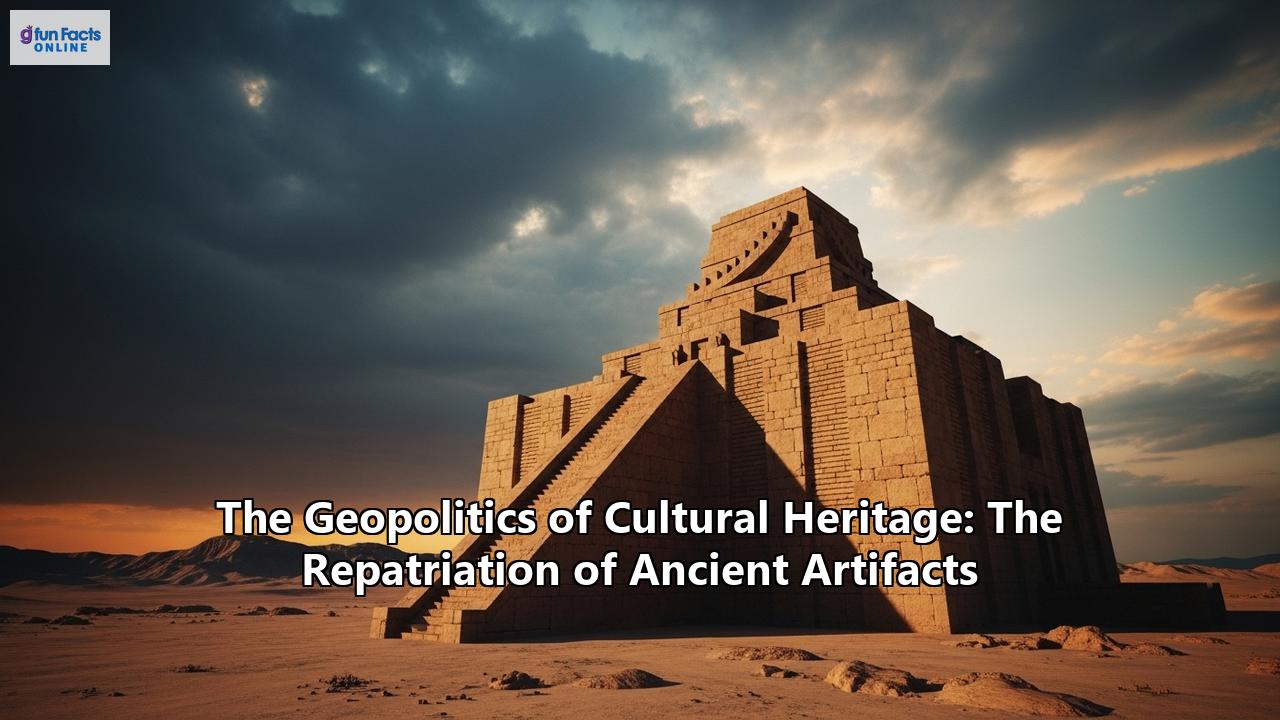
The Geopolitics of Cultural Heritage: The Repatriation of Ancient Artifacts
In the hallowed halls of the world's most prestigious museums, priceless artifacts whisper tales of ancient civilizations, artistic genius, and human history. But for many, these whispers are drowned out by a clamorous question of ownership, a question that strikes at the heart of colonial legacies, national identity, and the very definition of cultural heritage. The push for the repatriation of ancient artifacts—the return of cultural property to its country of origin—has become a focal point of intense geopolitical debate, challenging the foundations of museum collections and forcing a global reckoning with the past. This is not merely a matter of returning objects; it is a profound negotiation of power, memory, and justice in a post-colonial world.
A Legacy of Plunder: How the West's Museums Were Filled
The story of many of the world's most famous museums is inextricably linked to the age of empire. During the 19th and early 20th centuries, as European powers expanded their colonial reach, a torrent of cultural artifacts flowed from Africa, Asia, and the Americas into the coffers of Western nations. This was often not a gentle acquisition; it was frequently an act of plunder, a spoil of war, or a transaction conducted under the extreme duress of colonial domination.
Archaeological expeditions, often funded by Western institutions, unearthed ancient treasures that were then shipped back to Europe and North America to be studied and displayed as a testament to the "discoveries" of the explorers and the "primitiveness" of the colonized. This process mutually supported the colonial enterprise; the acquisition of ancient knowledge justified further colonial dominance, while shaping how European colonialists identified with the artifacts and the ancient peoples who made them. In many cases, these artifacts were seen as trophies, symbols of military might and cultural superiority.
This historical context is crucial to understanding the current demands for repatriation. For many nations, the presence of their most significant cultural treasures in foreign museums is a constant and painful reminder of a history of subjugation and the violent erasure of their cultural identity.
The Great Debates: Contentious Cases That Define the Discourse
The arguments for and against repatriation are complex and multifaceted, often pitting the ideals of cultural nationalism against those of cultural internationalism. These debates are best understood through the lens of some of the most iconic and long-running repatriation disputes.
The Elgin Marbles: A Two-Century Controversy
Arguably the most famous repatriation case is that of the Elgin Marbles, a collection of classical Greek marble sculptures that were once part of the Parthenon on the Acropolis in Athens. Between 1801 and 1812, Thomas Bruce, the 7th Earl of Elgin and the British ambassador to the Ottoman Empire, removed the sculptures and transported them to Britain. In 1816, the British Parliament purchased the collection, and it has been housed in the British Museum ever since.
Greece has formally demanded the return of the Marbles since 1983, arguing that they were taken illegally by a foreign occupying power and are an inalienable part of their national and cultural heritage. The Greek government contends that the Parthenon and its sculptures are a single, indivisible work of art that can only be truly appreciated in its original context.
The British Museum, backed by the UK government, has consistently refused to return the Marbles. It argues that Lord Elgin acted with the permission of the legitimate Ottoman authorities at the time and that the museum has protected the sculptures from the ravages of pollution and neglect that have damaged the remaining structures in Athens. The museum also posits itself as a "universal museum," where the Marbles can be seen in a global context by an international audience, a claim that is itself a subject of heated debate.
The Rosetta Stone: A Spoil of Imperial War
Another of the British Museum's most prized possessions, the Rosetta Stone, is also the subject of repatriation calls from Egypt. Discovered by French soldiers in 1799 during Napoleon's campaign in Egypt, the stone was the key to deciphering ancient Egyptian hieroglyphs. However, following the defeat of the French by British forces in 1801, the stone, along with other antiquities, was surrendered to the British as a spoil of war.
Egyptian archaeologists and officials argue that the stone was taken illegally, an "act of plunder" that symbolizes Western cultural violence against Egypt. They contend that Egypt, as a subject of the Ottoman Empire at the time, had no say in the 1801 treaty that handed over their heritage. The British Museum counters that the treaty was signed by a representative of the Ottoman government, which was the legitimate ruling power in Egypt. The museum also points out that there are numerous other copies of the same decree in Egypt, though none hold the iconic status of the Rosetta Stone.
The Benin Bronzes: A Reckoning with Colonial Violence
The case of the Benin Bronzes presents a stark and undeniable example of colonial looting. In 1897, British forces launched a brutal "punitive expedition" against the Kingdom of Benin (in modern-day Nigeria), razing the capital and looting thousands of intricate brass and ivory sculptures and plaques from the royal palace. These artifacts, which hold profound religious and cultural significance for the Edo people, were auctioned off and are now scattered across museums in Europe and the United States.
In recent years, there has been a significant shift in the discourse surrounding the Benin Bronzes. A growing number of Western institutions are acknowledging the violent and unethical circumstances of their acquisition and have begun to repatriate them. Germany, for instance, has transferred ownership of over 1,100 Bronzes back to Nigeria. The Netherlands has also returned a significant number of artifacts. However, the British Museum, which holds the largest collection, has been more hesitant, citing legal constraints imposed by the British Museum Act of 1963 which prevents the deaccessioning of objects from its collection. This has led to ongoing negotiations and a broader conversation about the legal and moral responsibilities of museums.
The Legal and Ethical Battlefield
The debate over repatriation is fought on both legal and ethical grounds, with a complex web of international conventions, national laws, and philosophical arguments shaping the discourse.
International Frameworks: A Patchwork of Principles
Several international treaties have been established to address the illicit trafficking of cultural property. The most significant of these is the 1970 UNESCO Convention on the Means of Prohibiting and Preventing the Illicit Import, Export and Transfer of Ownership of Cultural Property. This convention, ratified by over 140 states, requires signatory nations to take measures to prevent the illicit trade in cultural items and provides a framework for restitution. However, a major limitation of the 1970 Convention is that it is not retroactive, meaning it does not apply to artifacts taken before its implementation. This excludes many of the most contentious colonial-era acquisitions, including the Elgin Marbles and the Rosetta Stone.
To address some of the shortcomings of the 1970 Convention, the 1995 UNIDROIT Convention on Stolen or Illegally Exported Cultural Objects was created. This convention applies to private law and establishes that the possessor of a stolen cultural object must return it. It also places the burden of due diligence on the buyer to ensure the legitimacy of their acquisition. However, fewer states have ratified the UNIDROIT Convention, and major art market countries have been notably absent from the list of signatories.
National Laws and Indigenous Rights
Beyond international agreements, many countries have enacted their own laws to protect their cultural heritage. In the United States, the Native American Graves Protection and Repatriation Act (NAGPRA) of 1990 has been a landmark piece of legislation. NAGPRA requires federal agencies and institutions that receive federal funding to return Native American human remains, funerary objects, sacred objects, and objects of cultural patrimony to lineal descendants and culturally affiliated tribes. The law has been instrumental in facilitating the return of thousands of ancestors and cultural items, fostering a dialogue between museums and Indigenous communities.
Similarly, Australia has implemented the Indigenous Repatriation Program, which facilitates the return of Aboriginal and Torres Strait Islander ancestral remains and secret sacred objects from both overseas and Australian museums. These programs recognize the deep spiritual and cultural significance of these items to Indigenous communities and aim to contribute to healing and reconciliation.
The "Universal Museum" vs. Cultural Sovereignty
A central philosophical debate in the repatriation discourse is the concept of the "universal museum." Proponents of this idea, often the major museums in the Global North, argue that their encyclopedic collections, which showcase artifacts from across the world, foster cross-cultural understanding and are a part of a shared human heritage. They contend that these museums have the resources to preserve and display these objects for a global audience.
Critics, however, argue that the "universal museum" is a neocolonial construct that perpetuates the power imbalances of the past. They assert that this concept is used to justify the retention of looted artifacts and that it "otherizes" non-Western cultures by presenting their heritage through a Western lens. For these critics, the right of a nation or community to its own cultural heritage—its cultural sovereignty—trumps the claims of a "universal" institution.
The Future of Repatriation: Diplomacy, Technology, and a Shifting Paradigm
The landscape of cultural heritage is undeniably shifting. While legal battles and entrenched positions remain, there is a growing momentum towards repatriation, driven by increased public awareness, diplomatic pressure, and a greater willingness on the part of some museums to confront their colonial histories.
The Rise of Restitution Agreements
In recent years, there have been a number of successful repatriation agreements that offer a model for future resolutions. The return of thousands of artifacts from Machu Picchu by Yale University to Peru is a notable example. After a lengthy dispute, the two parties reached an agreement in 2010 that involved the return of the artifacts and the establishment of a joint research center and museum in Cusco, fostering ongoing collaboration.
Similarly, the ongoing repatriation of the Benin Bronzes by numerous institutions demonstrates a growing consensus on the need to address historical injustices. These returns are often framed not just as a legal transaction, but as a moral imperative and an act of reconciliation.
Digital Repatriation: A New Frontier?
Technology is also playing an increasingly important role in the repatriation debate. "Digital repatriation" refers to the creation of high-quality digital surrogates—such as 3D scans, photographs, and audio recordings—of artifacts, which can then be made available to their communities of origin. This can be a powerful tool for providing access to heritage, especially for dispersed communities or when the physical return of an object is not immediately possible.
However, digital repatriation is not without its complexities. Some critics argue that it can be used as a way for museums to avoid physical repatriation, perpetuating a form of digital colonialism where the institution retains control over the original object. It is therefore crucial that digital repatriation is seen as a complement to, rather than a substitute for, the physical return of artifacts, and that it is carried out in genuine collaboration with source communities.
Conclusion: Towards a More Equitable Future for Cultural Heritage
The geopolitics of cultural heritage is a complex and deeply emotional issue, woven into the fabric of history, identity, and power. There are no easy answers, and each repatriation claim carries its own unique set of historical and cultural nuances. Yet, the conversation is undeniably moving in a new direction. The old arguments for retaining artifacts acquired during the colonial era are facing increasing scrutiny, and the moral and ethical imperative to return cultural property is gaining ground.
The path forward will likely involve a combination of legal frameworks, diplomatic negotiations, and a genuine commitment to collaborative partnerships between museums and source communities. It will require a willingness to confront uncomfortable truths about the past and to imagine a future where cultural heritage is not a source of conflict, but a bridge to understanding and mutual respect. The objects in our museums are not just inert relics; they are living links to the past, and for many, the journey home is a crucial step towards reclaiming their history and defining their future.
Reference:
- https://en.wikipedia.org/wiki/Digital_repatriation
- https://www.bia.gov/service/nagpra
- https://retrospectjournal.com/2025/03/09/repatriating-the-benin-bronzes-the-controversy-behind-the-british-museum/
- https://www.newarab.com/features/british-shame-demanding-return-rosetta-stone
- https://www.standrewslawreview.com/post/the-british-museum-and-the-elgin-marbles-the-repatriation-debate
- https://www.britannica.com/topic/Elgin-Marbles
- https://alphachihonor.org/headquarters/files/Website%20Files/Aletheia/Volume%204%20Issue%201%20Spring%202019/Lord-Elgin-the-Parthenon-Marbles-and-the-Repatriation-Debate-Melissa-Jones.pdf
- https://lordslibrary.parliament.uk/elgin-marbles-uk-government-assessment-of-loaning-the-sculptures-to-greece/
- https://itsartlaw.org/2023/11/28/where-will-the-parthenon-marbles-go/
- https://en.wikipedia.org/wiki/Rosetta_Stone
- https://www.aljazeera.com/news/2022/11/30/after-220-years-egypt-demands-the-return-of-the-rosetta-stone
- https://www.pbs.org/newshour/world/egyptians-call-on-british-museum-to-return-the-rosetta-stone
- https://en.wikipedia.org/wiki/UNESCO_1970_Convention
- https://www.returningheritage.com/rosetta-stone-no-priority-for-restitution
- https://en.wikipedia.org/wiki/Repatriation_of_the_Benin_Bronzes_to_Nigeria
- https://sites.temple.edu/tudsc/2023/12/14/navigating-colonial-histories-mapping-the-repatriation-of-the-benin-bronzes/
- https://www.unesco.org/en/fight-illicit-trafficking/about
- https://unesco.libguides.com/1970convention
- https://www.heritageforpeace.org/heritage-for-peace/legal-framework/unidroit-convention-on-stolen-or-illegally-exported-cultural-objects/
- https://en.wikipedia.org/wiki/UNIDROIT_Convention_on_Stolen_or_Illegally_Exported_Cultural_Objects
- https://www.unidroit.org/instruments/cultural-property/1995-convention/
- https://www.unesco.org/en/node/66421
- https://www.nps.gov/subjects/nagpra/index.htm
- https://www.bia.gov/service/nagpra/how-to
- https://peabody.harvard.edu/nagpra-peabody
- https://aiatsis.gov.au/about/what-we-do/return-cultural-heritage/other-repatriation-resources-and-programs
- https://www.nma.gov.au/about/repatriation
- https://theinheritageproject.wordpress.com/2011/09/19/in-favour-of-a-universal-heritage/
- https://sites.tufts.edu/museumstudents/2019/02/20/should-we-defend-the-universal-museum/
- https://sapirjournal.org/culture/2023/the-role-and-relevance-of-museums-today-from-the-universal-to-the-particular/
- https://englianos.wordpress.com/2016/05/10/against-the-universal-museum/
- https://www.diggitmagazine.com/papers/decolonizing-universal-museum
- https://ictnews.org/archive/yale-returns-all-machu-picchu-artifacts-to-peru/
- https://news.yale.edu/2015/06/04/peru-yale-partnership-future-machu-picchu-artifacts
- https://en.wikipedia.org/wiki/Peru%E2%80%93Yale_University_dispute
- http://archivesmanual.wikidot.com/digital-repatriation
- https://anubhasha.org/digital-repatriation/
- https://wac.colostate.edu/docs/atd/volume18/Krupa,Grimm.pdf
- https://heritagemanagement.org/beyond-access-rethinking-ownership-justice-and-decolonization-in-digital-repatriation-initiatives/