
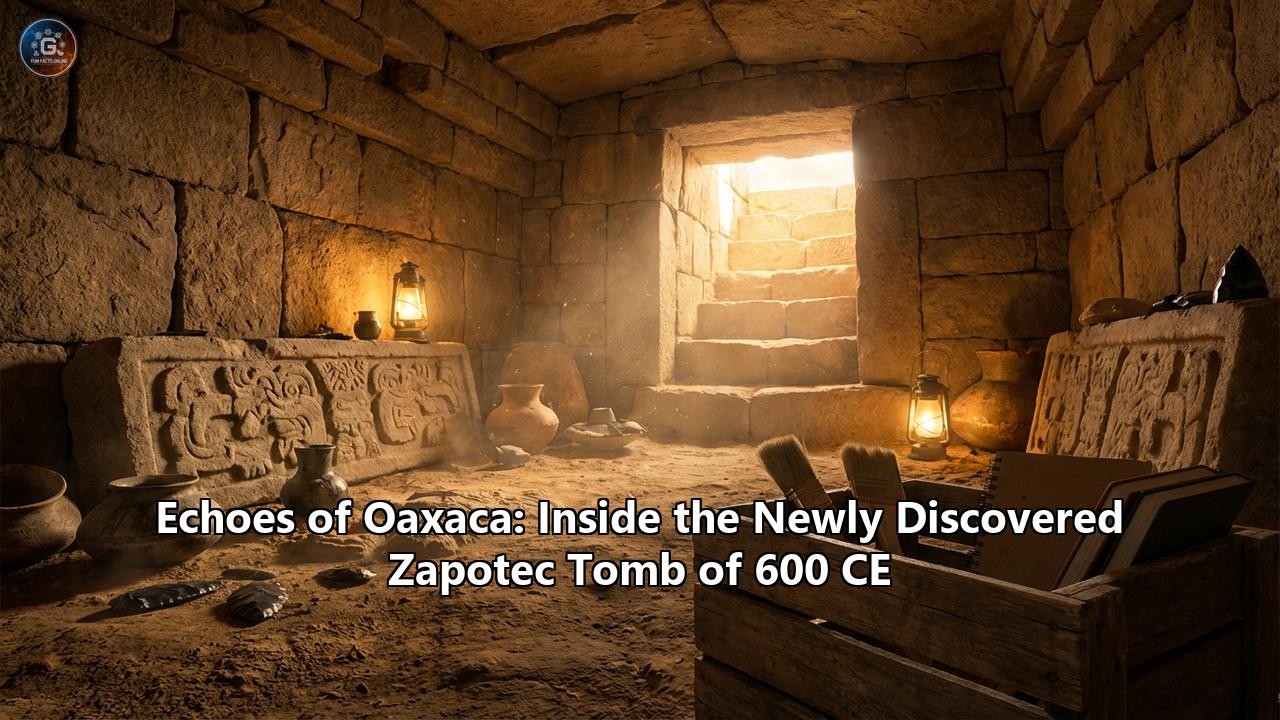
The wind through the Etla Valley carries the scent of dry earth and copal, a fragrance that has not changed in two thousand years. Here, in the heart of Oaxaca’s Central Valleys, the past does not merely rest; it waits. In late 2025, that wait ended on the slopes of Cerro de la Cantera in San Pablo Huitzo. What began as a desperate race against looters culminated in January 2026 with an announcement that shook the archaeological world: the discovery of Tomb 10, a sealed Zapotec time capsule from 600 CE.
This was not just another find. It was a revelation. Guarded by a monumental sculpture of an owl—the messenger of the underworld—and adorned with polychrome murals of a sacred procession, this tomb has opened a new window into the golden age of the "Cloud People" (Ben 'Zaa). It offers a rare, terrifying, and beautiful glimpse into how the Zapotec elites faced the great mystery of death.
Part I: The Discovery at the Warrior’s Watchtower
The Shadow of the Looters
The story of Tomb 10 begins not with a trowel, but with a whisper. In the rugged terrain of San Pablo Huitzo, roughly 30 kilometers northwest of Oaxaca City, the landscape is dotted with mounds that the locals call mogotes. These are the ruins of ancient temples and platforms, reclaimed by cactus and scrub. For centuries, they remained silent. But in 2025, the silence was broken by the clink of metal on stone.
An anonymous tip reached the National Institute of Anthropology and History (INAH). Looters—saqueadores—had located a cavity on the Cerro de la Cantera. The trade in pre-Hispanic artifacts is a shadow economy that threatens to erase history before it can be read. When INAH archaeologists arrived, they feared the worst. Often, they find only empty shells, stripped of their jade, ceramics, and souls.
But this time, the mountain had protected its own. The looters had breached the outer layers but had not penetrated the main chamber. What the archaeologists found as they carefully cleared the debris was a miracle of preservation. The seal was intact. The air inside had been still for fourteen centuries.
San Pablo Huitzo: The Ancient Fortress
To understand the magnitude of this find, one must understand the ground it lies in. San Pablo Huitzo is built upon the ruins of an ancient city known as Huijazoo, which translates to "Warrior Watchtower" or "Fortress" in Zapotec.
In 600 CE, during the Late Classic period, this was not a sleepy village. It was a strategic bastion. The Zapotec capital, Monte Albán, was the sun around which the Oaxacan world orbited, but Huijazoo was a powerful satellite. It guarded the northern entrance to the Etla Valley, the breadbasket of the empire. It stood on the frontier between the Zapotec heartland and the encroaching Mixtec lordships to the north. The lords of Huijazoo were warrior-kings, tasked with holding the line. They were wealthy, powerful, and deeply religious.
The discovery of Tomb 10 confirms that Huijazoo was more than a garrison; it was a necropolis of high status, a place where the lines between the living city and the city of the dead were blurred.
Part II: The Guardian of the Threshold
The Owl and the Ancestor
As the excavation team cleared the soil from the tomb’s facade, a face emerged from the earth to meet them. It was not human. It was the wide, staring visage of a Great Horned Owl (Búho), sculpted in high relief from stucco and stone.
In the Zapotec cosmology, the owl—often referred to as Moo or Tunkuluchú in broader Mesoamerican myth—is a creature of profound power. It is the avatar of the night, the messenger of the underworld, and the harbinger of death. But it is not "evil" in the Western sense. It is the guide. It is the creature that can see in the dark, navigating the treacherous path to Lyobaa (the Place of Rest).
The sculpture at Tomb 10 is unique. The owl is not merely perched; its great beak is open, and emerging from within the beak is the face of a man. This is a stunning piece of theological art. The man’s face is painted with red pigment—the color of life, blood, and the east. He wears the calm expression of nobility.
This imagery suggests a transformation. The Lord buried within is not simply dying; he is being consumed by, or perhaps becoming, the Owl. He is merging with the divine forces of the night to become an ancestor spirit. In Zapotec belief, the ancestors were active participants in the lives of their descendants. They could intercede with the lightning god Cocijo to bring rain, or with the earth lord to ensure fertility. By depicting the Lord inside the Owl, the tomb’s architects were declaring his new status: he is now a messenger. He has the power to fly between worlds.
The Guardians
Flanking this dramatic central sculpture are two jambs (vertical posts) carved with human figures. On one side stands a man; on the other, a woman. Both are dressed in the complex regalia of the Zapotec elite—feathered headdresses, ear spools, and heavy jade necklaces.
These are likely the "Guardians of the Lineage." Their presence at the door is significant. Zapotec society was deeply concerned with genealogy. The right to rule Huijazoo depended on one’s ability to trace their bloodline back to the founding ancestors. By placing a male and female figure at the entrance, the tomb emphasizes the duality of Zapotec creation—male and female, life and death—and asserts the legitimacy of the noble house. They stand eternally vigilant, holding ritual objects, ensuring that only the rightful initiate (or the rightful spirit) may pass.
Part III: Into the Chamber of the Dead
The Architecture of Eternity
Entering Tomb 10 is a descent into a sacred geometry. The tomb follows a cruciform or complex plan, typical of the elite burials of the Late Classic period. It is not a simple pit; it is a house for the dead, mimicking the palaces of the living.
The structure consists of a staircase leading down to an antechamber, which then opens into the main funerary chamber. The walls are constructed of perfectly cut limestone blocks, covered in a thick layer of lime stucco. This white canvas was the surface for the artists’ brushes.
The lintel—the horizontal stone beam spanning the doorway—is a masterpiece of epigraphy. Carved into the stone are a series of glyphs. These are "calendrical names." In the Zapotec world, as in much of Mesoamerica, a person’s name was often derived from their birthday in the 260-day ritual calendar (the Piye). A name like "Lord 12 Monkey" or "Lady 8 Deer" was not just a label; it was a destiny. These glyphs likely identify the primary occupant of the tomb and perhaps his illustrious ancestors, anchoring the burial in a specific moment of cosmic time.
The Procession of Copal
The true treasure of Tomb 10 lies inside the main chamber. As the archaeologists’ lights cut through the gloom, they illuminated walls that seemed to be bleeding color. These are the murals.
Painted in vibrant shades of ochre (yellow-brown), hematite red, turquoise green, calcium white, and deep charcoal blue, the murals depict a solemn ceremony. The scene is a procession. A line of figures moves across the walls, marching toward the entrance of the tomb.
They are not warriors. They are priests and nobles. In their hands, they carry bags—elaborately woven pouches with fringed bottoms. These are copal bags. Copal is a resin harvested from the Bursera tree. When burned, it produces a thick, sweet, white smoke that was believed to be the food of the gods. The smoke rising to the sky was the visual manifestation of prayer.
The figures in the mural are frozen in the act of offering. They are likely depicting the funeral rites of the Lord buried within. We see them chanting, their speech scrolls unfurling from their lips. We see the flow of feathers in their headdresses. The artistry is exquisite; the Zapotec painters mastered the use of line and color to create a sense of rhythm and movement.
This "Copal Procession" is more than decoration. It is a functional piece of magic. By painting the offering on the walls, the Zapotecs ensured that the ritual would continue forever. Long after the real incense had burned out and the mourners had died, the painted priests would continue to offer copal to the soul of the Lord, sustaining him in the afterlife for eternity.
Part IV: The Sister Tomb – A Tale of Two Lords
To fully appreciate Tomb 10, we must look a few hundred meters away to its "sister," the famous Tomb 5, discovered in the 1980s at the nearby Cerro de la Campana (part of the same Huijazoo complex). Tomb 5 is often called the "Sistine Chapel of the Zapotecs," and the similarities between the two are striking.
Lord 12 Monkey
Tomb 5 is the resting place of a ruler known as "Lord 12 Monkey." His tomb also features monumental sculptures at the entrance—masks of a Jaguar and a bird-serpent hybrid. Like Tomb 10, Tomb 5 is adorned with spectacular murals.
In Tomb 5, we see a procession of figures that parallels the new discovery. There is a depiction of a "Priestess" or noblewoman, dressed in a red and white huipil, holding a copal bag exactly like the ones in Tomb 10. This suggests a standardized ritual language in Huijazoo. The artists who painted Tomb 10 may have belonged to the same school or guild as the masters of Tomb 5.
However, Tomb 10 adds a new layer to the narrative with its Owl iconography. While Tomb 5 focuses on the Jaguar (earth/power) and the Serpent (sky/rebirth), Tomb 10 focuses on the Owl (underworld/transition). Together, they represent a cosmological balance. It is possible that the Lord of Tomb 10 and Lord 12 Monkey were related—perhaps father and son, or brothers who ruled different precincts of the fortress city. They are two verses of the same stone poem.
Part V: The World of 600 CE
The Twilight of the Classic
The year 600 CE was a pivotal moment. The great metropolis of Teotihuacan in central Mexico—which had long influenced the Zapotecs—was beginning to collapse. The political vacuum sent shockwaves across Mesoamerica.
In Oaxaca, Monte Albán was entering its late phases (Phase IIIb-IV). The centralized power of the capital was loosening. Regional centers like Huijazoo, Lambityeco, and Mitla were beginning to assert their independence. The discovery of Tomb 10, with its opulence and distinct local style, supports this theory. The Lords of Huijazoo were not mere provincial governors; they were kings in their own right, commanding enough resources to build monuments that rivaled those of the capital.
Life and Death in the Cloud Country
For the common Zapotec living in the shadow of the Cerro de la Cantera, life was a cycle of corn, beans, and tribute. They lived in wattle-and-daub houses, farming the fertile valley floor. But their lives were punctuated by the great ceremonies held by the elites.
When the Lord of Tomb 10 died, the city would have stopped. The sound of conch shell trumpets would have echoed off the mountains. The air would have turned white with the smoke of tons of burning copal. The procession depicted on the tomb walls would have been enacted in reality, winding its way up the steep slopes of the hill.
Death was not the end. The Zapotecs practiced ancestor veneration. The tomb was not sealed and forgotten; it was a temple. The antechamber was designed to be re-entered. Descendants would return on specific calendar days to leave fresh offerings, to ask for advice, or to introduce new family members to the "Old Ones." The open beak of the Owl was a portal—a mouth through which the ancestor could speak.
Part VI: The Scientific Future
Conservation and Analysis
Now that the discovery has been announced, the real work begins. The immediate priority for the INAH team is conservation. When a tomb is opened, the rush of fresh air, humidity, and microbes can destroy murals that have survived for a millennium. The team is currently stabilizing the microclimate, likely using climate-controlled airlocks to protect the pigments.
In the coming months and years, we can expect a flood of new data:
- DNA Analysis: If bone fragments are preserved, geneticists will look for familial links between the occupant of Tomb 10 and the Lords of Tomb 5 or Monte Albán.
- Isotope Analysis: By analyzing teeth, scientists can tell where the Lord was born and what he ate. Did he grow up in Huijazoo, or was he a prince sent from Monte Albán or even Teotihuacan?
- Epigraphy: Experts will work to decipher the specific calendrical names on the lintel. If they can read the name of the Lord, he will move from the realm of "anonymous ancestor" into the pages of written history.
Conclusion: Echoes of the Earth
The discovery of the Zapotec Owl Tomb in San Pablo Huitzo is a reminder that the earth has a memory. For 1,400 years, while empires rose and fell, while the Spanish arrived and the modern nation of Mexico was forged, the Owl Lord waited in the dark, clutching his human visage, ready to fly again.
This tomb is a gift. It tells us that the Zapotecs saw death not as a wall, but as a door—a door guarded by wisdom, painted in the colors of the rainbow, and scented with the sweet smoke of copal. As we gaze into the eyes of the Owl, we are not looking at a dead relic; we are looking into the soul of a civilization that, in the valleys of Oaxaca, is still very much alive.
Reference:
- https://www.theartnewspaper.com/2026/02/11/zapotec-tomb-discovered-oaxaca-mexico
- https://indiandefencereview.com/mexico-archaeological-find-zapotec-tomb-murals-revealed/
- https://aztec.mythologyworldwide.com/the-role-of-the-owl-in-aztec-symbolism/
- https://www.livescience.com/archaeology/1-400-year-old-zapotec-tomb-discovered-in-mexico-features-enormous-owl-sculpture-symbolizing-death
- https://arkeonews.net/extraordinary-polychrome-mural-reveals-1400-year-old-zapotec-tomb-in-oaxaca/
- https://artdaily.com/news/190398/A-window-into-ancient-Oaxaca--Mexico-unveils-a-remarkably-preserved-Zapotec-tomb
- https://www.ancientpages.com/2026/01/26/ancient-zapotec-tomb-unique-symbolic-mural-oaxaca-mexico/
- https://gulfnews.com/world/americas/1400-year-old-tomb-stuns-archaeologists-with-vivid-murals-giant-owl-1.500425871
- https://cool.culturalheritage.org/waac/wn/wn12/wn12-1/wn12-103.html
- https://www.ancient-origins.net/news-history-archaeology/zapotec-tomb-discovery-00102475
- https://en.wikipedia.org/wiki/Suchilquitongo_(archaeological_site))