
The humid air of Florida’s Space Coast hangs heavy over Launch Complex 39B, a site that has witnessed the triumphs of the shuttle era and the ghosts of Apollo. But today, in the early weeks of 2026, the concrete pad supports a new colossus. Standing 322 feet tall, bathed in the xenons of floodlights that struggle to illuminate its full majesty, is the Space Launch System (SLS). Perched atop this spire of orange foam and white steel is the Integrity—the Orion spacecraft that will carry four human beings further from Earth than anyone has traveled in over half a century.
Artemis II is not merely a mission; it is a statement of intent, a validation of engineering, and a definitive step toward a multi-planetary future. While Artemis I proved the machine could fly, Artemis II must prove it can sustain life. It is a ten-day odyssey designed to push the envelope of deep-space survival, navigation, and propulsion. It is the bridge between the footprints of the past and the lunar bases of the future.
This is the story of that mission—the crew, the machine, the physics, and the daring return to the Moon.
Part I: The Crew of the Integrity
Spaceflight is often discussed in terms of delta-v, thrust-to-weight ratios, and specific impulse. But at the heart of Artemis II are four beating hearts, individuals selected not just for their technical prowess but for their ability to represent humanity in the black void beyond low Earth orbit (LEO).
Commander Reid WisemanA native of Baltimore and a decorated Naval Aviator, Reid Wiseman carries the mantle of command with a blend of jovial approachability and steely competence. A veteran of the International Space Station (ISS), Wiseman knows the psychological rigors of orbit. But commanding Artemis II is a different beast. He is not just managing a timeline; he is managing the first crewed flight of a new vehicle. His role during the launch phase is critical—monitoring the automated ascent, ready to trigger an abort if the flight computers miss a catastrophic anomaly. Wiseman has spent years in the simulator, mastering the nuances of Orion’s manual control systems, which will be tested during the proximity operations demonstration.
Pilot Victor GloverIn the pilot’s seat sits Victor Glover, a man whose resume reads like the protagonist of a techno-thriller. A seasoned test pilot and engineer, Glover made history as the first Black astronaut to live on the ISS for a long-duration mission. On Artemis II, he becomes the first person of color to leave Earth’s orbit. Glover’s primary technical responsibility lies in the systems management of the SLS during ascent and the manual piloting of Orion during the proximity operations. His hands will be on the controls as they dance with the spent upper stage of the rocket, a delicate ballet performed at thousands of miles per hour.
Mission Specialist Christina KochChristina Koch is an engineer’s engineer. Holding the record for the longest single spaceflight by a woman, she is intimately familiar with the effects of microgravity on the human body. On Artemis II, she serves as the flight engineer, the master of Orion’s systems. She is the first woman to travel to the Moon, a milestone that reshapes the demographics of exploration. Her focus is the Environmental Control and Life Support System (ECLSS)—the machinery that scrubs carbon dioxide and generates oxygen. On this flight, for the first time, that system is not just a test article; it is the only thing keeping them alive.
Mission Specialist Jeremy HansenRepresenting the Artemis Accords and the international nature of this return, Jeremy Hansen of the Canadian Space Agency (CSA) joins the crew. A former fighter pilot and a lifelong explorer, Hansen is the first non-American to leave LEO. His presence signifies that the return to the Moon is not a solitary sprint by a superpower, but a collective stride by humanity. Hansen manages the timeline and payload operations, ensuring that every moment of the ten-day trek yields the maximum amount of data.
Part II: The Chariot – SLS Block 1
To break the shackles of Earth’s gravity requires violence controlled by mathematics. The Space Launch System Block 1 is the most powerful rocket ever successfully launched by NASA, generating a staggering 8.8 million pounds of thrust at liftoff—15% more than the legendary Saturn V.
The Core StageThe backbone of the SLS is the massive core stage, towering 212 feet. Its orange hue is the signature of the thermal protection foam insulation, crucial for keeping the super-chilled propellants liquid in the Florida heat. Inside, two massive tanks hold 733,000 gallons of liquid oxygen and liquid hydrogen.
At the base sit four RS-25 engines. These are not new inventions; they are veterans. Salvaged from the Space Shuttle program, upgraded with new controllers, and pushed to 109% of their original rated power, these engines are the Ferraris of rocket propulsion—efficient, powerful, and reusable, though on this mission, they will be sacrificed to the ocean.
The Solid Rocket Boosters (SRBs)Flanking the core are the twin five-segment Solid Rocket Boosters. Standing 17 stories tall, these are the heavy lifters. Once ignited, they cannot be turned off. For the first two minutes of flight, they provide 75% of the total thrust, burning six tons of propellant per second. They are the roar that rattles chest cavities three miles away; they are the raw force that punches the Integrity through the thick atmosphere.
The Upper Stage: ICPSStacked above the core is the Interim Cryogenic Propulsion Stage (ICPS). Powered by a single RL10 engine, this stage is responsible for two critical maneuvers: raising the Earth orbit to a high ellipse, and then performing the Trans-Lunar Injection (TLI) burn that flings the crew toward the Moon.
Part III: The Spacecraft – Orion and the ESM
If SLS is the muscle, Orion is the brain and the shield.
The Crew ModuleChristened Integrity, the crew module is a cone-shaped haven, 30% larger than the Apollo Command Module. It features a modern "glass cockpit" with three main display screens, replacing the hundreds of switches found in Apollo. It brings creature comforts previously unknown in deep space: a private toilet area (the Universal Waste Management System), a galley for rehydrating food, and exercise equipment to combat muscle atrophy.
Crucially, Orion carries a radiation shelter. In the event of a solar flare, the crew can retreat to the center of the capsule, using stowage bags to create a dense wall against high-energy particles.
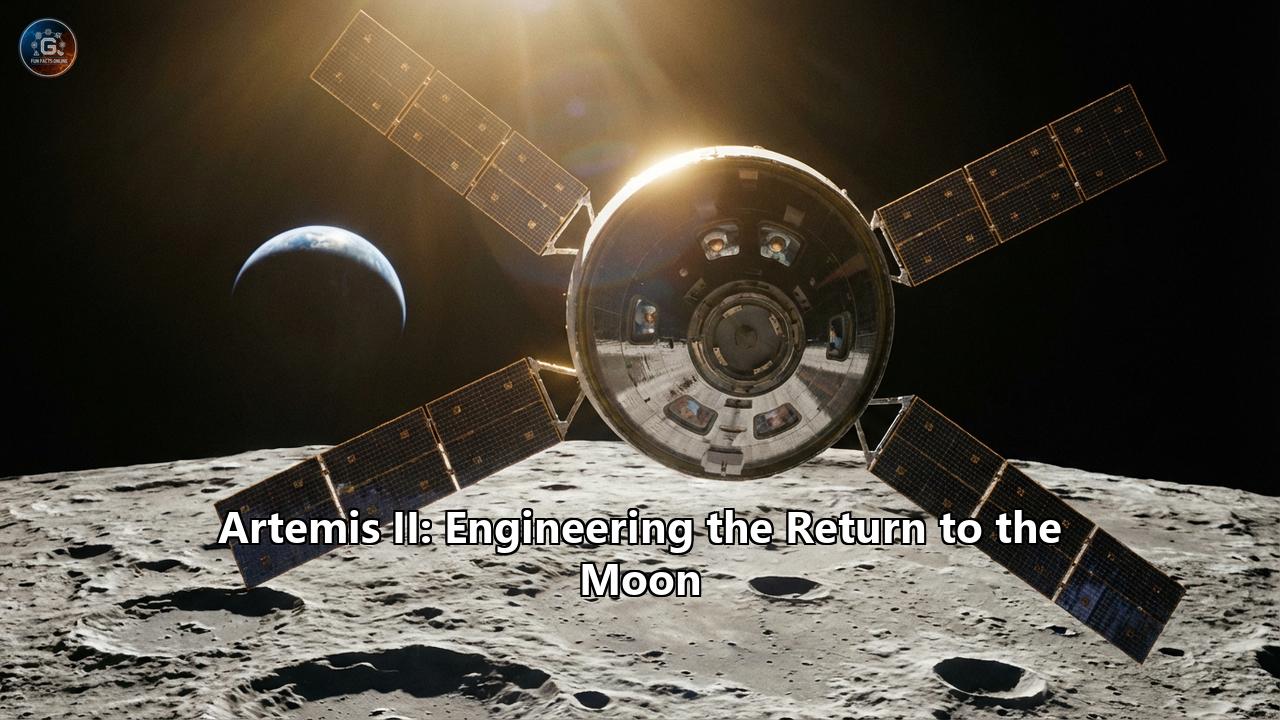
The European Service Module (ESM)Below the crew module lies the powerhouse of the ship, built not by NASA, but by the European Space Agency (ESA) and Airbus. The ESM provides electricity via four solar array wings, water, oxygen, and propulsion. It is a marvel of international cooperation. Its main engine is actually a refurbished Orbital Maneuvering System (OMS) engine from the Space Shuttle, giving the vehicle a proven heritage. The ESM also manages the thermal control, pumping fluid through radiators to shed the intense heat generated by electronics and crew metabolism.
Part IV: The Mission Profile
Artemis II is distinct from Apollo 8. It does not aim to enter a low lunar orbit. Instead, it follows a "Hybrid Free Return" trajectory, a safety-first flight path designed to ensure the crew comes home even if the main engine fails after the lunar burn.
Launch and AscentT-Minus Zero. The four RS-25s ignite, followed milliseconds later by the SRBs. The hold-down bolts explode, and the stack rises. The crew experiences a crushing 4G acceleration. Eight minutes later, the core stage cuts off and separates, falling back to Earth. The crew is now in orbit, but they don't head to the Moon yet.
The High Earth Orbit & Proximity OpsThis is the major deviation from Apollo. Orion and the attached ICPS enter an elliptical orbit around Earth (roughly 115 by 1,400 miles). They stay here for 24 hours. Why? To test the life support.
If the CO2 scrubbers fail or the toilet breaks in Low Earth Orbit, the crew can come home in hours. If they fail halfway to the Moon, the crew is dead. This "checkout orbit" is the critical safety gate.
During this phase, Pilot Victor Glover takes manual control. He separates Orion from the spent ICPS stage, turns the spacecraft around, and practices docking approaches. They won't actually dock, but they will fly in close formation, testing the handling qualities of the ship with the heavy service module attached. It proves Orion can dock with the lunar lander (Starship) or the Gateway station in future missions.
Translunar Injection (TLI)Once systems are green, the ICPS fires one last time. This is the big burn. It accelerates the crew to 24,500 mph, escaping Earth’s gravity well. They are now committed.
The CoastFor four days, the crew lives in the void. They cross the Van Allen radiation belts, where the sensors will spike, and the crew will hunker down. They will see Earth shrink to a marble, the "Blue Marble" view that changed humanity's perspective in 1968.
They will conduct medical experiments, testing how the human body processes nutrients and drugs in deep space radiation environments. They will test the optical communications system, beaming high-definition video back to Earth via laser, letting us ride along in real-time.
The FlybyDay 5. The Moon looms large, a gray, cratered behemoth filling the window. Unlike Apollo, which skimmed 60 miles above the surface, Artemis II swings wide—about 6,400 miles beyond the far side.
This moment is historic. As they pass behind the Moon, they will lose contact with Earth for nearly 30 minutes. They will be the furthest humans have ever been from home—over 230,000 miles + 4,600 miles beyond the Apollo 13 record.
In the silence of the lunar shadow, looking down at the battered crust of the farside, the crew will see the universe as no one has seen it for decades: stars unpolluted by Earthshine, a depth of blackness that is absolute.
Then, the Earthrise. As they emerge from behind the Moon, our blue planet will rise over the lunar limb—a symbol of fragility and unity.
The Return and Skip EntryGravity slingshots them back toward Earth. Four days later, they approach the atmosphere at Mach 32—25,000 mph.
The re-entry is a feat of unparalleled engineering. Apollo capsules plunged directly in. Orion will perform a "skip entry." It will hit the upper atmosphere, bounce off it like a stone skipping on a pond to bleed off speed and manage heat, and then dive back in for the final descent. This technique reduces the G-force load on the crew and allows for a more precise landing.
The heat shield, an advanced AVCOAT material, will endure temperatures of 5,000 degrees Fahrenheit. It will char and ablate, carrying the heat away from the crew.
Finally, three main parachutes, orange and white, will bloom. The Integrity will splash down in the Pacific Ocean off the coast of San Diego, where US Navy divers and the recovery ship will be waiting.
Part V: The Engineering Challenges
The delay of Artemis II to 2026 was driven by the uncompromising demand for safety. Three specific engineering hurdles defined the preparation for this mission:
- The Heat Shield: Analysis of Artemis I showed the heat shield charred differently than predicted, with some material liberating in chunks rather than ablating smoothly. Engineers spent 2024 and 2025 modeling this phenomenon, ultimately determining that despite the "pockmarked" appearance, the thermal protection remains sufficient to protect the crew.
- Life Support (ECLSS): Artemis I had no breathers on board. Artemis II is the debut of the oxygen generation and CO2 removal hardware. Extensive ground testing in vacuum chambers has pushed these systems to failure points to ensure they hold up in the vacuum of space.
- The Abort System: The Launch Abort System (LAS) is a rocket atop the rocket. If the SLS fails on the pad or during ascent, the LAS pulls the capsule away at 15Gs. Validating the software that triggers this system has been a monumental task of coding and simulation.
Part VI: Why We Return
Why do this? Why spend billions to repeat a journey made in 1968?
Because Artemis is not a repetition; it is a foundation. Apollo was a race; Artemis is a residence. The orbit and trajectory of Artemis II are designed to verify the physics and systems needed for Artemis III, which will land on the lunar South Pole—a region of eternal light and eternal shadow, where water ice hides in the craters.
Water is fuel. Water is air. If we can harvest it, the Moon becomes a gas station for the solar system. The Lunar Gateway, a space station to be built in lunar orbit, will serve as the staging ground for missions to Mars. Artemis II is the proof of concept for the deep-space transport that will take us there.
Furthermore, the scientific yield is distinct. The crew will be observing the lunar surface from a unique vantage point, identifying geological features for future landings. They are testing the radiation shielding that is a prerequisite for the six-month journey to the Red Planet.
Conclusion
As the countdown clock at Kennedy Space Center ticks toward zero in early 2026, the world holds its breath. Artemis II is more than a test flight. It is the rekindling of a spirit that many feared was lost—the spirit of exploration that drives us to look at the horizon and ask, "What lies beyond?"
When Wiseman, Glover, Koch, and Hansen climb into the Integrity, they carry with them the hopes of the Artemis Generation. They go not as conquerors, but as pathfinders. The engineering is sound. The risks are calculated. The destination is waiting.
We are going back. And this time, we are staying.
Reference:
- https://www.space.com/artemis-2-humans-moon-orbit
- https://en.wikipedia.org/wiki/Artemis_II
- https://www.nasa.gov/wp-content/uploads/2023/07/0080-sls-fact-sheet-jun2023-508-1.pdf
- https://www.nasa.gov/podcasts/houston-we-have-a-podcast/artemis-ii-the-orion-spacecraft/
- https://www.space.com/news/live/artemis-2-nasa-moon-rocket-rollout-jan-17-2026
- https://www.youtube.com/watch?v=MlhgjxlxKy8
- https://www.reddit.com/r/space/comments/1qdr9ym/why_is_there_very_less_excitement_for_the_artemis/
- https://www.youtube.com/watch?v=HqDVoXIck_s
- https://www.nasa.gov/mission/artemis-ii/
- https://www.space.com/space-exploration/human-spaceflight/iss-astronaut-spots-artemis-2-moon-rocket-on-the-launch-pad-from-space-photo
- https://www.nasa.gov/feature/our-artemis-crew/
- https://en.wikipedia.org/wiki/Space_Launch_System
- https://www.space.com/artemis-2-moon-mission-astronauts-meet-the-crew
- https://www.forbes.com/sites/jamiecartereurope/2026/01/18/nasas-artemis-ii-moon-rocket-reaches-launch-pad---what-happens-next/