
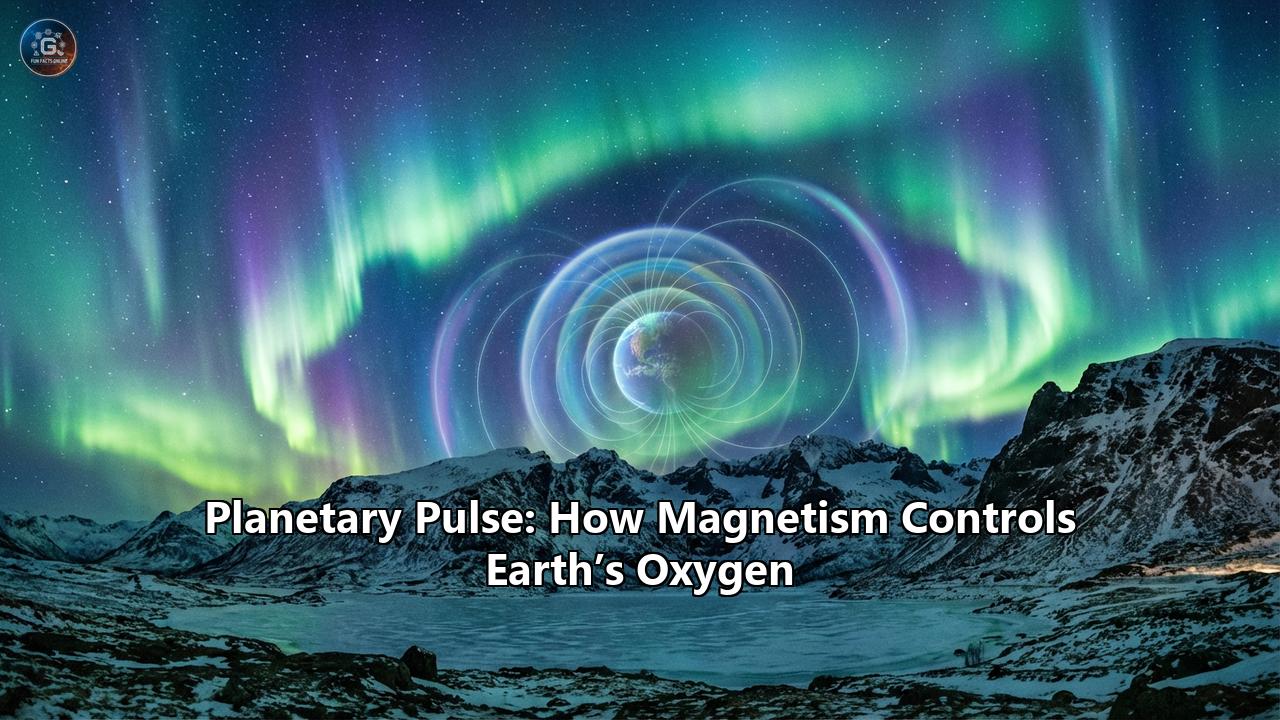
The invisible architecture of our planet is a violent, churning engine. We stand on a crust of solid rock, assuming stability, while beneath our feet a molten ocean of iron thrashes in a convection cycle as old as the world itself. This motion generates the magnetosphere, the colossal magnetic shield that extends thousands of miles into space, deflecting the lethal bombardment of solar wind that would otherwise strip away our atmosphere and sterilize the surface.
For decades, the scientific consensus was simple: the stronger the magnetic field, the safer the life. A strong shield equals a habitable planet. It is the reason Earth is a blue marble and Mars is a rusted desert.
But new evidence has shattered this linear narrative. We are discovering that Earth’s habitability did not arise from a shield that was always strong. Instead, it was a near-death experience—a collapse of the magnetic field so profound, so dangerous, and so specifically timed—that gave us the air we breathe today.
This is the story of the Planetary Pulse: the terrifying epoch when Earth’s heart skipped a beat, the shield failed, and in that window of vulnerability, the cosmos poured in to change the chemistry of our atmosphere forever.
Part I: The Silent Guardian
To understand the anomaly, we must first understand the baseline. The Earth is, in effect, a giant bar magnet. This magnetism is not a static property of the rock, but a dynamic byproduct of the geodynamo.
Deep in the center of the Earth, 3,000 kilometers down, lies the outer core. It is a fluid layer of iron and nickel, roughly the viscosity of water, heated to 4,000 degrees Celsius. Above it is the mantle, cooler and stiffer. Below it is the inner core, a solid ball of iron growing slowly as the planet cools.
The heat from the inner core causes the liquid iron in the outer core to rise, cool against the mantle, and sink again. This convection, combined with the rotation of the Earth (the Coriolis effect), turns the liquid iron into spiraling columns. Because iron is a conductor, this moving metal generates electric currents. And as any physicist knows, an electric current generates a magnetic field.
This self-sustaining loop is the geodynamo. It projects field lines out of the South Pole, wrapping around the planet, and diving back into the North Pole.
The Solar Wind WarIn the vacuum of space, this field meets its nemesis: the Sun. The Sun does not just emit light; it emits a constant stream of charged particles—protons and electrons—racing at 400 kilometers per second. This is the solar wind.
When the solar wind hits Earth’s magnetic field, it creates a shockwave called the bow shock. The magnetosphere compresses on the day side and stretches out into a long "magnetotail" on the night side. Without this shield, the solar wind would interact directly with our atmosphere. The high-energy particles would crash into gas molecules, imparting enough energy for them to escape gravity’s pull, effectively "sputtering" the atmosphere into space.
This is exactly what happened to Mars. Mars once had a thick atmosphere and liquid water. But roughly 4 billion years ago, its smaller geodynamo cooled and halted. The magnetic shield vanished. The solar wind began its relentless erosion, stripping away the air, boiling off the oceans, and leaving behind the freeze-dried husk we see today.
For Earth, the magnetic field is the difference between a garden and a graveyard. But the story of the Planetary Pulse suggests that for life to truly explode, the garden needed to be threatened.
Part II: The Boring Billion and the Oxygen Stasis
To appreciate the pulse, we must look at the timeline of oxygen.
Great Oxidation Event (GOE) occurred around 2.4 billion years ago, driven by cyanobacteria (blue-green algae) inventing photosynthesis. They pumped oxygen into the water, which rusted the iron in the oceans and eventually leaked into the air.
But then, everything stopped.
For over a billion years—an era geologists uncharitably call the "Boring Billion"—oxygen levels flatlined. They hovered at perhaps 1% to 10% of modern levels. Life remained microscopic, simple, and stagnant. There were no animals, no complex ecosystems. Just slime.
The planet was stuck in a chemical rut. Oxygen is a highly reactive, volatile gas. It loves to bond with things. If you produce it, it inevitably reacts with volcanic gases, rotting organic matter, or rocks. To build up a high-oxygen atmosphere (the 21% we have today), you need to break this equilibrium. You need to tip the scales drastically.
Something needed to change the equation of the atmosphere. The cyanobacteria were doing their job, pumping out oxygen, but the Earth was consuming it just as fast.
Then, 591 million years ago, during the Ediacaran Period, something bizarre happened in the deep Earth.
Part III: The Collapse
In 2024, a team of researchers led by John Tarduno at the University of Rochester published a bombshell study. They had been analyzing ancient crystals—specifically plagioclase feldspar and pyroxene—recovered from rocks in Brazil and Canada.
When these crystals formed from cooling magma billions of years ago, they trapped tiny magnetic inclusions. These inclusions act like fossilized compass needles, locking in the strength and direction of the Earth’s magnetic field at the exact moment of their birth.
By studying crystals from the Ediacaran period (roughly 590 to 565 million years ago), the team found something terrifying.
The readings were incredibly low.
Today, the magnetic field strength is roughly 40-60 microteslas.
During the Ediacaran, the strength plummeted to 0.5 to 1.5 microteslas.
The field had collapsed. It was operating at roughly 3% of its modern strength. For 26 million years, the shield was essentially down. The "Invisible Shield" had become a tattered veil.
In a standard model of planetary habitability, this should have been a catastrophe. Solar radiation should have irradiated the surface. The atmosphere should have begun to bleed away. Life should have retreated.
But the fossil record shows the exact opposite.
The Ediacaran ExplosionPrecisely during this window of magnetic collapse, life on Earth got big.
This is the era of the Ediacaran Biota—the first large, multicellular organisms. Creatures like Dickinsonia (a flat, ribbed oval up to a meter long) and Charnia (resembling a fern frond but actually an animal) appeared in the oceans. They were soft-bodied, strange, and unlike anything before them.
They were macroscopic. And macroscopic life requires one specific thing: Oxygen.
To grow a body larger than a microbe, you need high-energy metabolism. You need to burn fuel efficiently. You need oxygen to permeate deep into your tissues.
Geochemical proxies confirm that during this magnetic collapse, atmospheric and oceanic oxygen levels surged. They finally broke the "Boring Billion" ceiling.
The correlation was undeniable:
- Magnetic field collapses.
- Oxygen levels skyrocket.
- Complex life evolves.
The question was: Why? Why would removing the shield increase the oxygen?
Part IV: The Hydrogen Escape Valve
The answer lies in the weight of atoms.
The atmosphere is a mixture of gases. Oxygen is heavy (atomic mass 16). Nitrogen is heavy (14). Hydrogen is the lightest element in the universe (atomic mass 1).
When the magnetic shield weakens, the solar wind—that stream of high-energy protons—can penetrate deeper into the upper atmosphere. It creates a chaotic, energized environment. It breaks apart molecules, including water vapor (H2O).
When water vapor is split in the upper atmosphere, it separates into Oxygen and Hydrogen.
The Oxygen, being heavy, tends to stay gravity-bound to the Earth.
The Hydrogen, being light, is easily energized. Without a strong magnetic field to trap it or deflect the solar wind stripping it away, the Hydrogen creates a "polar wind" and escapes into space.
This process is known as atmospheric escape or Jeans escape (enhanced by solar wind stripping).
Normally, Hydrogen and Oxygen want to reunite to form water. It is a love story written in chemistry. But if you strip the Hydrogen away and send it into the void of space, the Oxygen is left behind with no partner. It has no choice but to accumulate in the atmosphere.
The Tarduno hypothesis suggests that the weak magnetic field acted as a planetary valve. It allowed the Earth to "vent" its excess hydrogen.
- Weak Field -> Solar Wind Strikes Atmosphere -> Hydrogen Stripped Away -> Oxygen Accumulates.
It was a cosmic trade-off. We lost water (hydrogen), but we gained breathable air. The sheer volume of hydrogen loss is estimated to be enormous—enough to dry out the planet significantly if it had continued forever. But it didn't continue forever. It lasted just long enough (26 million years) to pump the oxygen levels from the suffocating lows of the Proterozoic to the life-giving highs of the Phanerozoic.
This was the "Planetary Pulse." A relaxation of the defense systems that allowed the atmosphere to be purified.
Part V: The Engine Failure
Why did the field collapse in the first place? To understand this, we have to look at the life cycle of the Core.
The Earth’s core has not always looked the way it does today. In the early Earth (the Hadean and Archean eons), the entire core was liquid. The magnetic field was generated purely by thermal convection—the core was so hot that it was boiling vigorously, driving the dynamo.
But heat is a finite resource. As the Earth aged, it cooled. The convection slowed down. The dynamo began to sputter.
By the late Ediacaran period (590 million years ago), the Earth was facing an energy crisis. The core had cooled so much that the thermal convection was too weak to drive a strong magnetic field. The geodynamo was dying. This was the cause of the collapse. We were seeing a planet on the verge of becoming Mars.
If nothing had changed, the field might have died completely. The oceans would have slowly vaporized and been stripped away. The Earth would have become a dry, cold desert.
The Inner Core Saves the WorldBut then, a miracle of phase transition occurred.
The center of the Earth reached a critical pressure and temperature point. The iron at the very center began to freeze.
The Inner Core was born.
The nucleation of the solid inner core was the most important geological event since the formation of the planet. When iron freezes from liquid to solid, it releases latent heat. Furthermore, as the iron solidifies, it expels lighter elements (like oxygen, sulfur, and silicon) that were mixed in with it. These lighter elements rise rapidly through the remaining liquid outer core, like bubbles in champagne.
This "chemical convection" is much more powerful than simple thermal convection.
The birth of the inner core provided a new, supercharged power source for the geodynamo.
- Step 1: The Core cools, dynamo weakens (The Pulse/Collapse).
- Step 2: Oxygen levels rise due to hydrogen escape.
- Step 3: The Inner Core nucleates (solidifies).
- Step 4: The Dynamo is kickstarted with renewed vigor.
- Step 5: The Magnetic Field returns to full strength (The Cambrian Recovery).
The timing is impeccable. The field collapsed just long enough to oxygenate the atmosphere, and then the inner core nucleation rebooted the shield just in time to protect the newly evolving complex life from lethal radiation.
Part VI: The Cambrian Explosion and the Return of the Shield
Following the Ediacaran came the Cambrian Explosion (541 million years ago). This was the biological "Big Bang." In a geological blink of an eye, all major animal body plans appeared. Eyes, teeth, legs, shells, predators, prey.
While the Ediacaran biota were slow, soft, and mostly immobile, the Cambrian creatures were active. Active life requires DNA protection.
If the magnetic field had remained weak, the ultraviolet and cosmic radiation might have caused mutation rates so high that complex genomes couldn't remain stable. Or, the atmosphere might have been stripped too far, losing not just hydrogen but the nitrogen and water vapor essential for life.
The return of the strong field (the "Cambrian Recovery") locked in the gains.
- Oxygen was high: Thanks to the previous collapse.
- Shield was up: Thanks to the new inner core.
- Result: A protected, high-oxygen greenhouse where life could diversify into millions of forms.
It suggests that a habitable planet requires a dynamic history. A planet with a constantly strong shield might never oxygenate enough for intelligent life. A planet with a constantly weak shield dies. Earth hit the "Goldilocks" scenario: a strong shield that failed once, momentarily, to let the planet breathe, and then repaired itself.
Part VII: A Tale of Three Planets
To verify this hypothesis, we can look at our neighbors: Venus, Earth, and Mars.
Mars:Mars is the failure case. Its core was too small. It cooled too fast. Its dynamo died billions of years ago and never rebooted. It likely never formed a significant solid inner core to restart the engine.
- Result: The "Hydrogen Escape" phase never ended. It continued until the water was gone, then the nitrogen, then the atmosphere. The "Pulse" on Mars was a flatline.
Venus is the anomaly. It has no intrinsic magnetic field today. Yet, it has a crushing atmosphere (90 times thicker than Earth's). Why didn't the solar wind strip Venus?
The answer is likely the ionosphere. Venus’s atmosphere is so thick and ionized by the sun that it creates an "induced" magnetic field that offers some protection. But Venus lacks water.
It is believed that Venus may have suffered a "runaway" version of Earth’s pulse. Without a magnetic field to protect the water vapor, sunlight broke it down, and the hydrogen escaped completely, leaving behind a heavy, carbon-dioxide-rich atmosphere. Venus illustrates what happens if the "venting" phase goes on too long without a biological cycle to bury the carbon and a magnetic cycle to save the water.
Earth:Earth is the only one that pulsed. It had the mass to hold its atmosphere, the biology to create the oxygen, and the core dynamics to switch the shield off and on again.
Part VIII: The Biological Feedback Loop
The relationship isn't just one way (Magnetism -> Life). It is increasingly looking like a feedback loop (Life -> Magnetism?).
Some controversial but fascinating research suggests that the presence of life might actually influence the mantle, which influences the core.
How? Plate Tectonics.
Plate tectonics is the mechanism that cools the mantle. Cold slabs of crust subduct (sink) into the mantle, dropping deep down to the core-mantle boundary. This cooling of the core-mantle boundary is what draws heat out of the core, driving the convection that creates the magnetic field.
If Earth had no life, its sediment cycle would be different. The water content of the subducting slabs would be different.
Some models suggest that without the lubricating effect of water and the biological weathering of rocks, plate tectonics might seize up (like on Venus, which has a "stagnant lid").
If plate tectonics stops, the mantle stops cooling the core. The core stops convecting. The magnetic field dies.
So, a dizzying possibility emerges:
- Life produces Oxygen.
- Oxygen weathers rocks and creates wet clay sediments.
- Wet sediments lubricate subduction zones.
- Subduction keeps the mantle cool.
- Cool mantle keeps the Core churning.
- The Core generates the Magnetic Field.
- The Magnetic Field protects Life.
The "Planetary Pulse" of the Ediacaran might have been the moment this loop synchronized.
Part IX: The Pulse of the Future
If the magnetic field collapsed once, can it happen again?
The answer is yes. We are currently observing a weakening of the Earth’s magnetic field. Since the mid-1800s, the field strength has dropped by about 10%.
There is a large weak spot growing over South America and the southern Atlantic Ocean, known as the South Atlantic Anomaly (SAA). Satellites passing through this region often glitch because they are exposed to higher levels of radiation.
Is this the start of another collapse? Or a Pole Reversal?
Pole reversals (where North becomes South) happen irregularly, roughly every 200,000 to 300,000 years. The last one was 780,000 years ago. We are overdue.
During a reversal, the field doesn't disappear, but it becomes very complex and weak (perhaps 10% to 20% of current strength). It becomes multipolar (having 4 or 8 poles).
If a reversal happens, we would experience a mini-version of the Ediacaran pulse.
- More radiation reaching the surface.
- Potential changes in atmospheric chemistry (though over human timescales, the oxygen boost would be negligible).
- Massive disruption to our electric grids and satellite networks.
However, we shouldn't fear an oxygen catastrophe. The Ediacaran collapse lasted 26 million years. A pole reversal lasts a few thousand years. We will likely keep our atmosphere. But the "South Atlantic Anomaly" serves as a daily reminder that the geodynamo is not a machine we control. It is a chaotic beast.
Part X: The Search for Alien Pulses
This new understanding of the "Planetary Pulse" revolutionizes how we look for life in the universe.
For years, astrobiologists followed a simple rule: Look for exoplanets with strong magnetic fields.
We have found Earth-sized planets around Red Dwarfs (like Proxima Centauri b). But Red Dwarfs are violent stars. They flare constantly. The assumption was that unless Proxima b has a super-shield, its atmosphere is gone.
But the Earth model teaches us nuance.
Maybe we shouldn't be looking for a constantly strong shield. Maybe we should be looking for a planet that had a magnetic evolution.
A planet that started with a shield to protect its water... then lost the shield to vent its hydrogen and build up oxygen... and then regained the shield to protect its complex life.
We are looking for a specific history, not just a static state.
We are looking for the Pulse.
Deep Time Perspectives: The Geologist’s Clock
To truly grasp the magnitude of the Ediacaran pulse, one must appreciate the difficulty of the detective work involved. How do we know the magnetic field strength from 590 million years ago?
The heroes of this story are Zircons and Plagioclase.
Zircons are the oldest minerals on Earth. They are time capsules. They are incredibly hard, resistant to erosion, and can survive the recycling of the crust.
However, for magnetic studies, researchers often prefer plagioclase feldspar found in specific igneous intrusions.
The technique is called Paleointensity analysis.
- Find a rock that hasn't been reheated since it formed (reheating resets the magnetic record). This is rare.
- Extract 2-millimeter crystals.
- Use a SQUID (Superconducting Quantum Interference Device) magnetometer—an instrument so sensitive it can detect the magnetic field of a human heartbeat—to measure the magnetic moment of the crystal.
- Heat the crystal in the lab to erase its ancient magnetism and replace it with a known lab field.
- Compare the ratio of the ancient magnetism to the new magnetism to calculate the strength of the Earth's field 590 million years ago.
It is painstaking work. It took Tarduno’s team years to analyze enough samples from the Passo da Fabiana dike in Brazil and the Sept-Îles Complex in Canada to be statistically sure.
They found that the field wasn't just weak; it was unstable. The poles were likely wandering wildly. It was a time of magnetic chaos. And in that chaos, the chemistry of life found its opportunity.
The Biological Receiver: Magnetoreception
The "Planetary Pulse" didn't just change the air; it may have forced life to evolve sensors.
If the magnetic field was weak and chaotic during the dawn of animal life, and then suddenly strengthened and stabilized in the Cambrian, it provided a new navigational grid.
Many ancient lineages of animals—sea turtles, sharks, migratory birds, and even some bacteria—possess magnetoreception. They can feel the Earth’s magnetic field.
Did the "return of the field" in the Cambrian drive the evolution of these senses?
When the shield came back up, it created a consistent North-South highway. Predators and prey could use it to navigate the vast, featureless oceans. The stabilization of the geodynamo may have been the moment the "GPS of the Biosphere" was switched on.
Conclusion: The Fragile Balance
The story of the Planetary Pulse changes our perception of Earth. We are not a fortress. We are a dynamic vessel that survives by changing its state.
We often talk about the "Goldilocks Zone" in terms of distance from the Sun (not too hot, not too cold).
But there is also a Magnetic Goldilocks Zone.
- Too Strong: The atmosphere is never cleaned of hydrogen; oxygen levels remain low; life remains small.
- Too Weak: The atmosphere is stripped entirely; water is lost; the planet dies (Mars).
- Just Right (The Pulse): A strong field that collapses temporarily to allow oxygenation, then recovers to provide protection.
It forces us to ask: How rare is this?
How many planets out there have liquid cores that freeze at exactly the right rate? How many have a "Boring Billion" followed by a "Magnetic Collapse"?
It is possible that life is common, but oxygenated, complex life is rare, because it requires this specific, dangerous dance between the Core and the Atmosphere.
We are the children of a failing engine. We breathe because the shield broke. We exist because the Earth’s heart skipped a beat, and in that moment of weakness, the life-giving oxygen flooded in.
The Planetary Pulse is the rhythm of our existence—a reminder that in the geology of worlds, sometimes a breakdown is the most essential part of the breakthrough.
Reference:
- https://astrobiology.com/2025/06/connections-have-been-discovered-between-earths-oxygen-and-its-magnetic-field.html
- https://eos.org/articles/a-magnetic-low-may-have-paved-the-way-for-complex-life
- https://www.futurity.org/weak-magnetic-field-life-on-earth-3217672/
- https://www.researchgate.net/publication/389866981_Earth's_magnetic_dipole_collapses_and_life_explodes
- https://eos.org/articles/the-long-and-the-weak-of-it-the-ediacaran-magnetic-field
- https://astrobiology.com/2024/05/a-weak-magnetic-field-may-have-supported-the-diversification-of-life-on-earth.html
- https://www.researchgate.net/publication/380293715_Near-collapse_of_the_geomagnetic_field_may_have_contributed_to_atmospheric_oxygenation_and_animal_radiation_in_the_Ediacaran_Period
- https://e360.yale.edu/digest/earth-magnetic-field-oxygen
- https://academic.oup.com/nsr/article/12/5/nwaf082/8051343
- https://www.livescience.com/planet-earth/geology/scientists-discover-strong-unexpected-link-between-earths-magnetic-field-and-oxygen-levels
- https://pmc.ncbi.nlm.nih.gov/articles/PMC12164983/
- https://www.rochester.edu/newscenter/ediacaran-fauna-magnetic-field-collapse-604132/