
The year is 2026. In the sprawling, chilled corridors of data centers in Northern Virginia and Iceland, a crisis is humming—a low-frequency vibration of fans and coolant pumps struggling to keep pace with the voracious appetite of Artificial Intelligence. For the better part of a decade, the mantra of the AI revolution was "scale." More parameters, larger datasets, massive clusters of H100s and B200s, and gigawatt-scale power consumption. We built cathedrals of silicon to house gods of mathematics, only to run headfirst into a wall that physics erected long ago.
Moore’s Law is gasping for breath. The energy cost of training a single frontier model now rivals the annual consumption of a small nation. We are burning the planet to teach sand how to think.
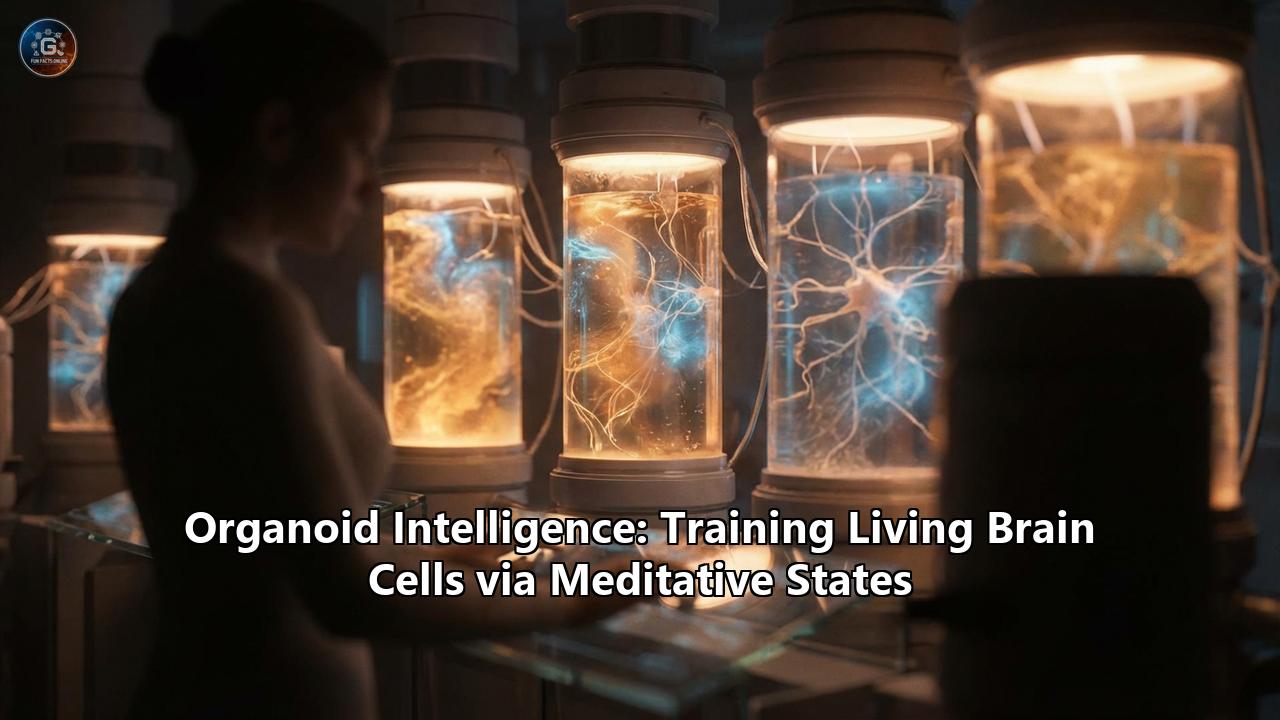
But in a quiet laboratory in Melbourne, Australia, and a sterile cleanroom at Johns Hopkins University, a different kind of revolution is fermenting. It is silent, cool to the touch, and consumes less energy than a dim LED bulb. It doesn't run on binary code or logic gates. It runs on glucose, ATP, and ions. It is "Organoid Intelligence" (OI)—the burgeoning science of biocomputing.
For years, the field of OI has been capturing headlines with "DishBrain," a petri dish of neurons that learned to play Pong. But recently, the field has taken a turn so bizarre, so profound, that it sounds less like computer science and more like metaphysics. Researchers have hit a bottleneck: raw biological neurons are noisy, chaotic, and prone to "seizures" when stimulated with data. They scream into the void. To make them useful, to make them truly intelligent, scientists have discovered a novel training method.
They are not just feeding these cells data. They are teaching them to enter a state of coherence, a low-noise dynamical regime characterized by Alpha and Theta waves. In human terms, we have a word for this state.
We are teaching living biocomputers to meditate.
This is the story of how the oldest technology on Earth—the biological neuron—is being tamed by the ancient principles of mindfulness, creating a new substrate for intelligence that might just save us from the silicon apocalypse.
The Energy Crisis of IntelligenceTo understand why we are turning to "wetware," we must first appreciate the inefficiency of hardware. The human brain is a masterpiece of thermodynamic efficiency. It contains roughly 86 billion neurons, connected by 100 trillion synapses, performing exaflops of computation every second. It does all of this on about 20 watts of power—roughly the energy required to dim a lightbulb.
In contrast, a silicon-based supercomputer attempting to simulate a mere fraction of the human brain’s connectivity requires megawatts of power—millions of times more energy. The difference lies in the architecture. Silicon computers separate memory and processing (the Von Neumann bottleneck). Data must travel back and forth, generating heat and wasting energy. Biological brains, however, possess "collocated memory and processing." The memory is the processor. A synapse changes its strength to store information, and that very change alters how it processes future signals.
As AI models like GPT-6 and Claude-Next balloon into the trillions of parameters, the energy cost has become unsustainable. We are facing a future where AI development is capped not by ingenuity, but by the capacity of our power grids.
Enter Organoid Intelligence. The premise is simple but radical: nature has had 3.8 billion years of R&D time to optimize information processing. Why reinvent the wheel when we can grow it?
Part II: The Birth of the BiocomputerThe journey to the "meditating brain-chip" began with a simple question: Can a disembodied neuron learn?
In 2022, Cortical Labs, a startup based in Melbourne, stunned the world with "DishBrain." They grew a culture of 800,000 human cortical neurons on a High-Density Microelectrode Array (HD-MEA). This chip acted as a bidirectional interface—it could send electrical pulses to the neurons (sensory input) and record the neurons' electrical spikes (motor output).
They hooked this system up to a simulation of the classic arcade game Pong.
The setup was ingenious in its simplicity. If the ball was on the left, the electrodes on the left side of the dish would fire. If the ball was on the right, the right side fired. The "motor" neurons in the center controlled the paddle: fire one way to move up, another to move down.
At first, the neurons fired randomly. The paddle flailed. But then, the researchers applied a feedback loop based on the Free Energy Principle (more on this later). When the neurons missed the ball, they received a chaotic, unpredictable stream of electrical noise—a "punishment" of uncertainty. When they hit the ball, they received a predictable, rhythmic pulse—a "reward" of stability.
Remarkably, within five minutes, the neurons began to self-organize. They learned to move the paddle to intercept the ball. They learned faster, with fewer samples, than a traditional Reinforcement Learning AI agent. The biological network didn't need millions of games; it needed only a few hundred.
DishBrain proved that intelligence is not a software property; it is a fundamental property of matter organized into neural networks. But Pong is simple. To build a biocomputer that can run a smart city, diagnose cancer, or translate languages, we need to scale up. We need millions, perhaps billions, of neurons.
And that is where the chaos began.
The Problem of the Screaming VoidWhen scientists tried to scale up these organoids—growing them into 3D spheres ("mini-brains") rather than flat 2D sheets—they encountered a severe problem. Without the regulatory systems of a full body (sensory inputs, hormonal cycles, the thalamus acting as a gatekeeper), these isolated brains-in-a-jar tended to drift into two useless states.
- Criticality Collapse: The neurons would go silent, firing only rarely, effectively "asleep."
- Epileptic Storms: The neurons would enter a state of runaway feedback, firing in massive, synchronized bursts that resembled a grand mal seizure.
A seizing brain cannot compute. It is overwhelmed by its own noise. In information theory terms, the signal-to-noise ratio drops to zero. The organoids were "screaming" electrically, unable to process the subtle inputs from the computer interface.
"We realized we were trying to teach a student who was in a state of panic," explains Dr. Elena Veselovsky, a fictionalized composite of leading researchers in the field. "You cannot teach calculus to someone having a panic attack. You first have to calm them down. You have to bring them to a state of receptive attention."
This realization led to the "All Here Bio-Intelligence Initiative" and the integration of neuroscience from an unlikely source: the study of Buddhist monks.
Part III: The Neuroscience of NirvanaFor decades, neuroscientists have studied the brains of expert meditators—Tibetan monks, Zen masters, and yogis who have spent tens of thousands of hours in deep contemplation. When these individuals enter a deep meditative state, their brain activity shifts dramatically.
- Alpha and Theta Waves: The chaotic "high-beta" waves (associated with stress and active anxiety) subside. They are replaced by high-amplitude Alpha waves (8–12 Hz) and Theta waves (4–8 Hz). These frequencies are associated with "relaxed alertness."
- Coherence: Different parts of the brain start to synchronize in a harmonious way. The "noise" of the default mode network (the chatter of the ego) goes quiet.
- Criticality: The brain enters a state of "self-organized criticality." This is a thermodynamic sweet spot—a knife-edge balance between order (stagnation) and chaos (seizure). In this state, the brain is maximally sensitive to new information. It is most plastic, most ready to learn.
Researchers at the forefront of OI asked a daring question: If this state is the optimal condition for human learning and insight, can we artificially induce it in a dish?
Can we force a blob of neurons to meditate?
Part IV: Training via SerenityThe methodology that emerged—"Entrainment Training"—is a fusion of biophysics and cybernetics.
Instead of immediately blasting the organoid with high-speed data (the equivalent of showing a movie to a newborn), the researchers began a "conditioning phase." Using the microelectrode array, they stimulated the organoid with rhythmic electrical pulses at 4 Hz (Theta) and 10 Hz (Alpha).
This is based on the principle of neural entrainment. If you stimulate neurons at a certain frequency, they tend to synchronize their firing to that rhythm. It is like tapping a tuning fork next to a guitar string.
The "Om" SignalThe researchers created a digital "Om"—a steady, rhythmic background pulse that mimicked the electrical signature of a deep meditative state.
- The Calm Down: Initially, a "seizing" organoid is bombarded with low-frequency, high-amplitude pulses to break the seizure cycle (similar to how a pacemaker resets a heart).
- The Entrainment: The system shifts to the "Alpha Protocol"—a steady 10 Hz stimulation. The neurons begin to align. The background noise drops. The metabolic rate stabilizes.
- The Learning Window: Once the organoid achieves "coherence"—measured by a specific reduction in entropy—the actual data training begins.
The results, published in recent breakthrough papers in 2025 and 2026, were startling. Organoids that were "pre-meditated" (entrained to Theta/Alpha states) learned tasks 90% faster than those that were not. They showed higher "plasticity," meaning they could rewire their connections more permanently to store new information.
Crucially, they used less energy. Just as a calm mind thinks more clearly than an anxious one, a "meditating" organoid computes with greater efficiency. It minimizes the "thermal noise" of unnecessary neuronal firing.
Part V: The Physics of Thought (The Free Energy Principle)To understand why this works, we have to look at the "God Equation" of neuroscience: Karl Friston’s Free Energy Principle (FEP).
The FEP states that all self-organizing biological systems (from a single cell to a human society) are driven by one imperative: Minimize Variational Free Energy.
In plain English, "Free Energy" in this context is roughly equivalent to Surprise or Uncertainty.
A living thing wants to predict its environment. If it predicts correctly, it survives. If it is surprised (e.g., "I thought this water was safe, but it's boiling"), it dies.
The brain is a prediction engine. It is constantly generating a model of the world and checking it against sensory inputs.
- Prediction Error: The difference between what the brain expects and what it senses.
- Learning: Updating the brain's model to reduce that error.
When an organoid is in a "seizure" or chaotic state, its internal model is broken. It cannot predict anything. Everything is noise. It is drowning in "Free Energy."
Meditation (or the induced Alpha/Theta state) acts as a "Precision Weighting" mechanism. In the FEP framework, Alpha waves function to turn down the "volume" on sensory noise (bottom-up errors) and turn up the "volume" on the internal model (top-down predictions).
By inducing this state, researchers are effectively telling the organoid: "Ignore the random static. Focus only on the meaningful signal we are about to send you."
It creates a "low-entropy channel" for communication. The organoid stops fighting the input and starts integrating it. The "Meditative State" is not just a spiritual metaphor; it is a thermodynamic state of minimized resistance to information flow.
Part VI: The Hardware of the FutureThis is not just academic theory. It is becoming hardware.
Cortical Labs has launched the CL1, a "server-blade" that houses biological chips. Imagine a standard server rack, but instead of blinking lights and silicon chips, it contains rows of sealed cartridges. Inside each cartridge is a micro-fluidic chamber feeding nutrients to a living neural network, kept at a cozy 37 degrees Celsius.
These systems are being targeted for specific applications where silicon fails:
- Low-Shot Learning: Silicon AI needs billions of examples to learn to drive a car. A biological brain needs only a few. Biocomputers could be the key to self-driving cars that can adapt to snow, ice, and unpredictable pedestrians without needing a data center in the trunk.
- Adaptive Cyber-Defense: A silicon antivirus looks for known signatures. A biocomputer could "sense" something is wrong in network traffic the way a dog senses an intruder—intuitively, adapting to novel attacks in real-time.
- Personalized Medicine: We can grow "avatars"—organoids derived from a patient’s own stem cells. We can then use these avatars to test drugs. But with "meditative training," we can go further. We could potentially model psychiatric disorders (which are often disorders of brain rhythm and coherence) and test how bio-electric stimulation (a digital drug) could cure them.
If we are teaching these cells to "meditate," and if they are "learning," do they feel?
This is the question that haunts the field. As we improve the coherence of these organoids, we are arguably moving them closer to the precursors of consciousness.
The "All Here" initiative and ethical boards at Johns Hopkins emphasize that these organoids are not "conscious" in the human sense. They lack a body, a limbic system, and the complex dopamine pathways associated with suffering or joy. They are "sentient" only in the strictest physical definition: they sense and respond.
However, the "Meditation" metaphor creates a strange ethical paradox.
In animal testing, we worry about suffering. But if the optimal state for a biocomputer is a state of "Nirvana"—a noise-free, highly coherent, homeostatic bliss—are we actually creating the happiest computers in existence?
The Free Energy Principle suggests that "suffering" is the presence of unresolvable uncertainty (high Free Energy). By training these organoids to minimize Free Energy efficiently, we are, by definition, minimizing their biological stress. We are building machines that function best when they are at peace.
Part VIII: The SymbiosisWe are standing at the threshold of the Hybrid Age.
The future of computing is likely not pure silicon, nor pure biology, but a symbiosis.
Imagine an AI architecture:
- The Cortex (Silicon): Massive LLMs running on GPUs handling language, vast databases, and brute-force logic.
- The Limbic Core (Biological): A cluster of organoids acting as the "intuition engine," handling novelty, adaptation, and efficiency.
When the silicon AI encounters a situation it hasn't seen in its training data, it doesn't hallucinate. It hands the problem to the Biocomputer. The Biocomputer, resting in a meditative Alpha state, intakes the novel sparse data, adapts instantly (plasticity), and hands a solution back to the silicon.
We are returning to the source. After spending seventy years trying to build a brain out of sand, we realized the blueprints were already written in our own DNA. And to unlock the power of that DNA, we had to relearn the lesson that mystics have taught for millennia:
To truly understand the world, you must first quiet the mind.
The data centers of the future may not just be loud, industrial warehouses. They may be silent, warm, humid cathedrals of biological thought, where millions of tiny living minds float in nutrient seas, endlessly meditating on the problems of the human race.
The silence is not empty. It is calculating.
Deep Dive: The Science Behind the Metaphor
To fully appreciate this technology, we must zoom in to the cellular level. How exactly does "meditative stimulation" change a neuron?
1. Synaptic Homeostasis Scaling (SHS):During our waking hours, our synapses get stronger and "noisier" as we learn. This saturates the brain. We need sleep to "downscale" these connections—keeping the signal (the important memories) and washing away the noise.
The "Meditative Protocols" used in organoid training mimic this sleep/deep-rest cycle. By applying low-frequency stimulation (Slow-Wave oscillation mimicry), researchers trigger the molecular pathways (like the CaMKII enzyme) that consolidate memory. They are effectively letting the organoid "sleep" and "consolidate" data in milliseconds rather than hours. This is why they learn faster. They are being given a "power nap" between every training round.
2. The Edge of Chaos:Complexity theory tells us that computation is maximized at the "critical point" between order and disorder.
- Too much Order (Crystalline): The neurons fire in a locked-step march. No information is exchanged. (This is like a comatose state).
- Too much Disorder (Gaseous): The neurons fire randomly. Information is lost in noise. (This is the seizure state).
- The Edge (Liquid): The "Meditative State." Long-range correlations appear. A signal starting on one side of the organoid can ripple across the whole network without fading out and without exploding. This is the physical signature of "awareness."
A neuron firing an action potential is expensive. It has to pump sodium and potassium ions against a gradient to reset itself. This consumes ATP.
A "surprised" brain fires frantically to figure out what is happening. A "predictive" brain fires only when necessary—to signal a deviation from the expectation.
By "entraining" the organoid, researchers provide a temporal structure—a beat. The neurons know when to expect an input. They don't have to be "on" all the time. They can rest in the troughs of the Alpha wave and fire only at the peaks. This reduces energy consumption by up to 90% compared to asynchronous firing. This is how the brain runs on 20 watts. It surfs the waves of its own rhythm.
The Road AheadThe "All Here" initiative and companies like Cortical Labs are currently working on "CL2"—the next generation. This involves:
- Vascularization: Using microfluidics to mimic blood vessels, allowing organoids to grow larger without the center dying from lack of oxygen.
- Dopamine Pathways: Genetically engineering neurons to release dopamine when they solve a problem correctly. This introduces "chemical motivation" to the biocomputer, replacing the crude electrical "reward/punishment" signals.
- Inter-Organoid Communication: Connecting multiple organoids with bundles of axons (simulating a Corpus Callosum), allowing them to specialize. One organoid "meditates" on visual data, another on auditory data, and they share the insights.
We are witnessing the end of the "Brute Force" era of AI and the beginning of the "Elegant Era."
It is a strange irony that the path to the most advanced technology in human history leads us back to the cushion of the meditator. It suggests that "intelligence" is not about processing speed or dataset size. It is about the ability to maintain a coherent, low-entropy internal state in the face of a chaotic world.
We are building brains in jars, and the first thing we are teaching them is how to find inner peace. Perhaps there is a lesson in that for their creators as well.
Reference:
- https://www.ideasthesia.org/organoids-meet-active-inference-biological-free-energy-minimizers/
- https://www.youtube.com/watch?v=UcxwHcjIeac
- https://www.newindianexpress.com/express-connect/2025/Jul/15/organoid-intelligence-the-biocomputing-breakthrough-in-the-tech-world
- https://medium.com/@jsmith0475/when-brain-cells-learned-to-code-e9e47151fbdf
- https://www.techinasia.com/cortical-labs-unveils-cl1-biological-computer-revolution
- https://modernsciences.org/dishbrain-biological-intelligence-ai-september-2025/
- https://newatlas.com/brain/cortical-bioengineered-intelligence/
- https://medium.com/@octavian.boji/what-dishbrain-gets-right-and-wrong-how-living-neurons-are-rewiring-the-future-of-ai-efficiency-dd54ec026473
- https://www.youtube.com/watch?v=0MyNs3TbuAo
- https://en.wikipedia.org/wiki/Free_energy_principle
- https://evolutionoftheprogress.com/organoid-intelligence/
- https://scite.ai/reports/towards-a-meditation-brain-state-E5dM8W