
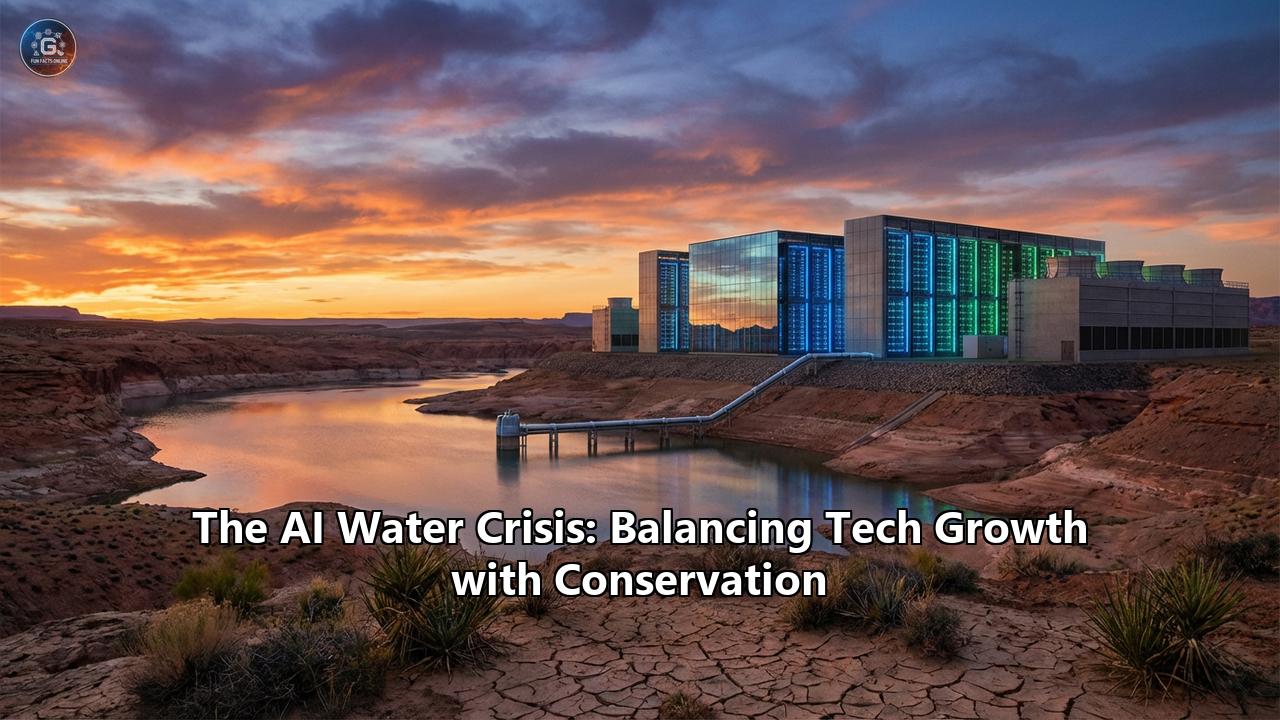
When you type a prompt into ChatGPT or ask Gemini to draft an email, the process feels ephemeral—a digital exchange of bits and bytes that exists in the "cloud." But the cloud is not a nebulous vapor; it is a physical infrastructure of steel, silicon, and concrete, humming with electricity and generating immense heat.
To keep this infrastructure from melting down, the tech industry is consuming one of Earth’s most precious resources at an alarming rate: fresh water.
As the race for artificial intelligence accelerates, a quiet crisis is brewing. It is a conflict between the exponential growth of a technology that promises to revolutionize our future and the conservation of the very resource required to sustain life today. This is the story of AI’s hidden thirst.
The Hidden Cost of a Prompt
To understand the scale of the problem, we must look beyond the abstract huge numbers and look at the cost of a single interaction.
Researchers at the University of California, Riverside, have estimated that a simple conversation with a chatbot—roughly 20 to 50 questions and answers—consumes about 500 milliliters of water. That is a standard plastic water bottle, “drunk” by the data center to cool the servers processing your request.
While a single bottle seems negligible, the math becomes staggering when scaled to the global level. With billions of users engaging with AI daily, the water footprint expands exponentially.
- Training a Model: Training GPT-3 alone is estimated to have consumed 700,000 liters of fresh water—enough to produce roughly 370 BMWs or 320 Tesla vehicles.
- The Corporate Footprint: In 2022, Microsoft’s global water consumption spiked by 34%, reaching nearly 6.4 billion liters (1.7 billion gallons). Google’s water usage rose by 20% in the same period.
- Future Projections: By 2027, global AI demand could drive water withdrawal to between 4.2 and 6.6 billion cubic meters annually. That is more than the total annual water withdrawal of half of the United Kingdom or the entire nation of Denmark.
Why Does AI Need So Much Water?
Data centers are essentially massive heaters. Thousands of servers packed into racks generate immense thermal energy as they process complex algorithms. If this heat isn't removed, the chips fail.
To cool them, companies typically rely on evaporative cooling towers. These work similarly to how sweating cools the human body: water is evaporated to remove heat from the air. While energy-efficient, this method is incredibly water-intensive.
- Water Consumption: This is water that is evaporated into the atmosphere and is effectively "lost" to the immediate local watershed.
- Water Withdrawal: This is water taken from a source (like a river or aquifer), used for cooling, and then returned. However, the returned water is often significantly warmer than the source, leading to thermal pollution, which can de-oxygenate local waterways and kill aquatic life.
The Human Toll: When Data Centers Meet Drought
The abstraction of "global statistics" falls away when you look at the specific communities on the front lines of this crisis. The conflict between big tech and local residents is becoming increasingly visible in water-stressed regions.
"This is Not Drought, It's Pillage" — Uruguay
In 2023, Uruguay faced its worst drought in 74 years. The situation in Montevideo was so dire that the government began mixing salty estuary water into the municipal supply, leaving tap water undrinkable for pregnant women and people with health conditions.
Amidst this crisis, Google was planning a new data center that would consume millions of liters of cool water daily. The public outcry was immediate. Graffiti appeared on walls across the capital reading, "No es sequía, es saqueo" ("This is not drought, it's pillage"). The protests forced the Uruguayan government and Google to renegotiate, eventually leading the company to propose a smaller facility with air-cooling technology.
The Secret in The Dalles — Oregon, USA
In the shadow of the Cascade Mountains, The Dalles, Oregon, has long been a haven for Google’s server farms. But for years, the exact amount of water the company used was treated as a "trade secret."
When the city council voted to approve a new $28.5 million water deal for Google in 2021, even the council members didn't know the precise usage figures until weeks before the vote. It took a lawsuit by The Oregonian newspaper against the city to force transparency. The records revealed that Google’s data centers in the town were consuming over a billion liters of water annually, nearly tripling their usage over five years, all while the region suffered through a severe "megadrought."
Farmers vs. The Cloud — Spain
In Talavera de la Reina, Spain, farmers are watching their crops wither as the region of Castilla-La Mancha faces chronic water shortages. Yet, Meta (Facebook’s parent company) has planned a data center there that is projected to consume over 600 million liters of potable water annually. For a local farmer who has lost 80-90% of their harvest to drought, seeing a tech giant secure access to millions of liters of water for "cloud" storage feels like a cruel irony.
The Industry Response: "Water Positive" by 2030
Recognizing the reputational and operational risk, the tech giants have made ambitious promises. Microsoft, Google, and Meta have all pledged to be "Water Positive" by 2030. This means they intend to replenish more water than they consume.
Their strategy relies on three pillars:
- Replenishment Projects: Investing in wetlands restoration, removing invasive species that hog water, and fixing leaks in municipal pipes.
- Recycled Water: Shifting from potable (drinking) water to "purple pipe" water—treated wastewater that is safe for cooling but not for drinking.
- Efficiency: Using AI to optimize the cooling systems themselves. Google’s DeepMind AI, for example, has been used to reduce the energy required for cooling by up to 40%.
The Critique: Is It Greenwashing?
Experts warn that "Water Positive" can be a misleading term.
- Location Mismatch: Water is a local resource, not a global one like carbon. Saving a million liters of water in a wet region like Ireland does nothing to help a drought-stricken community in Arizona or Chile. If a company consumes water in a desert but "replenishes" it in a rainforest, the net math works, but the local ecosystem still suffers.
- The "Withdrawal" Loophole: Companies often focus on reporting consumption (evaporation) rather than withdrawal. However, withdrawing massive amounts of water from a river, heating it up, and dumping it back in can be just as damaging to the environment as consuming it.
The Path Forward: Innovation and Regulation
The trajectory of AI growth suggests we cannot simply conserve our way out of this problem; we must innovate our way out.
Liquid Cooling is the most promising frontier. Instead of cooling the air around the servers, companies are experimenting with direct-to-chip cooling or immersion cooling, where servers are submerged in non-conductive fluids. These fluids are far more efficient at moving heat than air, drastically reducing the need for water evaporation. Moving the Workload is another solution. Why train an AI model in Phoenix, Arizona, in July? Data centers can be programmed to shift heavy, non-urgent workloads (like training a new model) to facilities in cooler climates or regions with abundant renewable energy and water, such as Scandinavia or Canada.Finally, Regulation is catching up. The days of water usage being a "trade secret" are ending. The European Union and impending US legislation are moving toward requiring strict environmental impact assessments for new data centers.
Conclusion
We are at a crossroads. Artificial Intelligence holds the potential to solve some of our greatest environmental challenges, from optimizing power grids to designing new materials for solar panels. Yet, if left unchecked, the physical infrastructure of AI threatens to exacerbate the very resource scarcity it hopes to solve.
The water crisis is not a reason to halt technological progress, but it is a mandate to redesign it. The "cloud" must be brought down to earth, grounded in the reality that our digital lives rely on a physical planet—one that is growing thirstier by the day.
Reference:
- https://www.reddit.com/r/environment/comments/16fhjz0/what_do_people_mean_when_a_data_center_consumes/
- https://waterwatch.org/the-dalles-drops-fight-to-keep-google-water-use-private/
- https://www.youtube.com/watch?v=VBzC7ifFTjs
- https://www.popsci.com/environment/google-facebook-sustainabile-water-use/
- https://www.greeneuropeanjournal.eu/dry-land-for-thirsty-data/
- https://interface.media/blog/2024/09/02/aws-data-centres-water-positive-pledge-isnt-greenwashing-but-it-is-misleading/
- https://www.theguardian.com/world/2023/jul/11/uruguay-drought-water-google-data-center
- https://columbiacommunityconnection.com/the-dalles/good-day-for-journalism-the-dalles-google-abdicate-in-water-fight-with-oregonian
- https://www.straitstimes.com/world/europe/thirsty-data-centres-are-making-europe-s-dry-summers-even-dryer
- https://blogs.microsoft.com/blog/2020/09/21/microsoft-will-replenish-more-water-than-it-consumes-by-2030/
- https://www.business-humanrights.org/en/latest-news/amazon-google-microsoft-allegedly-operating-and-expanding-water-intensive-datacentres-in-some-of-the-worlds-driest-region/
- https://www.onewaternews.com/corporate-giants-pledge-to-become-water-positive-by-2030
- https://stl.tech/blog/its-time-to-get-water-positive-by-2030/