
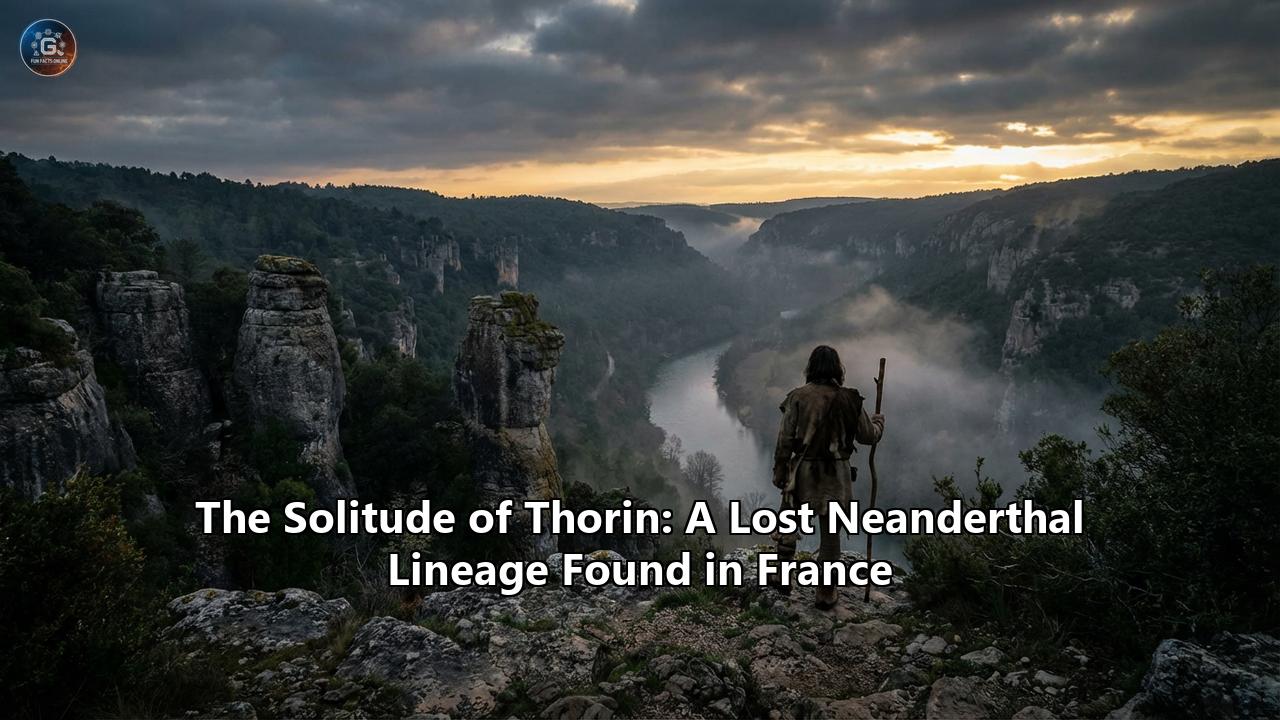
In the limestone folds of the Rhône Valley, where the wind whistles through the Grotte Mandrin, a secret has lain buried for forty-two millennia. It is a secret of isolation, of a people who looked out at a changing world and chose, or perhaps were forced into, a silence that would last fifty thousand years. This is the story of Thorin, the Neanderthal who should not have existed—or at least, not in the way that he did.
When archaeologists first brushed away the sediment from the teeth and jawbone in 2015, they had no idea they were looking at the last survivor of a "ghost population." They named him Thorin, after the exiled Dwarf King in J.R.R. Tolkien’s The Hobbit, a character defined by his noble lineage and his tragic isolation. It was a prescient naming. As the genetic machinery of modern science began to unravel the code within his ancient molar, a story emerged that has fundamentally rewritten the history of our closest extinct relatives.
Thorin was not just another Neanderthal. He was a relic of a lost world, a member of a lineage that had severed ties with the rest of Neanderthal humanity more than 100,000 years ago. While empires of ice rose and fell, while other Neanderthal groups traded genes and tools, and while Homo sapiens began their inexorable march into Europe, Thorin’s people remained apart. They lived in the heart of Europe, yet they were as isolated as if they were on a desert island.
This discovery, published in Cell Genomics in late 2024, has shattered the monolithic view of Neanderthals as a single, homogenous population doomed by stupidity or violence. Instead, it paints a haunting portrait of "The Solitude"—a social and genetic isolation so profound that it may well be the true reason the Neanderthals faded into the dark, leaving the earth to us.
Part I: The Cave of Time
To understand Thorin, one must first understand his home. The Grotte Mandrin is not a deep, terrifying abyss, but a rock shelter perched high above the Rhône River in southern France. It offers a strategic view of the valley below—a corridor that has been a highway for migrating herds and hominins for hundreds of thousands of years.
For decades, archaeologist Ludovic Slimak of the French National Centre for Scientific Research (CNRS) has haunted this shelter. Slimak is a man who looks at flint flakes and sees the fingerprints of the lost. He had long suspected that the Rhône Valley held a unique place in prehistory. The tools found here didn't always match the "classic" Mousterian industry found elsewhere in Europe. They were different. Distinct.
In 2015, the team was excavating a layer of soil designated "Layer B2," dating back roughly 42,000 to 50,000 years. This was the twilight of the Neanderthals. The Ice Age was tightening its grip, and the great game of survival was entering its final round. It was here, in the dirt of the cave floor, that they found the remains: fragments of a jaw and teeth.
They were undeniably Neanderthal. The robust roots, the morphology, the wear patterns—everything screamed Homo neanderthalensis. But when the samples were sent to Copenhagen for genomic analysis, the timeline broke.
The Genetic Paradox
Martin Sikora and Tharsika Vimala at the University of Copenhagen are the architects of ancient DNA. They are used to piecing together the shattered genomes of the past. But Thorin presented a paradox that stumped them for seven years.
When they sequenced Thorin’s DNA, the genetic molecular clock told them that this individual belonged to an ancient population. His genes looked like those of Neanderthals who lived 100,000 years ago—the "early" Neanderthals. Yet, the radiocarbon dating and the geological stratigraphy of Grotte Mandrin were clear: Thorin died only 42,000 to 50,000 years ago.
"We worked for seven years to find out who was wrong," Slimak later said. "Archaeologists or genomicists."
If the archaeologists were right, Thorin was a late Neanderthal living at the very end of his species' time on Earth. If the geneticists were right, he was an ancient fossil that had somehow been misplaced in the dirt.
The breakthrough came from the isotopes. By analyzing the chemical signatures in Thorin's teeth, the researchers could reconstruct the climate in which he lived. "Early" Neanderthals (100,000 years ago) lived during a warm, temperate period. But the isotopes in Thorin’s enamel sang a song of bitter cold, of steppe-tundra and ice. He had lived during the glacial maximum.
He was, indeed, a late Neanderthal. The archaeologists were right about when he lived. But the geneticists were right about who he was. The only explanation was chilling: Thorin belonged to a population that had stopped evolving with the rest of the species. He was a genetic living fossil.
Part II: The Lost Lineage
The implications of this finding are staggering. For a population's DNA to look "old" despite living in recent times, it means they must not have exchanged DNA with outsiders for a very, very long time.
Genetic drift is the slow mutation of a population over time. When groups meet and mate, they share these mutations, keeping the species relatively genetically uniform. But Thorin’s genome showed a deep divergence. His ancestors had split away from the main European Neanderthal line around 105,000 years ago.
For the next 50,000 years—five hundred centuries—Thorin’s lineage remained genetically isolated.
To put this into perspective, 50,000 years is the entirety of recorded human history multiplied by ten. It is the difference between us and the first people to paint in the caves of Sulawesi. For that immense stretch of time, Thorin’s people lived in the Rhône Valley and perhaps stretching toward Spain, and they seemingly never exchanged a single child, a single mate, or a single gene with the other Neanderthal groups living to the north or east.
The Ghost Population Revealed
Thorin was not alone in this genetic exile. The study found a match for his unique DNA signature. The closest relative to Thorin was not the Neanderthals found in Belgium or Croatia, but an individual found thousands of miles away in Gibraltar—nicknamed "Nana."
Nana had been found years earlier, but her genome had been difficult to place. Now, the picture snapped into focus. Thorin and Nana represented a distinct "Mediterranean" population of Neanderthals. While the "classic" Neanderthals roamed the northern plains of Europe, adapting to the cold and hunting mammoth, this ghost lineage clung to the warmer, rockier coasts and valleys of the south, stretching from the Rock of Gibraltar to the banks of the Rhône.
This discovery proves that the Neanderthal world was not a monolith. It was a mosaic of different nations, different tribes, perhaps even different subspecies, who were as alien to one another as they were to the incoming Homo sapiens.
Part III: The Solitude
Why? This is the question that haunts the researchers. Why would a group of humans (for Neanderthals were human in every meaningful sense) remain isolated for 50,000 years?
The geography of France is not so formidable. The distance between the Rhône Valley and the territories of other Neanderthal groups is a matter of two weeks' walking. "They were happy in their valley and did not need to move," Slimak mused in interviews. But biological isolation usually spells doom.
Thorin’s genome reveals the scars of this isolation. His DNA is riddled with "runs of homozygosity"—long stretches of identical genetic code inherited from both parents. This is the hallmark of inbreeding. It suggests that Thorin’s community was incredibly small, perhaps a band of a few dozen individuals, mating within the same shrinking gene pool for millennia.
This phenomenon, dubbed "The Solitude" by the researchers, stands in stark contrast to the behavior of early Homo sapiens.
The Social Network of the Sapiens
While Thorin’s people were turning inward, a new player had entered the game. Grotte Mandrin is not just famous for Thorin; it is famous for the "Neronian" layer.
In 2022, Slimak and his team shocked the world by revealing that Homo sapiens had reached this very cave 54,000 years ago—far earlier than previously thought. They found a modern human tooth and advanced arrowheads (Neronian points) sandwiched between layers of Neanderthal occupation.
This means that Thorin’s people and Homo sapiens were neighbors. They occupied the same cave system, separated perhaps by only a few seasons, or perhaps they even watched each other from across the river.
And yet, there is zero evidence of gene flow. Thorin’s genome contains no Homo sapiens DNA. The local modern humans, who carried tools and jewelry and social networks spanning continents, apparently did not interbreed with this isolated Neanderthal clan.
Here lies the crux of the extinction mystery. Modern humans are defined by our connectivity. An artifact found in a Sapiens site might originate from stone sources hundreds of kilometers away. We are a species of networks, of trade, of curiosity. We build bridges.
The Neanderthals of Thorin’s line built walls.
"This would be unimaginable for a Sapiens," Slimak noted. "And reveals that Neanderthals must have biologically conceived our world very differently from us."
Part IV: The Mechanism of Extinction
For over a century, we have asked what killed the Neanderthals. Was it war? Was it climate change? Was it a superior human brain?
The Solitude of Thorin suggests a different, more tragic answer: it was a failure of networking.
When populations become small and isolated, they become vulnerable. A bad winter, a disease, or a few years of poor hunting can wipe out a small tribe if they have no allies to turn to. Genetic diversity acts as a shield against disease and deformity; inbreeding strips that shield away.
The "Classic" European Neanderthals were already suffering from low genetic diversity, but Thorin’s lineage was in a death spiral. They were "living dead"—a population so genetically fragile that their extinction was almost a mathematical certainty.
When Homo sapiens arrived, they didn't need to commit genocide. They simply needed to exist. They brought with them a "fluidity" of existence—moving, mating, trading, and adapting. They had a social safety net that spanned the continent. If a human tribe in the Rhône failed, cousins from the Danube or the Mediterranean coast would eventually fill the void.
Thorin’s people had no cousins. They had only themselves. And when the end came, they died alone.
Part V: A New Vision of Prehistory
The discovery of Thorin forces us to rewrite the maps of the Ice Age. We can no longer think of "The Neanderthals" as a single entity. We must think of them as we think of human nations—distinct cultures and biological lineages with their own histories.
There was the Northern Lineage, the "classic" Neanderthals who are the ancestors of the Neanderthal DNA found in modern humans (due to interbreeding events in the Near East or elsewhere). And there was the Mediterranean Lineage, the ghost people of Thorin and Nana, who seemingly refused to mix, refused to change, and ultimately vanished without leaving a trace in our modern blood.
This adds a layer of complexity to the "replacement" theory. It wasn't a single wave of humans washing over a single bank of Neanderthals. It was a complex dance of alternating occupations. At Grotte Mandrin, the record shows:
- Neanderthals (The ancestors of Thorin)
- Homo Sapiens (The Neronian scouts, 54k years ago)
- Neanderthals (Thorin’s people return, 42k-50k years ago)
- Homo Sapiens (The final Aurignacian wave, permanent colonization)
Thorin represents the last gasp of the indigenous Europeans. After the first failed incursion of modern humans (the Neronian wave), Thorin’s people reclaimed the cave. They held it for thousands of years. They were resilient. They knew the land. But their isolation was a slow poison.
Conclusion: The Last King Under the Mountain
Thorin Oakenshield, the dwarf of Tolkien’s legend, died reclaiming his homeland, the last of his line. Thorin of Mandrin died in the cold wind of the Rhône, likely suffering from the genetic burden of his isolation, the last of a lineage that had survived for 100,000 years.
His discovery is a triumph of modern science—a testament to the power of genomics to pluck truth from the dust. But it is also a somber warning. It tells us that survival is not just about strength, or intelligence, or adaptation to the cold. It is about connection.
We, Homo sapiens, are here today because we are the "social animal" par excellence. We mixed. We traveled. We saw the stranger on the other side of the river and, occasionally, we crossed the water to make a friend instead of an enemy.
Thorin’s people stayed on their side of the river. They kept to the old ways, the old genes, the old silence. And in the end, the silence swallowed them whole.
As you look at the reconstruction of Thorin’s jaw, or the flint tools he knapped with hands identical to ours, remember that he is not just a fossil. He is a monument to a different way of being human—a way that was beautiful, resilient, and ultimately, too lonely to survive.
Detailed Analysis: The Science Behind the Discovery
To fully appreciate the magnitude of the Thorin discovery, we must delve into the specific scientific methodologies that allowed researchers to extract a ghost from a stone.
1. The Challenge of Ancient DNA (aDNA)DNA degrades over time. In a 50,000-year-old bone, the remaining DNA is shattered into microscopic fragments, often contaminated by bacteria, fungi, and the DNA of the archaeologists who handled it.
The team at the University of Copenhagen used "shotgun sequencing" combined with "capture arrays." This involves fishing out the specific human-like DNA strands from the soup of microbial genetic material.
- The Preservation: The unique chemical environment of Grotte Mandrin (protected from water and extreme heat fluctuations) helped preserve the molar’s root. Teeth are often the best vaults for DNA, as the enamel protects the inner material.
How did they know Thorin was a "late" Neanderthal if his genes looked "early"?
- Oxygen Isotopes: The ratio of Oxygen-18 to Oxygen-16 in tooth enamel varies depending on the water the individual drank as a child. This water reflects the local precipitation and temperature.
- The Signal: Thorin’s isotopes showed low levels of heavy oxygen, a signature of a cold, glacial environment. This matched the "Last Glacial Period" (roughly 115,000 – 11,700 years ago), specifically the colder phases around 45,000 years ago. This physically anchored him in the timeline, overruling the "molecular clock" discrepancy.
The archaeological context of Grotte Mandrin is as important as the biological one. The "Neronian" tool industry found in Layer E (below Thorin’s layer) is technologically advanced.
- Nano-blades: These are tiny, standardized flint points, some less than a centimeter long. They were likely used as arrowheads, propelled by bows or atlatls.
- The Link: These tools are totally unlike Neanderthal Mousterian tools. They match tools found in the Levant (Ksar Akil, Lebanon) associated with Homo sapiens. This is the smoking gun that proves modern humans were in France 10,000 years before the "official" colonization date.
- The Interaction: The fact that Thorin’s people lived after this Neronian layer means they re-colonized the cave after the humans left or died out. It paints a picture of a frontier zone where territories shifted back and forth.
The Philosophy of Otherness
Ludovic Slimak, the lead archaeologist, has written extensively on what he calls the "Otherness" of the Neanderthal. He argues against the trend of "humanizing" Neanderthals too much—trying to make them just like us.
The Thorin discovery supports his view. If Neanderthals were "just like us," they would have integrated. They would have been curious about the Neronian humans. They would have formed networks. The fact that they maintained a 50,000-year isolation implies a fundamental difference in psychology or social cognition.
Perhaps Neanderthals did not have the concept of "The Tribe" as an expandable unit. Perhaps their loyalty was strictly biological, limited to those they grew up with. This "hyper-conservatism" served them well for hundreds of thousands of years in a stable, predictable environment. But when the world became unstable—filled with rapid climate shifts and invasive, hyper-social human bands—the conservative strategy became a suicide pact.
The Future of the Past
The Grotte Mandrin is not finished yielding its secrets. The excavation is ongoing. "Thorin" is represented by teeth and jaw fragments, but the team is hopeful that more of him lies within the sediment.
Furthermore, the identification of the "Mediterranean Lineage" sends researchers back to the museum vaults. How many other fossils, excavated decades ago in Spain, Italy, or Southern France, belong to this ghost lineage? DNA re-analysis of old bones may reveal that the Neanderthal world was far more diverse than we ever imagined.
We are left with a new map of Europe 45,000 years ago. It is not a map of empty wilderness, but a map of borders. Here, the expanding network of the Aurignacian humans. There, the isolated pockets of the Thorin lineage. And in the silence between them, the final destiny of our sister species was decided.
Thorin’s solitude is no longer just his own. It is a part of our history, a reminder of the diverse ways humanity once tried to live upon this earth. And it is a reminder that in the long run, no one survives alone.
Reference:
- https://www.livescience.com/archaeology/dna-of-thorin-one-of-the-last-neanderthals-finally-sequenced-revealing-inbreeding-and-50-000-years-of-genetic-isolation
- https://www.newsweek.com/neanderthal-remains-challenge-history-ancient-human-relatives-anthropology-1952062
- https://archaeology.org/news/2024/09/13/possible-isolated-lineage-of-neanderthals-identified/
- https://www.iflscience.com/meet-thorin-a-cave-dwelling-population-of-neanderthals-were-isolated-for-50000-years-75910
- https://www.discovermagazine.com/thorin-the-neanderthal-was-one-of-the-last-of-these-ancient-humans-47430
- https://morningoverview.com/a-new-neanderthal-genome-reveals-a-lost-isolated-lineage/
- https://www.sciencealert.com/neanderthal-lineage-was-isolated-for-an-astonishing-50000-years
- https://www.smithsonianmag.com/smart-news/ancient-dna-reveals-neanderthal-group-was-isolated-for-50000-years-180985068/
- https://community.mytrueancestry.com/the-tale-of-thorin-a-neanderthal-discovery-at-grotte-mandrin/
- https://www.sapiens.org/archaeology/ghost-neanderthal-lineage/
- https://www.scimex.org/newsfeed/an-ancient-neanderthal-community-was-isolated-for-over-50-000-years
- https://www.mangaloretoday.com/today/Ancient-DNA-reveals-a-distinct-Neanderthal-lineage-that-evolved-separately-for-over-50-000-years.html
- https://www.labrujulaverde.com/en/2024/09/thorin-the-worlds-loneliest-neanderthal-belonged-to-a-lineage-isolated-for-over-50000-years/
- https://www.smithsonianmag.com/science-nature/europes-first-humans-may-have-arrived-in-three-waves-180982107/
- https://www.sci.news/archaeology/thorin-neanderthal-13253.html
- https://pubmed.ncbi.nlm.nih.gov/39265525/
- https://www.biorxiv.org/content/10.1101/2023.04.10.536015v1
- https://earthlogs.org/2022/02/15/did-earliest-modern-humans-in-europe-share-a-cave-with-neanderthals/
- https://www.google.com/search?q=time+in+Dr%C3%B4me,+FR
- https://www.sci.news/archaeology/grotte-mandrin-molar-10544.html