
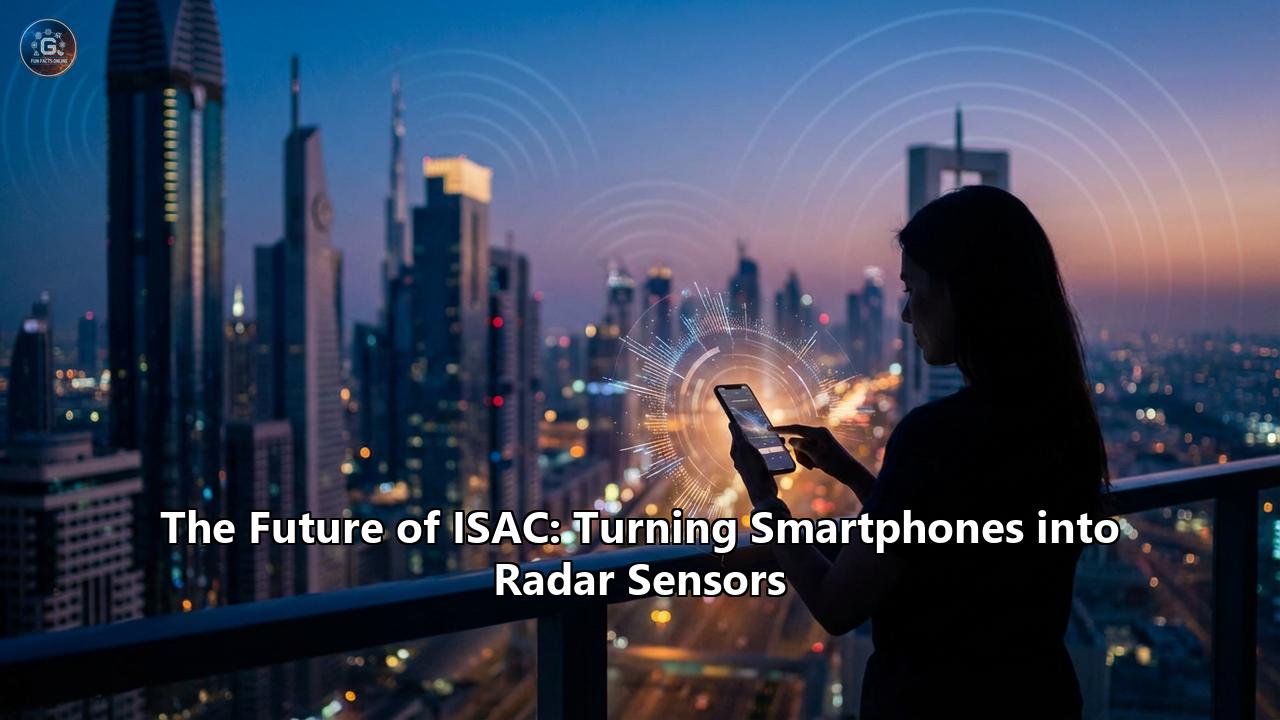
Imagine walking down the street, and your smartphone subtly vibrates to warn you that an electric scooter is speeding around the blind corner ahead of you. Or picture standing in your living room, holding up your phone, and using it to "see" a burst water pipe hidden deep within the drywall. Consider a shopping mall that can perfectly manage crowd flow and detect emergencies without a single privacy-invading camera, or a hospital room that monitors a patient’s breathing rate simply through the ambient radio waves bouncing around the room.
What sounds like science fiction is rapidly becoming a tangible reality. The secret lies not in adding more camera lenses or bulky sensors to our devices, but in a fundamental reimagining of how mobile networks and smartphones operate. This paradigm shift is known as Integrated Sensing and Communication (ISAC), a technological leap that is poised to be the crown jewel of the upcoming 6G era. By combining traditional wireless communication with highly advanced radar capabilities, ISAC is transforming everyday smartphones and mobile network base stations into a global, interconnected radar system.
As telecom giants, hardware manufacturers, and standard-setting bodies like 3GPP and ETSI push the boundaries of what radio frequencies can do, we are witnessing the birth of a "sixth sense" for our digital devices. This comprehensive exploration will delve into the mechanics, applications, economic impact, and future trajectory of ISAC, illustrating exactly how your smartphone is evolving into a high-precision radar sensor.
The Evolution from Communication to Perception
For decades, the trajectory of mobile telecommunications has been single-minded: move more data, faster, and with less latency. From the analog voice calls of 1G to the high-definition video streaming and low-latency gaming of 5G, the goal has always been to optimize the pipeline connecting point A to point B. The network was entirely blind to the physical world it operated in, acting merely as an invisible highway for data.
ISAC shatters this historical limitation. For the first time, the network will not only communicate information but also perceive the environment.
ISAC refers to the integration of sensing and communication functions within the exact same wireless infrastructure, utilizing the same spectrum and hardware. Traditionally, radar systems (like those used in aviation or weather tracking) and communication systems operated in strict isolation. They required separate antennas, different frequency bands, and distinct signal processing algorithms. ISAC merges these two worlds.
When a 6G or 5G-Advanced base station—or your smartphone—transmits a standard radio signal to download a webpage, that same radio wave inevitably bounces off objects in the physical environment: people, cars, buildings, and even raindrops. By capturing and analyzing the "echoes" of these bounced signals, ISAC-enabled devices can determine an object's shape, size, speed, material composition, and precise location.
In essence, ISAC gives mobile networks a capability remarkably similar to the echolocation used by bats. Just as a bat emits high-frequency squeaks and listens to the echoes to navigate in pitch darkness and hunt prey, your smartphone will soon emit radio frequency (RF) signals and process the returning echoes to "see" its surroundings, entirely independently of its optical cameras.
The Physics and Mechanics of Smartphone Radar
To understand how a smartphone can function as a radar, we must look at the underlying physics of electromagnetic waves and the engineering marvels of modern telecommunications.
1. The Power of High-Frequency Bands (mmWave and Sub-THz)The resolution of any radar system is heavily dependent on the frequency of the waves it uses. Older cellular networks operated on lower frequencies (sub-6 GHz), which are excellent for penetrating walls and traveling long distances but are too long in wavelength to detect fine details.
The introduction of millimeter-wave (mmWave) in 5G, and the upcoming use of Sub-Terahertz (Sub-THz) bands (100 GHz to 300 GHz) in 6G, changes the game entirely. These ultra-high frequencies have very short wavelengths. When these tiny waves strike an object, they scatter in ways that can be precisely measured. Because the waves are so small, they can detect minute movements—such as the millimeter-scale displacement of a human chest cavity during breathing, or the subtle vibrations of vocal cords.
2. Massive MIMO and BeamformingModern smartphones and base stations utilize Multiple-Input Multiple-Output (MIMO) technology, meaning they pack arrays of dozens or even hundreds of microscopic antennas into a single device. Through a process called beamforming, these antennas can focus radio waves into tight, directional beams rather than broadcasting them indiscriminately in all directions.
In an ISAC system, a smartphone can sweep these concentrated beams across a room. When the beam hits a surface and reflects back, the antenna array receives the signal. By measuring the Time of Flight (ToF)—the exact nanosecond it took for the signal to return—the device calculates distance. By measuring the Angle of Arrival (AoA), it determines the object's exact spatial position.
3. The Doppler Effect in Your PocketSpeed and movement are calculated using the Doppler effect. Just as an ambulance siren changes pitch as it drives past you, radio waves change frequency when they bounce off a moving object. If a person is walking toward your smartphone, the reflected radio waves will be slightly compressed, shifting to a higher frequency. If they are walking away, the waves stretch out. ISAC algorithms process these microscopic frequency shifts to determine the velocity of unconnected, passive objects in real-time.
4. Innovations like mmRippleAcademic and industry researchers are pushing the boundaries of what smartphone radar can do. A prime example is the recent development of "mmRipple," a technology showcased in IEEE research that empowers commodity mmWave radars with communication capabilities via smartphone vibrations. In this system, a smartphone uses its internal vibration motor to send active messages to a radar receiver. The radar detects the micro-vibrations of the phone casing, effectively allowing the smartphone to transmit data (up to 100 bits per second with advanced Pulse Width and Amplitude Modulation) simply by buzzing. This demonstrates the hyper-sensitivity of ISAC systems; they are perceptive enough to decode Morse-code-like vibrations from meters away.
The "Sixth Sense" Use Cases: Transforming Everyday Life
The transition from a connectivity-only network to a spatially aware network unlocks a dizzying array of applications. The ETSI (European Telecommunications Standards Institute) has already outlined numerous high-impact use cases for ISAC, categorizing them into several transformative domains.
Seeing the Unseen: Smart Homes and Structural SensingBecause radio waves can penetrate certain materials that visible light cannot, ISAC turns smartphones into non-destructive testing devices. As highlighted in recent industry demonstrations by telecom operators like Vodafone, users could point their smartphones at a wall to detect the presence of wooden studs, electrical wiring, or a hidden burst water pipe.
If you lose your keys in the couch cushions, an ISAC-enabled smartphone sweeping the room could identify the distinct radar signature of the metal keys and guide you directly to them.
Intruder Detection and Security Without CamerasTraditional home and enterprise security relies heavily on optical cameras. However, cameras fail in the dark, can be blinded by smoke, and pose massive privacy concerns. Using ISAC, a home Wi-Fi router or a 6G base station can flood a room with radio waves. It establishes a baseline radar map of the empty room. If an intruder enters, their physical body disrupts the radio waves. The network instantly detects the size, speed, and trajectory of the intruder—even in pitch darkness or behind smoke—triggering an alarm. Because the system only sees a "radar blob" rather than a detailed optical face, it provides high security without the dystopian feeling of being constantly watched by lenses.
Advanced Health MonitoringIn hospitals and eldercare facilities, ISAC represents a revolution in atraumatic medical detection. Currently, monitoring a patient's vitals requires strapping them with wearables or wiring them to machines. With a 6G ISAC network, the ambient radio waves in the hospital room bounce off the patient's body. The network can detect the rhythmic rise and fall of the chest to monitor breathing, and even the microscopic skin vibrations caused by the heartbeat. If an elderly person falls in their home, the sudden change in their vertical radar profile instantly alerts emergency services—no wearable panic button required.
Urban Safety and Crowd ManagementImagine a busy train station or a stadium. Today, managing crowd density relies on estimating numbers via CCTV. With ISAC, the mobile network itself acts as a massive radar dome. It can precisely count the number of humans in a space by identifying the volume of radar reflections. Shopping malls can analyze visitor volumes and traffic flow with perfect accuracy while guaranteeing absolute privacy, as no optical data is ever recorded. Furthermore, your phone could proactively alert you if you are walking toward a dangerously overcrowded area or an unfolding stampede.
Automotive Intelligence and Autonomous SystemsWhile modern autonomous vehicles bristle with LiDAR, optical cameras, and their own onboard radar, these sensors are strictly Line-of-Sight (LoS). If a child runs out from behind a parked truck, the car’s sensors cannot see them until the last millisecond. ISAC integrates the cellular network into the vehicle's sensory array. The 6G base stations on the street corner are continuously bouncing radar signals around the environment. The network detects the hidden child and instantly transmits this spatial data to the approaching car, allowing it to brake proactively.
Furthermore, ISAC can track the precise location of unauthorized drones in urban airspace or guide autonomous mobile robots in a bustling factory hall, preventing collisions.
Environmental and Weather MonitoringBecause high-frequency radio waves are scattered by precipitation, the national 6G infrastructure will effectively become a continent-wide meteorological sensor. By measuring how much a signal is degraded or scattered between a cell tower and a smartphone, the network can provide hyper-local, instant rainfall data. It can detect rising water levels on streets to issue early flood warnings, or monitor structural vibrations in bridges to predict collapses during natural disasters.
Privacy by Design: Sensing Without Seeing
The concept of a network that constantly maps the physical world naturally triggers immediate and severe privacy concerns. If the mobile network can see everything, are we stepping into an Orwellian surveillance state?
Interestingly, ISAC is largely being championed as a privacy-enhancing technology. The fundamental difference between optical cameras and ISAC radar is the nature of the data collected. A camera captures highly identifiable biometric data: facial features, skin color, clothing, and identifying marks. An ISAC system, on the other hand, captures physical geometry and movement.
When an ISAC system detects a human, it registers a point cloud or a mass of reflecting surfaces moving at a certain velocity. It knows someone is there, and it knows how fast they are moving, but it does not know who they are. This makes ISAC incredibly appealing for use cases in sensitive areas where cameras are legally or ethically prohibited—such as bathrooms, locker rooms, private hospital wards, and inside private homes.
However, the telecom industry acknowledges that stringent regulations will be required. The "radar signatures" of individuals could theoretically become identifiable if combined with other data (like the unique MAC address of the phone they are carrying). Consequently, standard-setting bodies are embedding strict anonymization protocols into the foundational architecture of 6G ISAC.
The Business Case: "Sensing-as-a-Service"
For Mobile Network Operators (MNOs) like AT&T, Vodafone, and Telefonica, ISAC is the holy grail. For the past decade, telecom operators have been squeezed into the role of "dumb pipes"—spending billions to build 5G networks, only to watch tech giants like Google, Meta, and Apple reap the massive software and service profits.
ISAC offers MNOs a chance to break free from this connectivity legacy. By turning their infrastructure into a giant radar system, they generate a completely new, incredibly valuable commodity: real-time spatial data.
This gives rise to the business model of "Sensing-as-a-Service" (SaaS). Under this model, operators become data brokers for the physical world.
- A city planner could pay the network for real-time traffic flow data to optimize stoplights.
- A logistics company could pay for precise drone-tracking corridors.
- A retail chain could subscribe to the network's indoor ISAC data to understand how customers move through their stores, without installing a single tracking camera.
ABI Research notes that this is the first truly innovative concept for cellular networks since 4G introduced mobile broadband. By utilizing APIs (Application Programming Interfaces), telecom operators can expose this sensing data to third-party developers, creating a massive new app ecosystem based on environmental awareness.
The Road to 6G: Current Trials and Real-World Implementation
While ISAC is widely billed as the centerpiece of 6G (expected to roll out commercially around 2030), the foundational steps are being taken right now.
The 3GPP, the global organization that governs cellular standards, has already included early ISAC features in its Release 19, which was frozen in late 2025 and is categorized under the 5G-Advanced standard. This means the bridge to ISAC is already under construction.
At the Mobile World Congress (MWC) in early 2026, the industry saw major breakthroughs. Vodafone, in partnership with Tiami Networks, showcased a highly successful commercial trial of ISAC. Operating out of Vodafone's R&D lab in Málaga, Spain, the companies used Tiami’s distributed application, PolyRAN, to successfully turn standard 5G base stations into wide-area sensors. They detected unconnected objects and people walking across the network without disrupting standard voice or data connectivity.
Crucially, this trial proved that ISAC does not strictly require futuristic 6G hardware to begin functioning; it can operate using current mobile spectrum and Open RAN compliant radio antennas. As Amitav Mukherjee, CEO of Tiami Networks, stated: "Deploying ISAC should be as seamless as enabling a software application within a 5G network".
Technical Hurdles and the Engineering Challenge
Despite the massive potential, turning a communication network into a high-fidelity radar system presents monumental engineering challenges that researchers are frantically working to solve before the 2030 6G deadline.
1. The Self-Interference Problem (Full-Duplex Limitations)Traditional radar systems listen for the echo of their own signal. But in a cellular network, a base station or smartphone is constantly bombarded by signals from millions of other devices. If a smartphone is blasting out a high-power radio wave to communicate with a cell tower, it is extremely difficult for its own antennas to simultaneously listen for the incredibly faint, microscopic echo bouncing off a nearby object. This requires "Full-Duplex" technology, which demands immensely complex analog and digital cancellation techniques to prevent the device's own powerful transmissions from deafening its sensitive receivers.
2. Hardware Cost and Network UpgradesWhile software like PolyRAN can enable basic ISAC on 5G, truly high-resolution 6G ISAC requires advanced hardware. Fully capable ISAC radios require dense Massive MIMO antenna arrays operating in the Sub-THz bands. ABI Research estimates that upgrading a single cell site to full ISAC capability could cost operators between $50,000 and $100,000. Scaling this across a national network requires hundreds of billions of dollars in capital expenditure.
3. Power Consumption and Battery DrainSmartphones are inherently limited by battery life. Firing continuous radar pulses and running the intense AI and machine learning algorithms required to process radar point-clouds into recognizable objects requires massive computational power. Chip manufacturers must develop highly specialized, ultra-low-power Neural Processing Units (NPUs) dedicated solely to ISAC signal processing so that leaving "radar mode" on doesn't drain a smartphone battery in an hour.
4. Channel Modeling and StandardizationUnlike communication, where you want a clean Line-of-Sight path, sensing relies heavily on Non-Line-of-Sight (NLoS) multipath reflections. The network has to untangle a chaotic mess of radio waves bouncing off windows, cars, and trees to form a coherent picture. ETSI and 3GPP are currently in the arduous process of creating standardized channel models so that an Ericsson base station, a Nokia edge server, and a Samsung smartphone can all speak the same "radar language" seamlessly.
A New Era of Perception
The convergence of communication and sensing represents a fundamental turning point in human technological history. We are moving away from devices that merely connect us to the digital realm, toward devices that seamlessly blend the physical, biological, and cyber worlds.
When 6G becomes the global standard, the invisible sea of radio waves that surrounds us will awaken. The national mobile infrastructure will become an intelligent, perceiving entity. Your smartphone will no longer just be a portal to the internet; it will be a highly sophisticated, bat-like sensory organ. It will monitor your health, protect your home, navigate autonomous cities, and see through the very walls around you.
The future of ISAC is not just about faster downloads or clearer calls. It is about endowing the digital world with the power of physical perception, fundamentally transforming our relationship with the environment and the devices in our pockets.
Reference:
- https://www.vodafone.com/news/newsroom/technology/vodafone-and-tiami-networks-trial-new-tech-turning-smartphones-into-radars-to-alert-users-of-danger
- https://www.abiresearch.com/blog/integrated-sensing-and-communication-isac-6g
- https://www.ispreview.co.uk/index.php/2026/02/vodafone-trial-5g-and-6g-mobile-tech-that-turns-smartphones-into-radars.html
- https://www.telecomstechnews.com/news/isac-will-turn-6g-networks-into-a-giant-radar-system/
- https://www.tejasnetworks.com/resource/integrated-sensing-and-communication-isac/
- https://www.telefonica.com/en/communication-room/blog/6g-isac-networks-that-communicate-perceive-same-time/
- https://www.communicationstoday.co.in/6gs-isac-tech-aims-to-turn-mobile-networks-into-radars/
- https://www.researchgate.net/publication/396249528_The_Role_of_ISAC_in_6G_Networks_Enabling_Next-Generation_Wireless_Systems
- https://www.telecoms.com/5g-6g/holy-6g-vodafone-it-s-a-batphone-
- https://arxiv.org/html/2405.01816v1
- https://www.huawei.com/en/huaweitech/future-technologies/integrated-sensing-communication-concept-practice
- https://www.interdigital.com/post/use-cases-for-isac-in-6g-a-look-ahead
- https://www.computer.org/csdl/journal/tm/2024/12/10637248/1ZsPOonBUEE
- https://ieeexplore.ieee.org/document/10637248/
- https://www.rcrwireless.com/20250708/fundamentals/isac-promises