
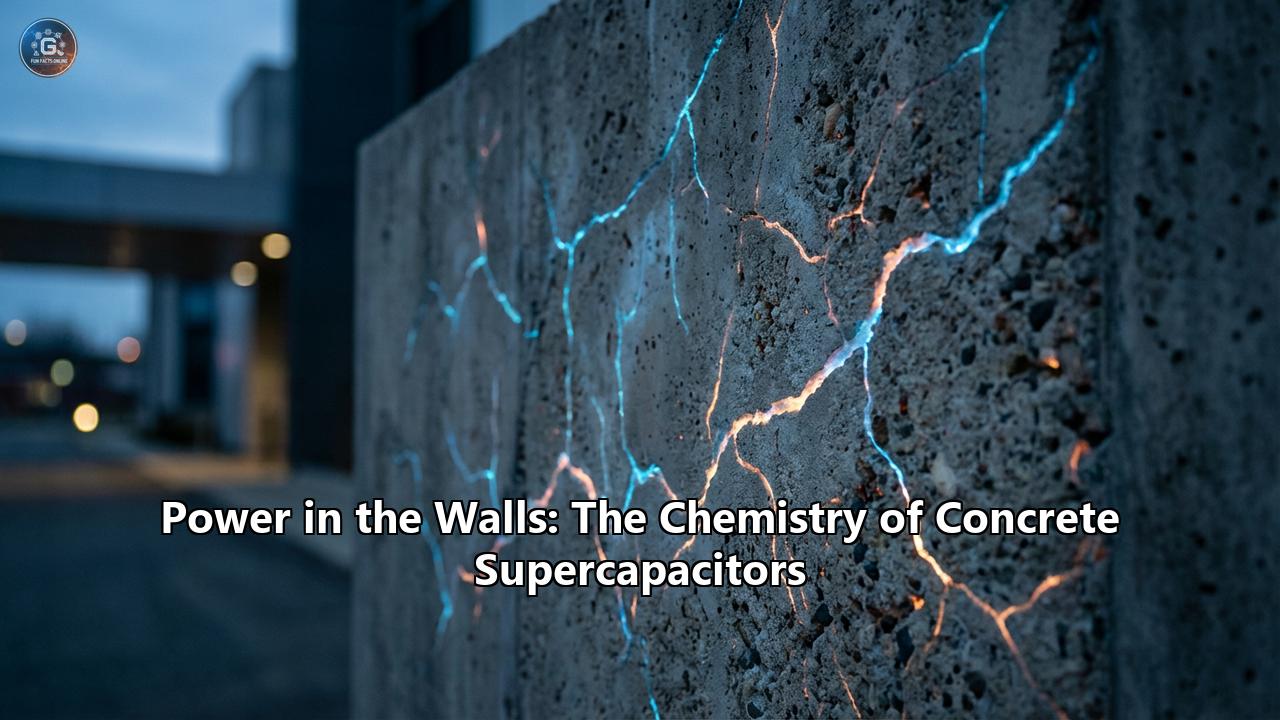
Imagine a world where your home is not just a shelter, but a living, breathing energy device. A world where the foundation under your feet and the walls protecting you from the wind are silently storing the energy of the sun, ready to release it when the lights go out. This is not science fiction; it is the burgeoning reality of structural energy storage, a field that has recently seen a quantum leap in performance thanks to a new understanding of ancient materials.
For decades, concrete has been the passive giant of the construction world—cheap, durable, and ubiquitous. But at the intersection of civil engineering and electrochemistry, a revolution is brewing. Researchers have unlocked a method to turn ordinary cement into a supercapacitor, a device capable of storing electrical charge, by introducing a simple, conductive additive: carbon black.
The implications are staggering. If the concrete foundations of a standard house were made of this material, they could theoretically store enough energy to power the entire home for a day. Roads could charge electric vehicles as they drive over them. Remote wind turbines could store energy in their own bases, eliminating the need for expensive external battery banks.
But how does a rock-like material conduct electricity? And more importantly, how does it store it? The answer lies in the complex, fractal chemistry of hydration and the delicate dance of ions within the microscopic pores of the wall.
The Anatomy of a Concrete Supercapacitor
To understand how a wall becomes a battery, we must first understand the difference between a battery and a supercapacitor.
- Batteries (like the Lithium-ion one in your phone) store energy chemically. Ions travel from one electrode to another, embedding themselves into the atomic structure. It is a slow process with high energy density but a limited lifespan.
- Supercapacitors store energy electrostatically. They don't rely on chemical reactions. Instead, they store charge on the surface of a material. Positive ions cling to a negative surface, and negative ions cling to a positive surface, creating an "electric double layer." Because there is no chemical reaction, they can charge and discharge almost instantly and last for millions of cycles.
The challenge for concrete has always been conductivity. Cement is an insulator; it blocks the flow of electricity. To turn it into a supercapacitor, you need to make it conductive, and you need to give it an enormous internal surface area to store those static charges.
The "Magic" Ingredient: Nanocarbon Black
The breakthrough, spearheaded by researchers at MIT’s Concrete Sustainability Hub (CSHub) and the Wyss Institute, involves a surprisingly simple recipe: cement, water, and carbon black.
Carbon black is effectively very fine charcoal. It is a historical material, used for centuries as a pigment and later as a reinforcing filler in car tires. It is highly conductive and inexpensive.
When you mix cement and water, a chemical reaction called hydration begins. The water doesn't just dry out; it becomes part of the crystal structure of the cement, turning the grey powder into a rock. As this happens, the water that isn't used creates a complex, branching network of pore channels throughout the hardening stone.
The genius of the MIT approach lies in the timing. Carbon black is hydrophobic (it repels water). When added to the wet cement mix, it naturally wants to get away from the water. As the water forms its pore network, the carbon black particles are forced together, self-assembling into long, conductive, fractal-like wires that run through the pores.
Imagine a dense forest where the trees are the solid cement, and the paths between them are the pores. The carbon black acts like a vine that grows along every single path, connecting the entire forest in a single, continuous, conductive web.
This "nanonetwork" has an incredibly high surface area. A small block of this material can have hundreds of square meters of internal carbon surface area, providing a massive playground for ions to cling to.
The 10x Leap: The Chemistry of the Electrolyte
Early prototypes of this technology were impressive proofs of concept, but they lacked the "punch" needed for real-world power. They used a simple aqueous electrolyte—essentially saltwater (potassium chloride dissolved in water).
In a supercapacitor, the voltage you can store is limited by the "breakdown voltage" of the electrolyte. For water-based systems, this is roughly 1.2 volts. If you push past that, the water splits into hydrogen and oxygen gas (electrolysis), ruining the device. Since energy stored is proportional to the square of the voltage ($E = \frac{1}{2}CV^2$), a low voltage limit severely cripples energy capacity.
The Recent Breakthrough (2024-2025):Researchers discovered that by swapping the saltwater for an organic electrolyte, they could unlock a tenfold increase in energy density. The new "secret sauce" typically involves:
- Solvent: Acetonitrile (a highly conductive organic liquid).
- Salt: Quaternary Ammonium Salts (bulky ions that are stable at high voltages).
This switch allows the concrete supercapacitor to operate at much higher voltages (up to 3-4 volts per cell) without breaking down. The result? A jump from requiring 45 cubic meters of concrete to store a home's daily energy (roughly a large basement) to just 5 cubic meters (a standard thick foundation wall).
This shift brings the energy density to approximately 2 kWh per cubic meter. While this is still far less than a lithium-ion battery (which packs hundreds of kWh into a cubic meter), concrete has a unique advantage: volume. We use massive amounts of it. If your house sits on 50 cubic meters of concrete, you don't need high density; you just need the volume to be active.
The Engineering Challenge: Wiring the House
Building a "concrete battery" isn't as simple as pouring a slab and plugging in a toaster. The architecture of the wall itself must change.
A single block of carbon-cement can only hold a small voltage. To get usable power (like 120V for your outlets), you need to stack hundreds of these "cells" in series.
- The Sandwich: A functional wall would likely be a laminate.
Layer 1: Carbon-cement (Positive Electrode)
Layer 2: A thin, insulating separator (permeable to ions but blocking electrons).
Layer 3: Carbon-cement (Negative Electrode)
- The Electrolyte Infusion: Once the structure is cured, the electrolyte fluid must impregnate the pores. This is where the new organic electrolytes are introduced.
Engineers envision pre-cast concrete slabs that are manufactured in factories, "charged" with electrolyte, sealed, and then trucked to the construction site. These "Power Slabs" would be clicked together like Lego bricks, with integrated electrical connections transferring the power from the foundation to the home's inverter.
The Dark Side: Toxicity and Safety
While the headline is "Green Concrete," the chemistry introduces a complex shade of grey.
The move to organic electrolytes (acetonitrile) creates a significant safety paradox. Acetonitrile is toxic and flammable. It can metabolize into cyanide in the human body if ingested or inhaled in large quantities.
- The Risk: Filling the walls of a residential home with tons of a flammable, toxic solvent creates a hazardous materials situation. If the foundation cracks or a fire breaks out, the "battery" could release dangerous fumes or accelerate the blaze.
- The Mitigation: This is currently the biggest hurdle for commercialization. Research is now pivoting toward "Water-in-Salt" (WIS) electrolytes. These are hybrid fluids that use massive concentrations of salt in water to expand the voltage window (up to 3V) without being flammable.
- Solid-State Future: Another avenue is geopolymer solid-state electrolytes. Researchers are experimenting with metakaolin-based clays that act as a solid electrolyte, removing the liquid solvent entirely. This would make the wall a truly solid, non-flammable rock battery, though current energy densities for these solid versions are lower.
Economic Landscape: Concrete vs. Lithium
The strongest argument for concrete supercapacitors is cost.
- Lithium-Ion Batteries: ~$130 - $150 per kWh. Reliant on cobalt, nickel, and lithium mining (geopolitical bottlenecks).
- Concrete Storage: The structural material (cement/water/carbon black) is incredibly cheap, costing pennies per kilogram. The cost driver is the electrolyte.
Even with expensive organic electrolytes, the "structural" aspect effectively subsidizes the storage. You are paying for the foundation anyway. If the marginal cost of making that foundation "smart" is low enough, the economics become unbeatable.
Estimates suggest that if the technology matures, it could offer energy storage at a fraction of the cost of chemical batteries, purely because the "casing" and "structure" of the battery are free (they are the building itself).
Applications Beyond the Home
- The Electric Highway:
Imagine a highway lane dedicated to EVs. As you drive, the road itself—a massive strip of supercapacitor concrete—wirelessly transmits energy to your car. The road charges up during the day from solar panels on sound barriers and discharges into cars at night. Since supercapacitors can charge/discharge millions of times without wearing out, the road wouldn't degrade like a chemical battery would.
- Off-Grid Infrastructure:
Remote sensors on bridges, wind turbines in the deep ocean, or military outposts could use their own concrete structures to buffer power, increasing resilience and reducing the need for diesel generator maintenance.
- Grid Stabilization:
Renewable energy is intermittent. The sun doesn't always shine; the wind doesn't always blow. A city built on "active foundations" provides a massive, decentralized buffer. When the grid has excess power, the buildings absorb it. When demand peaks, the buildings release it. This smooths out the "duck curve" of renewable energy production without requiring acres of land for lithium battery farms.
The Future: From Grey to Green Power
We are currently in the "prototype to pilot" phase. The science is proven; the engineering is the hurdle. Startups and university spin-offs are racing to solve the "acetonitrile problem," looking for safer, non-toxic electrolytes that preserve the high energy density.
We may see the first commercial "Power Slabs" appear in non-residential applications first—retaining walls, highway dividers, or industrial pads—where safety regulations are different from residential housing.
"Power in the Walls" represents a fundamental shift in how we view our built environment. For thousands of years, we have built on the earth. Now, we are learning to build with* the energy of the earth, turning the most abundant man-made material in history into the key to a sustainable future. The grey walls around you are waking up; they are just waiting for the spark.
Reference:
- https://www.researchgate.net/publication/379879224_The_guarantee_of_large-scale_energy_storage_Non-flammable_organic_liquid_electrolytes_for_high-safety_sodium_ion_batteries
- https://www.epa.gov/sites/default/files/2016-09/documents/acetonitrile.pdf
- https://bostonrealestatetimes.com/rechargeable-cement-based-batteries-is-viable/
- https://static.cymitquimica.com/products/54/pdf/sds-OR10008.pdf