
The dawn of the photonic era has arrived, and it travels at the speed of light.
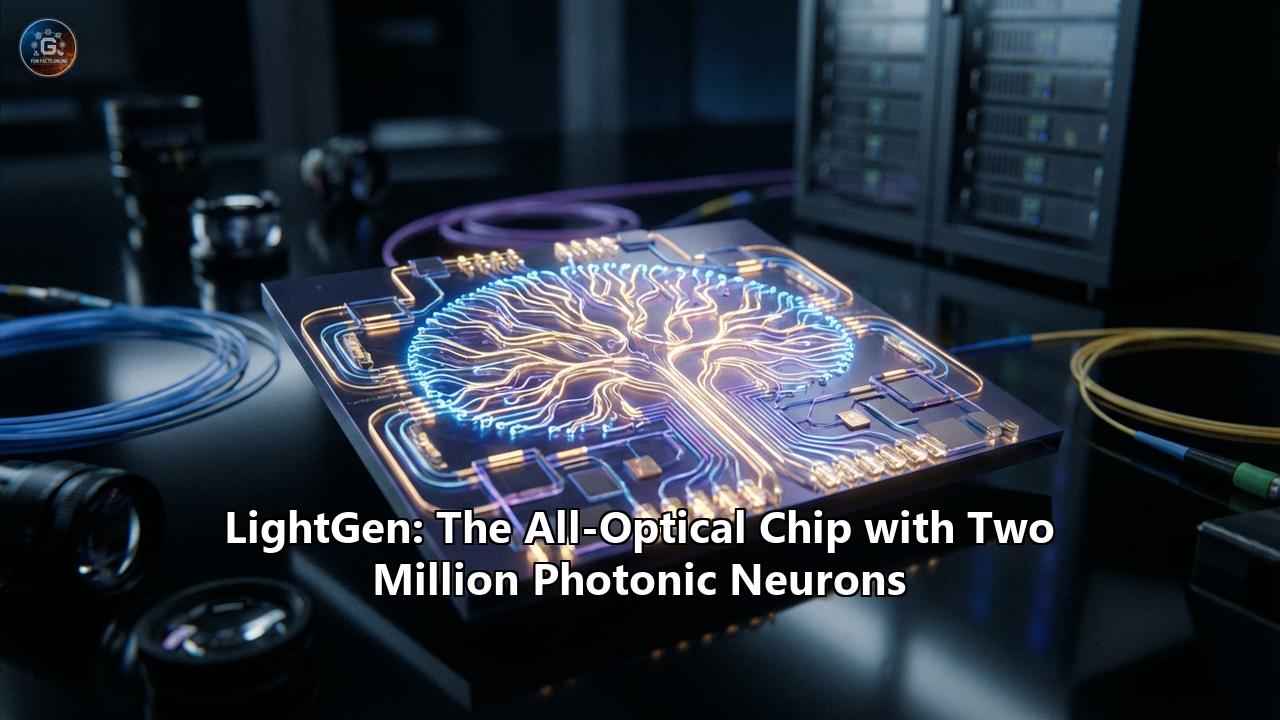
In a groundbreaking development that promises to reshape the landscape of artificial intelligence and high-performance computing, researchers from Shanghai Jiao Tong University and Tsinghua University have unveiled LightGen—a revolutionary all-optical chip that integrates over two million photonic neurons. This is not merely an incremental improvement over existing silicon-based processors; it is a fundamental reimagining of how machines "think," leveraging the physical properties of light to bypass the thermal and speed limitations of electrons.
As the world’s insatiable hunger for generative AI models like ChatGPT, Midjourney, and Sora pushes traditional electronic hardware to its breaking point, LightGen emerges as a beacon of sustainability and raw power. By processing information through the diffraction and interference of light waves, this chip achieves speeds and energy efficiencies that are orders of magnitude higher than the most advanced graphics processing units (GPUs) on the market today.
This article delves deep into the architecture, physics, and implications of LightGen, exploring how this optical leviathan could end the silicon dominance and usher in a new age of sustainable, instantaneous artificial intelligence.
The Silicon Wall: Why We Need Light
To understand the magnitude of the LightGen breakthrough, we must first confront the "Silicon Wall." For decades, Moore’s Law—the observation that the number of transistors on a microchip doubles about every two years—guided the semiconductor industry. However, as transistors shrink to the atomic scale, we are hitting hard physical limits:
- Heat Dissipation: Moving electrons through resistance generates heat. Modern GPUs are essentially sophisticated heaters that perform math, requiring massive cooling infrastructure.
- Data Movement Bottlenecks: In electronic chips, data must be shuttled between memory and processing units. This "von Neumann bottleneck" consumes more energy and time than the actual computation itself.
- Clock Speed Limits: Electronic transistors have a maximum switching speed, effectively capping how fast they can calculate.
LightGen shatters these barriers by replacing electricity with light. Photons, the fundamental particles of light, have no mass, generate negligible heat during propagation, and travel at the fastest speed possible in the universe. They can also pass through each other without interference, allowing for massive parallel processing that electrons simply cannot match.
The Architecture of LightGen: A Metasurface Masterpiece
At the heart of LightGen lies a sophisticated architecture that mimics the neural structure of the human brain but operates entirely in the optical domain. Unlike traditional chips that use logic gates (0s and 1s), LightGen uses diffractive deep neural networks (D2NNs).
1. Two Million Photonic Neurons
The headline feature of LightGen is its staggering scale. Previous optical computing attempts were often limited to a few hundred or thousand neurons, making them "lab toys" rather than viable processors. LightGen scales this up to 2.16 million photonic neurons integrated onto a chip measuring just 136.5 square millimeters.
These "neurons" are not biological cells or electronic transistors. They are specific physical points on diffractive metasurfaces—ultra-thin materials engineered with microscopic structures that bend and phase-shift light. When a wavefront of light passes through these layers, the interaction performs complex matrix multiplications—the core mathematics of AI—instantaneously.
2. Computation-by-Propagation
In a digital chip, a calculation happens in steps: load data, compute, store result. In LightGen, computation happens computation-by-propagation. The input data (e.g., an image) is encoded into a beam of light. As this light travels through the chip's layers, it diffracts and interferes with itself. By the time the light reaches the other side of the chip, the "calculation" is done. The physics of light propagation is the computation. This means the processing speed is effectively the speed of light passing through the chip—roughly 0.5 nanoseconds or less.
3. The Optical Latent Space (OLS)
One of the most significant innovations in LightGen is the creation of an Optical Latent Space. In generative AI (like creating an image from a prompt), the model works with a compressed, abstract representation of data called "latent space."
Historically, optical chips struggled with this because they had to convert light back into electricity to handle these complex, non-linear abstractions, destroying their speed advantage. LightGen keeps the signal in the optical domain. It uses a novel arrangement of compound eyes and diffractive layers to manipulate the "dimensionality" of the light beam, allowing it to perform the complex "decoding" part of generative AI without ever converting back to electricity until the very end.
Unmatched Performance: LightGen vs. NVIDIA A100
The specifications of LightGen are not just impressive; they are transformative. In peer-reviewed tests published in the journal Science, the chip was pitted against the NVIDIA A100, one of the world's leading AI accelerator chips. The results were staggering:
- Speed: LightGen achieved a computing speed of 35,700 TOPS (Tera Operations Per Second).
- Energy Efficiency: It delivered 664 TOPS per watt.
- The Comparison: This performance makes LightGen roughly 100 times faster and 100 times more energy-efficient than the electronic benchmark for specific generative tasks.
To put this in perspective: If you were to run a complex image generation task on a traditional GPU, it might consume hundreds of watts of power and take seconds. LightGen could theoretically do it in milliseconds using the power equivalent of a small lightbulb.
BOGT: The Brain Behind the Light
Hardware is nothing without software. A major challenge in optical computing has been "training" the chip. You cannot easily run "backpropagation" (the standard AI learning method) on a physical piece of glass.
The researchers developed a novel training algorithm called Bayesian-based Optical Generative Training (BOGT).
- Unsupervised Learning: Unlike many models that need massive, labeled datasets (e.g., "this is a cat," "this is a dog"), BOGT allows the chip to learn from the statistical patterns of data itself, similar to how the human brain learns by observation.
- Off-Chip Training, On-Chip Inference: The complex learning phase is simulated digitally to design the perfect physical structure of the metasurfaces. Once the design is finalized and the chip is fabricated (printed), it performs the task instantly with zero energy cost for the computation itself.
Applications: What Can LightGen Do?
LightGen is not a general-purpose CPU like the one in your laptop. It is a specialized accelerator designed for Generative AI and machine vision. The researchers demonstrated its capabilities in several demanding areas:
- High-Resolution Image Generation: The chip successfully generated high-fidelity, 512x512 pixel images of cats, landscapes, and complex textures, rivaling digital models but at a fraction of the energy cost.
- 3D Scene Construction (NeRF): LightGen was able to generate 3D volumetric scenes from 2D inputs, a computationally heavy task usually reserved for powerful server farms.
- Semantic Editing & Style Transfer: It could take an image and instantly apply the style of "Van Gogh" or edit specific features (like adding glasses to a face) purely through optical manipulation.
- Denoising: The chip acted as a perfect filter, taking grainy, noisy images and reconstructing them into sharp, clear visuals at light speed.
The Road Ahead: Challenges and Future
While LightGen is a monumental achievement, it is currently a research prototype. Several hurdles remain before it sits inside your home computer:
- The I/O Bottleneck: While the computation is light-speed, getting data into the chip (via lasers/modulators) and reading the result (via cameras/sensors) still involves slower electronic components. The team notes that the current performance is limited by these peripheral devices, not the chip itself.
- Programmability: Once a LightGen chip is fabricated, its "neural network" is physically set in stone (or glass). Unlike a GPU which can run Call of Duty one minute and ChatGPT the next, a specific LightGen chip is dedicated to the task it was printed for. However, future iterations could use "Spatial Light Modulators" to make the chip reprogrammable in real-time.
Conclusion: A Sustainable AI Revolution
We are standing at a precipice. The energy demands of AI are projected to consume the entire electricity output of countries. We cannot sustain the AI revolution with silicon alone.
LightGen represents a vital off-ramp from the "energy wall." By harnessing the intrinsic physics of light—its speed, its parallelism, and its efficiency—LightGen offers a glimpse into a future where intelligence is abundant, instant, and green. With over two million photonic neurons leading the charge, the future of computing looks bright—literally.
Reference:
- https://www.thestar.com.my/aseanplus/aseanplus-news/2025/12/21/chinese-team-builds-optical-chip-ai-that-is-100-times-faster-than-nvidias-market-leader
- https://www.scmp.com/news/china/science/article/3336918/chinese-team-builds-optical-chip-ai-100-times-faster-nvidias-market-leader
- https://singularityhub.com/2025/12/22/this-light-powered-ai-chip-is-100x-faster-than-a-top-nvidia-gpu/
- https://www.techinasia.com/news/chinese-scientists-develop-optical-ai-chip-100x-faster-than-nvidia
- https://www.webpronews.com/lightgen-optical-ai-chip-100x-faster-than-nvidia-a100/
- https://www.kad8.com/ai/lightgen-the-first-all-optical-generative-ai-chip/
- https://www.reddit.com/r/singularity/comments/1pqlxm7/chinese_researchers_unveil_lightgen_an_alloptical/
- https://global.chinadaily.com.cn/a/202512/20/WS6945ede4a310d6866eb2f9ad.html
- https://blogs.navakatha.com/2025/12/19/lightgen-explained-rewriting-ai-compute-and-running-generative-ai/
- https://newatlas.com/computers/optical-neural-network-chip-2-billion-images-second/
- https://www.youtube.com/watch?v=Vc4NpxAs4Gc
- https://www.reddit.com/r/LocalLLaMA/comments/1pqoldt/chinese_researchers_unveil_lightgen_an_alloptical/
- https://my.biggo.com/news/202512210450_Shanghai-Jiao-Tong-University-LightGen-All-Optical-AI-Chip-Breakthrough