
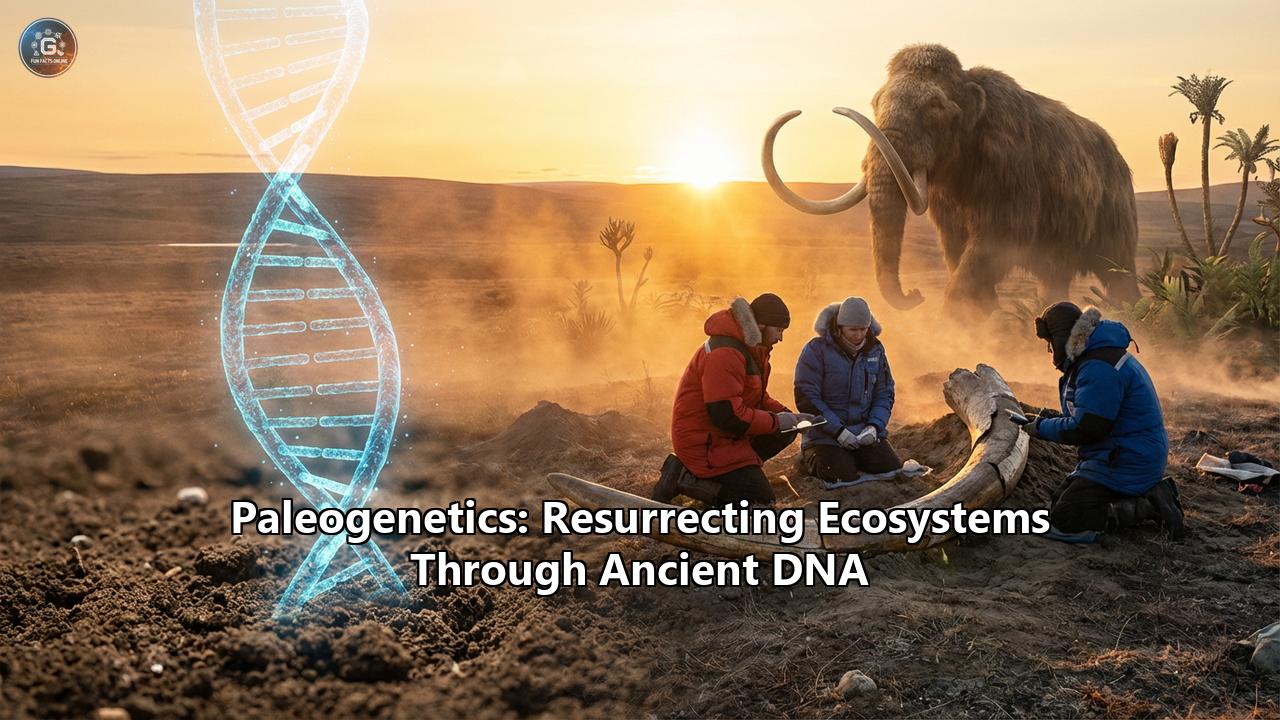
For billions of years, the rules of biology were absolute. Extinction was the final, irreversible period at the end of a species’ evolutionary sentence. When the last woolly mammoth exhaled its final breath on Wrangel Island roughly 4,000 years ago, or when the last dodo was hunted to oblivion in the forests of Mauritius in the 17th century, the ecological doors slammed shut on their existence. But today, standing at the bleeding edge of synthetic biology, genomics, and ecology, humanity is rewriting those rules. Welcome to the era of paleogenetics—a field that has aggressively transitioned from the speculative realm of science fiction into living, breathing reality.
The goal of paleogenetics is no longer just to sequence the degraded DNA of long-dead creatures for historical curiosity. Instead, the focus has shifted to "de-extinction"—or, more accurately, species proxy creation—with the ultimate aim of resurrecting lost ecosystems, combating anthropogenic climate change, and undoing the ecological damage wrought by millennia of human expansion. By merging ancient DNA (aDNA) recovery with cutting-edge CRISPR genome editing, scientists are not just aiming to put extinct animals in zoos; they are building the ultimate ecosystem engineers.
The Molecular Time Machine: Decoding Ancient DNA
To understand how a species is resurrected, one must first dismantle the Hollywood myths. Unlike the premise of Jurassic Park, scientists cannot extract perfectly preserved blood from amber, nor can they simply inject a complete extinct genome into a modern egg and clone it. DNA is a fragile molecule. Upon the death of an organism, cellular enzymes and environmental factors immediately begin cleaving the DNA into millions of microscopic fragments. Over thousands of years, these fragments degrade further, suffering from chemical modifications like the deamination of cytosine to uracil.
As a result, recovering ancient DNA from Pleistocene permafrost or fossilized bones yields a highly fragmented genomic jigsaw puzzle. Paleogeneticists must sequence these millions of tiny fragments and mathematically align them against the intact reference genome of the extinct animal's closest living relative. Given the evolutionary divergence between an extinct species and its modern cousin, there are inevitable gaps and false-positive single nucleotide polymorphisms (SNPs). Therefore, the modern scientific definition of de-extinction does not mean creating a 100% identical genetic replica.
Instead, it involves mapping the genomic limits of de-extinction and identifying the specific genes responsible for the extinct animal's unique core traits. Once these target genes are identified—such as those dictating thick hair, subcutaneous fat layers, small ears to prevent heat loss, and cold-adapted hemoglobin in mammoths—scientists use CRISPR-Cas9 multiplex genome editing to painstakingly splice these ancient traits into the living cells of the modern relative. What emerges is not a perfect clone, but a functionally equivalent "proxy"—a modern species engineered to look, behave, and ecologically function exactly like its extinct ancestor.
Colossal Biosciences: The Engine of De-Extinction
The driving force behind this biological revolution is Colossal Biosciences, a Dallas-based biotech firm founded in 2021 by visionary entrepreneur Ben Lamm and renowned Harvard geneticist George Church. What began as a highly publicized startup has rapidly mutated into a scientific titan. By late 2025, Colossal achieved "decacorn" status—becoming Texas's first private venture valued at over $10.32 billion. This astronomical valuation was cemented in September 2025 following a massive $320 million Series C funding round, which included a $120 million extension with participation from the U.S. Innovative Technology Fund (USIT), Bob Nelsen, and filmmaker Peter Jackson. To date, Colossal has raised over $555 million, an unprecedented war chest for conservation and genetic engineering.
The company’s rapid expansion is not merely financial. Colossal employs over 193 scientists across cutting-edge facilities in Dallas, Boston, and Melbourne. In 2025, the firm made aggressive strategic acquisitions, absorbing the TIGRR Lab at the University of Melbourne to launch Colossal Australia (led by Chief Biology Officer Andrew Pask) and acquiring ViaGen Pets, the global leader in animal cloning technologies boasting over 80% success rates. With Beth Shapiro, a pioneer in ancient DNA, serving as Chief Science Officer, Colossal has assembled an unparalleled brain trust dedicated to reviving the woolly mammoth, the thylacine (Tasmanian tiger), the dodo, and the dire wolf.
The Dire Wolf Vanguard: A 2025 Breakthrough
The theoretical promise of paleogenetics crystallized into breathing reality in April 2025. In what was widely heralded as a watershed moment for de-extinction, Colossal Biosciences announced the birth of three genetically engineered dire wolf pups: Romulus, Remus, and Khaleesi.
The dire wolf (Aenocyon dirus), a fearsome apex predator that vanished from North America roughly 12,500 years ago, was brought back through a masterful display of genetic engineering. Scientists extracted ancient DNA from a 13,000-year-old tooth and a 72,000-year-old skull fragment. By comparing this degraded genetic material to the genomes of modern canids, researchers isolated 14 specific gene sequences unique to the extinct dire wolf.
Using targeted CRISPR editing, these ancient gene sequences were spliced into the DNA of the grey wolf, which was chosen for its evolutionary proximity. The process required removing the original nuclei from grey wolf egg cells and inserting the altered genetic material. These prepared embryos were then implanted into domestic dog surrogates. While only one embryo survived in each of the first two surrogate dogs (requiring caesarean sections), the successful births provided the world's first living proof-of-concept for gene-driven species restoration. Today, the pups are exhibiting physical traits matching the fossil record, including distinct body structures, larger teeth, and thick white coats. The dire wolf milestone irrevocably proved that resurrecting complex extinct traits was no longer theoretical.
Taking to the Skies: The Avian De-Extinction Hurdle
While editing mammalian DNA relies on somatic cell nuclear transfer (cloning)—a technique well-refined since Dolly the sheep—resurrecting extinct birds presents an entirely different, arguably more complex, challenge. Because of the unique reproductive biology of birds, traditional cloning methods are ineffective; you cannot simply implant an edited embryo into a hard-shelled egg.
Colossal tackled this hurdle head-on with its Dodo revival initiative. In September 2025, the company’s Avian Genetics Group announced a historic, world-first breakthrough: the successful laboratory cultivation of pigeon primordial germ cells (PGCs). PGCs are the embryonic precursors to sperm and eggs. By cultivating them in a lab, scientists created a vehicle to transmit CRISPR-edited DNA to the next generation of birds.
Colossal is utilizing the Nicobar pigeon—the closest living relative to the extinct dodo—to develop these dodo-specific PGCs. The long-term strategy involves integrating these gene-edited germ cells into a flock of surrogate chickens. These surrogate chickens, acting as living biological factories, will eventually produce fertile eggs that hatch chicks carrying the engineered traits of the dodo. This leap in avian reproductive science not only cleared the path for the dodo's return but immediately triggered new projects, including a partnership with filmmaker Peter Jackson and the Ngāi Tahu Research Centre to revive the towering, 12-foot-tall South Island giant moa of New Zealand.
The Crown Jewel: Resurrecting the Woolly Mammoth
Despite the awe-inspiring return of the dire wolf and the rapid progress on the dodo, the crown jewel of paleogenetics remains the woolly mammoth. For Colossal, the mammoth represents the ultimate test of their technology and the key to their broader ecological mission.
Colossal scientists are utilizing the Asian elephant—which shares 99.6% of its DNA with the woolly mammoth—as the baseline genome. By early 2025, the team had already successfully edited more than 25 mammoth-specific genes into Asian elephant cells. These edits focus on the core physiological characteristics required to survive in sub-zero Arctic conditions: highly altered fat metabolisms, thick insulating hair, reduced ear sizes to mitigate frostbite, and specialized hemoglobin that efficiently transports oxygen at freezing temperatures.
To prove the efficacy of these specific genetic edits, Colossal previously created a "woolly mouse"—a chimeric rodent engineered with mammoth DNA that successfully exhibited accelerated fat metabolism and a long, golden coat. But the ultimate goal is far larger. Colossal is operating on an aggressive, concrete timeline: they are on track to have mammoth-elephant hybrid embryos ready for implantation into Asian elephant surrogates by the end of 2026, with the goal of the first mammoth calf taking its first steps in 2028.
The Siberian Canvas: Pleistocene Park
If Colossal Biosciences is the biological engine of de-extinction, the 20-square-kilometer reserve known as Pleistocene Park is its ultimate destination. Located on the Kolyma River south of Chersky in the Sakha Republic of northeastern Siberia, this grand ecological experiment was founded in 1996 by Russian scientists Sergey and Nikita Zimov.
The Zimovs formulated a radical hypothesis regarding the end of the Pleistocene epoch. Approximately 20,000 years ago, northern Siberia was not the barren, mossy, dark taiga and tundra we see today. It was the "Mammoth Steppe"—the largest biome on Earth, an incredibly rich, highly productive grassland ecosystem teeming with millions of large herbivores, including mammoths, woolly rhinoceroses, bison, horses, and cave lions. The conventional scientific consensus held that climate change at the end of the last Ice Age destroyed this ecosystem. The Zimovs, however, hypothesized that human overhunting of the megafauna was the true culprit. Without the massive herbivores to graze, trample brush, and fertilize the soil, the deep-rooted grasses were quickly outcompeted by slow-growing, low-productivity mosses, shrubs, and larch forests.
Pleistocene Park is a meticulously controlled attempt to reverse-engineer this lost biome. The core philosophy is "Nature-Based Solutions" to climate change. The Arctic permafrost is a planetary ticking time bomb. This permanently frozen layer of soil contains massive stores of organic carbon—if it thaws, it threatens to release greenhouse gases (carbon dioxide and methane) equivalent to all other anthropogenic emissions combined.
By repopulating the Arctic with a high density of grazing animals, the Zimovs are physically altering the landscape to act as a colossal climatic refrigerator. The ecological mechanisms are brilliantly simple. In the winter, the ambient air in Siberia drops to minus 58 degrees Fahrenheit (-50°C), but the thick layer of winter snow acts as a heavy insulating blanket, keeping the permafrost below relatively warm. When large herds of herbivores forage during the winter, they trample and scrape away this snow to reach the grass. This exposes the ground directly to the severe Arctic air, driving the deep winter freeze further into the soil and lowering the permafrost temperature.
Furthermore, shifting the landscape from dark boreal forests and shrubs back to open, lighter-colored grasslands drastically increases the region's albedo effect. Lighter grasses reflect significantly more of the sun’s solar radiation back into space, whereas dark forests absorb the heat, further warming the region. Pasture ecosystems in the Arctic also boast a much higher capacity to absorb greenhouse gases and sequester carbon deep within the root networks of the soil compared to modern tundra.
The Ultimate Ecosystem Engineer
For decades, the Zimovs have been manually reconstructing this ecosystem. Starting in 1988 with early animal introductions, they have painstakingly shipped in herds of beasts to populate the park. Today, the reserve hosts over 100 animals representing nine major herbivore species: reindeer, Yakutian horses, moose, Kalmykian cows, sheep, goats, domestic yaks, musk oxen, and wild Bactrian camels. In a grueling 2019 expedition, Nikita Zimov drove 12 steppe bison all the way from Denmark to Siberia, and the park acquired 24 more plains bison and 14 musk oxen in 2023.
The herbivores are doing exactly what they were hypothesized to do—knocking down shrubs, devouring moss, and allowing grasses to reclaim the soil. But the ecosystem is missing its keystone species. It is missing the biological bulldozer. It is missing the mammoth.
This is where the grand visions of Pleistocene Park and Colossal Biosciences seamlessly intersect. Sergey Zimov works in close collaboration with George Church. While bison and horses can trample snow and eat grass, they cannot effortlessly knock down fully grown larch trees. A six-ton, cold-adapted mammoth proxy can. When Colossal's mammoths reach maturity, the plan is to rewild them into Pleistocene Park. There, they will serve as the ultimate ecosystem engineers, violently uprooting the encroaching boreal forests, mass-fertilizing the soil with their nutrient-rich dung, and maintaining the vast expanses of the resurrected Mammoth Steppe.
The Ethical and Ecological Crossfire
As the 2028 timeline for the first mammoth calf rapidly approaches, paleogenetics has ignited a fierce, multi-faceted debate across the global scientific community. The International Union for Conservation of Nature (IUCN) developed strict guidelines in 2016 for the revival of species, notably avoiding the term "de-extinction" in favor of "proxies," acknowledging that no gene-editing technology can reproduce an exact, behaviorally identical replica of a lost animal.
Critics raise profound ecological questions: If you de-extinct an individual, how will it adapt to a modern ecosystem that has evolved for millennia without it?. Is it ecologically responsible to introduce engineered megafauna into the Arctic, or is this merely an exercise in high-tech hubris? Some conservationists argue that spending hundreds of millions of dollars to resurrect a mammoth or a dodo is a distraction from the urgent crisis of saving the thousands of currently living species teetering on the brink of extinction. They argue that humanity is treating extinction as a reversible inconvenience rather than a permanent tragedy, potentially alleviating the moral guilt of ongoing habitat destruction.
However, the proponents of paleogenetics counter with the "moral imperative" argument. As Beth Shapiro, Colossal’s Chief Science Officer, succinctly stated: "We are an evolutionary force at this point. We are deciding what the future of these species will be". With humanity having driven these species to extinction—archaeological evidence points heavily to human spears ending the mammoth's reign—we bear a fundamental responsibility to use our technology to restore what we destroyed.
Furthermore, the technological spin-offs generated by de-extinction research are already providing massive, tangible benefits to modern conservation efforts. The tools used to create the dire wolf are actively being deployed to save existing endangered species. For instance, Colossal recently successfully cloned a litter of four healthy Red "Ghost" Wolves, providing a critical genetic lifeline for this critically endangered canid. Additionally, the Colossal Foundation—the company's $100 million nonprofit conservation arm—is leveraging its genomic research to develop an mRNA vaccine for the deadly Elephant Endotheliotropic Herpesvirus (EEHV), a disease that devastates modern elephant populations. The vaccine is currently undergoing trials at five U.S. zoos. By mapping the genomes of extinct birds, the avian team has also generated vital high-quality reference genomes for highly endangered modern species, including the tooth-billed pigeon and the Rodrigues solitaire.
A New Genesis
The resurrection of ecosystems through ancient DNA is no longer a fringe theory relegated to the pages of speculative fiction; it is a heavily funded, scientifically validated, and rapidly accelerating reality. The birth of the dire wolf pups in 2025, the cultivation of dodo-relative germ cells, and the impending birth of a mammoth proxy in 2028 represent a monumental paradigm shift in our relationship with the natural world.
We are moving past the Anthropocene—an era defined by humanity's destruction of biodiversity—and stepping tentatively into an era of synthetic restoration. By merging the degraded, frozen ghosts of the Pleistocene with the precision of modern CRISPR technology, paleogenetics offers a profoundly audacious hope. If we can rebuild the Mammoth Steppe, lock the carbon bomb of the permafrost deep beneath the trampled snow, and watch six-ton titans walk the Earth once more, we will not just be playing God. We will be taking responsibility for the garden we so carelessly trampled. The extinct are returning, and with them, the possibility of a cooler, wilder, and immensely more resilient planet.
Reference:
- https://www.youtube.com/watch?v=upCJYEFDfN8
- https://pmc.ncbi.nlm.nih.gov/articles/PMC12794020/
- https://rupensavoulian.com/2025/04/
- https://time.com/7274542/colossal-dire-wolf/
- https://www.synbiobeta.com/read/colossal-advances-dodo-de-extinction-with-significant-world-s-first-breakthrough-in-pigeon-pgcs-and-secures-an-additional-120m-in-funding-for-species-expansion-1764e
- https://tsginvest.com/colossal-biosciences/
- https://colossal.com/colossal-dire-wolf-back-in-2025/
- https://www.gadgets360.com/science/news/scientists-revive-dire-wolves-using-ancient-dna-and-modern-gene-editing-8116085
- https://techfundingnews.com/colossal-biosciences-raises-120m-to-advance-dodo-bird-de-extinction-efforts/
- https://reviverestore.org/pleistocene-patreon/
- https://www.gsd.harvard.edu/project/pleistocene-park/
- https://pleistocenepark.ru/
- https://en.wikipedia.org/wiki/Pleistocene_Park
- https://www.ebsco.com/research-starters/science/pleistocene-park