
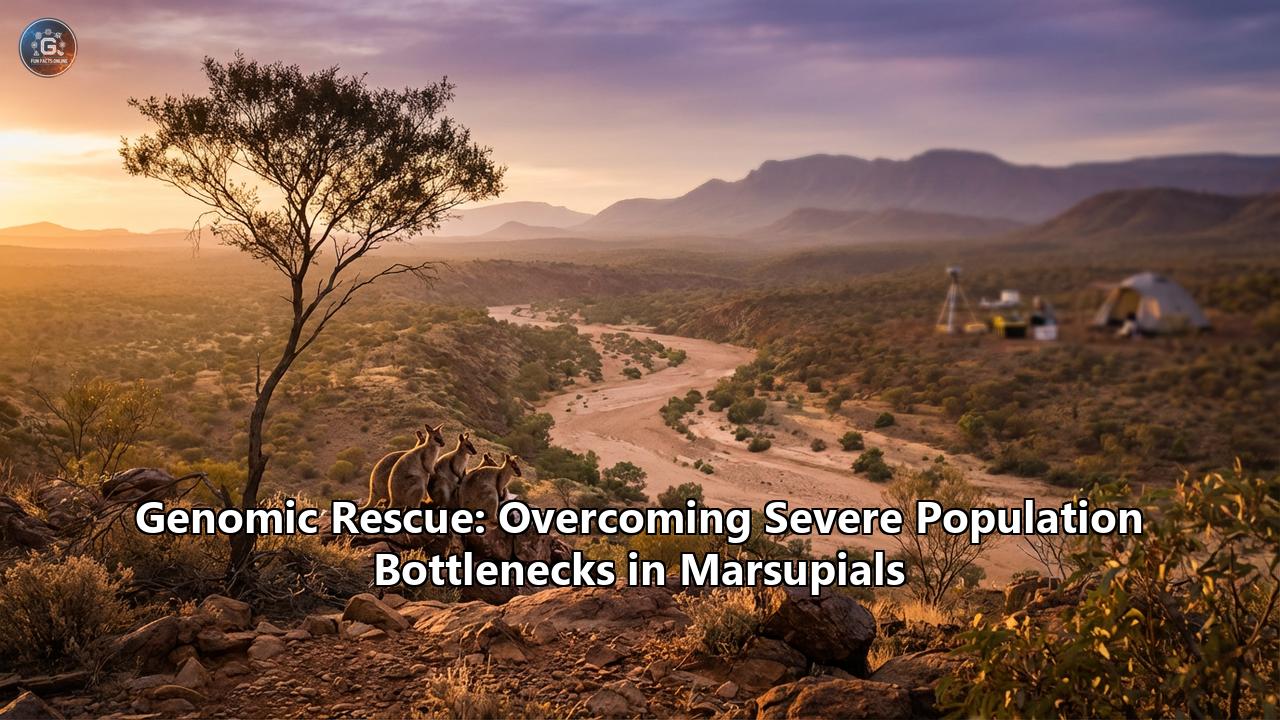
The history of life on Earth is written in the language of DNA—a dynamic, ever-changing script of adaptation, resilience, and survival. Yet, for many species, this genomic library is being rapidly burned. When a species experiences a catastrophic drop in population size due to habitat destruction, disease, or extreme weather events, it undergoes what biologists call a "population bottleneck." The surviving individuals represent only a tiny fraction of the original genetic diversity. In the aftermath, the population faces a peril almost as deadly as the initial disaster: the extinction vortex.
In Australia, a continent home to the greatest diversity of marsupial fauna on the planet, the stakes are exceptionally high. The region also bears the grim title of having the highest mammal extinction rate in modern history, with dozens of unique species vanishing since European colonization,. For marsupials—from the iconic koala and the ferocious Tasmanian devil to the diminutive mountain pygmy possum—the threats of habitat fragmentation, invasive predators, and rapid climate change are unrelenting.
However, a scientific revolution is fundamentally changing the landscape of conservation. By merging traditional wildlife ecology with advanced molecular biology, scientists are pioneering a new frontier known as "genomic rescue." Through whole-genome sequencing, targeted genetic translocations, biobanking, and cutting-edge assisted reproductive technologies (ART), conservationists are no longer just documenting the decline of these unique mammals; they are actively engineering their survival.
The Mechanics of the Extinction Vortex
To understand the power of genomic rescue, one must first understand the invisible genetic threats that plague small populations. A population bottleneck drastically reduces the number of breeding individuals, effectively acting as a sieve that filters out vast amounts of genetic variation,.
Genetic diversity is the raw material of evolution. It provides a population with a diverse toolkit of alleles (gene variants) that can offer resistance to novel pathogens, adaptability to shifting temperatures, and resilience against environmental stressors. When a bottleneck occurs, the genetic toolkit is stripped down. The immediate consequence is an increase in genetic drift—the random fluctuation of gene frequencies—which can cause beneficial alleles to vanish entirely by chance,.
Furthermore, as the population shrinks, related individuals are forced to breed. Inbreeding significantly increases the likelihood of homozygosity, where an offspring inherits two identical copies of a gene. If these copies happen to be deleterious (harmful) recessive mutations, the resulting animal may suffer from compromised immune function, lower fertility, and developmental defects,,. This phenomenon, known as inbreeding depression, initiates a positive feedback loop: the population shrinks further due to poor health, which leads to even more inbreeding, which drives the population down again. This inescapable downward spiral is the "extinction vortex",.
For decades, conventional conservation wisdom held that once a population fell below a certain threshold and lost its genetic diversity, it had effectively reached an evolutionary dead end,. Genomic rescue flips this paradigm on its head, proving that human intervention and natural demographic rebounds can restore lost genetic vitality.
The Mountain Pygmy Possum: A Paradigm of Genetic Rescue
The proof-of-concept for genetic rescue in marsupials was vividly demonstrated in the high alpine ranges of Australia, starring one of the world’s rarest creatures: the mountain pygmy possum (Burramys parvus). Restricted to isolated boulder fields in freezing elevations, these mouse-sized marsupials are highly vulnerable to habitat degradation and feral predators like foxes and cats.
By 2005, one specific population at Mt. Buller in Victoria had experienced a devastating collapse, dwindling to fewer than 20 known individuals,. Geographic fragmentation meant that this population had been completely isolated from other mountain pygmy possums for roughly 20,000 years,. Their gene pool had reached a disastrously low ebb, and extinction seemed imminent.
In a bold conservation experiment, a team of researchers led by Dr. Andrew Weeks from the University of Melbourne decided to implement a "genetic rescue" strategy,. In 2011, they captured six healthy, genetically diverse males from a larger population at Mt. Hotham and introduced them to the dwindling Mt. Buller group,.
Historically, conservationists have been hesitant to mix long-isolated populations due to a theoretical risk known as "outbreeding depression," where hybrid offspring might lose localized adaptations or suffer from genetic incompatibilities,,. However, the mountain pygmy possum rescue completely shattered these fears. The introduction of fresh DNA sparked an immediate and profound biological revitalization.
The results were astonishing. The first-generation hybrid possums displayed remarkable "hybrid vigor" (heterosis). They grew physically larger, female hybrids produced significantly more pouch young, and they enjoyed longer lifespans compared to the non-hybrid residents,,. Driven by this influx of genetic diversity, alongside aggressive predator control and habitat restoration, the Mt. Buller population experienced rapid demographic growth. By recent estimates, the population had swelled to over 200 adults—the largest ever recorded at that site—and boasted the highest levels of genetic diversity in its modern history,,. The mountain pygmy possum project served as a beacon, proving that targeted gene flow could rapidly pull a marsupial out of the extinction vortex,.
Tasmanian Devils: Surviving the Transmissible Cancer Crucible
While the mountain pygmy possum faced isolation and predators, the Tasmanian devil (Sarcophilus harrisii) has been fighting a highly visible, gruesome battle against a unique biological anomaly: Devil Facial Tumour Disease (DFTD). Discovered in the mid-1990s, DFTD is a contagious cancer that spreads through the biting behavior typical of devil social interactions. The disease has decimated wild populations, causing declines of over 80% across the island of Tasmania,.
Early genomic analyses suggested a bleak future. Tasmanian devils had suffered prehistoric population bottlenecks thousands of years ago during periods of climatic instability, leaving them with historically low genetic diversity,. This lack of diversity was heavily implicated in their susceptibility to the cancer; the devils' immune systems failed to recognize the infectious tumor cells as foreign.
Fearing the total loss of the species in the wild, the Save the Tasmanian Devil Program rapidly established an "insurance metapopulation"—a massive captive breeding network across dozens of zoos and protected sanctuaries, such as Maria Island,. The goal was to preserve the remaining genetic diversity in a disease-free environment for future rewilding.
Recent breakthroughs in genomic sequencing have painted a much more optimistic picture of the devil’s future. An extensive 2022 study published in iScience, led by Dr. Katherine Farquharson and Dr. Carolyn Hogg, meticulously compared the genomes of 830 wild devils and 553 insurance population devils,. The researchers analyzed over 500 critically important functional genes, specifically those linked to reproduction and immune response,.
The findings were a monumental victory for conservation management. The study proved that the insurance population successfully captured and maintained the genetic diversity of the wild populations,. Concerns that captive devils were becoming genetically "naive" or losing crucial wild alleles were largely unfounded. Furthermore, scientists have identified clear 'footprints' of natural selection in the DNA of wild devils; populations are rapidly evolving in real-time, showing genetic shifts in loci related to immune response and cancer resistance,. Armed with this genomic data, managers can now continuously optimize translocations, carefully supplementing wild populations with captive-bred individuals to maximize genetic variation and bolster the species' evolutionary arms race against the tumor.
Koalas: Recombination and the Demographic Path to Recovery
Perhaps no Australian marsupial is as globally recognized—or has suffered as tragic a recent history—as the koala (Phascolarctos cinereus). Once abundant across the continent's eastern seaboard, koalas have endured centuries of hunting for the fur trade, devastating habitat clearance, and rampant diseases like Chlamydia and the Koala Retrovirus (KoRV). The catastrophic Black Summer bushfires of 2019-2020 further decimated their numbers, incinerating vast tracts of vital eucalyptus habitat and pushing several regional populations to the brink.
Due to historical population crashes, many koala populations, particularly in southern Australia and Victoria, experienced severe bottlenecks. For example, modeling indicates that the Victorian koala population once crashed to a mere 102 individuals before eventually expanding to larger numbers in subsequent generations. According to classical population genetics, such an extreme bottleneck should have left these koalas genetically impoverished, riddled with deleterious mutations, and highly vulnerable to extinction,.
However, a groundbreaking whole-genome study published in the prestigious journal Science in March 2026 has radically reshaped our understanding of genetic risk and evolutionary resilience,. Led by Dr. Collin Ahrens, a team of researchers analyzed whole-genome sequencing data from 418 koalas representing 27 distinct populations across Australia,. Their findings challenged long-held conservation assumptions by demonstrating that genetic recovery from severe bottlenecks is not only possible but actively occurring,.
The researchers discovered that rapid demographic growth—a population surge following a crash—can act as an evolutionary reset button,. As the bottlenecked Victorian koala populations began to expand, the mathematical realities of genetics shifted. The key mechanism driving this recovery was recombination, the natural biological process that reshuffles DNA during the formation of sperm and egg cells,,.
In small, stagnant populations, deleterious alleles are often physically linked to beneficial ones on a chromosome, dragging the overall fitness of the population down. But as the koala populations grew rapidly in size, increased rates of recombination physically broke apart these bad allele combinations. This genetic reshuffling, combined with the gradual introduction of new mutations, diluted the harmful genetic load and allowed rare, functional alleles to reappear and spread,.
This 2026 discovery provides an extraordinary message of "conservation optimism." It proves that a bottleneck does not guarantee a slow march to extinction,. If conservationists can mitigate external threats—such as protecting remaining habitats from bulldozers and bushfires, and managing disease—and allow the population size to rapidly expand, natural evolutionary processes can actually restore the long-term genetic health and adaptive capacity of the species,,.
The ART of Marsupial Conservation
While whole-genome sequencing allows us to read the genetic code of endangered species, we still need physical mechanisms to propagate this diversity. This is where Assisted Reproductive Technologies (ART) become essential. ART encompasses techniques like artificial insemination, in vitro fertilization (IVF), and sperm and egg cryopreservation (biobanking),. While these methods are routine in human medicine and livestock agriculture, they have historically been incredibly difficult to adapt to marsupials,.
Marsupial reproduction diverges radically from placental mammals. They give birth to highly altricial (undeveloped) young after incredibly short gestation periods—often just a few weeks—and the majority of early development occurs externally in the mother’s pouch. Because of their unique hormonal cycles, reproductive tract anatomy, and embryonic development, traditional mammalian ART protocols simply do not work on marsupials,.
A colossal leap forward was achieved in February 2025 by a University of Queensland team led by Dr. Andres Gambini,. His team successfully produced the world’s first kangaroo embryos using IVF and intracytoplasmic sperm injection (ICSI), where a single sperm is injected directly into a mature egg,. Because eastern grey kangaroos are relatively abundant, they serve as a perfect proxy model to refine these complex techniques without risking endangered animals.
Dr. Gambini’s breakthrough provides a critical blueprint for the future. By demonstrating that marsupial eggs and sperm can be successfully collected, cultured, and fertilized in a laboratory setting, researchers are laying the groundwork for establishing "frozen zoos",. In the future, conservationists will be able to freeze the gametes or skin cells of genetically valuable, critically endangered marsupials—such as the northern hairy-nosed wombat or the Leadbeater's possum. If a wild population suffers a massive loss of diversity due to a bushfire, scientists could thaw these preserved cells, create embryos via IVF, and use surrogate mothers of a common species to rapidly inject lost genetic diversity back into the wild population,,.
Biobanking and the De-Extinction Frontier
The ultimate frontier of genomic rescue is synthetic biology and de-extinction. While bringing back extinct species captures the public's imagination, the technologies developed in these pursuits have immediate, life-saving applications for living endangered marsupials.
This synergy is perfectly encapsulated by the efforts of Colossal Biosciences, a company working to resurrect the Thylacine (Tasmanian tiger), the apex marsupial predator that was hunted to extinction by 1936,. In late 2024, Colossal, working alongside Dr. Andrew Pask from the University of Melbourne, announced they had assembled a near-complete, chromosome-level Thylacine genome using DNA extracted from a 110-year-old preserved head,. The genome's quality is unprecedented for an extinct species, providing the fundamental blueprint of the animal.
However, having a digital genetic blueprint is only half the battle. To bring a thylacine back, researchers must edit the genome of a living surrogate species. Colossal identified the fat-tailed dunnart (Sminthopsis crassicaudata), a mouse-sized carnivorous marsupial, as the closest living relative and ideal surrogate,. Prior to this project, virtually no ART existed for the dunnart,.
Driven by the needs of the de-extinction project, Colossal's researchers successfully developed a method to artificially induce ovulation in the fat-tailed dunnart, allowing them to collect multiple mature eggs simultaneously,. Furthermore, they engineered a world-first artificial uterus device capable of hosting marsupial embryos through the critical early stages of pregnancy,. They have also managed to create the most highly edited animal cell line to date by swapping over 300 genetic edits into dunnart stem cells,.
The implications of these dunnart breakthroughs stretch far beyond the Thylacine. These exact same artificial reproductive and biobanking technologies are urgently needed for living, critically endangered species like the Kangaroo Island dunnart (Sminthopsis aitkeni). Endemic only to the western end of Kangaroo Island, this tiny marsupial lost over 98% of its habitat in the catastrophic 2019-2020 bushfires, and the surviving population of a few hundred individuals is heavily preyed upon by feral cats,. By utilizing the stem cell derivation, artificial ovulation, and embryo cultivation techniques pioneered by the de-extinction movement, conservationists now possess the tools to biobank the Kangaroo Island dunnart's genome and rapidly breed them in captivity, ensuring they do not follow the Thylacine into the abyss,.
Conclusion: A New Era of Conservation Optimism
We have entered an era where conservation is no longer limited to merely fencing off habitats and hoping for the best. The convergence of ecology, whole-genome sequencing, assisted reproductive technologies, and synthetic biology has created a powerful toolkit for genomic rescue.
The successful genetic revitalization of the mountain pygmy possum proved that targeted gene flow can banish the specter of inbreeding depression. The resilience of the Tasmanian devil's insurance populations confirms that we can successfully archive wild genetic diversity. The monumental genomic studies on the koala reveal that populations can purge their genetic burdens through recombination if given the demographic space to rapidly expand. And finally, the laboratory marvels of kangaroo IVF and dunnart reproductive engineering offer an unprecedented insurance policy against sudden environmental catastrophes.
While the threats facing marsupials—from climate change to invasive predators—remain daunting, these scientific breakthroughs rewrite the narrative of extinction. By actively managing the genomic health of these species, we are restoring their evolutionary potential, ensuring that Australia’s unique marsupials continue to adapt, thrive, and define the continent's ecological heritage for millennia to come.
Reference:
- https://news.uq.edu.au/2025-02-06-first-ivf-kangaroo-embryo-major-leap-marsupial-conservation
- https://www.downtoearth.org.in/wildlife-biodiversity/australian-scientists-create-28-kangaroo-embryos-using-ivf-in-conservation-breakthrough
- https://researchonline.jcu.edu.au/34508/
- https://www.labonline.com.au/content/life-scientist/article/colossal-biosciences-progresses-towards-thylacine-de-extinction-334935607
- https://www.zoopraha.cz/documents/2024-082_Vyrocni-zprava-2023.pdf
- https://hiddenvalewildlife.uq.edu.au/project/innovative-reproductive-techniques-preserving-marsupial-species
- https://www.reddit.com/r/Futurology/comments/1g5vh47/deextinction_company_colossal_claims_it_has/
- https://colossal.com/sequencing-the-tasmanian-tiger-how-colossal-is-rebuilding-the-thylacine-genome/
- https://www.livescience.com/animals/extinct-species/most-complete-tasmanian-tiger-genome-yet-pieced-together-from-110-year-old-pickled-head
- https://pubmed.ncbi.nlm.nih.gov/36529108/
- https://www.pittwateronlinenews.com/Inbox-and-Environment-News-Issue-450.php
- https://www.pittwateronlinenews.com/Inbox-and-Environment-News-Issue-543.php
- https://media.australian.museum/media/dd/documents/AM_AR_2020_web.8334140.pdf
- https://www.selectscience.net/article/colossal-achieves-multiple-scientific-firsts-in-progress-towards-thylacine-de-extinction