
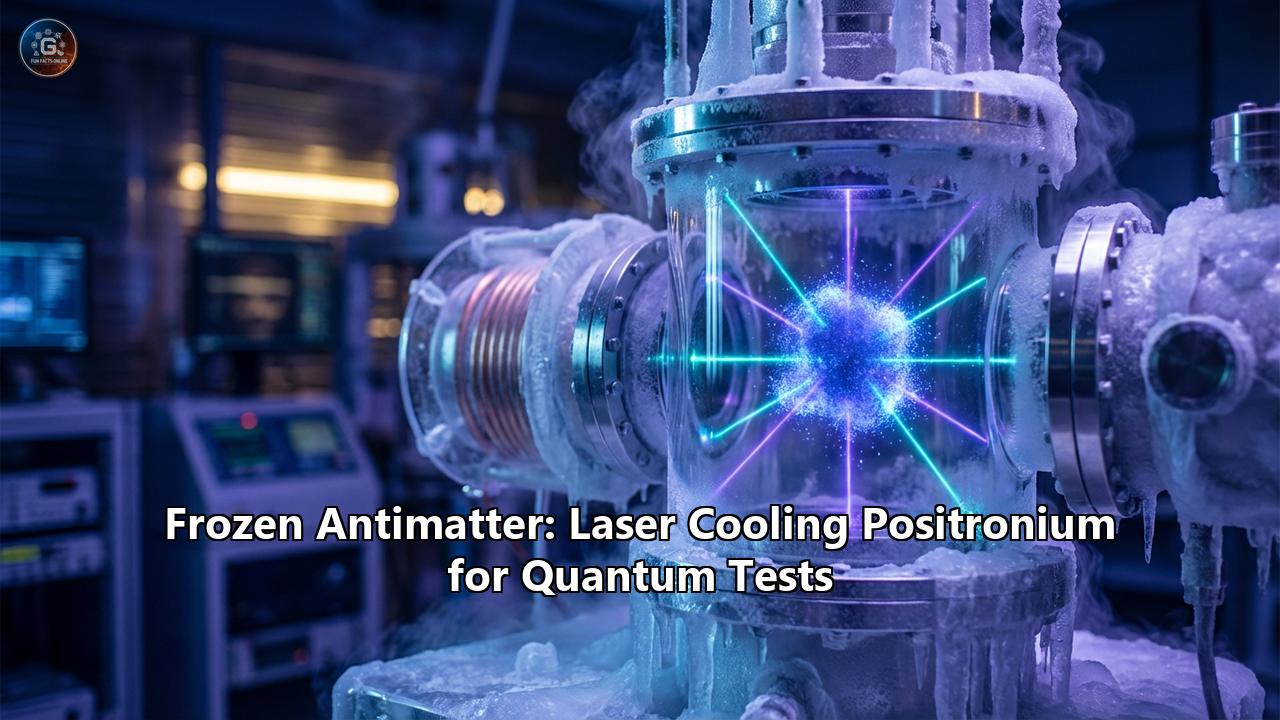
1. Introduction: The Paradox of Frozen Fire
For nearly a century, antimatter has captured the human imagination as the ultimate volatile substance. When antimatter meets matter, they annihilate instantly, releasing pure energy in accordance with Einstein’s $E=mc^2$. To "freeze" such a substance seems paradoxical—like trying to hold a flame in a block of ice. Yet, this is exactly what physicists have recently accomplished.
In early 2024, the physics community was electrified by the announcement that the AEgIS collaboration at CERN (European Organization for Nuclear Research) and a separate team at the University of Tokyo had successfully cooled positronium atoms using lasers. This was not merely a marginal improvement in temperature; it was a fundamental change of state, dropping the temperature of these exotic atoms from a scorching 380 Kelvin (roughly the boiling point of water) to a frigid 170 Kelvin in the CERN experiment, and even further to nearly 1 Kelvin in the Tokyo experiment.
This achievement represents the culmination of over 30 years of theoretical work and experimental frustration. Positronium is not just any atom; it is a purely leptonic system, free from the "messy" strong nuclear forces that bind protons and neutrons. This makes it the ideal laboratory for testing Quantum Electrodynamics (QED), the most precise theory in the history of physics. By slowing these atoms down, we can finally ask the universe some of its most guarded questions: Does antimatter experience gravity the same way matter does? Can we build a laser that shoots gamma rays instead of visible light?
2. The Nature of Positronium: The Lightest Atom in the Universe
2.1 Composition and Properties
Standard atoms are composed of a heavy nucleus (protons and neutrons) orbited by light electrons. Positronium (Ps), however, is a true "exotic" atom. It consists of an electron ($e^-$) and its antimatter twin, the positron ($e^+$), orbiting each other. There is no nucleus. The two particles have identical mass but opposite charge, meaning they swirl around a common center of mass located exactly in the middle of the bond.
Because it lacks a heavy nucleus, positronium is incredibly light—about 1/1000th the mass of a hydrogen atom. This low mass makes it extremely sensitive to external forces, including the "kick" of a laser photon, which is both a blessing and a curse for physicists.
2.2 The Lifetime Problem: A Race Against Annihilation
Positronium comes in two varieties, determined by the "spin" of its particles:
- Para-positronium (p-Ps): The spins are opposite (singlet state). This form is extremely unstable and annihilates into two gamma rays in just 125 picoseconds. It is too short-lived to be useful for laser cooling.
- Ortho-positronium (o-Ps): The spins are parallel (triplet state). This form is "long-lived" in the quantum world, surviving for roughly 142 nanoseconds (ns) in a vacuum before decaying into three gamma rays.
142 nanoseconds is the window of opportunity. To put this in perspective, light travels only about 42 meters in this time. In this blink of an eye, the experimentalists must create the positronium, hit it with thousands of laser pulses to cool it, and perform their measurements before the atoms spontaneously vanish into a burst of radiation.
2.3 The 1S-2P Transition: The Magic Frequency
To cool an atom, you need to interact with its energy levels. For positronium, the "handle" used by physicists is the transition between the ground state (1S) and the first excited state (2P).
The energy required to make this jump corresponds to ultraviolet light with a wavelength of approximately 243 nanometers.
The challenge lies in the "linewidth" of this transition. Because the atom lives for such a short time, its energy levels are "fuzzy" (a consequence of the Heisenberg Uncertainty Principle), leading to a broad natural linewidth. Furthermore, because the atoms are so light, they move incredibly fast at room temperature—around 100 kilometers per second. This speed creates a massive Doppler shift, meaning the laser light, from the atom's perspective, appears to be the wrong color unless it is precisely tuned.
3. The Physics of Laser Cooling Antimatter
3.1 The Doppler Cooling Mechanism
Laser cooling works on the principle of momentum transfer. A laser beam is tuned to a frequency slightly below the resonance of the atom (red-detuned).
- Head-on Collision: If an atom moves toward the laser, the Doppler effect shifts the light's frequency up (blue-shift), bringing it into resonance.
- Absorption: The atom absorbs a photon. Since photons carry momentum, this absorption delivers a tiny "kick" opposite to the atom's motion, slowing it down.
- Spontaneous Emission: The atom then re-emits the photon in a random direction. Over many cycles, the random emissions average out to zero momentum change, but the targeted absorptions consistently slow the atom down.
3.2 The Mass Challenge: Recoil and Broadening
For heavy atoms like Rubidium or Cesium, a single photon's kick is negligible, like throwing a ping-pong ball at a bowling ball. You need millions of cycles to cool them.
For positronium, the "bowling ball" is also a "ping-pong ball." The mass is so low that a single UV photon changes the atom's velocity by a significant amount. This high "recoil velocity" means the atom can quickly be knocked out of resonance with the laser.
Additionally, the Doppler broadening is extreme. In a warm cloud of positronium, some atoms move at 10 km/s, others at 50 km/s. A standard, single-frequency laser is too narrow; it would only cool a tiny fraction of the atoms (those moving at exactly the right speed) and miss the rest. This is why traditional laser cooling, which works so well for normal matter, failed for positronium for decades.
3.3 Why Standard Cooling Failed for 30 Years
Since the proposal of positronium cooling in 1988, scientists hit a wall. Narrowband lasers (lasers with a very specific color) saturated the transition too quickly or couldn't cover the velocity spread. The atoms would either annihilate before they could be cooled or simply fly through the laser beam unaffected. The solution required rethinking the laser itself.
4. The Breakthrough Experiments
Two different philosophies emerged to solve the Doppler/Lifetime problem: Brute force spectral width (AEgIS) and dynamic frequency tracking (Tokyo).
4.1 The AEgIS Approach: Broadband Laser Cooling at CERN
The AEgIS (Antimatter Experiment: gravity, Interferometry, Spectroscopy) collaboration took the "broadband" approach.
- The Laser: They developed a custom alexandrite-based laser system. Unlike standard lasers that emit a sharp spike of frequency, this laser produces a "broad" pulse of light that covers a wide range of frequencies simultaneously.
- The Strategy: By having a spectral bandwidth that matches the Doppler width of the moving positronium cloud (about 100 GHz), the laser interacts with all the atoms at once, regardless of their speed.
- The Result: In a paper published in Physical Review Letters, AEgIS demonstrated cooling from ~380 K down to ~170 K. They achieved this without using electric or magnetic fields (which would disturb the antiparticles), a crucial feature for future gravity tests.
4.2 The Tokyo Approach: Chirped Pulse Trains
The University of Tokyo team, led by Kosuke Yoshioka, took a "sniper" approach using chirped lasers.
- The Laser: They built a system that emits a "chirp"—a pulse where the frequency changes rapidly over time (like a slide whistle going from low to high pitch).
- The Strategy: As the positronium atoms slow down, their Doppler shift changes. A fixed-frequency laser would lose them. The chirped laser follows the atoms as they decelerate, keeping the light in resonance with the cooling transition throughout the entire braking process.
- The Result: This method is more efficient for reaching ultracold temperatures. They reported cooling positronium gases to around 1 Kelvin (-272°C) in just 100 nanoseconds. This is effectively stopping the atoms in their tracks.
4.3 Comparative Analysis
- AEgIS demonstrated that a large cloud can be cooled effectively in a complex antimatter factory environment, paving the way for bulk antimatter handling.
- Tokyo demonstrated the ultimate precision limits, showing that positronium can be brought to a near-standstill, which is essential for the Bose-Einstein Condensate goals.
5. Inside the Antimatter Factory
To understand the magnitude of this engineering feat, one must look at the facility where it happens: CERN's Antimatter Factory.
5.1 The Role of the ELENA Decelerator
Antiprotons are created at high speeds by smashing protons into a target. To study them, they must be slowed down. They pass through the Antiproton Decelerator (AD) and then into ELENA (Extra Low ENergy Antiproton) ring. ELENA is a synchrotron that decelerates antiprotons to just 100 keV (kiloelectronvolts), making them "catchable" by electromagnetic traps.
5.2 Creating the Positronium Cloud
While ELENA provides antiprotons, AEgIS also needs positrons. These come from a radioactive Sodium-22 source. The positrons are accumulated in a specialized trap and then dumped onto a nano-channeled silicon target.
- When positrons hit the silicon, they pick up electrons.
- They emerge from the silicon not as lone particles, but as neutral positronium atoms.
- This creates the "cloud" that the lasers then target.
5.3 Trapping and Detection
Because positronium is neutral, it cannot be held in place by simple electric fields (which only work on charged particles). This is why laser cooling is so vital—it acts as "optical molasses" to slow the atoms down so they can be studied before they hit the walls.
To prove they cooled the atoms, AEgIS used a Moiré deflectometer. This is a classical gratings-based interferometer. By measuring the shadow pattern the atoms cast on a detector, scientists can calculate their velocity. A "blurred" shadow means fast atoms; a "sharp" shadow means cold, slow atoms.
6. The Holy Grail: Positronium Bose-Einstein Condensate (BEC)
The most exciting theoretical outcome of this work is the creation of a Positronium Bose-Einstein Condensate (Ps-BEC).
6.1 What is an Antimatter BEC?
A BEC is a state of matter formed when bosons (particles with integer spin) are cooled to near absolute zero. Their quantum wavefunctions overlap, and they lose their individual identity, behaving as a single "super-atom."
Since Positronium is a boson, it can theoretically form a BEC. However, unlike normal matter BECs (made of Rubidium or Sodium), a Ps-BEC would be a condensate of antimatter-matter hybrids.
6.2 The Mechanism of Self-Amplified Gamma-Ray Lasers
This is where physics approaches the edge of science fiction.
In a dense Ps-BEC, all the atoms are in the same quantum state. When they annihilate, they don't just pop randomly like popcorn. The annihilation of one atom can stimulate the annihilation of its neighbors.
- Coherent Decay: The gamma rays produced would be coherent—moving in phase with each other.
- The Graser: This would create a "Gamma-Ray Laser" or "Graser." Currently, we have lasers for visible light, UV, and X-rays. A gamma-ray laser would be orders of magnitude more energetic.
- Self-Amplification: The instability of the BEC acts as an amplifier. A spontaneous decay triggers a cascade, resulting in a directed pulse of 511 keV gamma radiation.
This device would allow us to "see" into the nucleus of atoms with unprecedented resolution, potentially revolutionizing nuclear physics and materials science.
7. Testing the Foundations of Reality
Why go to all this trouble? The primary driver is the "Missing Antimatter" problem. The Big Bang should have created equal amounts of matter and antimatter. Today, the universe is almost entirely matter. Where did the antimatter go?
7.1 The Einstein Equivalence Principle (WEP)
The Weak Equivalence Principle states that gravity acts on all mass and energy equally, regardless of composition. A feather and a hammer fall at the same rate on the Moon.
Does an antimatter hammer fall at the same rate? General Relativity says yes. But if it falls slightly differently—or even falls up (antigravity)—it would break the Standard Model and offer a clue to the missing antimatter mystery.
7.2 Does Antimatter Fall Up? (AEgIS vs. GBAR vs. ALPHA-g)
Frozen positronium is the key to measuring this "g" (gravitational acceleration) for antimatter.
- AEgIS: Uses the Moiré deflectometer to measure the vertical drop of a beam of horizontal positronium atoms. If they are cold (slow), they spend more time in the gravity field, making the drop measurable.
- GBAR (Gravitational Behaviour of Antihydrogen at Rest): Plans to create ultra-slow antihydrogen ions, cool them, strip the extra electron, and watch the neutral atom free-fall from a height of 20 cm.
- ALPHA-g: Traps antihydrogen in a magnetic bottle and then slowly turns off the magnetic field, observing whether the atoms "fall" out the bottom or "float" out the top.
The success of laser cooling positronium directly boosts the efficiency of producing cold antihydrogen (via charge exchange), benefiting all these experiments.
7.3 CPT Symmetry and Spectral Precision
CPT Symmetry (Charge, Parity, Time) suggests that a universe made of antimatter should look exactly like ours, just flipped. If positronium's spectral lines (the colors of light it absorbs) differ even by a fraction of a hertz from theoretical predictions, it would indicate a violation of CPT symmetry. Cold atoms mean less Doppler noise, allowing for spectral measurements of unprecedented precision.
8. Future Horizons
8.1 Advanced Spectroscopy
With the ability to cool positronium to 1 K, scientists can now perform "Ramsay interferometry" and other high-precision techniques. This could reveal deviations in the fine structure of the atom that point to "New Physics"—forces or particles not currently described by the Standard Model.
8.2 Potential Applications
- Gamma-Ray Imaging: A Ps-BEC gamma laser could allow for holographic imaging of nuclear structures or the detection of micro-fractures in materials at the femtometer scale.
- Space Propulsion: While still highly theoretical, the high energy density of antimatter annihilation, if controlled via a BEC mechanism, has been proposed in speculative papers as a potential ignition source for fusion propulsion or direct thrust, though this remains centuries away.
9. Conclusion: A New Chapter in Physics
The successful laser cooling of positronium is more than just a technical milestone; it is the taming of the most volatile substance in existence. For thirty years, the "frozen fire" of positronium was a theoretical dream. Today, it is an experimental reality.
As AEgIS and the Tokyo team refine their techniques, we stand on the precipice of answering the most fundamental questions of our existence. Does gravity discriminate? Is the symmetry of the universe perfect, or is it flawed? By freezing the ghost, humanity has taken a decisive step toward understanding the substance of the cosmos itself. The age of antimatter quantum mechanics has officially begun.
Reference:
- https://www.sciencealert.com/breakthrough-physicists-cooled-antimatter-to-near-absolute-zero-for-the-first-time
- https://physicsworld.com/a/matter-antimatter-gas-of-positronium-is-laser-cooled/
- https://www.researchgate.net/publication/282921428_Gamma-ray_laser_based_on_the_collective_decay_of_positronium_atoms_in_a_Bose-Einstein_condensate
- https://cerncourier.com/a/alpha-g-clocks-the-freefall-of-antihydrogen/
- https://www.researchgate.net/publication/338666289_Gravity_and_antimatter_the_AEgIS_experiment_at_CERN
- https://cerncourier.com/a/aegis-on-track-to-test-freefall-of-antimatter/
- https://home.cern/news/news/experiments/aegis-track-test-free-fall-antimatter
- https://www.sciencedaily.com/releases/2024/09/240911112036.htm
- https://arxiv.org/abs/2310.08761
- https://www.researchgate.net/publication/390341832_Positronium_Doppler_laser_cooling_results_and_perspectives
- https://www.researchgate.net/publication/379935526_Development_of_a_laser_for_chirp_cooling_of_positronium_to_near_the_recoil_limit_using_a_chirped_pulse-train_generator
- https://www.icols2025.it/wp-content/uploads/2025/05/Abstract_YOSHIOKA_invited.pdf
- https://www.semanticscholar.org/paper/62620ac4b81e5a4afe196670fd5af7239e867a57
- https://www.t.u-tokyo.ac.jp/en/press/pr2024-09-12-001
- https://www.youtube.com/watch?v=jWaDideHf6w
- https://www.researchgate.net/publication/264246185_Self-Amplified_Gamma-Ray_Laser_on_Positronium_Atoms_from_a_Bose-Einstein_Condensate