
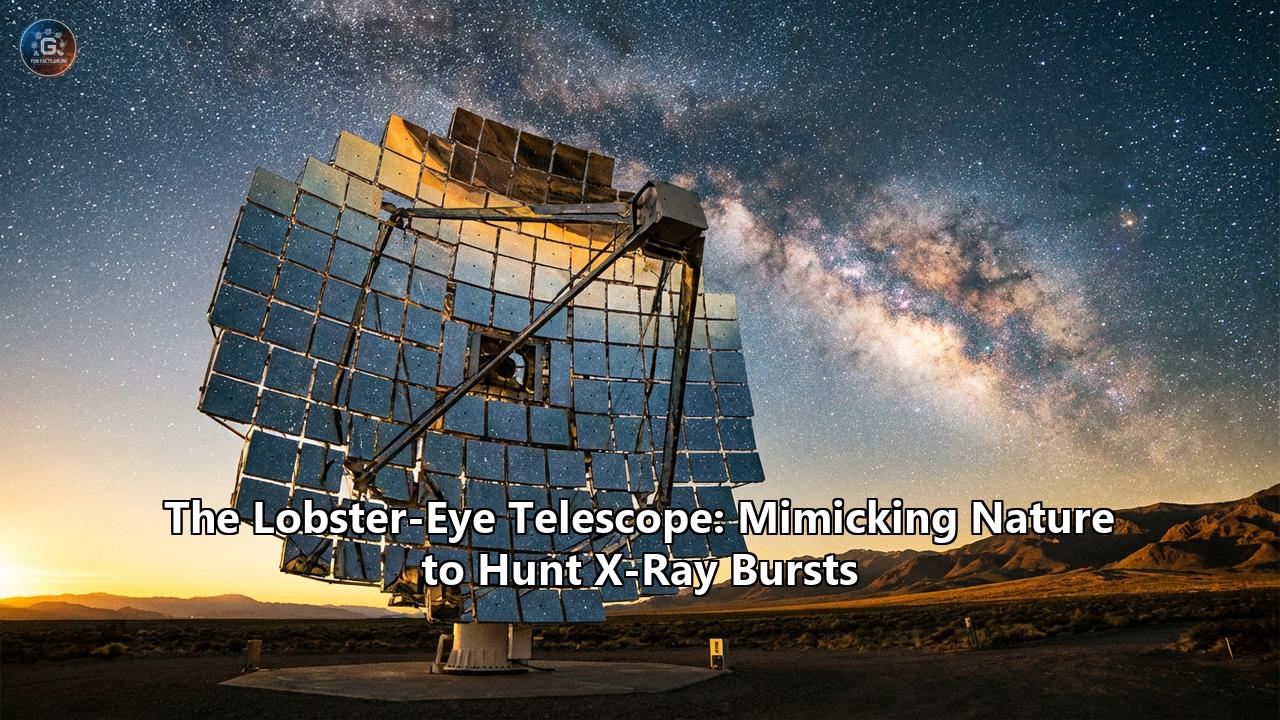
In the dark, murky waters of the ocean floor, the spiny lobster (Panulirus argus) scurries through the gloom. It is a creature of the deep, hunting in environments where light is scarce. To survive, evolution granted it a vision system unlike almost any other in the animal kingdom. While human eyes use lenses to refract (bend) light, focusing it onto a retina, the lobster’s eyes are built on a completely different principle: reflection. Its eyes are honeycombs of thousands of tiny, square-shaped tubes, lined with reflective material. These tubes channel light, bouncing it off their internal walls to concentrate it onto a central point, granting the lobster a uniquely wide field of view and high sensitivity to motion.
For decades, this biological marvel was just a curiosity of marine biology. But in the high-stakes world of X-ray astronomy, it became the key to solving a problem that had plagued scientists for half a century: How do you watch the entire universe at once?
The answer lay in mimicking the crustacean. Today, a new generation of "Lobster-Eye" telescopes is orbiting the Earth, scanning the cosmos not for predators in the mud, but for the most violent and transient events in the universe—exploding stars, colliding black holes, and the shredding of suns. This is the story of how a biological quirk revolutionized the hunt for X-ray bursts.
1. The X-Ray Problem: Why Conventional Mirrors Fail
To understand why the lobster eye is so revolutionary, one must first understand the immense difficulty of building an X-ray telescope.
When you look at a normal mirror in your bathroom, you are seeing visible light bouncing off a silvered surface. Visible light photons have relatively low energy; they bounce easily. X-rays, however, are high-energy photons. If you shine an X-ray beam directly at a standard mirror, it won't bounce—it will smash right through or be absorbed. This is why X-rays are used in medicine; they pass through the soft tissue of your body to image the bones beneath.
For astronomers, this penetrating power is a nightmare. You cannot build a standard telescope with a curved dish to catch X-rays, because the "light" would simply pass through the dish.
The Grazing Incidence Solution
The only way to reflect an X-ray is to skip it off a surface like a flat stone skipping across a pond. If the X-ray hits a metal surface at an extremely shallow angle—less than 1 or 2 degrees—it will reflect. This technique is known as grazing incidence optics.
For the past 40 years, the gold standard for X-ray astronomy has been the Wolter Type-I telescope. Named after the German physicist Hans Wolter, this design nests layers of cylindrical, tapered mirrors inside each other. X-rays enter the open end, graze off a parabolic mirror, then graze off a hyperbolic mirror, and finally focus on a detector.
This design is incredibly effective at producing sharp images. The famous Chandra X-ray Observatory and the XMM-Newton telescope use this design. However, they suffer from a fatal flaw: tunnel vision. Because the mirrors must be long and shallow to catch the X-rays, their Field of View (FoV) is tiny—often less than 1 degree (about twice the width of the full moon).
A Wolter telescope is like a high-powered sniper rifle. It is perfect for studying a known target in immense detail, but it is useless for finding new, random explosions across the vast sky. If a star explodes behind you while you are looking through a sniper scope, you will never know it happened.
Astronomers needed a surveillance camera, not a sniper rifle. They needed a wide-angle lens that could watch huge swathes of the sky simultaneously. But how do you build a wide-angle lens when you can only reflect light at shallow angles?
2. Roger Angel and the Biological Inspiration
In the late 1970s, an astronomer named Roger Angel at the University of Arizona stumbled upon a paper in a scientific journal describing the eyes of macruran crustaceans (lobsters, shrimps, and crayfish).
He read that the lobster eye is a "superposition compound eye." It consists of thousands of ommatidia (eye units), but unlike the hexagonal facets of a fly, the lobster’s facets are square. These square tubes are arranged on a sphere, all pointing toward a common center.
The geometry is elegant in its simplicity. Light entering a square tube reflects off the flat side walls. If the tube is long enough and the square is perfect, light from any direction will enter a specific tube, bounce twice (once off a vertical wall, once off a horizontal wall), and emerge focused toward a central retina.
In 1979, Angel published a landmark paper titled "Lobster eyes as X-ray telescopes." He proposed that if we could manufacture millions of tiny, square, hollow tubes and curve them into a sphere, we could create an X-ray lens with an unlimited field of view.
The "Angel" Geometry
In Angel's theoretical design, X-rays entering the square pores would graze the sides—just like the stone skipping on the pond—but because the pores are arranged spherically, X-rays coming from any part of the sky would find a set of pores aligned correctly to reflect them.
This creates a unique "focusing" effect. Unlike a standard lens that creates a perfect dot, a lobster-eye optic creates a distinctive "cross" shape (a crucial detail we will return to later). Most of the light focuses into a central bright spot, while some rays only bounce once, creating cross-arms.
The theory was sound. It promised a telescope that could view 1000 times more sky than Chandra. But there was a catch: in 1979, the technology to build millions of perfectly aligned, microscopic square tubes simply did not exist. The idea was shelved, waiting for engineering to catch up with biology.
3. The Wilderness Years: Engineering the Impossible
For nearly 30 years, the lobster-eye telescope remained largely a "paper tiger"—brilliant in theory, impossible in practice.
The manufacturing requirements were brutal. The pores needed to be tiny (about 20 to 40 microns wide, roughly half the width of a human hair). They needed to be perfectly square. Their internal walls had to be smooth down to the nanometer scale to reflect X-rays without scattering them. And finally, thousands of these pores had to be curved precisely into a spherical shape.
Early attempts tried to glue flat plates of glass together or etch silicon, but the results were heavy, fragile, or optically poor.
The Breakthrough: Micro-Pore Optics (MPO)
The turning point came with the maturation of Micro-Channel Plate (MCP) technology, originally designed for night-vision goggles. Engineers at companies like Photonis (in France) and researchers at the University of Leicester (UK) adapted this technique to create Micro-Pore Optics (MPO).
The process is a feat of material science:
- Glass Drawing: A square rod of glass is inserted into a square tube of a different, etchable glass.
- Bundling: These are drawn out into thin fibers, stacked together into a bundle, and drawn again. This is repeated until you have a solid block containing millions of microscopic glass fibers.
- Slumping: The glass block is sliced into thin wafers. These wafers are then heated and "slumped" over a spherical mold to give them the required curvature.
- Etching: The wafers are dipped in acid, which eats away the core glass fibers, leaving behind millions of hollow square tubes.
- Coating: The interior of the pores is coated with a thin layer of Iridium or Gold to enhance X-ray reflectivity.
By the 2010s, humanity finally had the "eye." Now, we needed to put it in space.
4. The Pathfinder: LEIA
Before risking a full-scale flagship mission, the technology needed to be proven in the harsh environment of space. The Chinese Academy of Sciences (CAS) took the lead.
In July 2022, China launched the Lobster Eye Imager for Astronomy (LEIA) aboard the SATech-01 satellite. LEIA was a technology demonstrator—a small version of the instrument intended for future missions.
The results were spectacular. Within days of activation, LEIA captured wide-field X-ray images of the Galactic Center, the Scorpius constellation, and the Cygnus Loop nebula. The images showed the characteristic "cross" point spread function predicted by Roger Angel forty years earlier. LEIA proved that the delicate glass micropores could survive the violent vibration of a rocket launch and the thermal extremes of orbit. The stage was set for the main event.
5. The Hunter: The Einstein Probe
On January 9, 2024, a Long March 2C rocket roared into the sky from the Xichang Satellite Launch Center, carrying the Einstein Probe (EP).
The Einstein Probe is the realization of the lobster-eye dream. It is a mission dedicated to Time-Domain Astronomy—the study of things that change, flash, and explode.
The Wide-field X-ray Telescope (WXT)
The crown jewel of the Einstein Probe is the WXT. It mimics the lobster eye design using 12 modules, each containing 36 million micro-pores.
- Field of View: The WXT covers a staggering 3,600 square degrees in a single shot. That is roughly one-eleventh of the entire celestial sphere.
- Scan Rate: In just three orbits (about 5 hours), the Einstein Probe can scan almost the entire night sky.
- Sensitivity: It is ten times more sensitive than previous wide-field monitors.
The Follow-up X-ray Telescope (FXT)
The WXT acts as the "spotter." When it detects a flash—a new X-ray source that wasn't there an hour ago—the satellite automatically slews (turns) to point its second instrument, the FXT.
The FXT is a traditional Wolter-I telescope. It has a narrow field of view but high resolution and sensitivity. It acts as the "sniper," zooming in on the target identified by the lobster eye to analyze its spectrum and determine its physical nature.
This combination of a wide-angle "discoverer" and a narrow-angle "analyzer" on a single satellite allows the Einstein Probe to catch transient events in real-time, often before they fade away.
6. The Science: What Are We Hunting?
Why go to all this trouble? What is happening in the X-ray universe that requires such a wide eye? The answer is transients. The X-ray sky is not static; it is a violent, flashing strobelight show.
A. Tidal Disruption Events (TDEs)
One of the primary targets for lobster-eye telescopes is the Tidal Disruption Event. This occurs when an unlucky star wanders too close to a Supermassive Black Hole (SMBH) at the center of a galaxy.
As the star approaches, the black hole's gravity pulls harder on the front of the star than the back. This tidal force overcomes the star's own gravity, ripping it apart. The star is "spaghettified"—stretched into a long, thin stream of hot gas. As this debris spirals into the black hole, it heats up to millions of degrees, releasing a massive flare of X-rays.
Before lobster-eye optics, catching a TDE was largely a matter of luck. They are rare, occurring perhaps once every 10,000 to 100,000 years in a galaxy. But because the Einstein Probe watches thousands of galaxies simultaneously, it can turn TDE discovery from an artisanal rarity into an industrial process, finding dozens or hundreds a year.
B. Gamma-Ray Bursts (GRBs)
GRBs are the most powerful explosions in the universe, often caused by the collapse of massive stars or the collision of neutron stars. They emit a prompt flash of gamma rays, followed by an "afterglow" in X-rays that fades rapidly.
Catching this afterglow is critical to pinpointing the location of the burst so that ground-based optical telescopes can find the host galaxy. The lobster-eye's wide view ensures that when a GRB goes off, there is a high probability the telescope is already looking at it, or can swivel to it within minutes.
C. Supernova Shock Breakouts
When a massive star dies, the core collapses, sending a shockwave racing outward. When this shockwave breaks through the surface of the star, it produces a brilliant flash of X-rays—the very first signal of the supernova. This flash lasts only minutes. By the time visible light telescopes see the supernova days later, the "shock breakout" is long gone. Lobster-eye telescopes offer our best chance to witness the exact moment a star dies.
D. Gravitational Wave Counterparts
When detectors like LIGO sense the ripples in spacetime from colliding neutron stars, they provide a very rough map of where the event happened—often a swath of sky covering hundreds of square degrees. Traditional telescopes are too narrow to search this haystack. The Einstein Probe, with its massive field of view, can cover the entire LIGO error box in a single pass, hunting for the X-ray "needle" that pinpoints the collision.
7. The Fleet: SVOM and SMILE
The Einstein Probe is not alone. The success of MPO technology has spawned a fleet of lobster-eye missions, each with a unique specialization.
SVOM (Space-based multi-band astronomical Variable Objects Monitor)
Launched in June 2024, SVOM is a joint mission between France (CNES) and China (CNSA). Its primary mission is hunting Gamma-Ray Bursts.
SVOM carries the MXT (Microchannel X-ray Telescope). Unlike the Einstein Probe's wide scanner, the MXT is a "narrow-field" lobster telescope (about 1 square degree). It uses the lobster optic not for width, but for lightness. Traditional Wolter mirrors are heavy metal shells; MPO glass plates are featherlight. This reduces the satellite's weight, allowing it to slew (turn) incredibly fast to catch fading bursts.
SMILE (Solar wind Magnetosphere Ionosphere Link Explorer)
Planned for launch in 2025, SMILE (ESA/China) turns the lobster eye toward a much closer target: Earth.
We usually think of space as empty, but Earth sits inside a magnetic bubble (the magnetosphere) that is constantly buffeted by the Solar Wind. The interaction between the solar wind and our magnetic field creates X-rays via a process called "Solar Wind Charge Exchange."
SMILE will use a lobster-eye Soft X-ray Imager (SXI) to take video of the Earth's magnetic nose (the magnetopause). It will show us, for the first time, the global "weather" of our magnetic shield, watching it buckle and flex during solar storms. The wide field of view is essential here because the magnetosphere is huge—it covers a massive portion of the sky from the satellite's perspective.
8. The Future: From Eyes to Arrays
The successful deployment of lobster-eye optics marks a paradigm shift in astronomy. We are moving from the era of "pointing and looking" to "monitoring and alerting."
Future concepts are already being discussed. The ISS-Lobster (or ISS-TAO) concept proposes mounting these modules on the International Space Station. Even more ambitious plans suggest large arrays of these telescopes could essentially film the entire X-ray sky continuously, creating a "movie" of the high-energy universe rather than static snapshots.
We are also seeing the democratization of X-ray astronomy. Because MPO optics are lightweight and (relatively) cheap compared to the hand-polished mirrors of Chandra, they can be fitted onto smaller, cheaper satellites (CubeSats), allowing universities and smaller nations to launch their own high-energy observatories.
Conclusion
Nature needed 500 million years to evolve the lobster's eye, perfecting a design that could see in the dark depths of the ocean. It took humanity another 45 years to understand that design, replicate it in glass and iridium, and launch it into the vacuum of space.
The Lobster-Eye telescope is a triumph of biomimicry. It reminds us that sometimes, the solutions to the most complex problems in astrophysics are already solved, walking around on the sea floor. As the Einstein Probe and its sister missions open their compound eyes, we are about to see the universe as the lobster sees its world: a place where nothing can hide in the dark, and every flash of motion is instantly seen. The hunt is on.
Reference:
- https://cnmvipvoice.org/2023/01/02/how-lobster-eyes-can-help-astronomers-get-a-wider-view-of-the-cosmos/
- https://en.wikipedia.org/wiki/Lobster-eye_optics
- https://iachec.org/wp-content/presentations/2023/Sembay-SXI_2023.pdf
- https://experts.arizona.edu/en/publications/lobster-eyes-as-x-ray-telescopes/
- https://www.researchgate.net/publication/325256857_Lobster_Eye_X-ray_optics_for_astrophysics_Recent_status
- https://www.youtube.com/watch?v=a-ztVhY3_wc
- https://en.wikipedia.org/wiki/Wolter_telescope
- https://www.researchgate.net/publication/326240996_MXT_instrument_on-board_the_French-Chinese_SVOM_mission
- https://indico.in2p3.fr/event/19287/contributions/72698/attachments/53573/69849/PosterMXT_Nanjing_2019.pdf
- https://arxiv.org/abs/2511.14911
- https://www.semanticscholar.org/paper/Tidal-disruption-events-in-the-first-billion-years-Pfister-Dai/1f3a708f5d81f6e0d8dcc313105f37d42f1e8b3d
- https://pubs-en.cstam.org.cn/data/article/dqyxxwl/preview/pdf/SI8380-Hubbard.pdf
- https://scispace.com/pdf/mxt-instrument-on-board-the-french-chinese-svom-mission-1h6tgif6ay.pdf
- https://arxiv.org/abs/2211.13489
- https://www.svom.eu/en/mxt-microchannel-x-ray-telescope-en/
- https://www.youtube.com/watch?v=SZjjwiH5kH8