
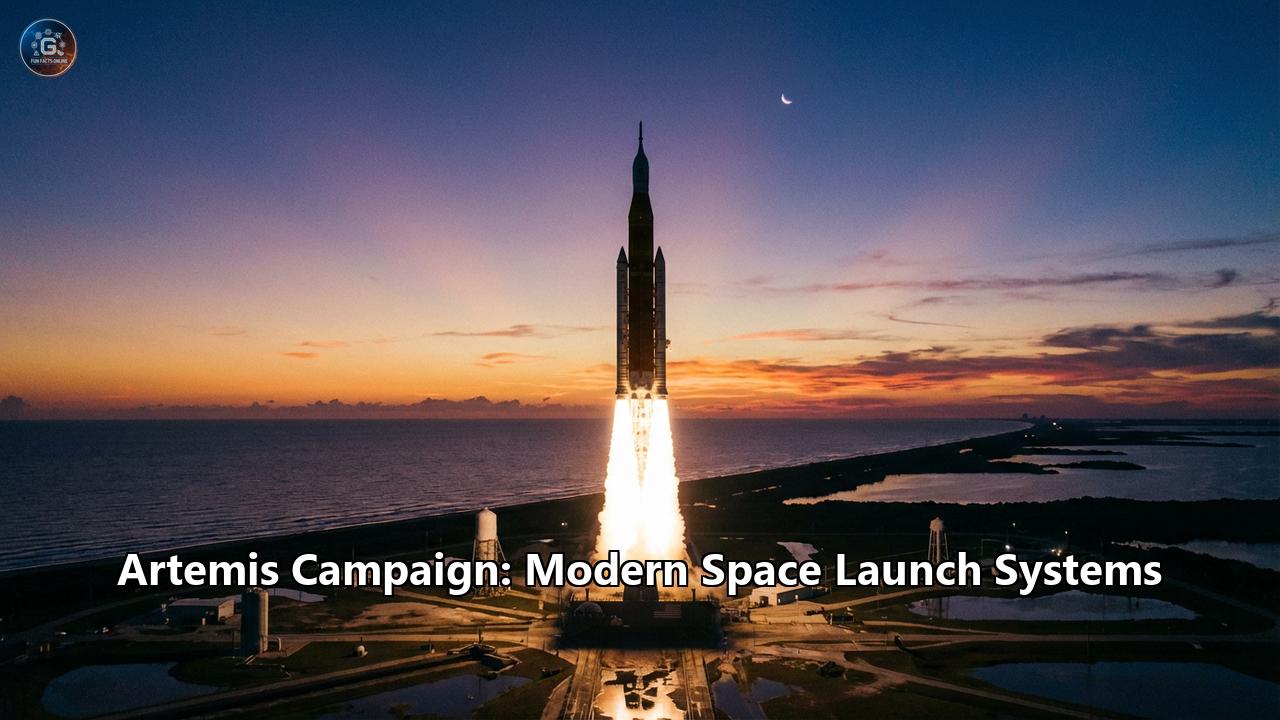
Fifty years after the final Apollo astronauts left their footprints in the lunar dust, humanity is no longer content with merely visiting the Moon. We are going back to stay. The Artemis Campaign represents the most ambitious, technologically advanced, and internationally collaborative space exploration endeavor in human history. Unlike the Space Race of the 20th century, which was fueled by Cold War geopolitical rivalries and relied on disposable, single-use hardware, the modern return to the Moon is built on a foundation of sustainability, commercial partnerships, and reusable modern space launch systems.
From the sheer brute force of NASA’s Space Launch System (SLS) to the futuristic, stainless-steel monolith of SpaceX’s Starship, the vehicles designed to carry humanity into the deep cosmos represent a paradigm shift in aerospace engineering. As we navigate the complex realities of orbital mechanics, cryogenic propellants, and deep-space life support in early 2026, the Artemis campaign is proving that while space remains unforgivingly hard, the rewards of conquering it have never been greater.
The Artemis Architecture: A Phased Return to Deep Space
The Artemis program is not a single mission, but a phased architectural campaign designed to establish a permanent human presence on and around the Moon, acting as a stepping stone for future crewed missions to Mars.
The campaign officially kicked off with Artemis I in late 2022, an uncrewed flight test that successfully sent the Orion spacecraft further into deep space than any human-rated vehicle had ever gone before. It proved that the foundational hardware—the SLS rocket and the Orion capsule—was structurally sound and capable of surviving the blistering speeds of a lunar return trajectory.
Artemis II marks the critical next step. This mission, expected to last roughly 10 days, will carry four astronauts—NASA's Reid Wiseman, Victor Glover, and Christina Koch, alongside the Canadian Space Agency’s Jeremy Hansen—on a free-return trajectory around the Moon. It will be the first time humanity has ventured beyond Low Earth Orbit (LEO) since 1972. The crew will test Orion’s life support systems, communication arrays, and manual piloting capabilities before returning to Earth.Following this flyby, Artemis III will make history. Currently targeted for no earlier than 2027 or 2028, this mission will see the first woman and the first person of color step onto the lunar surface near the Moon’s South Pole, a region permanently shadowed and rich in water ice. Artemis III introduces a radically new mission architecture: rather than taking a lunar lander all the way from Earth on a single rocket, the Orion capsule will rendezvous with a commercial Human Landing System (HLS) in lunar orbit, transferring the crew for the descent to the surface.
The Beating Heart: Space Launch System (SLS) and Orion
At the center of NASA's deep-space architecture is the Space Launch System (SLS) and the Orion spacecraft. In an era where commercial rockets dominate Low Earth Orbit, the SLS is a government-owned behemoth tailored specifically for deep-space payload mass and departure energy.
The SLS Block 1 configuration, used for the initial Artemis missions, generates a staggering 8.8 million pounds of thrust at liftoff. This power is derived from a massive core stage fueled by liquid hydrogen and liquid oxygen, powered by four RS-25 engines—the highly reliable, upgraded engines leftover from the Space Shuttle program. Flanking the core stage are two extended twin solid rocket boosters (SRBs) manufactured by Northrop Grumman, which provide 75% of the vehicle's thrust during the first two minutes of flight.
Atop the SLS sits the Orion Spacecraft, built by Lockheed Martin, which houses the crew module, and the European Service Module (ESM), provided by Airbus Defence and Space under the European Space Agency (ESA). The ESM is the powerhouse of Orion, providing electricity, propulsion, thermal control, and the vital air and water required to keep the astronauts alive in the void.
However, developing the world's most powerful rocket is not without its growing pains. The road to Artemis II has been fraught with the immense technical challenges inherent to cryogenic fuels and deep-space vehicles. Following Artemis I, engineers spent months analyzing unexpected ablation (charring and shedding) of Orion’s heat shield during its fiery reentry into Earth's atmosphere, leading to necessary schedule adjustments to ensure absolute crew safety.
By early 2026, the Artemis II SLS rocket was fully stacked in the Vehicle Assembly Building (VAB) and rolled out to the historic Launch Pad 39B at the Kennedy Space Center. However, spaceflight demands perfection. In late February 2026, during pre-launch checkouts and wet dress rehearsals, engineers detected a stubborn anomaly in the flow of helium to the rocket's upper stage (the Interim Cryogenic Propulsion Stage, or ICPS). Because helium is critical for pressurizing propellant tanks and purging fuel lines, NASA made the difficult but prudent decision on February 25, 2026, to roll the 322-foot-tall rocket back to the VAB. The 4-mile, 12-hour trek back indoors allowed technicians to safely build access platforms, diagnose the helium issue, and replace core stage and flight termination system batteries. As a result, the Artemis II launch date, originally slated for early 2026, was officially adjusted to target no earlier than April 2026.
This meticulous, safety-first approach underscores a fundamental truth about modern spaceflight: when human lives are strapped to millions of pounds of high explosives, schedule pressure must always yield to engineering reality. Anomalies on the pad are an inconvenience; anomalies in deep space are fatal.
The Human Landing Systems: A Commercial Revolution
Perhaps the most defining feature of the Artemis campaign is NASA’s reliance on commercial partnerships for the Human Landing System (HLS). During Apollo, NASA owned and operated the Lunar Module. For Artemis, NASA is purchasing a "ride" to the surface from private aerospace companies, fostering a competitive, fixed-price commercial ecosystem.
SpaceX's Starship HLS
SpaceX won the initial HLS contract with a heavily modified variant of its massive Starship vehicle. The Starship HLS represents a dramatic departure from traditional spacecraft design. Standing taller than the entire Apollo Lunar Module, Starship HLS boasts a pressurized internal volume of approximately 600 cubic meters—more than half the internal volume of the entire International Space Station—and features two massive airlocks.
To get to the Moon, Starship relies on an orbital refueling architecture. Because of its massive size, Starship consumes most of its propellant just reaching Earth orbit. To solve this, SpaceX will launch a series of Starship tanker variants to fill an orbiting propellant depot. The Starship HLS will launch, dock with the depot, top off its tanks with liquid oxygen and liquid methane, and then fire its Raptor engines to shoot toward the Moon.
By early 2026, SpaceX's silent but rapid progress on the HLS variant became undeniable. The company successfully completed 49 major NASA milestones. At their facilities, they built a flight-article HLS cabin equipped with functional avionics, power systems, crew communications, and environmental control and life support systems (ECLSS). They rigorously tested the life support hardware in nosecone mockups, ensuring the system could flawlessly manage oxygen, nitrogen, humidity, and temperature. They also completed full-scale drop tests of Starship's lunar landing legs on simulated lunar regolith, and successfully qualified the androgynous docking system that will link Starship with the Orion capsule and the Lunar Gateway.
Looking ahead, SpaceX is targeting massive milestones for 2026, including a crucial ship-to-ship propellant transfer demonstration in orbit, followed by an uncrewed landing demonstration on the Moon targeted for 2027 to validate the hardware before astronauts climb aboard for Artemis III. The capability of Starship is game-changing: it is designed to deliver not just humans, but up to 100 tons of cargo directly to the lunar surface, enabling the deployment of large habitats, pressurized rovers, and scientific laboratories.
Blue Origin's Blue Moon
Recognizing the need for redundancy and competition, NASA later awarded a second HLS contract to Blue Origin to develop the Blue Moon lander for Artemis V and beyond. By 2026, Jeff Bezos’s space company demonstrated a ruthless commitment to the lunar effort, going so far as to pause its suborbital New Shepard tourism flights to focus its engineering might entirely on the Moon.
Blue Origin’s strategy utilizes a dual-path development. They are currently building the Blue Moon Mark 1, an uncrewed cargo lander standing 8 meters tall capable of delivering 3 metric tons to the lunar surface. This vehicle serves as a technology pathfinder. The ultimate prize is the Blue Moon Mark 2, a towering 16-meter-tall crewed lander powered by three advanced BE-7 engines. Unlike Starship's methane-based system, Blue Moon relies on liquid hydrogen and liquid oxygen (hydrolox)—some of the most efficient, but difficult to store, propellants in rocketry.
Blue Origin’s landers will launch on the company’s heavy-lift New Glenn rocket from Cape Canaveral. The progress of both SpaceX and Blue Origin highlights the brilliance of NASA's commercial procurement strategy: by relying on multiple vendors with entirely different engineering philosophies, the Artemis campaign is shielded against the failure of any single vehicle architecture.
Lunar Gateway: Humanity’s First Deep-Space Outpost
While Artemis III will go directly to the Moon's surface, the long-term sustainability of the Artemis campaign relies on the Lunar Gateway. The Gateway is a small, modular space station that will be assembled in a Near-Rectilinear Halo Orbit (NRHO) around the Moon. This unique orbit provides continuous line-of-sight communication with Earth, constant solar illumination for power, and a highly efficient gravitational "parking spot" that makes it easy for landers to reach anywhere on the lunar surface, particularly the South Pole.
The foundational modules of the Gateway are the Habitation and Logistics Outpost (HALO), built by Northrop Grumman, and the Power and Propulsion Element (PPE), built by Maxar. These modules will act as the command center, living quarters, and power station for arriving astronauts.
Starting with Artemis IV (slated for the late 2020s), the SLS will upgrade to the "Block 1B" configuration. This upgrade introduces the Exploration Upper Stage (EUS), which is powerful enough to carry the Orion spacecraft and massive Gateway modules in a single launch. International partners are heavily involved in the Gateway's future: the ESA is providing the ESPRIT refueling and communication module, and the Canadian Space Agency is providing Canadarm3, an advanced autonomous robotic arm designed to maintain the station while it is uncrewed.
Commercial rockets will also play a vital role here. SpaceX’s Falcon Heavy rocket has been tapped to launch foundational pieces of the Gateway, and a modified version of their cargo spacecraft, the Dragon XL, will deliver supplies, science experiments, and extravehicular activity (EVA) suits to the station ahead of crew arrivals.
The Realities of 2026: Flexibility in Deep Space Exploration
The modern era of space exploration is characterized by breathtaking ambition, but it is also grounded by the unyielding laws of physics. As of early 2026, the timelines for the Artemis campaign reflect the sobering reality of developing new deep-space technologies.
With Artemis II targeting the April 2026 launch window (following the helium anomaly rollback), the schedule for Artemis III has naturally shifted. The General Accountability Office (GAO) and NASA leadership have acknowledged that Artemis III will likely fly no earlier than 2027, with many industry analysts pointing toward September 2028. The complexity of orbital refilling, the mass production of Raptor engines, and the finalization of new commercial spacesuits built by Axiom Space require time to perfect.
However, NASA has built flexibility into the Artemis manifesto. If the Starship HLS requires more time for uncrewed testing, NASA officials have expressed an openness to flying Artemis III as a crewed mission to dock with the Lunar Gateway or conduct an extensive test of Orion and a commercial vehicle in Low Earth Orbit, ensuring the momentum of the SLS and Orion programs continues uninterrupted while the landers mature.
The Horizon: A Sustainable Future
The Artemis campaign is laying the foundation for an interplanetary future. By utilizing the massive lift capability of the Space Launch System, the deep-space survivability of the Orion spacecraft, the economic efficiency of commercial heavy-lift rockets, and the sheer innovation of the Starship and Blue Moon human landing systems, humanity is building an infrastructure that will outlast any single political administration.
We are returning to the Moon to learn how to live off the land, how to process lunar water ice into rocket propellant and breathable air, and how to protect fragile human biology from the relentless radiation of deep space. Every agonizing launch delay, every rollback to the Vehicle Assembly Building, and every fiery test of a commercial lander is a down payment on a grander vision.
The launchpads of Florida and the orbital assembly depots above our atmosphere are currently preparing for the roar of Artemis. As we look up at the Moon tonight, it is no longer just a serene, glowing orb in the sky; it is a destination. It is the site of humanity’s next great outpost, and the ultimate stepping stone to the red sands of Mars.
Reference:
- https://en.wikipedia.org/wiki/Artemis_program
- https://www.nasa.gov/humans-in-space/artemis/
- https://www.asc-csa.gc.ca/eng/astronomy/moon-exploration/artemis-missions.asp
- https://www.planetary.org/articles/artemis-ii-what-to-expect
- https://en.wikipedia.org/wiki/Artemis_II
- https://en.wikipedia.org/wiki/Artemis_III
- https://www.boeing.com/space/space-launch-system
- https://www.youtube.com/watch?v=c_VoCIbZghg
- https://www.skyatnightmagazine.com/news/when-will-artemis-ii-launch
- https://aerospaceglobalnews.com/news/nasa-artemis-ii-sls-roll-back-helium-leak/
- https://www.nasa.gov/blogs/missions/2026/02/24/first-motion-set-for-artemis-ii-rollback/
- https://www.nasaspaceflight.com/2025/11/starship-block-3-path-moon/
- https://www.theweeklyspaceman.com/articles/starship-hls-the-new-update-shows-silent-progress
- https://www.spacex.com/updates
- https://www.reddit.com/r/ArtemisProgram/comments/1oz3ras/spacex_is_reportedly_targeting_orbital_refueling/
- https://www.youtube.com/watch?v=uUf6nvtGhFw