
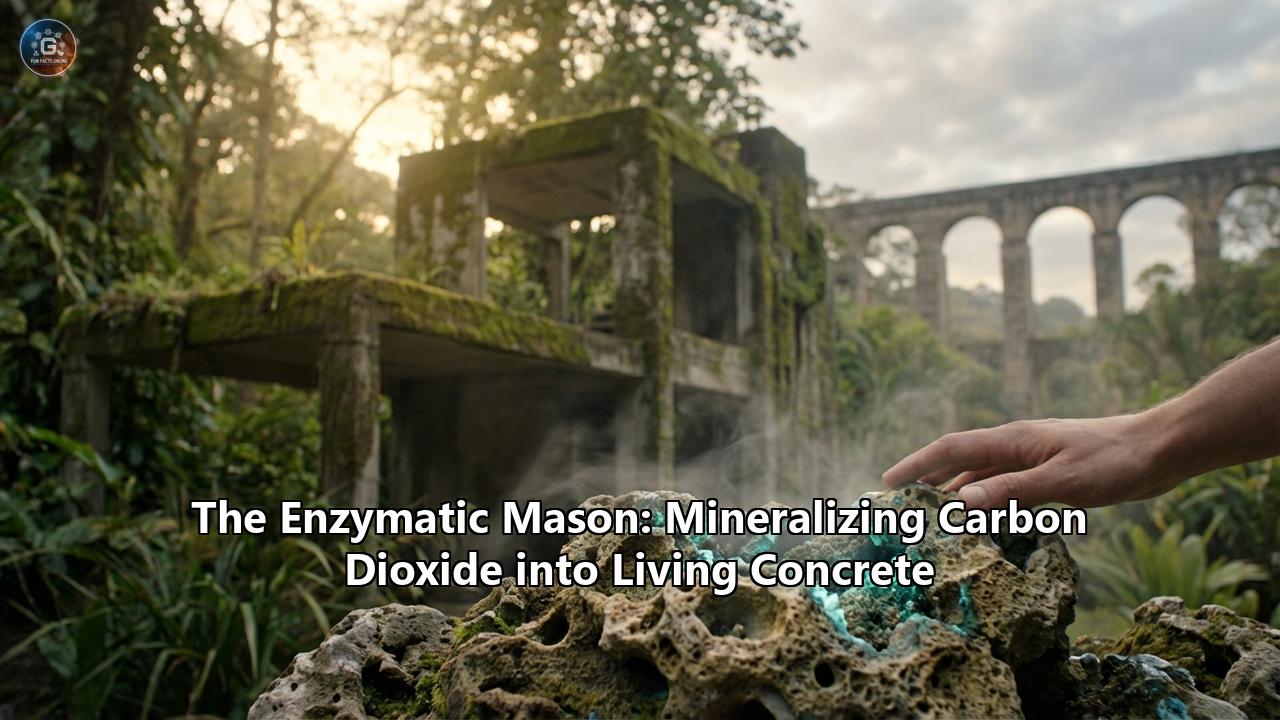
The history of human civilization is written in stone. From the Great Pyramids of Giza to the aqueducts of Rome and the sky-piercing needles of modern Manhattan, our mastery over the physical world has been defined by our ability to stack, bind, and shape minerals. For nearly two centuries, the protagonist of this story has been Portland cement—the gray, ubiquitous powder that, when mixed with water and aggregate, forms the bedrock of modern society. It is a material of immense utility, but it carries a hidden, crushing weight. The production of concrete is a quiet ecological catastrophe, responsible for roughly 8% of global carbon dioxide emissions—more than the aviation and shipping industries combined. If the concrete industry were a country, it would be the third-largest emitter on Earth, trailing only China and the United States.
But a new protagonist is emerging from the microscopic world, one that promises to rewrite the rules of construction. This is the story of the "Enzymatic Mason"—a convergence of synthetic biology, materials science, and architecture that seeks to transform our buildings from inert, carbon-emitting statues into living, breathing organisms. It is a shift from the industrial "fire and crush" methods of the 19th century to the "grow and heal" logic of biology. By harnessing the power of carbonic anhydrase enzymes and calcifying bacteria, scientists are unlocking a future where our cities do not just house life—they are life.
Chapter 1: The Gray Paradox
To understand the revolutionary potential of the Enzymatic Mason, one must first confront the deep flaws of our current master builder. Portland cement is a marvel of chemical engineering, but it is born of violence. The process begins in massive kilns heated to over 1,400 degrees Celsius (2,500 degrees Fahrenheit), temperatures required to break down limestone (calcium carbonate) into calcium oxide (lime) and CO2. This process, known as calcination, is a double-edged sword: not only does the heating require vast amounts of fossil fuels, but the chemical reaction itself releases stored carbon dioxide directly from the rock into the atmosphere. For every ton of cement produced, roughly one ton of CO2 is released.
Once poured, concrete is a dead material. It does not adapt; it does not heal. It fights a losing battle against entropy from the moment it sets. Water infiltrates its pores, rusting the steel reinforcement within; freeze-thaw cycles pry open microscopic fissures; the earth shifts, and the rigid stone cracks. We fight this decay with maintenance, patches, and eventually, demolition and replacement, continuing the cycle of emission and waste. We have built a world that is static in a reality that is dynamic.
The Enzymatic Mason proposes an inversion of this paradigm. What if, instead of releasing CO2 to make stone, we used CO2 as the raw material? What if the binding agent wasn't a product of heat, but a product of enzymes? What if a wall could sense a crack and knit itself back together?
Chapter 2: The Biological Architect
The concept of "living concrete" rests on a process that nature perfected billions of years ago: biomineralization. It is the same process that allows mollusks to grow seashells and corals to build reefs. In these natural systems, soft biological tissues orchestrate the precipitation of hard minerals from the surrounding environment.
The star of this new architectural era is a class of enzymes known as Carbonic Anhydrase (CA). Found in red blood cells, plant leaves, and various bacteria, CA is one of nature's fastest catalysts. Its primary job is to manage carbon dioxide. In the human body, it helps transport CO2 out of tissues; in the context of the Enzymatic Mason, it is the worker that grabs CO2 molecules and water to produce bicarbonate and protons.
When calcium ions are present (typically introduced via sand, aggregate, or dissolved calcium sources), the bicarbonate reacts to form Calcium Carbonate (CaCO3)—limestone.
This is the core magic trick:
$$ \text{CO}_2 + \text{H}_2\text{O} \xrightarrow{\text{Carbonic Anhydrase}} \text{HCO}_3^- + \text{H}^+ $$
$$ \text{Ca}^{2+} + \text{CO}_3^{2-} \rightarrow \text{CaCO}_3 (\text{Calcite}) $$
While geological limestone takes eons to form, the Enzymatic Mason can accelerate this mineralization process by a factor of a million. A reaction that might naturally take years can occur in minutes.
Researchers are deploying this enzyme in two primary ways:
- Free Enzyme Addition: Extracting or synthesizing the CA enzyme and mixing it directly into a binding solution. This creates a "self-healing" chemical potential within the material.
- Whole-Cell Biomineralization: embedding living bacteria, such as Sporosarcina pasteurii or photosynthetic cyanobacteria like Synechococcus, directly into the structural matrix. These microbes act as tiny, living factories, constantly producing the enzyme and managing the local chemical environment to precipitate calcite crystals on demand.
Chapter 3: Growing the Future (The WPI and CU Boulder Breakthroughs)
The theoretical framework of bioconcrete has existed for decades, but recent breakthroughs have moved it from a petri dish curiosity to a viable structural material.
At the University of Colorado Boulder, a team led by Dr. Wil Srubar has pioneered the creation of "Living Building Materials" (LBMs). Their approach is radically different from traditional masonry. They inoculate a scaffold of sand and hydrogel (a nutrient-rich gelatin) with Synechococcus cyanobacteria. Unlike traditional concrete manufacturing, which is a subtractive and energetic process, this is an additive, biological one.
The process resembles gardening more than construction. The sand-hydrogel mix provides a structure, and the cyanobacteria are the gardeners. As they photosynthesize, they absorb CO2 from the air and drive the precipitation of calcium carbonate, mineralizing the gelatin scaffold into a hard, brick-like substance.
The most stunning property of CU Boulder’s LBM is its reproductive capability. If you take one of these living bricks and cut it in half, each half can be fed into a new sand-hydrogel scaffold, and the bacteria will migrate and mineralize the new material. One brick becomes two; two become four. This "exponential manufacturing" model suggests a future where materials are not shipped across oceans but are "grown" on-site from a parent culture, drastically reducing logistics costs and emissions.
Meanwhile, at Worcester Polytechnic Institute (WPI), Dr. Nima Rahbar has developed what is termed "Enzymatic Construction Material" (ECM). Rahbar’s team focuses on the pure power of the Carbonic Anhydrase enzyme to create a "negative emission" material. Their ECM can cure in hours rather than the 28 days required for traditional concrete to reach full strength. It boasts a compressive strength that rivals biological mortar and consumes CO2 actively during its formation. Rahbar’s work highlights the possibility of a "self-healing" mechanism where the enzyme remains dormant within the matrix. When a crack forms, air (containing CO2) enters; the enzyme wakes up, captures the CO2, and fills the crack with new calcite crystals. It is a material that feeds on the very greenhouse gas that threatens our climate.
Chapter 4: The Self-Healing Mechanism
The durability crisis of modern concrete is largely a function of its brittleness. Micro-cracks are inevitable. In traditional concrete, these cracks are the beginning of the end—pathways for moisture, salt, and oxygen to corrode the steel skeleton inside.
The Enzymatic Mason solves this through biological vigilance. In systems utilizing Sporosarcina pasteurii, the bacteria are encapsulated in protective distinct markers—often clay pellets or specialized hydrogels—along with a nutrient source (like calcium lactate). These capsules sit dormant within the concrete, sometimes for decades, waiting for a trigger.
That trigger is the crack itself. When the concrete splits, the capsule ruptures or becomes exposed to water and oxygen entering the fissure. The bacteria awaken from their spore-like state. They metabolize the nutrient food source and release the carbonic anhydrase enzyme. The enzyme converts the infiltrating CO2 and the calcium nutrient into limestone crystals.
The crack is not merely filled with a glue; it is healed with stone.
This process has been observed to seal cracks up to 0.8mm wide completely. While this sounds small, in the world of structural engineering, sealing these micro-cracks prevents them from coalescing into macro-cracks that threaten the building's integrity. It is an immune system for our infrastructure.
Chapter 5: Carbon Negative: Turning a Pollutant into a Resource
The environmental implication of the Enzymatic Mason is the most compelling argument for its adoption. Traditional concrete is a carbon emitter. Living concrete is a carbon sink.
Let us look at the math. A cubic yard of traditional concrete is responsible for emitting roughly 400 to 600 lbs of CO2 (depending on the mix and cement source). In contrast, enzymatic construction materials can sequester carbon. By using CO2 as a reactant to form the binder, the material physically locks away the gas in a stable mineral form (calcite) that will not degrade for geologic timeframes.
Some estimates suggest that a cubic yard of Enzymatic Construction Material could sequester over 100 lbs of CO2. This is a swing of over 500 lbs of CO2 per cubic yard—a massive shift. If widely adopted, the construction industry could pivot from being a primary driver of climate change to a significant player in carbon capture and storage (CCS).
Furthermore, the cyanobacteria approach uses sunlight as an energy source. The bricks are effectively "solar-powered" during their growth phase, absorbing sunlight and atmospheric carbon to build structure. This aligns perfectly with the concept of a circular bioeconomy, where waste (CO2) becomes value.
Chapter 6: The Engineering Challenges
Despite the promise, the Enzymatic Mason faces significant hurdles before it can displace Portland cement entirely.
1. Structural Strength and Consistency:While living concrete is strong—often comparable to cement mortar or low-strength concrete—it has not yet consistently reached the ultra-high compressive strengths (10,000+ psi) required for skyscrapers or heavy infrastructure like bridge decks. It is currently best suited for pavers, facades, low-rise structures, and non-structural infill. However, rapid advancements in scaffold density and enzyme efficiency are closing this gap.
2. The Water Problem (Desiccation):For bacteria to survive and function, they generally need moisture. In the CU Boulder experiments, the relative humidity had to be controlled to keep the cyanobacteria alive. If the brick dries out completely, the "living" aspect dies. While the structural integrity remains, the self-healing and reproductive capabilities are lost. Researchers are currently investigating "extremophiles"—bacteria adapted to deserts—and methods of sporulation that allow the microbes to hibernate in total dryness for years, only waking when a rainstorm (and the accompanying water damage) arrives.
3. Economics and Scale:Portland cement is incredibly cheap. It is essentially cooked dirt. Biological nutrients, hydrogels, and enzyme extraction are currently more expensive. However, as with all biotechnologies (like DNA sequencing or lab-grown meat), costs drop exponentially with scale. The ability to use industrial waste streams (like corn steep liquor or lactose mother liquor) as bacterial food sources could drastically lower the price tag.
4. Regulation and Acceptance:The construction industry is notoriously conservative. Building codes are written in blood; they change only when safety is absolutely guaranteed. Convincing engineers and regulators to sign off on a material that contains living organisms—one that effectively "grows"—will require years of rigorous long-term durability testing. Questions about how these bacteria behave over 50 or 100 years, or if they could interact negatively with the local ecosystem (though most used are non-pathogenic), must be answered.
Chapter 7: The Vision of a Living City
Imagine a city in the year 2070.
The skyline does not gleam with the sterile glass and steel of the 20th century. Instead, the buildings have a texture to them, an organic warmth. These structures were not built; they were cultivated.
Construction sites look different. There are no roaring cement mixers or dust-choked air. Instead, there are bioreactors—large, transparent tanks where the initial "seed" bricks are multiplying. The scaffolding of a new tower is erected, and a slurry of sand, gel, and dormant enzymes is pumped into the molds. Over the next few days, the walls solidify, drawing carbon dioxide out of the smoggy air to fuel their own hardening.
As the building ages, it interacts with its environment. A summer storm causes a micro-fracture in the southern facade. As the rain seeps in, the wall senses the moisture. dormant bacterial spores bloom, metabolize the calcium nutrients embedded in the matrix, and mineralize the crack, sealing it before the sun comes out.
The sidewalks are made of enzymatic pavers that eat the exhaust of the electric buses passing by. The city is no longer a heat island of dead rock; it is a carbon sponge.
In this future, the role of the architect changes. They are no longer just designers of form, but choreographers of biology. They specify the genetic strain of the masonry as carefully as they once specified the grade of steel.
Conclusion: The Stone That Breathes
The Enzymatic Mason represents a profound philosophical shift in how we interact with the material world. For thousands of years, we have viewed nature as something to be conquered, cleared, and paved over. We replaced the complexity of the forest with the simplicity of the slab.
But the complexity of the forest was doing something the slab could not: it was maintaining a balance. By inviting the microscopic world into our macroscopic construction, we are finally admitting that nature is the superior engineer. The enzyme is more efficient than the kiln. The bacterium is a better mason than the machine.
We stand at the threshold of a new Stone Age—not one of primitive chipping, but of sophisticated biological partnership. The transition will be difficult, fraught with technical bottlenecks and economic battles. But the prize is a civilization that heals itself, a built environment that cleans the air, and a legacy written in living stone. The Enzymatic Mason is ready to work; we just need to give it the blueprint.
Reference:
- https://enzymatic.io/enzymatic-construction-material/
- https://www.research-collection.ethz.ch/server/api/core/bitstreams/67ec741f-5178-4739-825e-3d71f2736930/content
- https://sdgs.un.org/partnerships/self-healing-enzymatic-bio-concrete-fight-climate-change
- https://enzymatic.io/2022/03/19/state-of-the-art-living-concrete-alternative-soaks-up-carbon/
- https://ceramics.org/ceramic-tech-today/bacteria-bind-bricks-to-create-sustainable-living-building-material/
- https://www.advancedsciencenews.com/scientists-create-living-concrete-from-bacteria-and-sand/
- https://www.colorado.edu/mse/2020/01/16/bricks-alive-building-materials-come-alive-help-bacteria
- https://www.colorado.edu/today/2020/01/15/building-materials-come-alive
- https://www.allplan.com/blog/self-healing-bricks-eat-co2/
- https://www.researchgate.net/publication/366350550_Low_Carbon_Bacterial_Self-Healing_Concrete
- https://www.dundee.ac.uk/phds/opportunities/carbon-negative-self-healing-enzymatic-construction-materials
- https://www.wpi.edu/news/carbon-negative-building-material-developed-worcester-polytechnic-institute-published-matter
- http://www.sciencedaily.com/releases/2026/01/260121034148.htm