
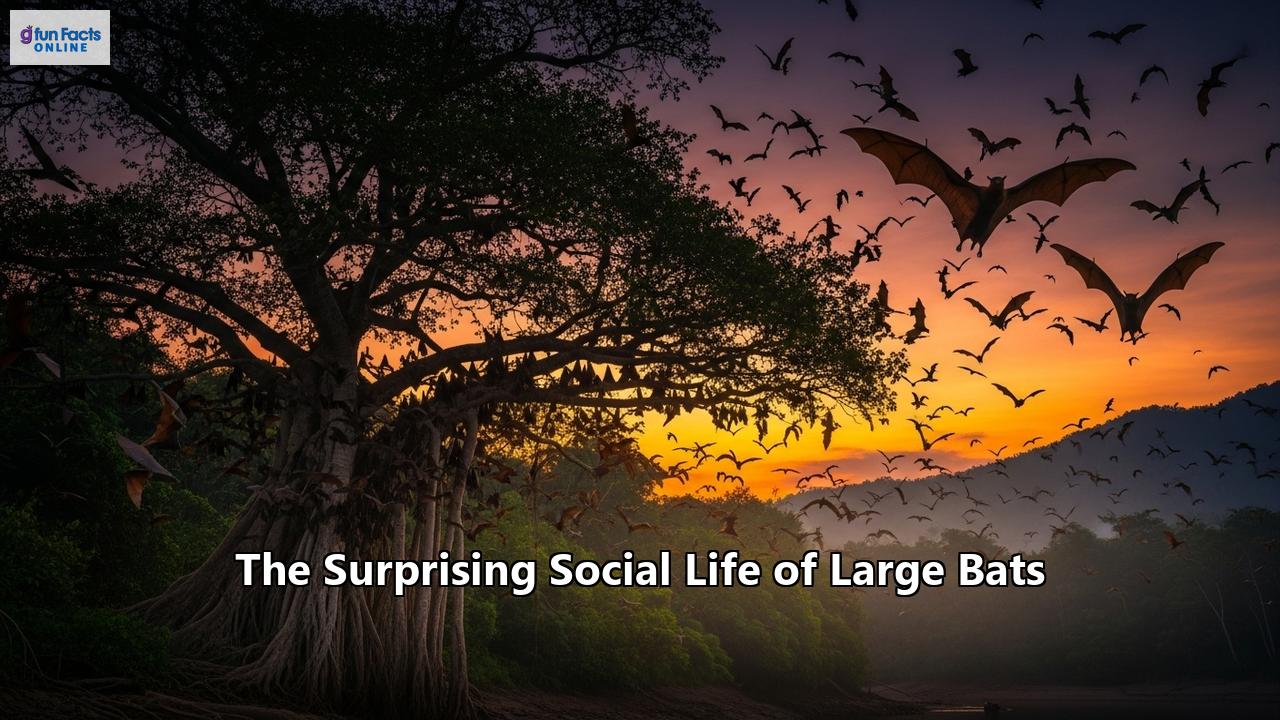
A world away from the solitary, sinister figures of folklore, many of the world’s largest bat species live lives of astonishing social complexity. Far from being simple creatures of the night, these mammals engage in sophisticated behaviors that rival those seen in primates and other highly intelligent animals. From vast, bustling cities of millions to intimate family groups that share food and affection, the social tapestry of large bats is as diverse as it is surprising. This article delves into the intricate social dynamics, advanced communication, remarkable cooperation, and surprising intelligence that define the lives of these fascinating nocturnal flyers.
The Intricate Fabric of Bat Societies: Beyond the Colony
When we think of bat colonies, we might imagine a chaotic mass of screeching animals. While the numbers can be staggering—some colonies of straw-colored fruit bats in Africa can swell to over a million individuals—these are not anonymous aggregations. Instead, they are highly structured societies with layers of complexity that scientists are only just beginning to unravel.
Flying Foxes: Cities in the Trees
Flying foxes, the giants of the bat world, are a prime example of complex social organization. These large fruit- and nectar-eating bats, belonging to the genus Pteropus, often form massive colonies known as "camps." These camps, which can be permanent or semi-permanent, are not just random collections of individuals but are structured communities.
Within these bustling camps, there are often distinct social units. The grey-headed flying fox of Australia, for instance, forms harems during the breeding season, with a single male defending and mating with a group of up to six females. The Indian flying fox exhibits a male-dominated hierarchy, where higher-ranking individuals claim the most desirable roosting spots higher up in the trees. This vertical social ladder is a constant source of interaction and communication within the colony.
The social structure of flying foxes can also be incredibly fluid, changing with the seasons and the availability of resources. The Bonin flying fox, for example, displays a fascinating seasonal shift in its social arrangements. During the winter breeding season, they form harems. However, in the summer, these groups dissolve, and the bats become largely solitary, with the exception of mothers nursing their young. This dynamic social system highlights their ability to adapt their social behaviors to their biological needs.
Some flying fox camps are even multi-species affairs. In Australia, it's not uncommon to find grey-headed flying foxes, black flying foxes, and little red flying foxes sharing the same roosting site, with each species occupying a designated area. This cohabitation points to a level of inter-species tolerance and social organization that is truly remarkable.
The little red flying fox of Australia is known for forming incredibly dense and nomadic camps, sometimes numbering in the hundreds of thousands to a million individuals. These bats are highly mobile, following the flowering of eucalyptus trees across the continent. Their nomadic lifestyle necessitates a flexible social structure that allows for the constant influx and departure of individuals.
The Fission-Fusion Phenomenon: A Primate-Like Social System
One of the most fascinating aspects of some bat societies is a phenomenon known as fission-fusion dynamics, a social structure also seen in chimpanzees, dolphins, and early humans. This is where a large colony, or "supergroup," frequently splits into smaller, temporary subgroups that change in size and composition throughout the day. These subgroups may forage separately at night before merging back into the main colony at the roost.
Bechstein's bats, though not a "large" bat in the same way as a flying fox, provide a well-studied example of this complex social system. Research has shown that despite the constant splitting and merging of the colony, these bats form and maintain long-term social relationships with specific individuals, even those they are not related to. This suggests that they have the cognitive ability to remember and maintain numerous social bonds within their dynamic society. These long-term relationships are crucial for cooperative behaviors like information sharing about food sources and social grooming. The ability to maintain these stable relationships in a constantly changing social environment is a testament to their sophisticated social intelligence. This model of fission-fusion is likely applicable to many large bat species as well, providing a framework for understanding how immense colonies can function as coherent social entities.
The Symphony of the Night: Communication in Large Bat Societies
Living in such large and complex social groups requires sophisticated communication. Bats, being primarily nocturnal, rely heavily on sound and smell to navigate their social world. Their vocal repertoire is far more than just the high-frequency clicks of echolocation; it is a rich language of social calls that convey a wide range of information.
Vocal Communication: A Rich and Varied Language
Scientists have identified a diverse array of social calls in various bat species, each with a specific function. These can range from aggressive "squawks" used in territorial disputes to "appeasement" calls that promote social contact and de-escalate conflict. Mother bats and their pups have individually distinct calls, allowing them to find each other amidst the clamor of a crowded maternity roost.
The spectacled flying fox is known for being particularly vocal, with a wide range of calls used to defend territories, attract mates, and communicate with their young. The sheer volume of sound emanating from a large flying fox camp at dawn and dusk is a testament to the intensity of their social interactions.
Recent research has even begun to explore the neural basis of this complex communication. Studies on Egyptian fruit bats have shown that their brains are wired to process social information. Incredibly, different sets of neurons in a bat's frontal cortex are activated depending on which individual in the group is vocalizing. This suggests that bats have a neural representation of "who's who" in their social circle, an ability that is fundamental to navigating complex social networks. Furthermore, the brains of communicating bats show a synchronized activity, suggesting a deep neural connection during social interactions. This synchronization is context-dependent, being strongest during spontaneous social communication.
The Role of Scent in Social Bonding
While vocalizations are crucial, scent also plays a vital role in bat social lives. Many species have specialized glands that produce odorous secretions used to mark territories and signal reproductive status. The unique scent of each individual may also help bats to recognize their roost-mates and young. For flying foxes, who rely on their excellent sense of smell to find fruit and nectar, it is likely that olfaction is also a key component of their social toolkit.
A World of Cooperation: Helping Hands and Shared Meals
Perhaps the most surprising aspect of the social life of large bats is their capacity for cooperation. From sharing food with starving neighbors to working together to raise young, these behaviors challenge the notion of a cutthroat natural world and reveal a deep-seated instinct for mutual aid.
The Altruism of Vampire Bats
While not technically "large" in the sense of a flying fox, the common vampire bat deserves special mention for its remarkable cooperative behaviors, which provide a powerful model for understanding sociality in other bat species. These bats have a unique and pressing dietary need: they feed exclusively on blood and will starve to death if they fail to find a meal for two consecutive nights.
To combat this ever-present threat, vampire bats have developed a sophisticated system of food sharing. A bat that has successfully fed will regurgitate a portion of its blood meal to a roost-mate who was not so lucky. This life-saving act of altruism is not random. Vampire bats are more likely to share with individuals who have previously shared with them, demonstrating a form of reciprocal altruism. They are also more likely to share with close relatives.
These food-sharing relationships are built and maintained through social grooming. Bats that spend more time grooming each other are more likely to share food. This suggests that grooming acts as a social glue, strengthening the bonds that underpin their cooperative network. Fascinatingly, studies have shown that vampire bats form these "friendships" in captivity and that these bonds persist when they are released back into the wild. Even with hundreds of potential partners to choose from, they stick with their established friends.
The Gentle Giants: Cooperation in Spectral Bats
For a long time, the spectral bat, the largest carnivorous bat in the Western Hemisphere, was thought to be a solitary hunter. However, recent groundbreaking research has revealed a surprisingly tender and cooperative side to these impressive predators.
Using cameras placed inside a roost, scientists have observed a family of spectral bats engaging in a range of affectionate and cooperative behaviors. They were seen "hugging" each other by wrapping their wings around one another, a gesture thought to reinforce family bonds. The bats were also observed cuddling together in a tight "cuddle ball" and grooming each other.
Most remarkably, the adult bats were seen sharing food with their younger family members. An adult returning from a hunt would often pass its prey—a bird or a rodent—to a juvenile bat. This behavior may help to supplement the young bats' diet as they transition from milk to solid food, and it may also give them a chance to practice handling prey in the safety of the roost. The researchers even documented instances of the bats leaving the roost together, suggesting that they may hunt cooperatively. These findings have completely overturned the image of the spectral bat as a solitary predator and have shown that even apex predators can have a rich and gentle social life.
Biparental Care and Communal Nurseries
While males of most bat species do not participate in raising young, the spectral bat appears to be an exception, with both parents contributing to the care of their offspring. This biparental care is a rare strategy among bats and is another indicator of their complex social system.
In many flying fox species, while the males may not directly provision the young, the communal nature of their roosts provides a safe environment for mothers to raise their pups. Females form maternity colonies where they rear their young together. After the first few weeks of carrying their pups with them on foraging trips, the mothers will leave them in a "crèche" at the roost while they go out to feed. This communal nursery system offers protection in numbers for the vulnerable young.
The Brains Behind the Social Network: Cognitive Abilities of Large Bats
The complex social lives of large bats are supported by a suite of advanced cognitive abilities. To navigate a world of shifting alliances, remember the identities of hundreds of individuals, and engage in cooperative exchanges, these animals need some serious brainpower. And recent research is showing that they have it in spades.
Episodic Memory and Future Planning in Fruit Bats
Some of the most exciting recent discoveries in bat cognition have come from studies of wild Egyptian fruit bats. Researchers have found that these bats possess cognitive abilities that were once thought to be exclusive to humans and a few other select species, such as episodic memory and the ability to plan for the future.
Episodic memory is the ability to recall specific past events. In the case of the fruit bats, this manifests as the ability to remember "what, where, and when." They can remember which trees they have visited, where those trees are located, and how long it has been since they last bore fruit. This incredible ability allows them to create a mental map of their environment that is not just spatial but also temporal, enabling them to forage efficiently by not wasting time on trees that are not currently productive.
These bats also demonstrate future-oriented behavior. By tracking their flight paths as they left the roost in the evening, researchers found that the bats flew directly to specific trees, sometimes a long way off, indicating that they had planned their route before they even set off. They would even fly faster when the planned destination was farther away, further evidence of their ability to plan ahead.
Delayed Gratification and Complex Decision-Making
The fruit bats in these studies also showed evidence of delayed gratification, another hallmark of advanced cognition. They would fly past closer, known food sources to reach a more desirable tree further away. This ability to inhibit the immediate impulse for a greater future reward is a key component of complex decision-making.
Furthermore, the bats' choices of which trees to visit first revealed another layer of their sophisticated cognitive abilities. Bats that left the roost earlier tended to go for high-sugar fruits, likely to get a quick energy boost. Those that left later often sought out protein-rich fruits. This suggests that the bats are not just planning where and when to go, but also what kind of nourishment they need, a truly complex decision-making process.
The Evolutionary Drivers of Bat Sociality
Why have so many large bat species evolved such complex social lives? The answer likely lies in a combination of ecological and evolutionary pressures. Group living offers a number of potential benefits that could have driven the evolution of sociality in these animals.
One of the most significant advantages of living in a group is enhanced defense against predators. For a flying fox roosting in a large camp, the sheer number of individuals provides safety in numbers. A predator is less likely to be successful when faced with thousands of potential targets, and with more eyes and ears on the lookout, the chances of early detection are much higher.
Social thermoregulation is another important driver of group living, particularly for smaller bat species. By huddling together, bats can conserve body heat and reduce the energy costs of maintaining their body temperature. While larger bats have a lower surface area to volume ratio and are better at retaining heat, huddling can still provide energetic benefits, especially in cooler climates or during periods of inactivity.
For many bat species, suitable roosting sites are a limited resource. Trees of the right height and structure for a flying fox camp, or caves with the right temperature and humidity, can be scarce. This limitation on available "real estate" can force bats to congregate in large numbers, creating the conditions for the evolution of social interactions and complex societies.
Finally, the benefits of information sharing are a powerful driver of sociality. In a large, stable social group, information about the location of food sources can be quickly and efficiently transmitted. This "information center" hypothesis suggests that roosts act as hubs where bats can learn about the best foraging spots from their successful roost-mates. This is particularly important for fruit- and nectar-eating bats, whose food sources can be patchy and unpredictable in both space and time.
Conclusion: A New Appreciation for the Masters of the Night
The social world of large bats is a far cry from the simple, solitary existence often portrayed in popular culture. These are animals that live in vast, structured societies, communicate through a complex repertoire of calls, and engage in remarkable acts of cooperation and altruism. Their intricate social lives are built on a foundation of advanced cognitive abilities, including long-term memory, future planning, and complex decision-making.
From the bustling, hierarchical camps of flying foxes to the primate-like fission-fusion societies of other species, and from the life-saving food sharing of vampire bats to the tender, affectionate care of spectral bat families, the social landscape of these creatures is rich and varied. As we continue to study these masters of the night, we gain a deeper appreciation for the incredible diversity of social behavior in the animal kingdom and a new respect for the surprising social lives of large bats. Their complex societies are a powerful reminder that the night is not a time of darkness and solitude, but of vibrant social connection and interaction.
Reference:
- https://animalia.bio/straw-coloured-fruit-bat
- https://en.wikipedia.org/wiki/Straw-coloured_fruit_bat
- https://www.researchgate.net/publication/320108511_Sociality_of_Bats
- https://en.wikipedia.org/wiki/Pteropus
- https://www.futurezoologistacademy.com/blog/flying-foxes
- https://biologydictionary.net/flying-fox/
- http://littleaussiebat.com.au/flying-fox-facts/
- https://animalia.bio/indian-flying-fox
- https://zooboise.org/animals/indian-flying-fox/
- https://pmc.ncbi.nlm.nih.gov/articles/PMC3145188/
- https://royalsocietypublishing.org/doi/abs/10.1098/rspb.2010.2718
- https://kristapatriquin.com/research/fission-fusion-dynamics/
- https://royalsocietypublishing.org/doi/10.1098/rsif.2022.0170
- https://www.researchgate.net/publication/49822806_Bats_are_able_to_maintain_long-term_social_relationships_despite_the_high_fission-fusion_dynamics_of_their_groups
- https://academic.oup.com/bioscience/article/58/8/737/381072
- https://www.frontiersin.org/journals/ecology-and-evolution/articles/10.3389/fevo.2022.903107/full
- https://journals.plos.org/plosone/article?id=10.1371/journal.pone.0044550
- https://www.encyclopedia.com/environment/encyclopedias-almanacs-transcripts-and-maps/old-world-fruit-bats-i-pteropus
- https://www.sciencedaily.com/releases/2021/10/211021175145.htm
- https://pmc.ncbi.nlm.nih.gov/articles/PMC8775406/
- https://www.hfsp.org/hfsp-news/how-do-brains-bats-manage-complex-group-social-interactions
- https://resourcelibrary.clevelandmetroparks.com/animals/133
- https://en.wikipedia.org/wiki/Indian_flying_fox
- https://www.worldlandtrust.org/species/mammals/straw-coloured-fruit-bat/
- https://focusingonwildlife.com/news/fruit-bats-have-cognitive-abilities-previously-believed-to-be-exclusive-to-humans-research-finds/
- https://news.cgtn.com/news/2024-07-02/Researchers-discover-advance-cognition-among-wild-bats-1uTXk4qejao/p.html
- https://themedialine.org/mideast-daily-news/wild-bats-demonstrate-human-like-cognitive-abilities-study-finds/
- https://www.researchgate.net/publication/232684501_Causes_and_Consequences_of_Sociality_in_Bats