
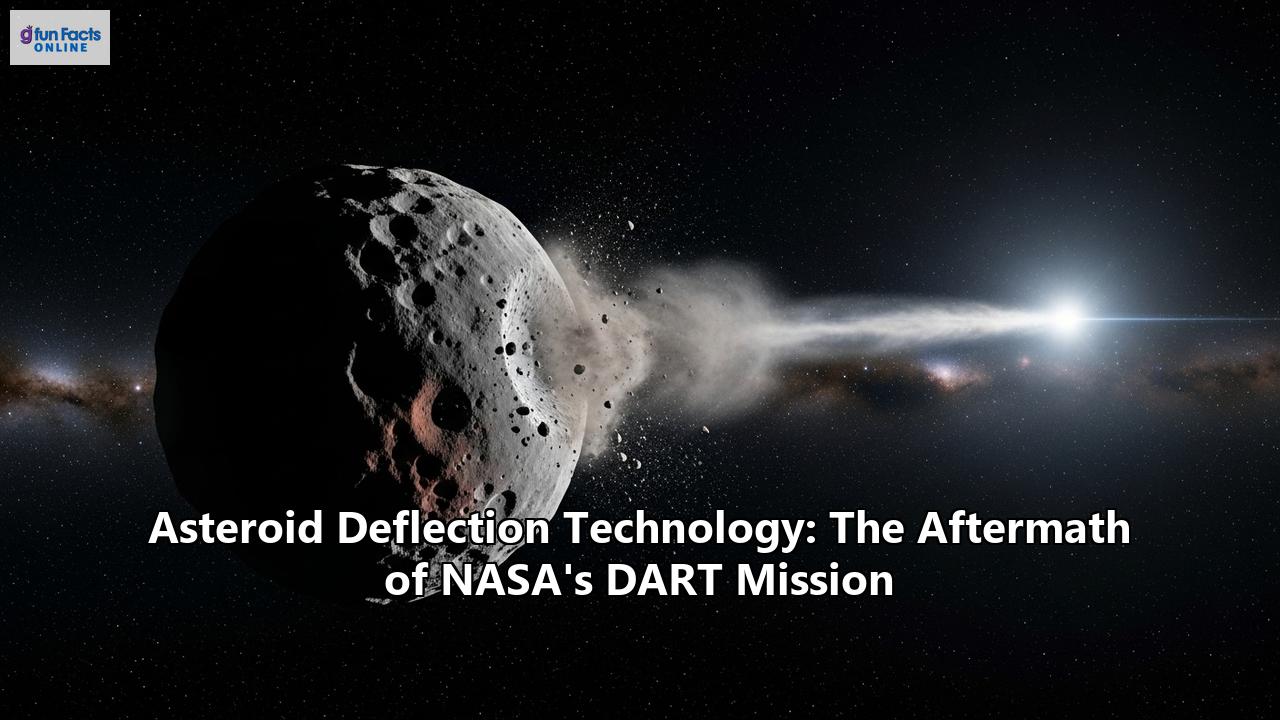
In an unprecedented display of human ingenuity and foresight, NASA's Double Asteroid Redirection Test (DART) has etched a new chapter in the history of planetary defense. On September 26, 2022, the world watched as a spacecraft, no bigger than a small car, deliberately collided with a distant asteroid, forever altering its path. This was not an act of aggression, but a meticulously planned experiment to test our ability to protect Earth from a potential cosmic threat. The aftermath of this cosmic collision has been a cascade of scientific revelations, challenging and refining our understanding of asteroids and how we might one day save ourselves from them.
The Target: A Distant, Harmless Duo
The subject of this audacious test was the binary asteroid system Didymos. The larger asteroid, Didymos, is about 780 meters in diameter, and it is orbited by a smaller moonlet named Dimorphos, measuring approximately 160 meters across. Neither of these celestial bodies posed any threat to Earth, which made them the perfect candidates for this groundbreaking experiment. The goal was to see if a kinetic impactor—essentially a high-speed projectile—could measurably change the orbit of Dimorphos around Didymos.
Launched on November 24, 2021, the DART spacecraft traveled for ten months to meet its target. The mission's success hinged on its ability to autonomously navigate and strike the relatively small Dimorphos at a staggering speed of roughly 14,000 miles per hour (about 22,530 kilometers per hour).
A Smashing Success: More Than Just a Nudge
The moment of impact was a resounding success, but the true measure of the mission's effectiveness came in the following weeks. Scientists had set a minimum success benchmark of altering Dimorphos's 11-hour and 55-minute orbital period by at least 73 seconds. The actual result shattered all expectations. Observations confirmed that the impact had shortened the orbit by a remarkable 33 minutes.
This astonishing outcome was the first piece of a much larger and more complex puzzle. It proved that the kinetic impactor technique was a viable method for asteroid deflection, but it also hinted that the physics of such a collision were far more intricate than previously modeled.
The Aftermath: A Cascade of Surprises
The initial success of the DART mission was just the beginning of a torrent of new discoveries that have reshaped our understanding of asteroids and planetary defense.
A "Rubble Pile" Revealed
The final images sent by DART just before its demise offered a close-up view of Dimorphos, revealing a surface covered in boulders and suggesting it was not a solid, monolithic rock. Post-impact analysis has confirmed this, characterizing Dimorphos as a "rubble-pile" asteroid—a loose conglomeration of rocks and debris held together by gravity. This composition is similar to other asteroids visited by spacecraft, such as Bennu and Ryugu.
This "rubble-pile" nature turned out to be a crucial factor in the mission's outcome. Instead of creating a simple crater, the impact caused a global deformation of the asteroid.
The Unexpected Power of Ejecta
One of the most significant findings from the DART mission was the unexpectedly large role played by the ejecta—the tons of rock and dust blasted into space by the impact. The recoil from this plume of debris provided a much greater push to the asteroid than the momentum of the spacecraft itself. This "momentum enhancement," with a measured factor of approximately 3.6, means the impact was about 3.6 times more effective at moving the asteroid than if Dimorphos had simply absorbed the spacecraft's momentum without any ejecta.
This discovery has profound implications for future planetary defense missions. It suggests that a smaller and lighter spacecraft could be used to deflect a threatening asteroid, making such missions more feasible and cost-effective.
A Swarm of Boulders and a Reshaped World
The surprises didn't stop there. The impact didn't just create a cloud of dust; it unleashed a swarm of boulders, some several meters in size. The Italian Space Agency's LICIACube, a small satellite that flew past the impact site, captured images of these boulders streaming away from Dimorphos.
Recent studies have shown that these boulders carried a significant amount of momentum, adding an extra "kick" to the asteroid's deflection. Intriguingly, the boulders were not ejected randomly but in distinct clusters, suggesting a complex interaction with Dimorphos's surface. Some researchers have even theorized that DART's solar panels may have struck larger surface boulders moments before the main impact, contributing to this unique pattern of debris.
The force of the impact and the subsequent ejection of material were so great that they completely reshaped Dimorphos. What was likely a relatively symmetrical, oblate spheroid before the impact became a more elongated, "watermelon-shaped" ellipsoid. Simulations indicate that while up to 1% of the asteroid's mass was ejected into space, a staggering 8% of its mass was redistributed across its surface, with material from the interior being exposed. The orbital path of Dimorphos also changed from circular to slightly eccentric.
The Future of Planetary Defense: Lessons from DART
The DART mission has provided a wealth of data that will be analyzed for years to come, refining our strategies for planetary defense.
The Hera Mission: A Second Look
To fully understand the long-term consequences of the DART impact, the European Space Agency (ESA) is preparing a follow-up mission called Hera. Scheduled to launch in October 2024 and arrive at the Didymos system in 2026, Hera will conduct a detailed "crime scene investigation."
Hera will measure the mass of Dimorphos, study the properties of the impact crater, and analyze the asteroid's composition and internal structure. It will also carry two small CubeSats, Milani and Juventas, to perform close-up inspections. The data gathered by Hera will be crucial for validating the kinetic impactor model and turning it into a well-understood and repeatable planetary defense technique. There is even a small but non-negligible chance that Hera might be able to observe some of the boulders ejected by the DART impact that remain in orbit around the binary system.
Beyond Kinetic Impactors: A Multi-faceted Approach
The kinetic impactor, as demonstrated by DART, is currently the most mature technology for asteroid deflection. However, it is not the only option being considered. The choice of deflection method would depend on the size and composition of the threatening asteroid and the amount of warning time available. Other potential techniques include:
- Gravity Tractor: This method involves a spacecraft flying alongside an asteroid for an extended period. The mutual gravitational attraction, though small, would be enough to slowly pull the asteroid off its collision course. This is a more gentle approach suitable for situations with ample warning time.
- Laser Ablation: This technique would use powerful lasers from one or more spacecraft to vaporize rock on the asteroid's surface. The resulting jets of gas would act as a small but continuous thruster, gradually pushing the asteroid.
- Nuclear Detonation: Considered a last resort, a nuclear device could be detonated near an asteroid. The goal would not be to shatter it, which could create multiple threats, but to use the blast's energy to push the asteroid onto a different trajectory.
The DART mission has provided invaluable real-world data that will inform the development of all these technologies. It has highlighted the importance of understanding an asteroid's physical properties and the complex dynamics of high-velocity impacts.
A New Era of Planetary Defense
The aftermath of the DART mission has ushered in a new era of planetary defense. We have moved from theoretical concepts to a proven capability. While the threat of a catastrophic asteroid impact remains a concern, the success of DART has shown that we are not powerless. Humanity has taken its first concrete step toward being able to protect itself from the whims of the cosmos, demonstrating that with ingenuity, collaboration, and the courage to take on monumental challenges, we can safeguard our home planet for generations to come. The legacy of DART is not just a crater on a distant asteroid, but a new sense of security and a testament to the power of science in the service of humanity.
Reference:
- https://orbitaltoday.com/2025/07/10/nasa-darts-asteroid-impact-unleashed-boulders-that-packed-the-real-punch/
- https://timesofindia.indiatimes.com/science/nasas-dart-mission-ejected-boulders-from-asteroid-dimorphos-offering-new-insight-into-asteroid-collision-outcomes/articleshow/122360523.cms
- https://thesciencesurvey.com/spotlight/2025/07/04/the-latest-updates-in-asteroid-deflection-technology/
- https://en.wikipedia.org/wiki/Dimorphos
- https://en.wikipedia.org/wiki/Double_Asteroid_Redirection_Test
- https://www.heramission.space/scenario
- https://secwww.jhuapl.edu/techdigest/content/techdigest/pdf/V35-N04/35-04-Adams.pdf
- https://www.nasa.gov/centers-and-facilities/marshall/nasas-dart-data-validates-kinetic-impact-as-planetary-defense-method/
- https://www.nasa.gov/missions/imagery-of-early-results-from-nasas-dart-mission/
- https://www.space.com/nasa-dart-mission-dimorphos-didymos-asteroid-impact-reshaping
- https://www.nasa.gov/missions/dart/nasa-study-asteroids-orbit-shape-changed-after-dart-impact/
- https://www.timesnownews.com/technology-science/nasas-dart-collision-reshapes-asteroid-dimorphos-rubble-pile-structure-discovered-article-108112474
- https://www.astronomy.com/science/nasas-dart-mission-may-have-changed-the-shape-of-asteroid-dimorphos-new-study-reveals/
- https://pmc.ncbi.nlm.nih.gov/articles/PMC11289397/
- https://www.planetary.org/articles/asteroid-deflection-techniques-to-save-the-earth
- https://scitechdaily.com/nasas-dart-mission-deflected-an-asteroid-but-unleashed-a-swarm-of-space-boulders/
- https://cmns.umd.edu/news-events/news/massive-boulders-ejected-during-dart-mission-complicate-future-asteroid-deflection
- https://universemagazine.com/en/the-collision-of-the-spacecraft-with-the-asteroid-caused-a-flurry-of-debris/
- https://skyandtelescope.org/astronomy-news/nasas-dart-impact-reshaped-the-asteroid-dimorphos/
- https://www.heramission.space/
- https://www.esa.int/Space_Safety/Hera/After_NASA_s_asteroid_impact_ESA_s_Hera_comes_next
- https://en.wikipedia.org/wiki/Hera_(space_mission))
- https://cordis.europa.eu/project/id/282703/reporting