
For decades, the collective human imagination of spaceflight was dominated by the image of a rocket aggressively fighting its way out of Earth’s gravity, riding a pillar of fire into the blackness of low Earth orbit (LEO). From the launch of Sputnik to the assembly of the International Space Station (ISS) 400 kilometers above our heads, we have mastered the "shallow end" of the cosmic ocean. But as humanity pivots back to the Moon and sets its sights on Mars, the brute-force physics of early spaceflight is no longer sufficient. We are entering the era of deep-space human exploration, a paradigm shift that requires us to leave behind the relatively simple two-body physics of LEO and embrace the chaotic, beautiful, and highly efficient invisible architecture of the solar system.
At the heart of this new era is the mastery of orbital mechanics beyond the lunar far side. By understanding and utilizing the complex gravitational interplay between the Earth, the Moon, and the Sun, engineers are mapping out a highway system carved entirely out of gravity. This is the story of how we will surf the gravitational contours of deep space to establish a permanent human presence in the cosmos.
The Lunar Far Side and the Edge of the Gravity Well
To go anywhere in deep space, we must first master "cislunar space"—the vast volumetric sphere extending from Earth to just beyond the Moon's orbit. During the Apollo era, missions relied on free-return trajectories or standard lunar orbit insertions. Apollo spacecraft would fire their engines to brake into Low Lunar Orbit (LLO), a path deep within the Moon's gravity well. Escaping that well to return home required another massive, fuel-heavy engine burn.
Today's Artemis program takes a vastly different approach. Artemis II, the first crewed mission to return to the lunar vicinity in over 50 years, utilizes a free-return trajectory as a safety net. Orion will swing around the far side of the Moon, passing roughly 7,500 kilometers beyond the lunar surface. On this path, gravity does the heavy lifting; the combined pull of the Earth and Moon naturally bends the spacecraft's track into a loop that falls back to Earth without requiring a major propulsive maneuver.
However, for a sustained presence, a quick loop is not enough. We need a staging ground. Enter the Lagrange points.
Whenever two massive bodies (like the Earth and the Moon) interact, their combined gravitational pulls and the centrifugal force of an orbiting object create five points of equilibrium, known as Lagrange points (L1 through L5). If you place a spacecraft at one of these points, it effectively hovers, requiring almost no fuel to stay in place.
The Earth-Moon L2 point sits roughly 60,000 kilometers beyond the far side of the Moon. It is a region of profound strategic and scientific value. A station positioned near L2 always faces the lunar far side, providing an unprecedented relay for communication with rovers and astronauts operating in the radio-quiet zone of the Moon. But hovering exactly at L2 is dynamically unstable. Instead, orbital mechanics gives us a more elegant solution: the Near-Rectilinear Halo Orbit (NRHO).
The Gateway and the NRHO: Balancing on the Edge
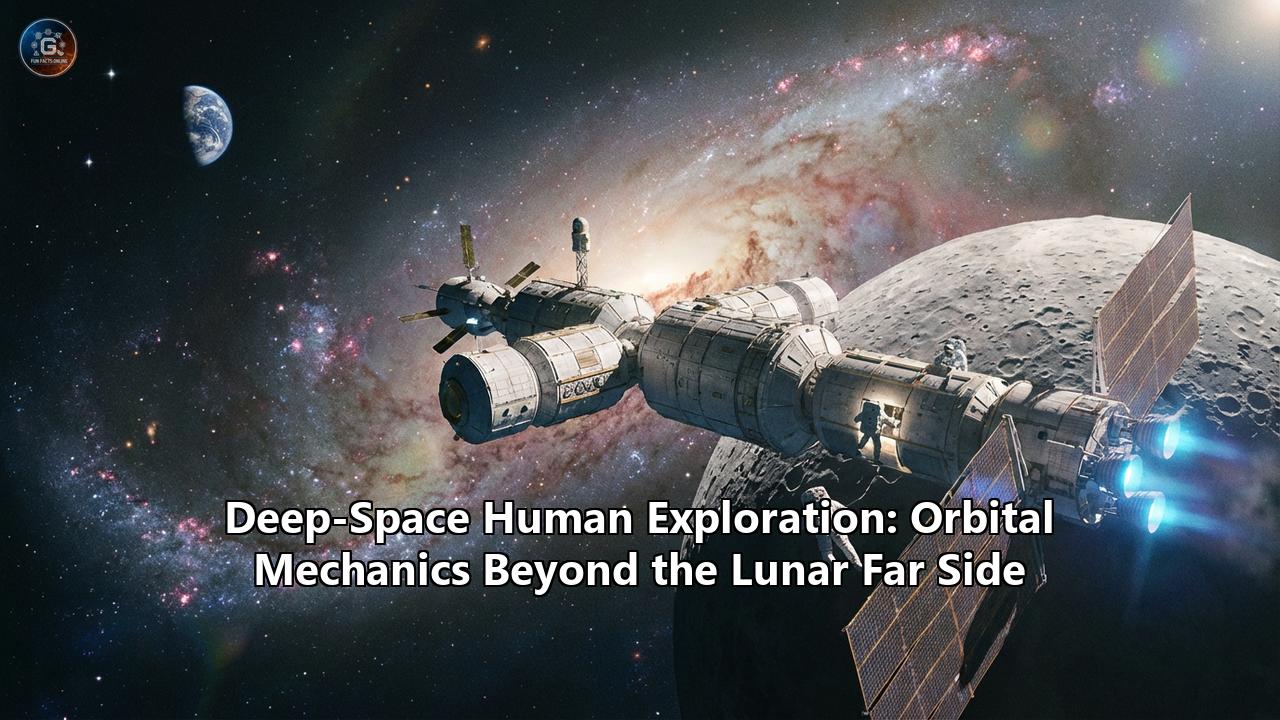
The cornerstone of the Artemis deep-space architecture is the Lunar Gateway, a space station that will not orbit the Earth, nor will it strictly orbit the Moon in the traditional circular sense. Instead, it will be placed in an NRHO.
An NRHO is a highly eccentric, specialized halo orbit that exists in the restricted three-body problem (Earth, Moon, and spacecraft). To visualize it, imagine a halo hovering over the Moon's poles. The Gateway will fly in a 9:2 resonant NRHO, meaning it completes nine orbits for every two lunar months. This path will bring the station as close as 3,000 kilometers from the lunar North Pole and swing it out as far as 70,000 kilometers over the lunar South Pole. It takes approximately seven days to complete one orbital cycle.
Why choose such a bizarre, elliptical path? The brilliance of the NRHO lies in its efficiency and accessibility.
- Constant Communication: Unlike Apollo capsules that lost contact with Earth when passing behind the Moon, the Gateway’s high orbit over the South Pole ensures an unbroken line of sight to Earth at all times.
- Low Station-Keeping Costs: NASA characterizes LLO as being deep in the gravity well, while an NRHO is "balanced on the edge". Because it leverages the gravitational balance of Earth and the Moon, it requires less than 10 meters per second of delta-v (change in velocity) per year to maintain—a staggeringly low amount of fuel.
- The Perfect Jumping-Off Point: Dropping down to the lunar South Pole from the Gateway's periapsis (closest point) requires very little energy, and breaking out of the NRHO into deep space towards Mars is equally efficient.
In 2022, NASA and Advanced Space launched the CAPSTONE mission—a microwave-sized CubeSat—specifically to fly this exact NRHO, effectively testing the mathematical waters before the crewed Gateway modules arrive. By mastering the NRHO, humanity is building an orbital spaceport that rests delicately on the fault lines of gravity.
The Interplanetary Transport Network (ITN)
Once we leave the Earth-Moon system, the mechanics of spaceflight change again. For decades, interplanetary travel relied on the Hohmann transfer orbit. Proposed by Walter Hohmann in 1925, this method involves an elliptical orbit tangent to both the starting planet and the destination planet, requiring two major engine burns: one to leave, one to arrive. It is the most fuel-efficient 2-body transfer, but it is rigid, requiring specific launch windows and massive amounts of chemical propellant.
But the solar system is not a 2-body system; it is an N-body system. The gravitational fields of the Sun, planets, and moons overlap and interact, creating a constantly shifting, invisible topography. By utilizing the mathematics of chaos theory and invariant manifolds, astrodynamicists have discovered the Interplanetary Transport Network (ITN).
The ITN is a vast, solar-system-wide network of "tubes" that connect the Lagrange points of various planets and moons. A spacecraft injected into one of these invariant manifolds is carried along by the natural gravitational currents of the solar system. It requires virtually zero fuel. You can theoretically travel from an Earth-Moon Lagrange point to a Sun-Mars Lagrange point using only tiny thruster puffs to navigate the intersections of these gravitational currents.
The catch? The ITN is excruciatingly slow. A transit to Mars on the ITN could take decades. While this makes the ITN impractical for carrying living, breathing humans who are subjected to harsh cosmic radiation and the degrading effects of microgravity, it is a revolutionary concept for deep-space logistics. Future robotic freighters could use the ITN to transport heavy, low-value commodities—like construction materials, water, or extracted asteroid regolith—to Martian or lunar outposts years in advance of human crews, creating a highly efficient, slow-moving supply chain that underpins a space-based economy.
The Mars Cycler: A Perpetual Motion Locomotive
If the ITN is the slow cargo ship of the solar system, how do we get humans to Mars without bankrupting our resources on massive rockets that must carry their own return fuel? The answer lies in an astrodynamic concept straight out of science fiction but grounded in rigorous mathematics: The Mars Cycler.
First heavily championed in 1985 by Apollo 11 astronaut Buzz Aldrin, the "Aldrin Cycler" is a spacecraft placed in a highly specific elliptical heliocentric (sun-orbiting) trajectory. Instead of launching a new habitat from Earth to Mars every two years, the Cycler is a massive, permanently orbiting space station that continuously crosses the orbital paths of both Earth and Mars.
Because a Martian year is 1.88 Earth years, the synodic period—the time it takes for Earth and Mars to align—is about 2.135 Earth years. The Aldrin Cycler makes an eccentric loop around the Sun, swinging past Earth, catching a gravity assist, and slingshotting to Mars in about 146 days (4.8 months). It then spends 16 months coasting beyond Mars's orbit before intercepting Earth again.
The genius of the cycler is that it never stops. Once established in its orbit, the cycler requires almost zero propulsion, relying entirely on the gravity-assist flybys of the planets to maintain its momentum.
This solves the biggest problem of deep-space human flight: mass. Protecting humans from solar flares and galactic cosmic radiation requires heavy shielding (likely thick layers of water or regolith). Providing artificial gravity to prevent muscle atrophy requires massive, spinning centrifuges. Accelerating that kind of mass to Mars and braking it upon arrival would require an impossible amount of chemical fuel.
With a Cycler, the heavy habitat is already moving. Astronauts launch from Earth in a small, lightweight "taxi" spacecraft. The taxi fires its engines to match the velocity of the passing Cycler, docks with it, and the crew moves into the spacious, shielded habitat for the five-month cruise. As the Cycler zips past Mars, the crew gets back into their taxi, detaches, and uses aerodynamic drag (aerocapture) in the Martian atmosphere to slow down and land, while the massive Cycler habitat sails on, empty, looping back toward Earth to pick up the next crew.
To maintain a continuous pipeline—essentially a planetary train service—mission planners propose multiple cyclers. One "up escalator" cycler would handle Earth-to-Mars transit, while a "down escalator" cycler on a complementary trajectory would handle the Mars-to-Earth return. This infrastructure turns deep-space travel from a series of isolated, risky "flags and footprints" expeditions into a sustainable, routine transit system.
Advanced Propulsion and Hyperbolic Leveraging
While cyclers and halo orbits reduce the need for heavy chemical propellants, maneuvering the initial mass into these trajectories, and launching the taxis to catch them, requires advanced propulsion technologies.
Chemical rockets (like the liquid oxygen and hydrogen engines on the SLS or SpaceX Starship) provide incredibly high thrust, allowing them to escape deep gravity wells quickly. However, their specific impulse (efficiency) is low. Deep space requires engines that can burn for months or years.
Solar Electric Propulsion (SEP) and Hall-Effect Thrusters:The Lunar Gateway will rely heavily on the Power and Propulsion Element (PPE). Using massive solar arrays, the PPE generates electricity to ionize xenon gas, accelerating it through a magnetic field. While the thrust is comparable to the weight of a sheet of paper on your hand, in the frictionless vacuum of space, this constant, gentle push can build up immense speeds over time. SEP is what makes maneuvering within the delicate dynamics of an NRHO possible.
Nuclear Thermal Propulsion (NTP):For the fast-transit taxis required to catch Mars cyclers, engineers are revisiting Nuclear Thermal Propulsion. By using a nuclear fission reactor to heat liquid hydrogen to extreme temperatures and expelling it through a nozzle, NTP offers double the efficiency of chemical rockets while maintaining high thrust. This technology could shrink Earth-Mars transit times outside of the cycler architecture from seven months to under 100 days, drastically reducing radiation exposure.
Furthermore, orbital mechanics allows us to use trickery to catch the cyclers. A maneuver called $V_\infty$ (V-infinity) leveraging is being studied by astrodynamicists. Instead of launching directly into the cycler's high-speed path, a spacecraft can launch into a resonant Earth orbit, coast for a year, and perform a relatively small deep-space maneuver. When it encounters Earth a second time, it leverages Earth’s gravity during the flyby to massively amplify its velocity, saving up to 23 metric tons of propellant for a 70-metric-ton cycler vehicle. It is the cosmic equivalent of pulling back on a swing at just the right moment to maximize your height.
The Human Element in the Cosmic Machine
Understanding the math of deep-space orbital mechanics is only half the battle; integrating the fragile human body into this framework is the ultimate challenge. The mechanics of the Artemis and Mars Cycler architectures are specifically designed around biological limitations.
Deep space is a hostile, radioactive ocean. The Earth's magnetosphere protects LEO astronauts from the worst of solar radiation, but once Orion or a Mars taxi crosses the lunar orbit, it is exposed to the full brunt of galactic cosmic rays (GCRs) and unpredictable solar particle events.
Trajectories must therefore balance efficiency with exposure. The Artemis II loop is a carefully choreographed sprint. By swinging around the Moon and returning to Earth in roughly 10 days, the crew minimizes their time in the deep radiation environment. Similarly, the ITN's zero-fuel paths are discarded for crewed missions simply because a human would absorb a lethal dose of radiation over a multi-year transit.
The psychological isolation of deep space also dictates orbital design. The Lunar Gateway's NRHO was selected in part because it provides an unbroken line-of-sight to Earth. This means uninterrupted communication, a psychological tether for astronauts looking at a home planet that appears no larger than a marble in the void. Furthermore, the 7-day cadence of the NRHO provides regular, predictable windows for lunar descents and emergency aborts back to Earth. If a medical emergency occurs, the mechanics of the NRHO ensure that the crew is never more than a few days away from a favorable return trajectory.
Redefining Our Relationship with Gravity
From the Apollo-era brute-force engine burns to the Artemis-era near-rectilinear halo orbits, and looking forward to the cyclers and interplanetary transport networks of tomorrow, our relationship with gravity is evolving.
We no longer view gravity merely as a chain holding us down. Instead, modern astrodynamics views the solar system as an intricate, undulating topography of peaks, valleys, and invisible currents. The Lagrange points are the safe harbors; the invariant manifolds are the ocean currents; the cycler orbits are the trade winds.
The deep-space human exploration of the 21st century—beginning with the Artemis missions beyond the lunar far side—will not be about conquering space. It will be about learning to sail it. By mastering the orbital mechanics of the multi-body universe, humanity is laying down the permanent, invisible infrastructure required to transform us from a single-planet species into a solar-system-spanning civilization.
Reference:
- https://www.wemuth.de/17-166575-humanitys-big-return-to-the-moon-heres-how-the-artemis-2-mission-will-unfold/
- https://en.wikipedia.org/wiki/Interplanetary_Transport_Network
- https://en.wikipedia.org/wiki/Lunar_Gateway
- https://en.wikipedia.org/wiki/Near-rectilinear_halo_orbit
- https://scholar.colorado.edu/downloads/kp78gh57f
- https://www.universetoday.com/articles/the-lunar-gateway-will-be-in-a-near-rectilinear-halo-orbit
- https://en.wikipedia.org/wiki/Interplanetary_spaceflight
- https://space.stackexchange.com/questions/72/how-much-of-the-interplanetary-transport-network-is-currently-known
- https://www.reddit.com/r/spaceflight/comments/1lga5qh/what_is_a_mars_cycler/
- https://en.wikipedia.org/wiki/Mars_cycler
- https://marspedia.org/Mars_cycler
- https://news.fit.edu/academics-research/florida-tech-researchers-explore-buzz-aldrins-mars-cycler-concept/
- https://engineering.purdue.edu/AAC/wp-content/uploads/2012/09/EstablishingCyclerTrajectoriesBetweenEarthAndMarsViaV-InfinityLeveraging-AIAA-2012-47461.pdf
- https://www.seti.org/news/back-to-the-moon/
- https://blogs.esa.int/orion/2022/11/15/artemis-i-short-mission-overview/