
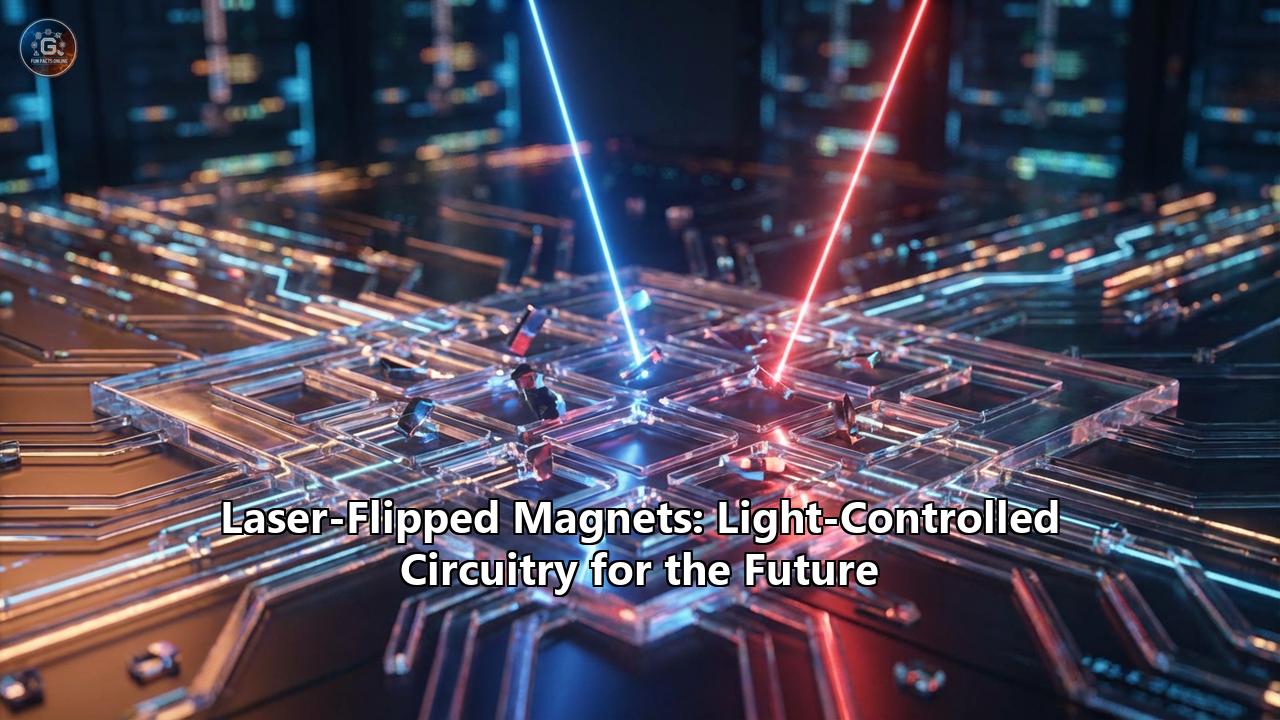
For decades, the relentless march of technological progress has been propelled by a single, foundational mechanism: the manipulation of electrons. Moving these tiny, charged particles through silicon pathways has given us the modern world, from the first mainframe computers to the smartphone in your pocket and the sprawling data centers powering artificial intelligence. But this electron-driven paradigm is approaching an insurmountable physical limit. As we pack billions of transistors into microscopic spaces, the sheer friction of moving electrons generates massive amounts of heat, leading to energy waste, thermal throttling, and a looming global energy crisis. The future of computing demands a radical departure from the status quo—a leap from the physical movement of electrical charge to the ethereal dance of light and magnetism.
Welcome to the frontier of optomagnetics and spintronics, where scientists are learning to flip magnets using nothing but ultra-short flashes of laser light. This breakthrough concept, known as all-optical magnetic switching (AOS), is paving the way for light-controlled circuitry. By harnessing the precise, instantaneous power of photons to manipulate the quantum "spin" of materials, researchers are laying the groundwork for computers that are thousands of times faster, remarkably energy-efficient, and capable of operating without the thermal bottlenecks that plague today's electronics.
The 180-Year-Old Assumption Overturned
To understand the magnitude of laser-flipped magnetism, we must first look back at how we traditionally understood the relationship between light and matter. In 1845, Michael Faraday discovered that a magnetic field could influence the way light travels through a material—a phenomenon known as the Faraday effect. For nearly 180 years following this discovery, the scientific consensus held that when light interacts with matter, it does so almost exclusively through its electric field. The magnetic component of light was considered too weak to cause any significant, direct interaction with the magnetic properties (or spins) of a material.
This fundamental assumption was spectacularly overturned in late 2025 by researchers at the Hebrew University of Jerusalem. In a landmark study, scientists proved that the oscillating magnetic field of light can, in fact, directly and powerfully influence the spin states of electrons in solid materials. By delivering carefully controlled, ultra-fast laser pulses, the team demonstrated that light transfers angular momentum to electrons, causing their magnetic alignment to twist and flip without the need for traditional electrical currents or bulky external electromagnets.
This discovery fundamentally broadens our understanding of light-matter interaction. Light is no longer just a tool for seeing, measuring, generating heat, or exciting electrons; it is a profound sculptor of magnetic architecture at the nanoscale. Because light can be delivered remotely, precisely, and without physical contact, it circumvents the wear, tear, and energy loss inherent in traditional wired circuits.
The Physics of the Femtosecond
The magic of laser-flipped magnets occurs in a timeframe so vanishingly small that it defies human comprehension: the femtosecond. A femtosecond is one quadrillionth of a second (10⁻¹⁵ seconds). To put this into perspective, a femtosecond is to a second what a second is to about 31.7 million years.
When researchers fire infrared lasers at magnetic materials, they do not deliver a continuous beam. Instead, they unleash femtosecond bursts of energy. For example, in a 2024 breakthrough by the Nordic Institute for Theoretical Physics (NORDITA), scientists fired 1,300-nanometer wavelength infrared lasers in femtosecond bursts of just 800 microjoules. For comparison, the lasers used in cosmetic hair removal operate at up to 40 joules (40 million microjoules).
Despite the low overall energy, the sheer concentration of this energy in such a minuscule sliver of time creates an incredibly intense localized effect. The laser pulses induce a circular motion in the atoms within the material. The circularly polarized photons transfer their angular momentum to the electron spins in the material, flipping their magnetic orientation almost instantly.
Historically, flipping a magnetic bit in a hard drive required generating a localized magnetic field using an electrical current—a relatively slow process that takes nanoseconds and bleeds energy as heat. By skipping the electrical middleman and using femtosecond laser pulses, all-optical switching can reverse magnetization on a picosecond or even sub-picosecond timescale, making data writing potentially thousands of times faster than current electronic methods.
The Evolution of All-Optical Switching: From Discovery to Circuitry
The journey toward practical light-controlled circuitry has been characterized by intense material science and quantum engineering. The field of ultrafast magnetism was born in 1996 when researchers discovered that a femtosecond laser pulse could demagnetize a thin nickel film in under a picosecond. However, the "holy grail" of deterministic all-optical switching (AOS)—the ability to reliably flip a magnet back and forth to write binary data (0s and 1s)—was not realized until a decade later.
Theo Rasing's group at Radboud University in Nijmegen demonstrated the first complete deterministic all-optical switching using circularly polarized laser pulses on an alloy made of Gadolinium, Iron, and Cobalt (GdFeCo). This phenomenon, dubbed all-optical helicity-dependent switching (AO-HDS), proved that light could write data, but it came with a catch: it often required a large number of laser pulses, which slowed down the process.
The focus then shifted to single-pulse switching. Single-pulse all-optical helicity-independent switching (AO-HIS) emerged as the champion for practical applications, as it requires just one microscopic flash of light to flip the magnetic bit, drastically reducing both time and energy consumption. But integrating this into the multi-layered ferromagnetic structures used in commercial spintronics proved highly complex.
A major leap forward occurred when researchers at the Eindhoven University of Technology successfully integrated single-pulse all-optical switching with the Spin Hall Effect (SHE). They engineered "synthetic-ferrimagnetic racetracks" composed of layers of Platinum, Cobalt, and Gadolinium (Pt/Co/Gd). In this elegant architecture, a single laser pulse flips the magnetic domain (writing the data), and the Spin Hall Effect drives the magnetic domain wall along the racetrack (moving the data). This combination of optical writing and spintronic moving is a foundational blueprint for integrated photonic memory devices—microchips where light and magnetism work in perfect tandem.
Magnons: The "Mexican Wave" of Computing
To truly appreciate the potential of laser-controlled magnetism, we must look at how the data travels once the magnet is flipped. In traditional electronics, information is carried by moving electrons. Think of this as a crowd of people physically running down a crowded hallway; they bump into each other, generate friction (heat), and expend a massive amount of energy.
In the realm of spintronics, information is carried by "magnons". A magnon is a quasiparticle, a quantum of a spin wave. Instead of electrons moving physically from point A to point B, they stay firmly in place and simply pass their magnetic "spin" orientation to their neighbor. This is much like a "Mexican wave" in a sports stadium: the crowd doesn't run around the stadium; they simply stand up and sit down in sequence, and the wave travels around the arena.
Because electrons aren't physically flowing through a circuit, there is virtually no electrical resistance, and therefore, zero heat waste.
In November 2025, engineers at the University of Delaware's Center for Hybrid, Active and Responsive Materials (CHARM) made a stunning discovery: magnons traveling through solid antiferromagnetic materials can generate measurable electric signals. Furthermore, these antiferromagnetic magnons can move at terahertz frequencies—roughly a thousand times faster than the magnetic waves in conventional materials.
This is a monumental finding. It means that future computer chips could merge optical inputs, magnetic waves, and electric systems directly. A laser pulse flips the magnet (writing data), the magnon wave instantly carries the data across the chip at terahertz speeds without generating heat, and it directly interfaces with electrical outputs. This removes the need for the constant, energy-draining conversions between electrical and magnetic states that throttle today's hardware.
Flatland Computing and 2D Magnetic Materials
While GdFeCo alloys and platinum racetracks laid the groundwork, the ultimate frontier of miniaturization lies in two-dimensional materials—substances thinned down to a single atomic layer. When materials are stripped down to a 2D plane, bizarre and highly useful quantum mechanics take over.
In 2017, the discovery of 2D van der Waals (vdW) magnets set the spintronics community ablaze. These materials, such as Chromium Triiodide, allowed for the ultimate scaling down of magnetic bits. However, they suffered from a fatal flaw for commercial tech: their Curie temperature (the point at which they lose their magnetic properties) was incredibly low. They only functioned in ultra-cold, cryogenic environments, rendering them useless for smartphones or standard data centers.
Overcoming this hurdle became the focus of intense global research. In 2024, the Nanocybernetic Biotrek group at MIT achieved a historic milestone. Utilizing a newly discovered van der Waals magnet with superior properties, they leveraged an intricate interplay of physical symmetries and the Spin Hall Effect to electrically switch the 2D magnet above room temperature. Crucially, they achieved this without needing any external magnetic fields. By proving that these ultra-thin magnets can operate reliably at room temperature, MIT opened the floodgates for deploying 2D magnetic materials into commercial, highly energy-efficient computing devices.
The physics of these 2D layers continues to yield astonishing results. In March 2026, physicists at The University of Texas at Austin observed a 50-year-old theoretical model come to life in a 2D crystal (an ultrathin antiferromagnet called nickel phosphorus trisulfide). They observed the elusive Berezinskii-Kosterlitz-Thouless (BKT) phase, identifying magnetic "vortices" that are exceptionally robust, confined to just a few nanometers, and exist in a single atomic layer. Because of their extreme stability and tiny footprint, these vortices offer a profound new route to controlling magnetism at the absolute limits of miniaturization, paving the way for ultra-compact technologies.
Rewiring Circuits on the Fly: The Power of Moiré Materials
If ultra-fast memory and zero-heat processing weren't enough, laser-flipped magnets are introducing an entirely new paradigm to computer science: physically adaptable hardware.
Historically, computer chips are hardwired. Billions of transistors are etched into silicon using photolithography; once printed, the physical layout of the circuit cannot be changed. Software can be rewritten, but hardware is permanent.
This rigid reality was challenged in a groundbreaking March 2026 study by researchers at the University of Basel and ETH Zurich. Working with specialized "moiré materials"—created by stacking two atomically thin lattices and twisting them slightly to create complex superlattices—the team succeeded in changing the polarity of a ferromagnet using a focused laser beam.
By shining light on the material, they could actively control its "topological Chern number," effectively altering the fundamental electrical routing properties of the material. As lead researcher Smoleński noted, this method will allow engineers to "optically write arbitrary and adaptable topological circuits on a chip" in the future.
Imagine a computer processor that physically rewires itself based on the task it is performing. If you are rendering a high-definition video, the laser pulses reconfigure the magnetic pathways on the chip to optimize for graphics processing. A fraction of a second later, if you switch to training a complex AI neural network, the lasers flash again, completely redrawing the circuitry to optimize for matrix multiplication. This fluid, light-controlled hardware bridges the gap between the physical and the digital, creating a processor that is as infinitely malleable as the software it runs. Furthermore, these optically drawn circuits can create miniature interferometers capable of detecting phenomenally small electromagnetic fields, ushering in a new era of precision sensing technologies for medicine, defense, and quantum mechanics.
Magnetizing the Non-Magnetic
The versatility of light-controlled magnetism extends beyond tweaking materials that are naturally magnetic. In a paradigm-shifting demonstration in May 2024, researchers from NORDITA and other institutions achieved what was once thought impossible: they magnetized a completely non-magnetic material at room temperature using light.
By firing their infrared femtosecond lasers at a non-magnetic material, the team induced a quantum property by controlling the lattice vibrations (phonons) of the atomic structure. The circular motion induced by the laser essentially "tricked" the atoms into generating a magnetic field. This "switchable" magnetic field, generated out of thin air in a non-magnetic base, can be used to store and transmit information.
The implications here are staggering. It means that the future of computing might not be constrained by the global supply of rare-earth magnetic metals. If we can use lasers to temporarily magnetize common, non-magnetic materials, we drastically expand the palette of resources available for manufacturing semiconductors and memory devices.
Solving the AI Energy Crisis
While the physics of laser-flipped magnets is undeniably beautiful, the commercial and societal imperative driving this research is urgent. We are in the midst of an explosion in global computing infrastructure. The meteoric rise of generative Artificial Intelligence, massive language models, and the Internet of Things has turned computers and data centers into the fastest-growing consumers of electricity on the planet.
Current projections warn that by 2040, the human race may struggle to generate enough electricity to sustain our accelerating computing demands. AI models require millions of interconnected GPUs running constantly, generating intense heat that requires equally massive, power-hungry liquid cooling systems to prevent them from melting.
Spintronics and all-optical switching offer a direct lifeline to this impending crisis. Because AOS relies on manipulating spins via light rather than shoving electrons through resistive wire, devices built on this technology are intrinsically low-power.
- Non-Volatility: Magnetic memory retains its state even when the power is turned off. Unlike traditional RAM, which must be constantly fed electricity to remember data, laser-flipped magnetic memory uses zero power at rest.
- Zero Thermal Friction: The use of magnons to transmit data eliminates the heat generated by electrical resistance. Data centers of the future could run incredibly fast while remaining cool to the touch, entirely eliminating the need for vast cooling infrastructures.
- Infinite Endurance: Because light interacts with the material without physical contact or wear-and-tear, these optically switched components have virtually unlimited endurance.
These attributes make light-controlled magnetic circuitry the ideal candidate for next-generation "in-memory computing" and neuromorphic (brain-like) processors, which aim to replicate the parallel processing power of the human brain at a fraction of the current energy cost.
Overcoming the Engineering Bottlenecks
Despite the profound theoretical and experimental successes, transitioning laser-flipped magnets from the laboratory to the inside of consumer laptops involves formidable engineering hurdles.
The most significant challenge is miniaturization. The ultra-fast femtosecond lasers used in these experiments are typically large, complex, and expensive benchtop instruments. For all-optical switching to revolutionize everyday technology, these lasers must be miniaturized and integrated directly onto silicon microchips—a field known as integrated photonics. Engineers are currently working on developing micro-ring resonators and microscopic laser diodes capable of generating the necessary femtosecond pulses in a form factor small enough to fit billions of them onto a standard processor.
Furthermore, there is the challenge of beam focusing. In the NORDITA 2024 experiment, researchers focused their laser pulses using three parabolic mirrors to create a beam approximately 0.5 millimeters in diameter. While 0.5 millimeters is small in the macroscopic world, it is unimaginably massive in the world of computing, where modern transistors are measured in nanometers (millionths of a millimeter). Achieving the nanoscale optical precision required to flip individual atomic bits without disturbing their neighbors relies on cutting-edge developments in near-field optics and plasmonic antennas, which can funnel light into spaces smaller than the light's own wavelength.
Finally, there is the energy equation of the laser itself. While the act of flipping the magnetic bit uses very little energy, generating the laser pulse currently requires a power overhead. For the system to be globally viable, the energy consumed by the integrated photonics must remain significantly lower than the energy saved by abandoning traditional electron-based switching.
A Light-Driven Horizon
We are standing on the precipice of a new era in human engineering. The transition from vacuum tubes to silicon transistors in the mid-20th century reshaped the course of history, giving birth to the information age. Today, we are witnessing the genesis of a transition equally profound: the shift from the electron to the photon and the magnon.
By proving that light's magnetic field can directly reach into the quantum heart of matter to twist and align electron spins, scientists have shattered centuries-old assumptions. We have learned to magnetize the non-magnetic, to move data at terahertz speeds without heat, to electrically switch atomic-thin sheets at room temperature, and to dynamically redraw the physical architecture of computer chips using nothing but focused beams of light.
Laser-flipped magnets and light-controlled circuitry represent the ultimate convergence of photonics, quantum mechanics, and materials science. They promise a future where technology is not bound by thermal throttling or electrical resistance. Instead, the computers of tomorrow will operate in a realm of pure, frictionless interaction, running vast artificial intelligences and complex simulations on whispers of light and the silent, wave-like dance of magnetic spins. The future of computing is not electrical; it is optical, magnetic, and brilliantly fast.
Reference:
- https://www.youtube.com/watch?v=H9p7DJoKaPg
- https://www.livescience.com/technology/computing/scientists-prove-quantum-theory-that-could-lead-to-ultrafast-magnetic-computing
- https://www.sciencedaily.com/releases/2026/03/260303050630.htm
- https://arxiv.org/abs/1809.02347
- https://www.sciencedaily.com/releases/2025/11/251104094141.htm
- https://www.youtube.com/watch?v=cfsRKghCbQE
- https://phantomsfoundation.com/COMRAD/2024/Abstracts/COMRAD2024_Mangin.pdf
- https://www.researchgate.net/publication/330290872_Integrating_all-optical_switching_with_spintronics
- https://scitechdaily.com/physicists-finally-observe-a-50-year-old-theory-come-to-life-in-a-2d-crystal/