
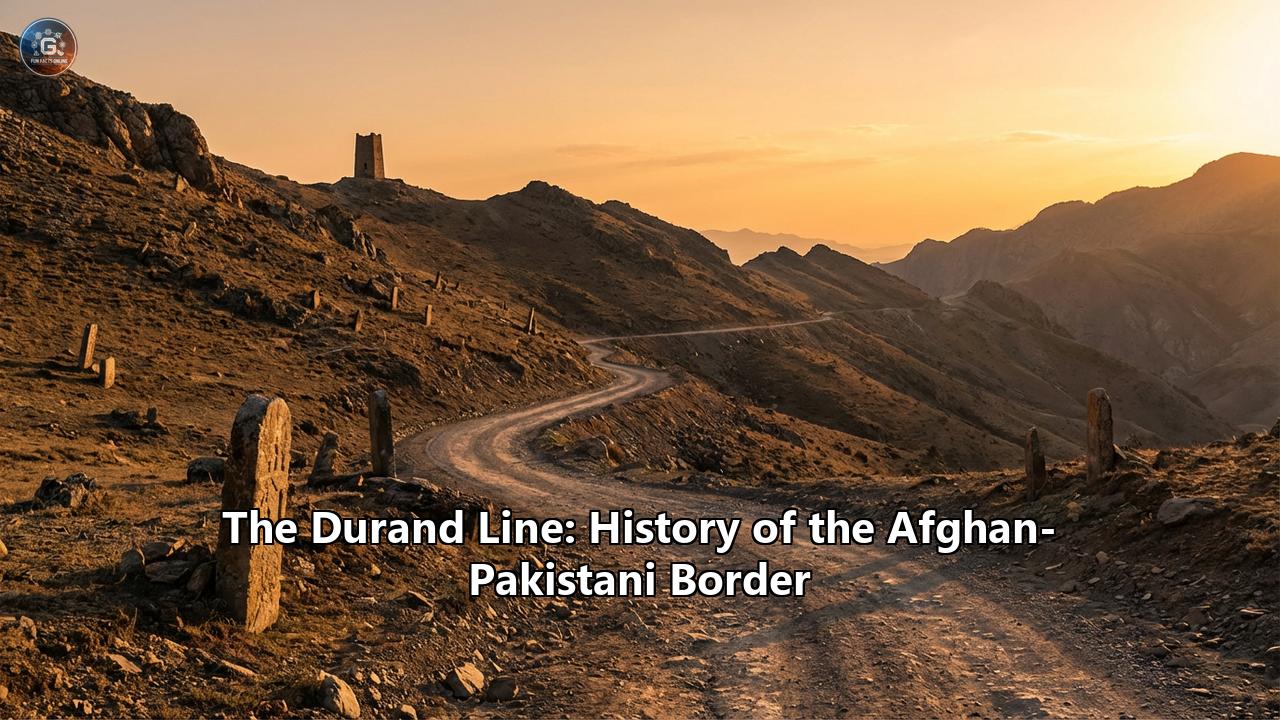
In the early hours of a late February morning in 2026, the skies over Kabul, Nangarhar, and Kandahar were violently illuminated by the flash of Pakistani airstrikes. Hours later, Afghan forces retaliated with large-scale offensives, claiming to have captured multiple military posts along the mountainous frontier. Artillery echoed through the jagged peaks, trade routes at Torkham and Chaman slammed shut, and a delicate, Qatari-mediated ceasefire hung by a thread. To the uninitiated observer, this might have seemed like a sudden eruption of modern geopolitical hostility. But to the Pashtun and Baloch tribes who inhabit these rugged borderlands, it was merely the latest spasm of violence born from a wound inflicted more than a century ago.
This conflict is not about modern resources or fleeting political disputes; it is about a line drawn on a map in 1893 by a British colonial officer. It is the Durand Line—a 2,640-kilometer (1,640-mile) frontier that slices through some of the most unforgiving terrain on Earth. For Pakistan, it is a non-negotiable, fixed, and settled international boundary. For Afghanistan, it is an illegal, hypothetical "colonial relic" that violently bisected a nation and severed the ancient familial, cultural, and economic ties of millions.
The story of the Durand Line is the story of modern South Asia. It is a tale of imperial hubris, desperate kings, Cold War proxy battles, and a multi-generational crisis of identity that continues to hold regional stability hostage. To understand why modern fighter jets and drones are bombing tribal villages in 2026, one must first travel back to the paranoid, high-stakes chessboard of the 19th-century "Great Game."
The Great Game and the Search for a Buffer
Throughout the 1800s, the vast, uncharted expanse of Central Asia became the arena for a quiet but existential rivalry between the two great superpowers of the era: the British Empire, expanding northward from the Indian subcontinent, and the Russian Empire, pushing southward through the steppes of Eurasia. London’s greatest fear was that Russian Cossacks would eventually march through the mountain passes of the Hindu Kush and pour into the jewel of the British crown—India.
To prevent this, the British adopted the "Forward Policy," seeking to establish a "scientific frontier" that could be easily defended. The strategy dictated that Afghanistan must serve as a compliant buffer state. However, subduing the fierce, fiercely independent Afghan tribes proved to be a catastrophic endeavor. The First Anglo-Afghan War (1839–1842) ended in one of the greatest military humiliations in British history, with an entire army of 16,000 retreating soldiers and camp followers annihilated in the snows of the Hindu Kush.
Following the Second Anglo-Afghan War (1878–1880), the British adopted a more pragmatic approach. They placed Amir Abdur Rahman Khan—who would come to be known as the "Iron Amir"—on the throne in Kabul. In exchange for recognizing his internal rule and providing him with financial subsidies and weapons to crush his domestic rivals, the British assumed control of Afghanistan’s foreign policy.
Abdur Rahman was a ruthless but highly intelligent state-builder. He recognized that his fractured kingdom was, in his own words, like a house without walls, surrounded by predatory empires. His priority was survival: he needed British arms and money to centralize his authority, but he deeply distrusted British intentions. The British, meanwhile, were tired of the constant tribal raids on their frontier garrisons and wanted a defined line to demarcate their exact sphere of influence. This mutual, yet highly suspicious, convergence of interests set the stage for one of the most consequential diplomatic meetings in Asian history.
The Stroke of a Pen: November 1893
In October 1893, Sir Henry Mortimer Durand, the Foreign Secretary of the British Indian government, arrived in Kabul. His mission was to negotiate a definitive southern and eastern border for Afghanistan. Durand was an astute diplomat fluent in Persian, which allowed him to negotiate directly with the Amir without intermediaries.
The negotiations were fraught. The British wanted to annex deeply strategic Pashtun territories, including the Khyber Pass, Kurram, Waziristan, and parts of Balochistan. Abdur Rahman fiercely resisted the idea of abandoning his formal sovereignty over the Pashtun hill tribes. He understood the complex dynamics of Pashtunwali (the traditional Pashtun code of honor) and the concept of nam (repute/honor), realizing that surrendering Pashtun lands would devastate his legitimacy and ignite a revolt.
The Amir issued a prophetic warning to the British regarding the fiercely independent tribal belt: "If you should cut them out of my dominions, they will never be of any use to you nor to me. You will always be engaged in fighting or other trouble with them, and they will always go on plundering".
Despite his misgivings, the Amir was operating under intense geopolitical coercion. To sweeten the bitter pill, Durand increased the Amir’s annual subsidy. On November 12, 1893, Abdur Rahman Khan and Mortimer Durand signed a single-page agreement comprising just seven short articles.
The Durand Line Agreement was, in many ways, a masterpiece of colonial ambiguity. The English text referred to fixing the limit of the two parties' "respective spheres of influence," pledging that neither would "exercise interference in the territories lying beyond this line". Crucially, historical evidence suggests the Amir viewed the line not as a permanent international boundary ceding sovereignty, but as a temporary, administrative demarcation of control. The agreement was drafted in English—a language the Amir could not read—with Dari translations, and rumors persist to this day that the Amir never actually signed the accompanying maps.
Regardless of the Amir's internal reservations, the geopolitical reality was sealed. With the stroke of a pen, the Durand Line forcibly cleaved the Pashtun heartland in two. Over 30 million Pashtuns would eventually find themselves split between two different national destinies, their ancestral lands, grazing routes, and kinship networks bisected by a theoretical line drawn by a man from London.
Surveying the Scar
Defining the line on paper was one thing; marking it on the Earth was entirely another. Between 1894 and 1896, joint British-Afghan survey teams set out to map the boundary. The terrain was nightmarish—ranging from the freezing, jagged peaks of the Spīn Ghar (White Mountains) and the Pamir Knot to the blistering expanses of the Registan Desert in the south.
The surveyors faced relentless hostility from the local tribes, who suddenly found out that a foreign empire had decreed their homes divided. In some regions, entire tribes like the Mohmands and the Waziris were virtually bisected, with brothers suddenly living in different "countries". The demarcation process was so perilous that a significant portion of the border, particularly the treacherous stretches near the Khyber Pass and the high mountains, was never physically marked at all.
The British Indian Empire absorbed the newly acquired territories into a heavily militarized buffer zone, eventually forming the North-West Frontier Province (NWFP, known today as Khyber Pakhtunkhwa) and the Federally Administered Tribal Areas (FATA). The British did not attempt to govern the tribes directly; instead, they ruled through a draconian legal framework called the Frontier Crimes Regulation (FCR), imposing collective punishment and maintaining control through bribery, political agents, and periodic military expeditions. The border remained fiercely restive, proving the Amir’s prophecy entirely correct.
The Phantom State of Pashtunistan and the Birth of Pakistan
The true crisis of the Durand Line erupted in 1947, as the sun finally set on the British Empire in India. Exhausted by the Second World War, the British hastily partitioned the subcontinent into two independent nations: Hindu-majority India and Muslim-majority Pakistan.
For the Pashtuns living on the British side of the Durand Line, partition presented an existential crisis. Prominent Pashtun leaders, most notably Khan Abdul Ghaffar Khan (the "Frontier Gandhi") and his Khudai Khidmatgar movement, vehemently opposed joining Pakistan. They boycotted the 1947 referendum that offered only the choice between India and Pakistan, demanding a third option: the creation of an independent state called "Pashtunistan". The British flatly refused.
When Pakistan inherited the Durand Line as its western border, the government in Kabul reacted with fury. Afghanistan officially repudiated the 1893 agreement, arguing that the treaty had been signed under duress with the British Empire—a political entity that no longer existed in the region. Because the British had left, Kabul argued, the treaties had lapsed, and the Pashtun territories should rightfully revert to Afghanistan or be granted self-determination.
In 1947, Afghanistan became the only country in the world to vote against Pakistan’s admission to the United Nations. This diplomatic slap in the face set the tone for decades of bitter enmity. Throughout the 1950s and 1960s, the Afghan government actively sponsored the Pashtunistan movement, broadcasting propaganda, funding proxies, and clashing with Pakistani border guards. At times, the rhetoric escalated to the point that diplomatic relations were severed and borders were closed, devastating landlocked Afghanistan’s economy.
Pakistan, a newly minted and highly insecure state facing a massive hostile neighbor in India to the east, viewed Afghanistan’s territorial claims as an existential threat to its west. The Pakistani military and intelligence apparatus internalized a deep-seated paranoia regarding Afghan irredentism, calculating that a hostile, nationalist Kabul could literally tear Pakistan apart by fracturing its Pashtun and Baloch provinces. This fear birthed Pakistan’s long-standing strategy of seeking "strategic depth" in Afghanistan—ensuring that whoever sat on the throne in Kabul was pliable, Islamist (rather than ethnic-nationalist), and friendly to Islamabad.
The Cold War Crucible and the Soviet Jihad
The geopolitical temperature of the Durand Line reached a boiling point in December 1979, when the Soviet Union invaded Afghanistan to prop up a failing communist government. Suddenly, the Durand Line was transformed from a disputed colonial boundary into the hottest front of the Cold War.
For Pakistan, the Soviet presence was a terrifying realization of the old "Great Game" nightmare—Russian tanks were now sitting right on the Durand Line. However, the porous, unregulated nature of the border—the very thing Pakistan had spent decades trying to control—became its greatest strategic asset.
With billions of dollars in funding from the CIA and Saudi Arabia, Pakistan's Inter-Services Intelligence (ISI) turned the tribal areas along the Durand Line into the ultimate staging ground for the Afghan Mujahideen. The concept of the border essentially vanished. Millions of Afghan refugees poured into Pakistan’s Khyber Pakhtunkhwa and Balochistan provinces, setting up massive camps that doubled as recruitment and training centers. Weapons flowed westward across the unguarded mountain passes; battle-hardened fighters flowed eastward to rest and resupply.
For ten years, the Durand Line bled the Soviet military dry. But the victory came at a horrific, lasting cost. The deliberate militarization of the borderlands fundamentally altered the social fabric of the Pashtun tribes. The traditional authority of tribal elders was usurped by heavily armed, radically indoctrinated warlords. A massive influx of weapons and the rise of a booming heroin trade transformed the region into one of the most volatile places on earth.
When the Soviets finally withdrew in 1989, they left behind a shattered Afghanistan. In the ensuing civil war, Pakistan once again utilized the Durand Line to project power, throwing its immense logistical weight behind a new, puritanical faction of student militia born in the refugee camps of the borderlands: the Taliban. By 1996, the Taliban had seized Kabul. Pakistan believed it had finally secured its "strategic depth" and pacified its western frontier. They were disastrously wrong.
The Frankenstein Effect: The War on Terror
The attacks of September 11, 2001, violently dragged the Durand Line into the 21st century. When the United States invaded Afghanistan and toppled the Taliban regime, thousands of Al-Qaeda operatives and Taliban fighters simply melted into the familiar, impenetrable mountains, crossing the Durand Line into Pakistan’s Federally Administered Tribal Areas (FATA).
For the next two decades, the Durand Line became the epicenter of the Global War on Terror. The US and its NATO allies found themselves fighting an impossible war. They were trying to stabilize Afghanistan while the insurgency enjoyed a seemingly endless sanctuary just a few miles away in Pakistan. The tribal areas—Waziristan, Khyber, Bajaur—became safe havens for an alphabet soup of militant organizations.
Under intense pressure from Washington, the Pakistani military launched massive, bloody operations into its own tribal belt—an unprecedented move that shattered the century-old treaties granting the tribes autonomy. In response, the militants turned their guns on the Pakistani state, giving birth to the Tehrik-i-Taliban Pakistan (TTP), a vicious umbrella organization that sought to overthrow the government in Islamabad.
Suddenly, Pakistan was facing the blowback of its own proxy strategy. The border had become a two-way street of terror. To halt the infiltration of TTP militants (and to unilaterally solidify its claim over the border), Pakistan embarked on a massive, multibillion-dollar engineering project in 2017: fencing the Durand Line.
A Fence of Fire
Pakistan’s border fence is a formidable physical barrier. Stretching across jagged peaks and plunging valleys, it consists of a pair of chain-link fences topped with razor wire, separated by a mined gap, and heavily monitored by hundreds of forts, sensors, and Turkish-supplied drones.
Islamabad heralded the fence as a necessary counter-terrorism measure, an airtight seal against militants and smugglers. But for the Pashtuns and Baloch whose lives span the border, the fence is an agonizing physical manifestation of their division. Families who had freely crossed the invisible line for centuries to attend weddings, funerals, and weekly markets now found themselves staring at razor wire. Strict passport and visa regimes were enforced at crossings like Torkham and Chaman, devastating the livelihoods of thousands of local traders who relied on cross-border commerce.
The Afghan government, at the time backed by the US, fiercely protested the fencing. Afghan border police repeatedly clashed with Pakistani troops attempting to erect the barrier, leading to lethal artillery duels and the destruction of Pakistani outposts. But the true geopolitical paradox of the Durand Line was yet to reveal itself.
The 2021 Reversal: The Taliban's Defiance
When the Afghan Republic collapsed in August 2021 and the Taliban swept back into Kabul, the establishment in Islamabad quietly celebrated. Pakistan assumed that the Taliban, having relied on Pakistani sanctuaries and ISI support for twenty years, would be compliant allies who would finally recognize the Durand Line and help crush the TTP.
Instead, the exact opposite happened.
The Taliban are, first and foremost, a deeply Pashtun-dominated movement. Upon taking power, their latent Afghan nationalism surged to the forefront. They flatly refused to recognize the Durand Line, echoing the exact same rhetoric as the kings and democratic presidents who preceded them. Taliban commanders, flush with captured American weapons, drove bulldozers into Pakistan's border fence, physically tearing down the razor wire and declaring that no power on earth would divide the Pashtun people.
Worse for Islamabad, the Taliban’s victory emboldened the TTP. Utilizing the ideological kinship and the vast, ungoverned spaces of eastern Afghanistan, the TTP began launching devastating, highly sophisticated attacks across the Durand Line into Pakistan. Pakistan repeatedly demanded that the Taliban rein in the militants, but Kabul consistently denied that the TTP was operating from Afghan soil, telling Islamabad that Pakistan's security failures were its own problem.
The 2025-2026 Escalation: A Region on the Brink
The simmering tensions boiled over into outright warfare in the latter half of the 2020s. The border became a theater of daily attrition. In 2025, frequent skirmishes erupted in Dishika, Bahramcha, Spin Boldak, and Torkham, paralyzing millions of dollars in regional trade and inflicting a heavy toll on civilian border populations. The dynamic was further complicated by Baloch separatist militants, such as the Balochistan Liberation Army (BLA), who also exploited the porous southern stretches of the Durand Line to launch attacks on Pakistani forces and Chinese infrastructure projects.
By February 2026, the rhetoric translated into catastrophic kinetic action. Frustrated by the relentless TTP attacks and what it viewed as Afghan complicity, the Pakistani military abandoned diplomacy. The Pakistan Air Force launched a massive, coordinated bombing campaign deep into Afghan sovereign territory, striking alleged militant targets in Kabul, Nangarhar, and Kandahar.
The Afghan response was swift and furious. "In response to the repeated rebellions and insurrections of the Pakistani military, large-scale offensive operations were launched against Pakistani military bases and military installations along the Durand Line," an Afghan government spokesperson declared on social media following the February strikes. Afghan defense officials claimed to have inflicted massive casualties on Pakistani forces, killing dozens of soldiers and capturing several military outposts alive, triggering intense artillery exchanges that lit up the night sky across six provinces.
In a desperate bid to prevent a full-scale regional war, Qatar brokered a fragile ceasefire. But as the spring of 2026 dawns, the border remains on a knife-edge. Trade is choked, xenophobia is rampant, and the Pakistani government has initiated deeply controversial mass deportation campaigns, forcing millions of Afghan refugees—many of whom have lived in Pakistan for decades—back across the very border they do not recognize.
The Enduring Legacy of Colonial Cartography
The tragedy of the Durand Line lies in its artificiality. It is a classic textbook example of imperial cartography divorced from human reality. Sir Mortimer Durand drew a line on a map to satisfy the strategic anxieties of a vanished empire, but in doing so, he set a time bomb in the heart of Asia.
Today, the Durand Line functions as a paradox. To the state of Pakistan, it is an absolute necessity—the legal bedrock of its western sovereignty. To relinquish it, or even to soften it, would risk the unravelling of the Pakistani state by empowering Pashtun and Baloch separatist movements. Yet, by attempting to enforce it with razor wire, drone strikes, and mass deportations, Pakistan continues to alienate the very populations it seeks to control, fueling a perpetual cycle of insurgency and retaliation.
For Afghanistan, the line remains an open wound. Regardless of who sits in the Arg (the presidential palace) in Kabul—be it a king, a communist, a western-backed democrat, or an Islamic emir—no Afghan leader has ever, or will ever, possess the political capital to legitimize the severing of the Pashtun homeland.
As the artillery shells continue to crater the mountains of Torkham and Chaman in 2026, the Durand Line stands as a grim monument to the limitations of borders. It is a reminder that lines drawn in distant drawing rooms cannot easily rewrite the geography of human identity. Blood, language, and shared history are thicker than ink, and stronger than razor wire. Until the fundamental socio-political grievances of the borderland populations are addressed through genuine cross-border reconciliation rather than militarized coercion, the line drawn by Mortimer Durand will ensure that the "Great Game" never truly ends—it merely continues to claim new victims.
Reference:
- https://lansinginstitute.org/2025/10/20/afghanistan-pakistan-border-clashes-2025/
- https://tollbit.lmtonline.com/news/world/article/afghan-authorities-carry-out-strikes-in-21943189.php
- https://medium.com/politi-kaka/shadows-across-the-durand-line-understanding-the-pakistan-afghanistan-escalation-in-2026-2e4d1993eddc
- https://analyticsias.com/afghan-pakistan-border-clashes-2025-the-real-story-behind-durand-line-tensions-and-regional-fallout/
- https://en.wikipedia.org/wiki/Durand_Line
- https://www.britannica.com/event/Durand-Line
- https://afghandiaspora.org/2025/07/09/a-fence-of-fire-how-pakistans-durand-line-obsession-fuels-conflict-in-afghanistan/
- https://afghandiaspora.org/2025/08/09/time-to-revisit-british-border-legacies-why-the-durand-line-cant-be-the-basis-of-modern-geopolitics/
- https://indianexpress.com/article/research/the-complex-history-of-the-durand-line-that-divides-pakistan-and-afghanistan-10310334/
- https://hasp.ub.uni-heidelberg.de/journals/iaf/article/download/1337/1319
- https://anantaaspencentre.in/wp-content/uploads/2022/11/durand.pdf
- https://afghandiaspora.org/2024/02/22/durand-line-a-historical-injustice-to-pashtun-identity/
- https://www.efsas.org/publications/study-papers/the-durand-line-a-razors-edge-between-afghanistan-and-pakistan/
- https://www.ijstr.org/final-print/feb2020/The-Durand-Line-Key-Of-The-Afghan-Problem.pdf
- https://ciaotest.cc.columbia.edu/olj/si/si_4_8/si_4_8_007.pdf