
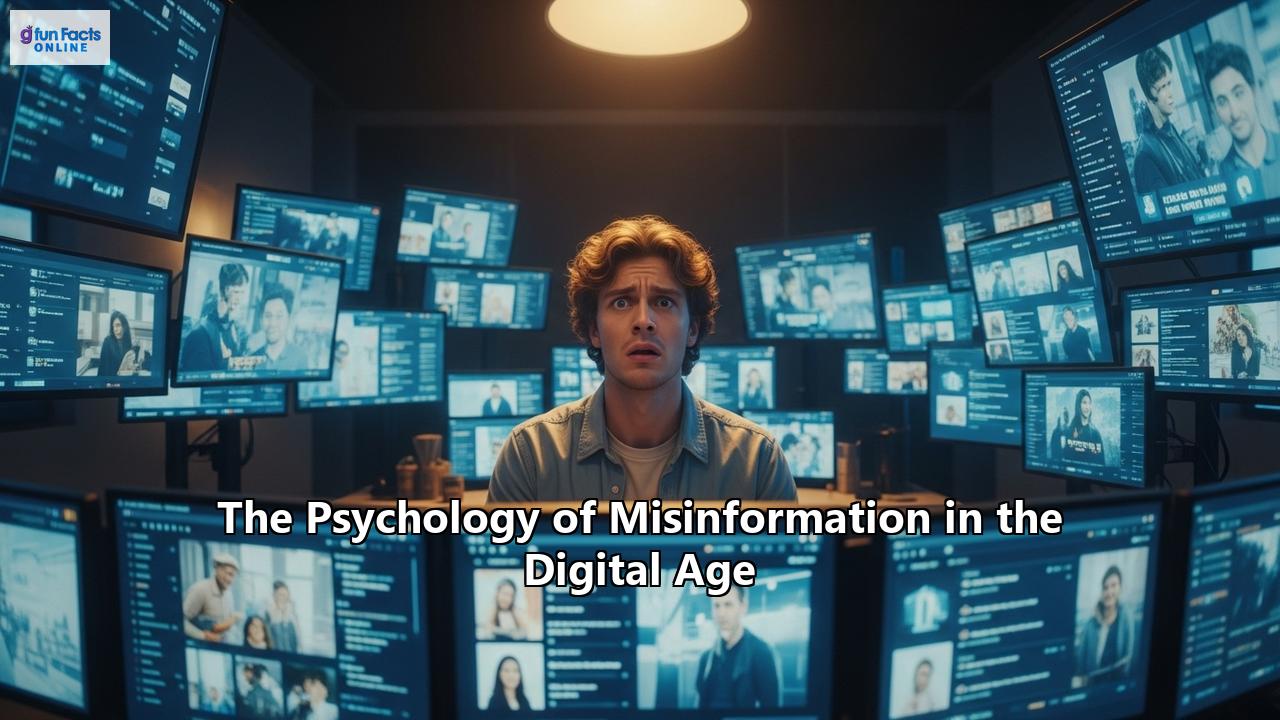
The Psychology of Misinformation in the Digital Age
The digital age has ushered in an era of unprecedented access to information, connecting billions of people globally and democratizing the flow of knowledge. However, this digital revolution has a dark side: the rampant spread of misinformation. False or misleading information, often sensationalized and emotionally charged, can proliferate across social media platforms and websites with alarming speed, influencing public opinion, eroding trust in institutions, and even posing a threat to public health and safety. Understanding the psychological factors that make us vulnerable to misinformation is the first critical step in combating its pervasive influence.
The Cognitive Shortcuts That Make Us Susceptible
Our brains are wired to process vast amounts of information efficiently, and to do so, they often rely on mental shortcuts known as cognitive biases. While these biases are generally adaptive, they can be exploited by the producers of misinformation, making us more likely to accept false claims without critical evaluation.
- Confirmation Bias: This is one of the most significant factors in our susceptibility to misinformation. It's our natural tendency to seek out, interpret, and recall information that confirms our existing beliefs and values. Social media algorithms often amplify this bias by creating "echo chambers" or "filter bubbles," where we are primarily exposed to content that aligns with our current views. This self-reinforcing cycle makes it difficult for new or contradictory information, even if factual, to penetrate our established belief systems.
- Availability Heuristic: Our brains tend to judge the likelihood of an event by how easily examples come to mind. Sensational and emotionally charged stories are more memorable, and therefore, our brains may perceive them as more common or believable. Misinformation often leverages this by using shocking headlines and dramatic narratives that are easily recalled.
- Illusory Truth Effect: Repeated exposure to information can increase our belief in its accuracy, even if we know it to be false. This is because familiarity can be mistaken for truth. In the digital world, where misinformation can be shared and reposted countless times, the illusory truth effect can be particularly potent.
- Bandwagon Effect: This is the tendency to adopt certain behaviors or beliefs because many other people are doing so. When we see a post with a high number of likes, shares, and comments, we may be more likely to perceive it as credible, a phenomenon known as social proof. This can lead to the rapid and widespread dissemination of misinformation, often without individual users verifying the accuracy of the content.
- Belief Perseverance: Also known as the backfire effect, this is the tendency to cling to one's initial belief even when presented with contradictory evidence. In some cases, attempts to correct misinformation can actually strengthen a person's belief in the false information.
The Role of Emotions in Believing and Spreading Misinformation
Emotions play a powerful role in how we process information and make decisions. Misinformation is often designed to evoke strong emotional responses, such as fear, anger, and outrage, which can override our critical thinking abilities.
- Emotional Reasoning: When we engage in emotional reasoning, we allow our feelings to dictate our beliefs. If a piece of information makes us feel angry or afraid, we may be more likely to believe it, regardless of the evidence. Research has shown that people who rely more on their emotions are more susceptible to believing fake news.
- Emotional Contagion: In the interconnected world of social media, emotions can spread like wildfire. The outrage or fear expressed by others in our social network can influence our own emotional state, making us more likely to share the information that elicited those emotions.
- Negative Emotions: Fake news headlines and articles are often crafted to provoke strong negative emotions like anger, disgust, and fear. These emotions can increase engagement and sharing, contributing to the viral spread of misinformation. However, some research suggests that anger can also increase discernment, as it can motivate people to challenge information they perceive as false.
The Digital Environment: A Fertile Ground for Misinformation
The architecture of the digital world itself contributes significantly to the spread of misinformation.
- Social Media Algorithms: Social media platforms use algorithms to personalize our news feeds and show us content that is most likely to keep us engaged. These algorithms often prioritize sensational, emotional, and outrageous content, which is more likely to be misinformation. This creates a feedback loop where engaging with misinformation leads to more exposure to it.
- Echo Chambers and Filter Bubbles: As mentioned earlier, algorithms can create personalized information environments where we are primarily exposed to viewpoints that align with our own. These "echo chambers" or "filter bubbles" can limit our exposure to diverse perspectives and make us more vulnerable to misinformation that confirms our existing biases.
- The Speed and Scale of Information Dissemination: In the digital age, information can be shared with a global audience in a matter of seconds. This rapid dissemination makes it difficult to verify the accuracy of information before it goes viral. The sheer volume of information we are exposed to on a daily basis can also lead to cognitive overload, making it more difficult to critically evaluate each piece of content we encounter.
The Psychology of Misinformation Creators
Understanding the motivations of those who create and spread misinformation is also crucial. While some may spread misinformation unintentionally, many do so with a clear purpose. These motives can include:
- Financial Gain: Misinformation can be a lucrative business. The more clicks, shares, and views a piece of content gets, the more ad revenue it can generate.
- Political Influence: Misinformation can be used as a tool to influence public opinion, sway elections, and undermine trust in political opponents.
- Social Disruption: Some actors may create and spread misinformation simply to sow discord, create chaos, and erode social cohesion.
- Ideological Expression: For some, spreading misinformation is a way to express their identity and signal their affiliation with a particular group.
Countering the Spread of Misinformation: A Multi-Faceted Approach
Given the complex psychological and technological factors at play, there is no single solution to the problem of misinformation. A comprehensive approach is needed that involves individuals, social media platforms, educators, and policymakers.
Individual Strategies:- Develop Media Literacy Skills: Media literacy is the ability to critically analyze and evaluate media content. By learning to question sources, evaluate evidence, and recognize biases, individuals can become more discerning consumers of information.
- Engage in Critical Thinking: Before sharing information, take a moment to pause and think critically about its source, its purpose, and its potential impact. Ask yourself: Is the source credible? Is the information supported by evidence? Is it designed to provoke an emotional response?
- Fact-Check Information: There are a number of reliable fact-checking organizations, such as Snopes, FactCheck.org, and PolitiFact, that can help you verify the accuracy of information. You can also use reverse image search tools like TinEye to check the authenticity of images.
- Be Aware of Your Own Biases: Recognizing our own cognitive biases is the first step in overcoming them. Be open to information that challenges your existing beliefs and make an effort to seek out diverse perspectives.
- Algorithm Transparency and Reform: Social media companies can and should make changes to their algorithms to prioritize accuracy over engagement. They can also provide users with more control over their news feeds and make their algorithms more transparent.
- Fact-Checking and Labeling: Social media platforms can partner with fact-checking organizations to identify and label misinformation. These labels can help users make more informed decisions about the content they consume and share.
- AI and Machine Learning: Artificial intelligence and machine learning can be used to detect and flag misinformation at scale. These technologies can also be used to identify and disrupt the networks of bots and trolls that are often used to spread false information.
- Media Literacy Education: Integrating media literacy into school curricula is essential to equip the next generation with the skills they need to navigate the complex information landscape of the digital age.
- Public Awareness Campaigns: Public awareness campaigns can help to educate the public about the dangers of misinformation and provide them with the tools they need to combat it.
- Support for Local Journalism: A strong and independent press is a vital bulwark against misinformation. Supporting local journalism can help to ensure that communities have access to high-quality, reliable information.
The fight against misinformation is one of the defining challenges of the digital age. It requires a collective effort from all of us. By understanding the psychological vulnerabilities that make us susceptible to false information, and by taking proactive steps to counter its spread, we can help to create a more informed and resilient society.
Reference:
- https://www.ebsco.com/research-starters/information-technology/information-age-digital-age
- https://eaea.org/2020/04/30/critical-media-literacy-to-fight-fake-news/
- https://academic.oup.com/heapro/article/40/2/daaf023/8100645
- https://cyabra.com/blog/psychological-effect-of-disinformation/
- https://commonslibrary.parliament.uk/disinformation-and-its-effects-on-society/
- https://guides.lib.uci.edu/Misinfo/bias
- https://www.ecostampa.it/en/blog/filter-bubble-and-echo-chamber-information-in-the-time-of-social-networks/
- https://www.apa.org/topics/journalism-facts/misinformation-belief-action
- https://www.pnas.org/doi/10.1073/pnas.2409329121
- https://www.repository.cam.ac.uk/items/a86b249f-12f1-4a94-893d-6943c8f58a7b
- https://www.consensus.app/search/how-do-emotions-influence-belief-in-fake-news/5WM4-NvBSXaG5foKgQYk4g/
- https://www.apa.org/topics/journalism-facts/misinformation-recommendations
- https://files.osf.io/v1/resources/hm9vu_v1/providers/osfstorage/618a5d3b2730b7010c5cd153?action=download&direct&version=2
- https://csh.ac.at/news/do-emotions-make-us-more-susceptible-to-misinformation-not-per-se-according-to-a-new-study/
- https://library.queens.edu/misinformation-on-social-media/algorithms
- https://commsroom.co/the-role-of-algorithms-in-amplifying-misinformation/
- https://www.darden.virginia.edu/sites/default/files/inline-files/05_16371_RA_KitchensJohnsonGray%20Final_0.pdf
- https://scispace.com/pdf/filter-bubbles-and-digital-echo-chambers-1f7s4k4t5b.pdf
- http://essay.utwente.nl/95556/1/Pasca_BA_BMS.pdf
- https://chakdahacollege.ac.in/Journal/27/Pdf/Latest/apr24/10-9(1)-Diseiye%20Oyighan-1-21.pdf-Diseiye%20Oyighan-1-21.pdf)
- https://www.ewadirect.com/proceedings/chr/article/view/16044
- https://www.researchgate.net/publication/385331781_Research_on_the_Speed_of_Information_Transmission_and_User_Cognition_in_the_New_Media_Era
- https://www.frontiersin.org/journals/psychology/articles/10.3389/fpsyg.2021.790848/full
- https://www.apa.org/topics/journalism-facts/how-why-misinformation-spreads
- https://ijcrt.org/papers/IJCRT2407287.pdf
- https://jedfoundation.org/resource/combat-misinformation-find-credible-sources-tips/
- https://www.routledge.com/Fighting-Fake-News-Teaching-Critical-Thinking-and-Media-Literacy-in-a-Digital-Age-Grades-4-6/Housand/p/book/9781618217288
- https://civicnebraska.org/20-ways-to-fight-disinformation/
- https://www.telefonica.com/en/communication-room/blog/technology-to-combat-fake-news/
- https://mschools.com/cognitive-biases-why-do-we-swallow-the-misinformation-bait/
- https://carnegieendowment.org/research/2024/01/countering-disinformation-effectively-an-evidence-based-policy-guide?lang=en
- https://eicta.iitk.ac.in/knowledge-hub/cyber-security/disinformation-security-strategies-to-combat-fake-news-in-the-digital-age-2025/
- https://www.weforum.org/stories/2024/06/ai-combat-online-misinformation-disinformation/
- https://www.rand.org/research/projects/truth-decay/fighting-disinformation/search.html
- https://zenodo.org/records/14964028/files/MRSJAHL-0112025-GP.pdf?download=1
- https://www.turing.ac.uk/sites/default/files/2023-11/tackling_online_misinformation_report_2023_v3.pdf