
Imagine a robot that doesn't move with the robotic whir-clank of servos and gears, but with the silent, fluid grace of a panther. Imagine a shirt that physically tightens its weave when you step into the cold, or a prosthetic limb that doesn't just move, but feels the strain of the object it holds.
For decades, this was science fiction. Robots were rigid, heavy, and powered by bulky electric motors. But a quiet revolution is taking place in materials science labs from MIT to the University of Texas. It is the era of Fiber-Type Artificial Muscles—polymers that contract, lift, and relax exactly like biological tissue, yet possess strength and endurance that biology could only dream of.
This is the story of how ordinary fishing line, high-tech hydrogels, and smart polymers are being twisted, coiled, and engineered into the "flesh" of the future.
Part 1: The Anatomy of a Synthetic Muscle
Beyond the Electric Motor
To understand why fiber-type muscles are revolutionary, we must first understand the problem they solve. Traditional robots are built on rigid actuation. An electric motor spins a shaft, which turns a gear, which moves an arm. It is precise, but it is heavy, complex, and energetically costly to simply hold a position.
Biological muscle is different. It is a linear actuator—it pulls. It is soft, compliant, and has a high "power-to-weight ratio." Artificial muscle fibers aim to replicate this. They are lightweight strands that, when stimulated by heat, electricity, or chemistry, physically shorten (contract) and pull a load, just like your biceps.
The "Twisted and Coiled" Breakthrough
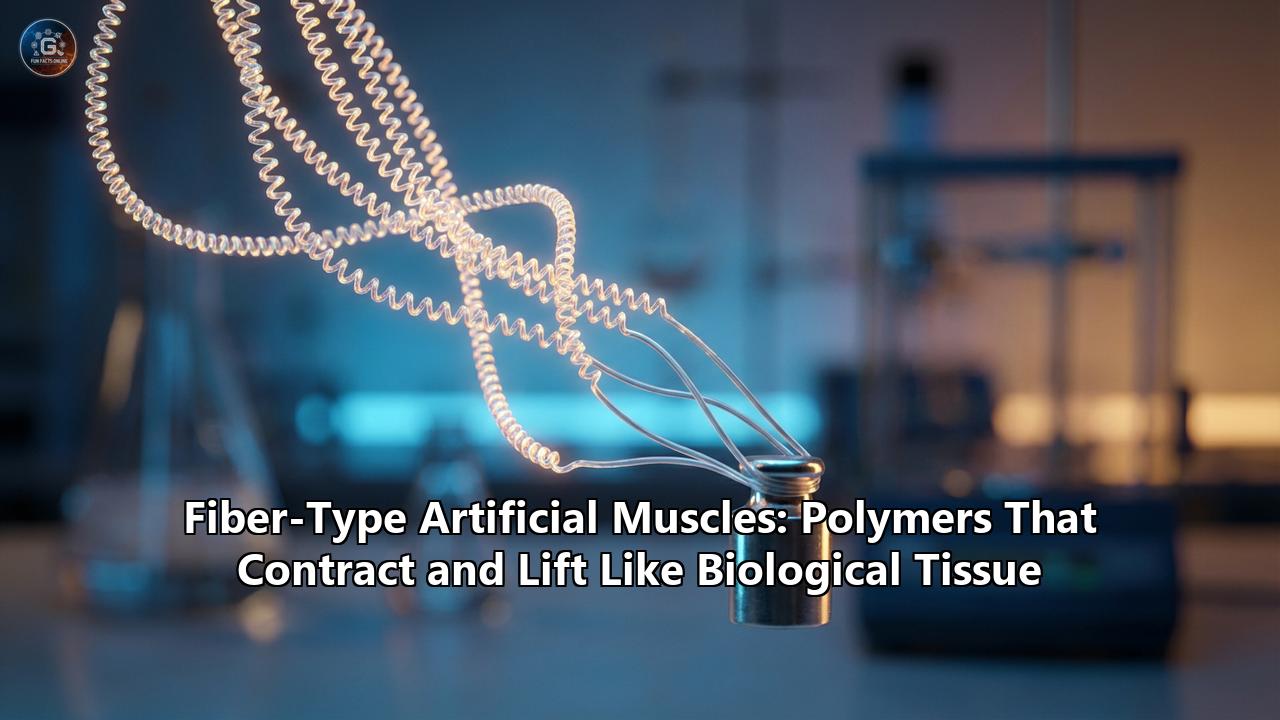
The field took a massive leap forward with the discovery of Twisted and Coiled Polymers (TCPs). Researchers found that if you take a high-strength polymer fiber—like ordinary nylon fishing line or sewing thread—and twist it until it coils back on itself (like an over-twisted rubber band), you create a structure with immense potential energy.
When you heat this coiled fiber, the polymer chains inside become disordered and want to expand. But because of the twisted geometry, this expansion is forced sideways, causing the coil to untwist and shorten lengthwise.
- The Result: A fiber that contracts by up to 50% of its length.
- The Power: These fibers can lift 100 times more weight than a human muscle of the same size.
- The Cost: Cents per meter.
Part 2: The Cutting Edge (2024–2025 Innovations)
The basic "fishing line muscle" was just the beginning. The last 12 months have seen an explosion in innovation, pushing these fibers from lab curiosities to viable industrial components.
1. The Mandrel-Free "Giant Stroke"
Until recently, making high-performance coiled muscles required wrapping fibers around a rod (a mandrel), a slow and expensive process. In 2025, researchers at the University of Texas at Dallas unveiled a "mandrel-free" fabrication method. By plying twisted strands together directly, they created "giant spring-index" muscles.
- Why it matters: These new fibers can stretch to 97% of their original length without breaking. This allows for soft robots that can extend reach and grasp objects with unprecedented flexibility.
2. Multi-Directional "Iris" Actuation
Biological muscles don't just pull in a straight line; they weave and wrap to create complex motions (think of your tongue or the iris of your eye). MIT engineers recently developed a method to stamp hydrogel-based fibers into complex patterns.
- The Breakthrough: They created an artificial "iris" that contracts both radially and concentrically at the same time. This paves the way for robots that can squeeze, twist, and manipulate objects with the dexterity of an octopus tentacle rather than a claw.
3. Dielectric Elastomer Fibers (DEAs)
While thermal muscles are strong, they can be slow to cool down. Dielectric Elastomers are the "electric sports cars" of artificial muscle. They activate instantly when high voltage is applied.
- 2025 Advance: A new technique involving "mask-free stamping" of carbon nanotube electrodes has allowed for the creation of massive, 180mm-long fibrous muscles. These are fast, efficient, and scalable, perfect for high-speed robotics like flapping wing drones.
Part 3: The Materials Menu
Not all artificial muscles are created equal. Different applications require different "flesh."
| Material Type | Mechanism | Strength | Best For |
| :--- | :--- | :--- | :--- |
| Twisted Polymer (TCP) | Thermal (Heat) | Super-High (lifts 100x weight) | Heavy lifting, prosthetics, exoskeletons |
| Hydrogels | Chemical / pH / Ion | Low to Medium | Bio-compatible medical implants, soft grippers |
| Shape Memory Alloys (SMA) | Thermal (Phase Change) | High | High-force, low-cycle applications (e.g., latches) |
| Pneumatic Fibers | Air/Fluid Pressure | Medium | Soft robotics, "McKibben" artificial muscles |
The Rise of Hydrogels: The "Bio-Hybrid" Approach
Hydrogels are networks of polymer chains that hold huge amounts of water, similar to real tissue. Recent studies have combined these with living muscle cells to create "bio-hybrid" actuators.
- Self-Healing: Unlike nylon, these hydrogel-biological hybrids can theoretically heal themselves after damage, powered by the nutrients in their environment.
- The "Iron Man" Fabric: Researchers in Australia have woven silicon-tube "muscles" into textiles. These smart fabrics can lift 192 times their own weight. Imagine a shirt that helps a stroke victim lift their arm by contracting the fibers woven directly into the sleeve.
Part 4: The Nervous System – Proprioception
A muscle without a nerve is useless. If a robot doesn't know how much its arm is stretched, it cannot move gracefully. This is where proprioception (the body's sense of position) comes in.
Self-Sensing Fibers
In the past, robots needed external sensors (cameras or encoders) to see their limbs. The new generation of fiber muscles is self-sensing.
- Conductive Nanowire Meshes: By embedding conductive networks into the fiber, the electrical resistance changes as the fiber stretches. The muscle becomes the sensor.
- Magnetic Tube-Fibers: A 2025 study introduced fibers filled with magnetic materials. As the tube deforms, the magnetic field changes, allowing the system to know exactly how much force is being applied.
This is a game-changer for prosthetics. A user controlling a prosthetic hand via these fibers wouldn't just crush a paper cup; the system would sense the resistance and stop, providing a "reflex" loop faster than human thought.
Part 5: The Efficiency Battle
The elephant in the room for fiber muscles, particularly thermal TCPs, has been efficiency. Heating up a plastic thread takes energy, and waiting for it to cool down takes time. It’s inefficient compared to an electric motor (which is ~90% efficient).
The Solution: Active Cooling and Hybridization- Fluidic Cooling: New prosthetic designs pump coolant through the center of hollow muscle fibers, drastically increasing the speed of actuation (up to 10-20 Hz).
- The FR-PTCA: A recent innovation, the "Fiber-Reinforced Pneumatic Twisted-and-Coiled Actuator," combines pneumatic power with the coiled geometry. This hybrid approach has doubled the energy efficiency of previous designs to over 19%, making untethered, battery-powered soft robots a reality.
Part 6: Future Horizons
We are standing at the precipice of a "Soft Age" in robotics. As these fibers become stronger, faster, and smarter, the line between machine and organism will blur.
1. Smart Clothing & Exosuits
We are moving away from the "mech-suit" sci-fi trope toward "power clothing." Lightweight, breathable fabrics woven with artificial muscle fibers could provide active support for the elderly, preventing falls or assisting with walking, without the stigma of a robotic frame.
2. Micro-Medical Robots
Hydrogel fibers are soft enough to navigate the human body without causing damage. Future surgical tools could be soft, worm-like robots that wiggle through arteries to remove clots, driven by external magnetic fields or internal chemical reactions.
3. The "Artificial Supermuscle"
Researchers are now synthesizing fibers that exceed biological performance in every metric: stress, strain, power density, and endurance. We are not just mimicking nature anymore; we are optimizing it. The goal is an actuator that is energy-efficient, self-sensing, and self-healing.
Conclusion
Fiber-type artificial muscles represent a fundamental shift in engineering. We are moving from the age of rigid, discrete components to an age of continuous, integrated materials. These polymers do not just do work; they embody the motion itself.
From the fishing line in a lab in Texas to the bio-hybrid gels in Zurich, the strands of this technology are weaving a future where our machines are as soft, adaptable, and alive as we are. The robots of the future won't just be built; they will be woven.
Reference:
- https://www.miragenews.com/new-study-reveals-strong-soft-artificial-muscles-1353370/
- https://www.youtube.com/watch?v=IJAMFkdBpjc
- https://editverse.com/scientists-create-artificial-muscles-bioengineered-tissue-thats-stronger-than-human-muscle/
- https://news.mit.edu/2025/artificial-muscle-flexes-multiple-directions-offering-path-soft-wiggly-robots-0317
- https://www.sciencedaily.com/releases/2025/03/250317163528.htm
- https://www.inceptivemind.com/engineers-develop-new-smart-textiles-using-artificial-muscle-fibers/25453/
- https://www.nationthailand.com/international/international-news/40018983
- https://www.researchgate.net/publication/390831356_An_Embedded_Proprioceptive_Sensing_Method_for_Soft_Artificial_Muscles_With_Tube-Fiber_Structure
- https://sunrobotics.lab.asu.edu/assets/pdf/weissman2023efficient.pdf