
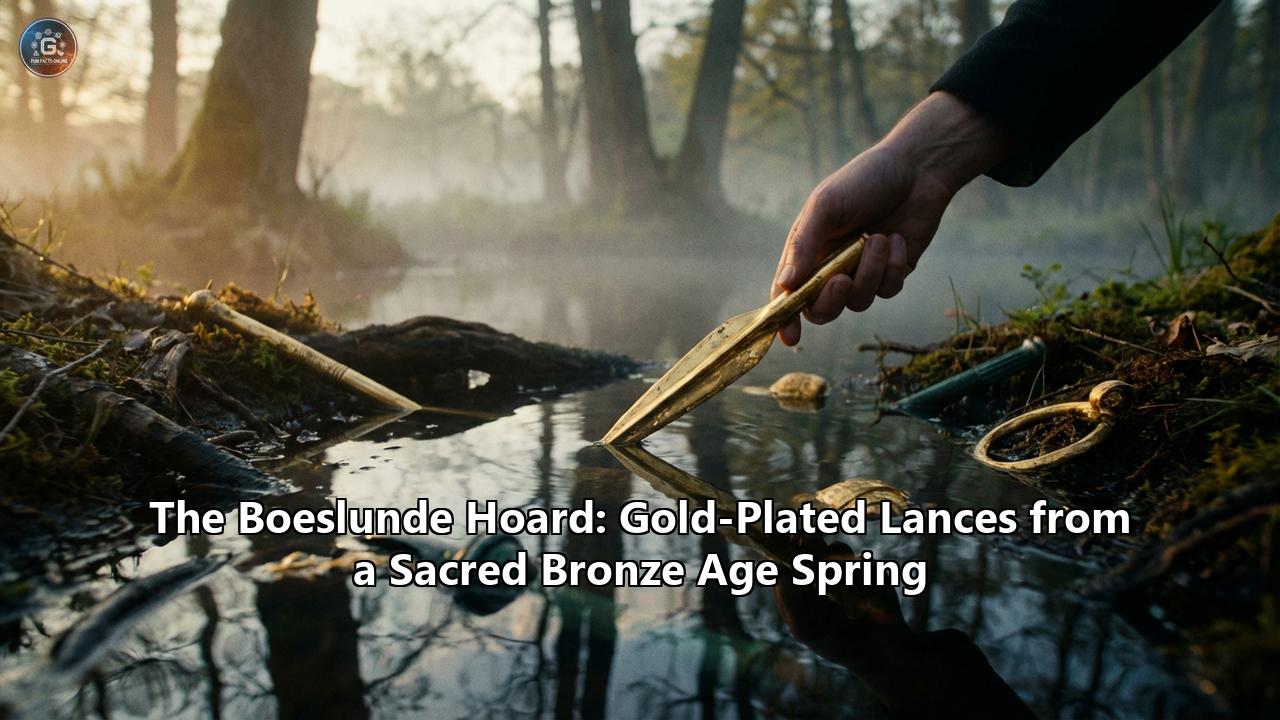
The late afternoon sun hangs low over the rolling hills of Southwest Zealand, casting long shadows across the fields of Boeslunde. It is a landscape that has kept its secrets well, hidden beneath the plowshare and the pasture for nearly three millennia. But in August 2025, the earth finally yielded a treasure so unexpected, so historically "impossible," that it has sent shockwaves through the world of archaeology.
Here, at the edge of a forgotten spring on the slopes of the Borgbjerg Banke, archaeologists from Museum Vestsjælland have unearthed two objects that should not exist: heavy iron lances, forged at the dawn of the Iron Age yet decorated with the lavish gold craftsmanship of the high Bronze Age.
This is the story of the Boeslunde Hoard’s newest and most startling chapter. It is a story of a sacred spring, a "Priest-King" of unimaginable wealth, and a society standing on the razor's edge of a technological revolution. It is a discovery that rewrites the timeline of Nordic history and illuminates the rich, ritualistic inner life of the people who walked these hills 2,800 years ago.
I. The Impossible Discovery
The excavation in the summer of 2025 was not a shot in the dark. Boeslunde had long been known as a "goldfield"—a place where the soil seemed to sweat precious metal. For decades, amateur detectorists and professional archaeologists had pulled wonders from this earth: heavy gold "oath rings," delicate gold bowls, and thousands of enigmatic gold spirals. But the team led by archaeologist Lone Claudi-Hansen was looking for context. They wanted to understand why this specific hillside was so holy.
They found their answer in the dark, organic mud of a buried water source.
As the team carefully troweled away the layers of peat and clay, they hit something hard and heavy. It was not the green-blue of oxidized bronze they expected, but a corroded, reddish-brown lump. Iron. In a Bronze Age stratum.
"It was a moment of pure confusion," Claudi-Hansen later recounted. "In the Nordic Bronze Age, iron is a ghost. It’s a rumor. To find a weapon made of it is rare enough. But then we saw the glimmer."
Under the X-ray fluorescence and the gentle cleaning in the conservation lab, the corrosion gave way to a sight that defied belief. Along the blade of the iron lance were circular inlays of pure gold. It was a fusion of two worlds: the new, terrifying technology of killing (iron) and the ancient, sacred metal of the sun (gold).
The Dating ShockThe true bombshell, however, came from the lab. Preserved in the anaerobic mud of the spring was a small lump of birch pitch—a prehistoric glue used to secure the lance's sheath. Because it was organic, it could be carbon-dated. The results came back with a precision rarely seen in archaeology: 900–830 BC.
This date, falling squarely within Period V of the Nordic Bronze Age, makes these lances the oldest iron weapons ever found in Denmark. They predate the official start of the Danish Iron Age by centuries. They prove that the transition to iron was not a slow, clumsy stumble, but a high-status revolution embraced by the elite.
II. The Lances: Weapons of the Sun
To understand the magnitude of this find, one must look closely at the lances themselves. The best-preserved of the two measures 47 centimeters today, though it would have been closer to 60 centimeters in its prime.
The Marriage of MetalsIn 900 BC, iron was not the utilitarian metal of plowshares and nails. It was a rare, exotic substance, likely imported from the Hallstatt cultures of Central Europe or even further south. It was magnetic, harder than bronze, and mysterious. To the people of Boeslunde, iron was likely seen as a "magical" material.
By inlaying this dark, foreign metal with local, glowing gold, the smiths were creating a powerful symbolic object.
- Iron represented the new power, the martial strength, and the connection to distant, exotic lands.
- Gold, eternal and incorruptible, represented the sun, the divine, and the continuity of the ancestors.
The decoration—concentric gold circles—is pure Bronze Age solar iconography. These lances were likely not meant for the chaotic mud of the battlefield. They were "prestige weapons," carried by a chieftain or a priest to signal his command over both the earthly realm of trade and war, and the heavenly realm of the sun.
III. The Sacred Spring: A Portal to the Otherworld
Why were these priceless items thrown into the mud? The 2025 excavation revealed that the "goldfield" of Boeslunde was actually centered around a sacred spring.
In the cosmology of the Bronze Age, water was a liminal boundary—a membrane separating the world of the living from the world of the spirits and gods. Springs, which bubbled up from the deep earth, were seen as direct portals to the Underworld.
The Ritual LandscapeSurrounding the spring, archaeologists found a "cooking pit field"—rows of ancient hearths used for preparing communal meals. This suggests that the deposition of the lances was not a secretive act by a lone individual. It was a public spectacle.
Imagine the scene: The community gathers at the slope of Borgbjerg Banke. Fires are lit, smoke curling into the autumn sky. The Priest-King, adorned in gold, steps forward to the edge of the black water. He holds the iron lance high, the gold inlays catching the sunlight. Then, with a prayer or a chant, he casts the weapon into the spring. It is a sacrifice of immense value—giving up the cutting edge of technology to appease the powers of the deep.
IV. Borgbjerg Banke: The "Cathedral" of the Bronze Age
The lances are only the latest piece of a puzzle that has been assembling itself for nearly 200 years. Boeslunde is not just a field; it is arguably the most important ritual center of the Late Bronze Age in Northern Europe.
The Oath Rings (Found 2009-2013)Before the lances, the field was famous for the "oath rings." These are massive, solid gold arm rings, weighing up to half a kilogram each. Ten have been found in total. They were likely worn by chieftains on the upper arm, a visible display of immense wealth. Like the lances, they were found deposited singly, suggesting they were sacrificed one by one over a long period.
The Gold Spirals (Found 2015)Perhaps the most enigmatic find was the discovery of nearly 2,200 tiny gold spirals. Made of flattened gold wire, these delicate coils are hair-thin and only a few centimeters long.
- The Theory: Archaeologists Flemming Kaul and Kirsten Christensen have proposed that these spirals were decorations on a ceremonial costume. Imagine a cloak or a hat, sewn with thousands of these gold springs. As the wearer moved during a sun dance, the spirals would catch the light, making the person "shimmer" like a living sun-god.
In the 19th century, farmers plowing near Borgbjerg Banke found six gold bowls. Some had handles shaped like horse heads—another potent solar symbol (the horse pulls the sun across the sky). These vessels were likely used to pour libations during the very same rituals where the lances were sacrificed.
V. The "Priest-King" of Boeslunde
Who was the man (or woman) who presided over these rites? The sheer concentration of gold—more than 4.5 kilograms found in this one area—suggests a centralization of power that challenges our understanding of Bronze Age society.
Scholars now speak of a "Boeslunde Priest-King," a figure who combined political authority with religious duty.
- The Trader: He controlled the flow of amber (Nordic gold) south to the Mediterranean, receiving copper, tin, and eventually iron in return.
- The Diplomat: The iron lances suggest he had connections to the elite Hallstatt chieftains of Austria and Southern Germany. He was part of a "global" network.
- The Mediator: His primary role was to mediate between his people and the gods, ensuring the sun rose and the harvest did not fail.
The gold-plated iron lances were likely his insignia of office—the scepter of a ruler who straddled two eras.
VI. A New Understanding of the Iron Age
Textbooks have traditionally drawn a sharp line between the Bronze Age and the Iron Age. The Boeslunde find blurs that line into irrelevance. It shows us that technological change was not a sudden "switch" but a complex process of adoption and adaptation.
The people of Boeslunde did not look at iron and see a "better tool." They saw a status symbol. They treated this new grey metal with the same reverence they treated gold. It took centuries for iron to become the common metal of the farmer. For the elite at Boeslunde, it was first a metal of the gods.
VII. Conclusion: The Echo of the Spring
The discovery of the Boeslunde lances is a triumph of modern archaeology. Through AMS dating, X-ray analysis, and persistent landscape study, we have recovered a moment frozen in time: the splash of a golden weapon hitting sacred water.
It reminds us that the past was vibrant, colorful, and incredibly complex. The people of the Bronze Age were not primitive survivalists; they were sophisticated artisans, ambitious traders, and deeply spiritual thinkers. They stood on the hill of Borgbjerg Banke, looked out over the Baltic Sea, and felt themselves to be at the center of the world.
And, looking at the gold that still glitters from their mud-soaked offerings, perhaps they were.
Further Reading & Visitor Information
The gold-plated lances, along with the oath rings and gold spirals, are currently being prepared for a major exhibition at Museum Vestsjælland.
- Location: Boeslunde, Southwest Zealand, Denmark.
- Museum: Museum Vestsjælland (Sorø/Slagelse branches).
- Key Era: Late Nordic Bronze Age (Period V) / Early Iron Age Transition.
- Significance: Oldest iron in Denmark; unique gold-iron hybrid technology.
Reference:
- https://natmus.dk/fileadmin/user_upload/Editor/natmus/antikken/dokumenter/PREHISTORIC_AEGEAN_AND_NEAR_EASTERN_METAL_TYPES.pdf
- https://en.wikipedia.org/wiki/Bronze_Age
- https://www.researchgate.net/publication/274150244_Late_Bronze_Age_iron_inlays_on_bronze_artefacts_in_central_Europe
- https://en.natmus.dk/historical-knowledge/denmark/prehistoric-period-until-1050-ad/the-bronze-age/arm-rings-of-gold/the-hoard-from-borgbjerg-banke/
- https://en.wikipedia.org/wiki/Nordic_Bronze_Age
- https://en.wikipedia.org/wiki/Iron_Age_Scandinavia
- https://arkeonews.net/denmarks-earliest-iron-weapons-2800-year-old-gold-decorated-spears-discovered/
- https://www.solekoru.com/sun-cult-sun-dancers-nordic-bronze-age/
- https://www.researchgate.net/publication/291766619_Late_Bronze_and_Early_Iron_Age_bronze_spear-_and_javelinheads_in_Bulgaria_in_the_context_of_Southeastern_Europe
- https://lex.dk/Boeslunde_guldfund
- https://www.youtube.com/watch?v=fS5V4SFai4s
- https://fiveable.me/archaeology-of-the-viking-age/unit-1/scandinavian-iron-age/study-guide/hLhkEsPMY9oI3FRz