
The Late Cretaceous landscape of North America was not a quiet place. In the dense, humid floodplains of what is now the Hell Creek Formation, a creature the size of a pigeon pecked its way out of an elongated egg. Covered in a coat of downy proto-feathers, with enormous eyes, a slender snout, and gangly legs, this hatchling looked nothing like the apocalyptic apex predators that have dominated human pop culture for over a century. Yet, this fragile creature was a Tyrannosaurus rex. If it survived the harrowing first years of its life, it would undergo one of the most extreme, terrifying, and biologically magnificent transformations in the history of vertebrate evolution—swelling into a 40-foot-long, 18,000-pound engine of bone-crushing destruction.
How does a creature morph from a long-legged, feathered runner into a multi-ton behemoth capable of snapping the femurs of Triceratops? For decades, paleontologists could only guess. They lined up fossils of different sizes and attempted to connect the dots based on external shapes. Today, the science of paleontology has evolved from a study of rocks into a deep biological science. By looking inside the fossils—literally slicing open the bones of the world's most famous predators—scientists have decoded the life cycles, growth rates, and lifespans of the tyrannosaurids.
This study of an organism's development from embryo to adult is known as ontogeny. In the case of the Tyrannosauridae family—which includes Tyrannosaurus, Tarbosaurus, Albertosaurus, Gorgosaurus, and Daspletosaurus—ontogeny is the master key to understanding not only the animals themselves but the entire ecological balance of the Late Cretaceous world.
The Bone Clock: Reading Paleohistology
To understand the lifespan of a dinosaur, one must first understand how to read a bone. Dinosaurs, like modern reptiles and amphibians, experienced seasonal fluctuations in their growth. During times of plenty—the warm, resource-rich wet seasons—they grew rapidly, laying down highly vascularized, spongy bone tissue. During the lean times of drought or winter, their metabolism slowed, and bone growth effectively stalled.
This cyclical halt in growth leaves a permanent, microscopic scar in the microstructure of the bone, known as a Line of Arrested Growth (LAG). Much like the rings of an ancient redwood tree, these LAGs can be counted to determine the exact age of the animal at the time of its death. The discipline dedicated to this microscopic study of fossil bone tissue is called paleohistology.
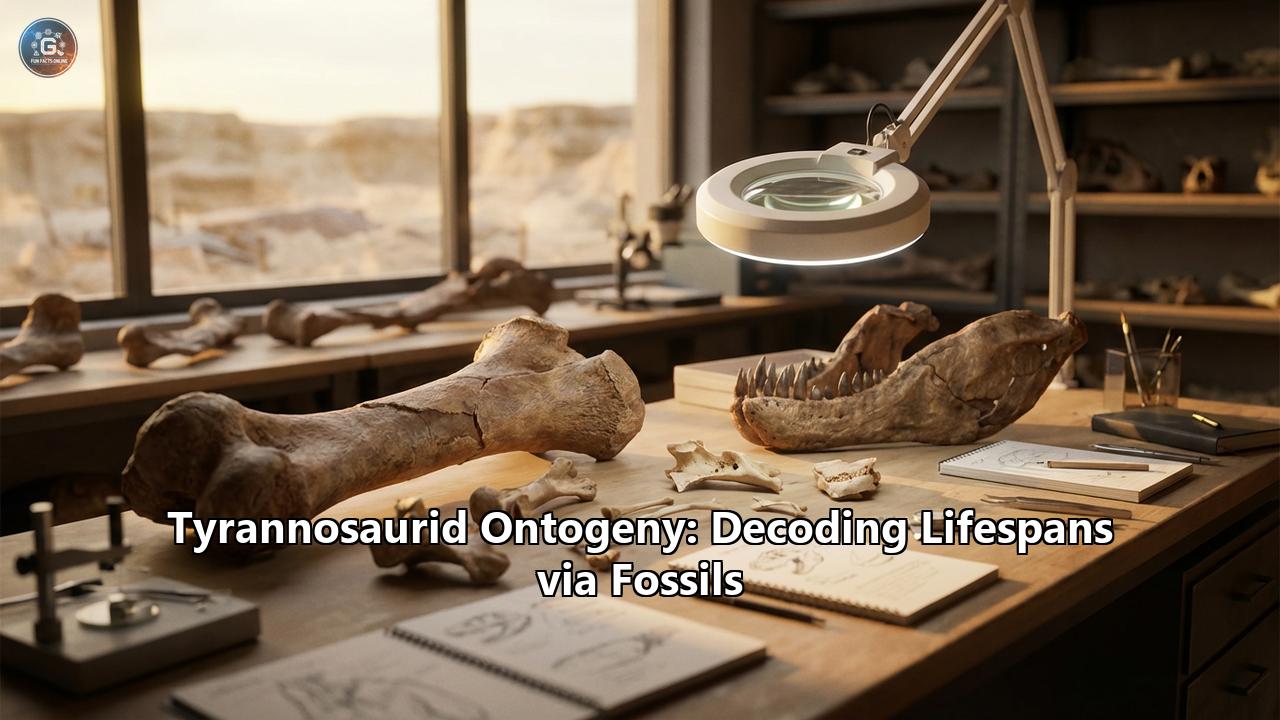
To age a tyrannosaurid, paleontologists typically use the weight-bearing bones of the legs, such as the femur (thigh bone) or the fibula (calf bone), as these bones record the most consistent growth. A researcher will use a diamond-tipped saw to extract a small core or cut a cross-section from the mid-shaft of the bone. The slice is then ground down until it is so thin that light can pass through it. Under a polarizing microscope, a spectacular landscape of osteons, blood vessel canals, and stark, dark LAGs is revealed.
However, decoding the tyrannosaurid bone clock is not as simple as counting tree rings. As a tyrannosaurid grew, its bones did not simply add layers to the outside; they remodeled from the inside. The medullary cavity—the hollow center of the bone that housed marrow—expanded as the animal grew, absorbing the innermost, earliest growth rings. To determine the true age of a massive adult T. rex, paleontologists must "back-calculate" the missing early years by superimposing the LAG spacing from known juvenile specimens onto the adult's remaining rings.
Through this intricate histological detective work, scientists have pieced together the tyrannosaurid survivorship curve. It paints a picture of a species that lived life in the fast lane: a childhood of extreme vulnerability, a teenage phase of explosive, terrifying growth, and a brutal adulthood that inevitably led to an early death.
The Vulnerable Years: Hatchlings and Infants
The fossil record is notoriously biased against small, delicate things. Because of this, infant tyrannosaurids were long considered the "ghosts" of the Cretaceous. Their fragile, pneumatic bones were easily crushed by sediment, dissolved by acidic soils, or digested by scavengers before they could fossilize.
However, recent discoveries have finally brought these infants into the light. Micro-fossil sites in Alberta and Montana have yielded tiny tyrannosaurid teeth, no larger than a grain of rice, alongside fragmentary embryonic jawbones and claws. These remains tell us that a hatchling tyrannosaurid was roughly three feet long from snout to tail, weighing just a few pounds.
In their first year of life, infant tyrannosaurs faced a crucible of survival. They were prey to everything larger than themselves, including dromaeosaurs (raptors), large crocodilians, azhdarchid pterosaurs, and even other, older tyrannosaurs. Their primary defense was speed. The ontogenetic scaling of tyrannosaurids shows that juveniles had exceptionally long lower legs (the tibia and metatarsals) compared to their upper legs (the femur). This is the hallmark of a highly cursorial (running) animal.
An infant tyrannosaurid did not hunt like its parents. It lacked the deep, heavy skull and thick, bone-crushing teeth that characterize the adults. Instead, its snout was long and low, and its teeth were slender and blade-like—perfect for slicing through the flesh of small lizards, mammals, and juvenile dinosaurs. This difference in diet and hunting style introduces one of the most vital concepts in dinosaur ecology: ontogenetic niche partitioning.
The Teenage Spurt and Ontogenetic Niche Partitioning
In modern ecosystems, apex predators like lions and wolves share their habitat with mid-sized predators like leopards, hyenas, and coyotes. But in the Late Cretaceous ecosystems dominated by tyrannosaurids, a strange phenomenon occurs in the fossil record: a glaring absence of medium-sized carnivores. Aside from the massive tyrannosaurids and the small, raptor-like theropods, the "middle management" of the food web seems to be missing.
Paleontologists hypothesize that tyrannosaurids monopolized the ecosystem by occupying different ecological niches as they grew. A single species effectively acted as several different species over the course of its lifespan.
When a tyrannosaurid reached its teenage years, it entered an exponential growth phase that defies modern comparison. Histological data from Tyrannosaurus rex reveals that around age 14, the animal's metabolism kicked into overdrive. For a period of about four to five years, a teenage T. rex was packing on up to 4.6 pounds (over 2 kilograms) of body mass every single day.
During this adolescent phase, the animal was a nightmare for the local fauna. A 15-year-old tyrannosaurid was roughly the size of a modern rhino, but built like an oversized greyhound. It was too fast for heavily armored prey like Ankylosaurus, but perfectly adapted to run down swift, medium-sized herbivores like ornithomimids and young hadrosaurs. Its jaws were transitioning; the skull began to deepen, and the muscles anchoring the jaw expanded, but it was still a pursuit predator that relied on slicing flesh rather than pulverizing bone.
By acting as the mid-sized predators of their environment, teenage tyrannosaurids actively outcompeted and suppressed the evolution of other medium-sized theropod species. They were the masters of the mesopredator niche, creating an ecosystem entirely ruled by a single family of theropods.
The Great Nanotyrannus Plot Twist
For decades, the narrative of the "teenage tyrannosaur" was defined by a handful of incredibly well-preserved, slender tyrannosaur skulls and skeletons from the Hell Creek Formation. The most famous of these was a beautifully intact specimen nicknamed "Jane," housed at the Burpee Museum of Natural History, and a skull discovered in 1942 by the Cleveland Museum of Natural History.
These specimens were highly cursorial, with long, low snouts, blade-like teeth, and long legs. In 1988, researchers analyzed the Cleveland skull and declared it a completely new, smaller species of tyrannosaur, naming it Nanotyrannus lancensis—the "tiny tyrant". However, as the concept of dramatic tyrannosaurid ontogeny gained traction in the early 2000s, the scientific consensus shifted drastically. For nearly twenty years, the prevailing wisdom in paleontology dictated that Nanotyrannus was not a real species at all; rather, "Jane" and the Cleveland skull were simply teenage Tyrannosaurus rex specimens undergoing their awkward, slender adolescent phase before expanding into bulky adults.
This consensus formed the bedrock of T. rex ontogeny for a generation. But science is a dynamic, ever-correcting process, and in late 2025, one of the fiercest debates in paleontology was finally blown wide open.
In a pair of bombshell papers published in Nature and Science in late 2025, researchers applied cutting-edge paleohistology and rigorous morphological analysis to finally settle the Nanotyrannus question. The results forced a massive rewrite of tyrannosaurid ontogeny.
A team led by Dr. Christopher Griffin and Dr. Caitlin Colleary at the Cleveland Museum of Natural History extracted histological data from the 80-year-old Cleveland skull holotype. Because they lacked limb bones, they used an innovative histological approach on a small, overlooked bone to determine the animal's age. The results were undeniable: the bone tissue showed the tightly packed outer growth rings of an animal that had completely ceased growing. The Cleveland skull did not belong to a rapidly growing teenager; it belonged to a mature, fully grown adult.
Simultaneously, a massive study published in Nature by Dr. Lindsay Zanno and Dr. Nick Longrich analyzed over 200 tyrannosaur fossils, comparing the disputed "teenage" specimens against actual known T. rex juveniles. They found stark anatomical differences that could not be explained by growth, including different tooth counts and an additional sinus cavity in the snout of the slender specimens that T. rex completely lacked. Furthermore, slicing into the leg bones of the famous "Dueling Dinosaurs" specimen—another slender tyrannosaur—revealed an animal that was over 20 years old and had finished growing at only one-tenth the body mass of a mature T. rex.
The "tiny tyrant" was real. The researchers concluded that Nanotyrannus was an entirely distinct genus, and they even identified a second species, naming the "Jane" specimen Nanotyrannus lethaeus.
This 2025 revelation completely upended the Late Cretaceous ecosystem model. T. rex was not the only tyrannosaur in North America at the end of the age of dinosaurs. If T. rex was the lion of the Hell Creek Formation—weighing 18,000 pounds and built for raw power—Nanotyrannus was the cheetah, weighing roughly 1,500 pounds and built for blistering speed.
While this discovery solved the mystery of Nanotyrannus, it opened a new, glaring hole in our understanding of T. rex ontogeny: if Jane and the Cleveland skull were not juvenile T. rex, then what did a real T. rex teenager look like? The answer is that true juvenile T. rex fossils are exceedingly rare, and those that do exist suggest that while T. rex did undergo a massive growth spurt, it was likely much bulkier and heavier-set in its youth than the hyper-gracile Nanotyrannus. The revelation proves that while ontogeny drives massive morphological changes, it cannot be used as a blanket excuse to dismiss distinct, smaller species.
Somatic Maturity: The Price of Absolute Power
Around the age of 18 to 20, the explosive growth phase of a T. rex (and other large tyrannosaurids like Tarbosaurus and Daspletosaurus) came to an end. The LAGs in their bones become tightly packed together near the outer edge of the bone cortex, forming what histologists call the External Fundamental System (EFS). The presence of an EFS is the definitive proof of somatic maturity; it means the dinosaur had reached its maximum genetic size and had stopped growing.
The physical transition into adulthood was staggering. The skull widened at the back and shortened at the snout, orienting the massive eyes forward to provide unparalleled binocular vision and depth perception. The jaw muscles—specifically the musculus pterygoideus and musculus adductor mandibulae—swelled to grotesque proportions. To accommodate this muscle mass, the skull bones fused and thickened.
The teeth also changed. The slender, slicing blades of their youth were replaced by thick, serrated, D-shaped spikes often compared to lethal bananas. These teeth were no longer just for slicing meat; they were "incrassate" (thickened) and engineered to withstand immense stress. The adult tyrannosaurid was an osteophagous (bone-eating) predator. Coprolites (fossilized feces) attributed to adult T. rex are packed with pulverized, semi-digested fragments of Triceratops and hadrosaur bone, proving that adults simply crushed through the armor and skeletons of their prey, consuming marrow and bone alike with a bite force exceeding 12,000 pounds.
However, the acquisition of this immense power came at a steep physical cost. The fossilized skeletons of adult tyrannosaurids read like prehistoric medical charts, detailing lives of unimaginable violence and pain.
Because they were too massive to run down swift prey, adult tyrannosaurids had to engage in close-quarters combat with the most dangerous herbivores to ever walk the Earth. A Triceratops equipped with three-foot facial horns, or an Ankylosaurus wielding a bone-shattering tail club, did not go down easily.
The study of fossil diseases and injuries—paleopathology—shows that adult tyrannosaurids were battered survivors. The famous T. rex specimen "Stan" features a healed broken neck, where two of his cervical vertebrae fused together after a catastrophic impact. Another specimen features a massive horn-wound from a Triceratops through the ribs.
Intraspecific combat (fighting among their own kind) was also rampant. Many adult tyrannosaur skulls, including the "Jane" Nanotyrannus specimen and numerous Daspletosaurus skulls, bear the unmistakable, healed puncture marks of other tyrannosaur teeth. They bit each other on the face, likely contesting territory, mating rights, or dominance over a carcass.
Disease was equally ruthless. The largest and most complete T. rex ever discovered, "Sue," displays horrifying paleopathologies. Sue's jaw is riddled with smooth-edged holes, long thought to be bite marks but now widely attributed to a severe parasitic infection similar to modern Trichomonas gallinae, a protozoan that infects the throats of modern birds. This infection would have caused massive swelling and lesions in the throat and jaw, making eating agonizing. Furthermore, Sue suffered from advanced gout, leaving her vertebrae fused and her tail immobilized in places.
Comparing the Cousins: Asian Tyants and Gracile Hunters
While Tyrannosaurus rex is the standard-bearer for tyrannosaurid ontogeny, the family tree was diverse, and growth strategies varied across different continents and lineages.
In Late Cretaceous Asia, Tarbosaurus bataar ruled the Nemegt Formation. Tarbosaurus was nearly identical in size to T. rex and underwent a similar explosive teenage growth spurt. However, structural differences in the skull of juvenile versus adult Tarbosaurus show that they handled the stresses of biting differently. While T. rex developed a rigid, heavily fused skull to deliver crushing bites, Tarbosaurus maintained a slightly more flexible skull, using complex locking mechanisms in its jaw bones to distribute the stress of struggling prey.
Meanwhile, the albertosaurines of North America—Albertosaurus and Gorgosaurus—represent a slightly different evolutionary strategy. These tyrannosaurids were older (living millions of years before T. rex) and generally more gracile. Histological studies show that Albertosaurus grew at a slightly slower rate than T. rex and maintained longer, more cursorial proportions even into adulthood. They were the marathon runners of the tyrannosaur world, prioritizing speed and agility over the sheer brute force of the tyrannosaurines.
Even stranger were the Alioramini, a tribe of long-snouted tyrannosaurids found in Asia, which includes Alioramus and the magnificent Qianzhousaurus (affectionately dubbed "Pinocchio rex"). For a time, paleontologists wondered if the long, delicate snouts of Alioramus specimens were simply a juvenile trait, much like the slender snouts of teenage T. rex. However, the discovery of a massive, highly mature Qianzhousaurus specimen proved that this lineage maintained its long, gracile snout well into late adulthood. Their ontogeny involved fusing cranial bones and developing elaborate cranial ornamentation, but they never bulked up their jaws to crush bone, indicating they specialized in smaller, swifter prey for their entire lives.
Demographics of Doom: The Survivorship Curve
By combining histology, ontogeny, and population data from mass death sites, paleontologists have drafted a complete demographic survivorship curve for tyrannosaurids. The most famous of these population data sets comes from the Dry Island Albertosaurus bonebed in Alberta, Canada, where over two dozen Albertosaurus individuals of varying ages died and were buried together in a single catastrophic event (likely a flood).
The bonebed reveals a fascinating demographic breakdown. It contains a few massive, old adults, a large number of older teenagers, but very few young juveniles.
When plotted on a graph, the tyrannosaurid survivorship curve resembles a modified "Type I" curve, similar to modern large mammals or birds.
- High Infant Mortality: Most tyrannosaurids died before their first birthday, picked off by predators or succumbing to disease and starvation.
- The Invincible Teens: If a tyrannosaurid survived its first two years, its chances of survival skyrocketed. Between the ages of 2 and 13, mortality rates dropped to roughly 2-4% per year. These juveniles were simply too fast to be caught by larger predators and too large to be bothered by smaller ones.
- The Adult Crash: The moment tyrannosaurids reached sexual maturity and their peak growth phase (around age 14-15), mortality rates spiked violently back up to 23% per year.
Why did adults die at such alarming rates? The answer lies in the harsh realities of their ecological niche. Adulthood brought the responsibilities of defending massive territories, battling rivals for mating rights, and the incredibly dangerous task of hunting multi-ton, heavily armed prey. A single misstep while pursuing a Triceratops could result in a shattered femur, leading to starvation.
Geriatric Giants: The Limits of the Bone Clock
Because of this violent lifestyle, very few tyrannosaurids survived into old age. The paradigm for tyrannosaurids is strictly "live fast, die young."
For a long time, the famous specimen "Sue" was considered the oldest known T. rex, with her bone histology revealing an age of roughly 28 years. In recent years, a massive specimen from Saskatchewan named "Scotty" and a beautifully preserved specimen in the Netherlands named "Trix" have rivaled Sue for the title of the oldest tyrant. Histological analyses of these massive brutes indicate they reached approximately 30 years of age.
But why only 30 years? Modern reptiles of comparable sizes, such as large crocodilians or giant tortoises, can easily live for 70 to 150 years. The fact that a 9-ton apex predator burned out and died of old age by its 30th birthday is a testament to the tyrannosaurid metabolism.
Tyrannosaurids were not sluggish, cold-blooded reptiles. Isotopic analysis of their teeth and bones, combined with their explosive growth rates, indicates they possessed high, avian-like metabolisms. They were warm-blooded, active, and grew at rates comparable to modern mammals and birds. This high-octane metabolism allowed them to achieve their massive size in just two decades, but it also meant their biological clocks ticked much faster than those of modern reptiles. A 30-year-old T. rex was a geriatric animal, at the absolute end of its biological lifespan, its body worn down by a lifetime of hyper-carnivorous exertion.
A Dynamic View of the Deep Past
The study of tyrannosaurid ontogeny has shattered the archaic view of dinosaurs as static, lumbering monsters. Through the precise, microscopic science of paleohistology, and the willingness of the scientific community to engage in rigorous, evolving debate—as seen in the dramatic 2025 resolution of the Nanotyrannus controversy—we now view these animals as dynamic, breathing organisms.
We can track their lives from the moment they hatched as fluffy, long-legged sprinters, to their terrifying adolescent growth spurts where they terrorized the mesopredator niche, all the way to their final decades as scarred, bone-crushing monarchs of the Late Cretaceous. The bones of the tyrannosaurids are not just pillars of calcium phosphate; they are biological clocks, and by learning how to read them, we have resurrected the life story of the most magnificent predators the world has ever known.
Reference:
- https://www.nationalgeographic.com/science/article/nanotyrannus-t-rex-dueling-dinosaur-fossil-debate
- https://www.cmnh.org/news/press-room/2025/12/04/research-spotlight-new-analysis-of-nanotyrannus-holotype-at-museum-leads-to-breakthrough-in-decades-old-dinosaur-debate
- https://connectsci.au/news/news-parent/6971/Debate-ended-over-whether-Nanotyrannus-is-a
- https://www.smithsonianmag.com/smart-news/this-tiny-tyrannosaur-could-settle-a-huge-scientific-debate-180987611/
- https://bioone.org/journals/journal-of-vertebrate-paleontology/volume-41/issue-4/02724634.2021.1999251/The-Cranial-Anatomy-of-the-Long-Snouted-Tyrannosaurid-Dinosaur-Qianzhousaurus/10.1080/02724634.2021.1999251.pdf