
The sheer, staggering beauty of Saturn has captivated the human imagination since Galileo first turned his primitive spyglass toward the heavens in 1610 and mistook the planet’s rings for "ears." For centuries, these celestial halos have stood as the crown jewels of our solar system—a symbol of cosmic perfection and permanence. We look at them and see eternity. But what if that sense of permanence is a lie? What if the rings of Saturn are not a timeless monument, but the glittering, icy blood spatter of a murder committed billions of years after the planets formed?
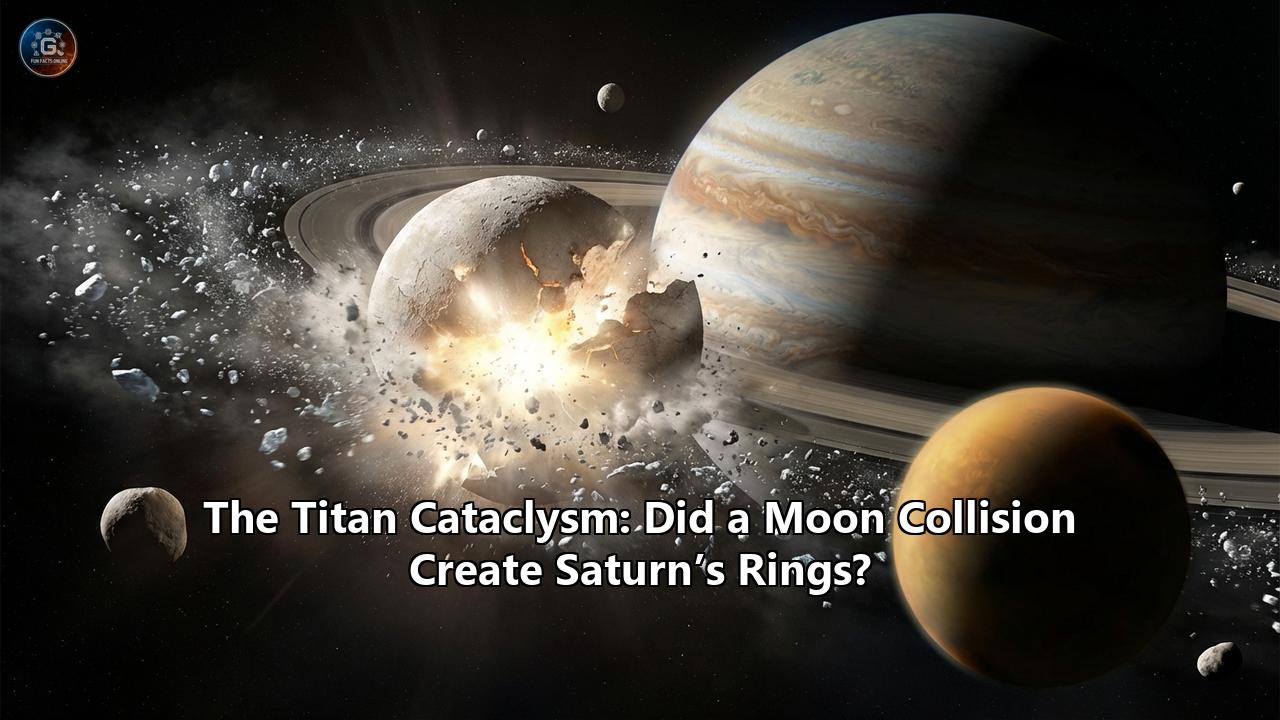
As we settle into 2026, the field of planetary science is reeling from a cascade of new findings that have upended our understanding of the gas giant. We are no longer looking at a static system, but at the aftermath of a violent celestial accident. This is the story of the "Titan Cataclysm"—a hypothesis that suggests Saturn’s rings are the ghostly debris of a lost moon, destroyed in a chaotic dance with Titan, the system’s brooding, smog-choked king.
This is not just a story about rocks and ice. It is a detective story played out on a canvas of millions of kilometers, involving orbital resonances, tidal forces, and a timeline that shrinks the age of the rings from the dawn of the solar system to the era of the dinosaurs. It forces us to ask: If we had looked up at the sky 100 million years ago, would Saturn have been naked?
Part I: The Illusion of Eternity
To understand the magnitude of the Titan Cataclysm theory, we must first understand the "Classic View" that held sway for centuries. Since the time of Laplace and Kant, the prevailing wisdom was that Saturn’s rings were primordial—leftovers from the accretion disk that formed the planet itself 4.5 billion years ago. In this view, the rings were as old as the solar system, a fossilized remnant of creation.
This theory felt intuitively right. Massive structures in space usually take eons to form and stabilize. The rings are vast, spanning up to 282,000 kilometers from the planet, yet they are shockingly thin—in some places, no thicker than a two-story house. The sheer delicacy of the structure suggested it had been settling there, undisturbed, for aeons.
However, there was always a "dirt" problem.
Saturn exists in a dusty neighborhood. The outer solar system is awash in micrometeoroids—tiny particles of rock and dust that constantly bombard planetary bodies. Over 4.5 billion years, these dark, sooty particles should have polluted the pristine water ice of Saturn’s rings, turning them dark and charcoal-grey. Yet, the rings are blindingly bright, reflecting sunlight with an albedo that rivals fresh snow.
For decades, astronomers hand-waved this anomaly. Perhaps the rings were so massive that the pollution was diluted. Perhaps there was a hidden mechanism cleaning them. But when NASA’s Cassini spacecraft arrived at Saturn in 2004, it began to dismantle the "primordial rings" theory piece by piece.
Cassini spent 13 years diving through the gaps, tasting the dust, and measuring the mass of the rings. Its final act, the "Grand Finale" in 2017, saw the probe plunge between the planet and the rings, allowing it to "weigh" the rings by measuring their gravitational pull.The result was a shock. The rings were light—too light to be old. If they were ancient, they would have been far more massive to survive billions of years of erosion and bombardment. The low mass, combined with their impossible brightness, pointed to only one conclusion: The rings are young. Shockingly young.
Current estimates place their age between 10,000,000 and 100,000,000 years. To put that in perspective, when the Stegosaurus roamed the Earth, Saturn may have had no rings at all. When the Tyrannosaurus rex looked up at the night sky, it might have seen a dim, ringless star where the jewel of the solar system now shines.
If the rings didn't form with Saturn, they had to come from somewhere else. They had to be made. And usually, the universe makes things by breaking other things.
Part II: The Lost Moon of Chrysalis
The first major breakthrough in the "cataclysm" narrative came in 2022, when researchers from MIT and UC Berkeley proposed the existence of a lost moon, which they poetically named Chrysalis.
The team was trying to solve two mysteries at once. The first was the age of the rings. The second was Saturn’s tilt. Saturn spins at a tilt of 26.7 degrees relative to its orbit. This is strange because gas giants usually form standing straight up. For years, astronomers believed Saturn’s tilt was caused by a gravitational resonance with Neptune. But Cassini data showed that Saturn was no longer in resonance with Neptune. Something had knocked it out.
The researchers ran thousands of computer simulations, winding the clock backward to see what kind of system could explain both the tilt and the rings. The simulations kept pointing to a missing piece: a moon about the size of Iapetus (roughly 1,500 kilometers across) that used to orbit between Titan and Iapetus.
According to the Chrysalis hypothesis, this moon existed for billions of years, keeping the system in balance. But there was a destabilizing force at work: Titan.
Titan is not just a moon; it is a monster. It is larger than the planet Mercury and possesses a thick, orange atmosphere. Crucially, Titan is migrating outward, moving away from Saturn at a rate of about 11 centimeters per year. This migration is the engine of chaos in the Saturnian system.
As Titan drifted outward, its gravity began to tug on Chrysalis. Around 160 million years ago, Titan and Chrysalis entered a "resonant" dance—a gravitational sweet spot where their tugs on each other amplified. This resonance pumped energy into Chrysalis’s orbit, making it more and more elliptical.
Eventually, Chrysalis’s orbit became so stretched that it passed too close to Saturn. It crossed the Roche Limit—the invisible line where a planet’s tidal forces become stronger than the gravity holding a moon together.
The result was instantaneous and catastrophic.
Imagine a world the size of a small continent being gripped by an invisible giant. The side of Chrysalis facing Saturn was pulled much harder than the side facing away. The moon groaned, cracked, and then shattered. Billions of tons of ice and rock were ripped apart.
According to the models, about 99% of Chrysalis’s mass would have spiraled into Saturn, swallowed by the gas giant’s atmosphere. But the remaining 1%—a cloud of pure, shattered water ice—was stranded in orbit.
Over the next few millennia, this debris field flattened out into a thin disk. The rocky heavy bits fell into the planet or were ejected, leaving behind the lighter, reflective water ice. The moon Chrysalis was gone, but from its "cocoon," the butterfly of Saturn’s rings had emerged.
Part III: The 2026 Paradigm Shift – The Titan-Hyperion Collision
While the Chrysalis theory provided an elegant solution, science rarely rests. As we moved into 2024 and 2025, new high-fidelity simulations and re-analysis of Cassini data began to suggest an even more violent and complex origin story. This is what is now being referred to as the Titan Cataclysm.
Recent papers published in late 2025 and early 2026 have shifted the focus from a solitary lost moon to a massive collision involving Titan itself.
Researchers at the SETI Institute and other planetary science centers began investigating the oddities of Hyperion, a chaotic, sponge-like moon that tumbles unpredictably in its orbit. Hyperion is locked in a 4:3 orbital resonance with Titan, meaning for every four times Titan orbits Saturn, Hyperion orbits three times.
The new models suggest that Hyperion is not a primordial moon, but a fragment of something larger. The theory posits that the Saturnian system once hosted a "Proto-Hyperion"—a substantial moon orbiting near Titan.
About 100 to 200 million years ago, Titan’s outward migration destabilized this Proto-Hyperion. But instead of just getting ripped apart by Saturn, this moon may have collided with Titan or passed so violently close that it was shredded by the encounter.
This "grazing collision" scenario is terrifying to visualize. A moon roughly the size of our own Moon (Titan) and a smaller icy world (Proto-Hyperion) screaming toward each other at tens of thousands of kilometers per hour. The impact or near-miss would have stripped the outer icy mantle off Proto-Hyperion, sending a spray of debris throughout the system.
This version of events solves several lingering problems with the Chrysalis theory:
- The "Cleanliness" of the Rings: If the rings were formed from the icy mantle of a destroyed moon, they would naturally be made of pure water ice, explaining their high albedo.
- The Surface of Titan: Titan has a relatively young surface with few craters. A massive system-wide bombardment event 100 million years ago could have resurfaced the moon or triggered cryovolcanic activity that wiped away ancient craters.
- The Existence of Hyperion: The modern moon Hyperion is likely the largest surviving chunk of the destroyed "Proto-Hyperion"—a piece of shrapnel left over from the car crash. Its porous, low-density structure supports the idea that it is a re-accreted pile of rubble rather than a solid, primordial body.
Part IV: The Mechanics of Destruction
To truly appreciate the Titan Cataclysm, we must delve into the physics of how a moon dies. It is not an explosion in the Hollywood sense. It is a gravitational dismantling.
The key concept is the Roche Limit. Every planet has a distance within which its tidal forces (the difference in gravity felt by the near side vs. the far side of an object) are stronger than the object's self-gravity. For a rigid rocky moon, this limit is closer to the planet. For a "rubble pile" moon held together loosely, the limit is further out.
When the doomed moon (be it Chrysalis or Proto-Hyperion) crossed this line, the process would have begun with "tidal stretching." The moon would have elongated into a cigar shape. Massive fissures would open in its crust, venting subsurface oceans or gases into space.
Then, the structural failure occurs. The moon doesn't just crack; it unzips. The side facing Saturn is ripped away, while the trailing side is flung outward. This creates a stream of debris—a "string of pearls" wrapping around the planet.
In the first few days after the destruction, Saturn would have been surrounded by a chaotic torus of massive boulders, some the size of mountains. These boulders would constantly collide with one another, grinding themselves down.
This grinding process is incredibly efficient. Large boulders smash into smaller rocks, which smash into pebbles, which smash into dust. This "collisional cascade" increases the surface area of the material, making the ring system brighter and brighter.
Within a few thousand years—a blink of an eye in cosmic time—the chaotic cloud would settle into a flat plane. This flattening happens because of the conservation of angular momentum and the fact that collisions cancel out vertical motion. If a rock is bobbing up and down, it will eventually hit another rock, and they will average out their motion, settling into the equator.
The result is the razor-thin sheet we see today. The rings are essentially a self-correcting system. If a particle tries to leave the plane, gravity and collisions gently nudge it back in.
Part V: A System on the Move – The Migration of Titan
The villain—or perhaps the architect—of this entire drama is Titan. Understanding Titan’s migration has been one of the most significant discoveries of the post-Cassini era.
For a long time, we assumed moons stayed where they were born. But gravity is a two-way street. Titan raises tides on Saturn, causing the giant planet to bulge slightly. Because Saturn rotates faster than Titan orbits, this bulge sits slightly "ahead" of Titan. The gravity of this bulge pulls Titan forward, speeding it up. When you speed up an orbiting object, it moves to a higher, larger orbit.
This process is happening to our own Moon, which drifts away from Earth at about 3.8 centimeters per year. But Titan is drifting much faster than expected—11 centimeters per year.
This rapid migration means Titan has covered a lot of ground over the last 4 billion years. It acts like a snowplow, sweeping through the solar system, pushing other moons into resonances, and destabilizing anything in its path.
The Titan Cataclysm theory suggests that the current layout of Saturn’s moons is not a peaceful family photo, but a snapshot of survivors. Mimas, Enceladus, Tethys, Dione, Rhea—they are the ones that dodged the bullet. Or perhaps, they are the children of previous collisions.
Some radical variations of the theory suggest that all the inner moons (Mimas through Rhea) are "second-generation" moons. They might have formed from the same debris field that created the rings. In this scenario, the destruction of the precursor moon created a massive disk of debris. The inner part of the disk, close to Saturn, remained as the rings (because it was inside the Roche Limit). The outer part of the disk, beyond the Roche Limit, clumped together to form the inner moons we see today.
This would explain why the inner moons are so icy and distinct from the rocky asteroids found elsewhere. They are siblings to the rings, born from the same catastrophe.
Part VI: The Implications for Life
The idea of a young, catastrophic Saturnian system has profound implications for the search for extraterrestrial life, particularly on Enceladus.
Enceladus is a tiny moon that shoots geysers of salty water into space, indicating a global subsurface ocean. It is one of the prime candidates for life in the solar system. Cassini even detected organic molecules in the plumes.
However, a subsurface ocean needs heat to stay liquid. If Enceladus were 4.5 billion years old, it should have frozen solid eons ago. The heat comes from tidal flexing—Saturn squeezing the moon. But theoretical models struggled to explain how this heat could last for billions of years without burning itself out.
If the Titan Cataclysm theory is correct, and the inner moons are young (or at least their current orbital configuration is young), then Enceladus might have been "turned on" only recently. The cataclysm that formed the rings 100 million years ago could have shoved Enceladus into its current eccentric orbit, kickstarting the tidal heating.
This is a double-edged sword for astrobiology.
On one hand, it solves the energy problem: the ocean is liquid because the heater was just turned on.
On the other hand, it might mean the ocean is too young for life to have evolved. On Earth, it took hundreds of millions of years for life to emerge. If Enceladus’s ocean is only 100 million years old, it might be a sterile, warm saltwater bath—a habitat with no inhabitants.
Alternatively, it implies that life can start much faster than we think. If we find microbes in the plumes of Enceladus, and we know the moon is young, it suggests that life is not a rare, slow accident, but a rapid, inevitable chemical imperative.
Part VII: The Ephemeral Beauty – The Death of the Rings
The Titan Cataclysm theory also forces us to confront a melancholy truth: We are incredibly lucky to be alive right now.
If the rings are only 100 million years old, they have existed for less than 2% of Saturn’s history. Intelligent life on Earth evolved during the exact, brief window where Saturn is most spectacular.
But the rings are dying.
Even before the "young ring" theory took hold, scientists knew about "Ring Rain." Saturn’s magnetic field sucks water grains out of the rings and dumps them into the planet’s atmosphere. Cassini measured this rain and found it was a torrent—massing up to 10,000 kilograms of material per second.
At this rate, the rings are eroding. The "pollution" from micrometeoroids is also darkening them. In another 100 to 300 million years, the rings will likely fade, thin out, and darken until they resemble the faint, wispy rings of Jupiter or Uranus.
Future civilizations on Earth (or whatever comes after us) will not see the glorious, golden disk we see. They will see a dark, thin band, or perhaps nothing at all. The "Titan Cataclysm" gave us a momentary gift—a splash of brilliance in the deep dark—and we are the only audience that will ever see it in its prime.
This sense of transience was highlighted in March 2025, when the rings "disappeared" from Earth’s view. This was an optical illusion caused by the "ring plane crossing," where Earth aligns perfectly with the edge of the rings. Because they are so thin, they vanish when viewed edge-on. While they reappeared shortly after, it was a poignant visual metaphor for their eventual fate. They are there, but they are fragile.
Part VIII: The Future of Exploration
The Titan Cataclysm hypothesis has revitalized the desire to return to Saturn. The Cassini mission ended in fire, but its data is still fueling new papers every month. However, to prove the collision theory once and for all, we need new boots (or robotic landing pads) on the ground.
Several proposed missions could settle the debate:
- Saturn Ring Observer: A probe that would hover just above the rings, watching the individual particles collide. By analyzing the composition of the "propeller" moonlets (tiny rocks hidden in the rings), we could determine if they are shards of a specific type of differentiated moon.
- Enceladus Orbilander: A mission to land on Enceladus and sample the plumes directly. Determining the age of Enceladus's surface and ocean would indirectly date the cataclysm that reshaped the inner system.
- Dragonfly (launching soon): NASA’s nuclear-powered drone copter heading to Titan. While its main goal is prebiotic chemistry, Dragonfly will measure Titan’s seismic activity and its precise rotation. These subtle clues could reveal the history of Titan’s migration and whether it still carries the "scars" of a massive collision 100 million years ago.
Conclusion: A Dynamic, Violent Solar System
The story of the Titan Cataclysm changes how we view our place in the universe. For a long time, we viewed the solar system as a clockwork mechanism—set in motion at the beginning of time and ticking away predictably ever since.
We now know this is false. The solar system is a dynamic, evolving, and often violent ecosystem. Moons wander, planets tilt, and worlds are destroyed. The rings of Saturn are not a static feature of the cosmos; they are debris. They are the wreckage of a world that died so that Saturn could wear a crown.
This hypothesis bridges the gap between the ancient chaos of the early solar system and the present day. It tells us that "history" didn't end 4 billion years ago. Big things are still happening.
As we gaze at Saturn through our telescopes in 2026, we are not looking at a painting. We are looking at a snapshot of an explosion in slow motion. We are witnessing the aftermath of the Titan Cataclysm. And in the grand scale of cosmic time, we have arrived just in time to see the show.
The rings are a reminder that beauty in the universe is often born from destruction, and that nothing—not even the most majestic structures in the sky—lasts forever. The moon that became the rings may have been named Chrysalis, implying a dormant state before a transformation. It is a fitting name. From the death of a moon, the butterfly of the rings emerged, spreading its wings of ice for a brief, shining moment in the dark.
Reference:
- https://www.iflscience.com/cascading-collisions-could-explain-saturns-rings-titans-atmosphere-and-many-other-saturnian-mysteries-82570
- https://www.sciencenews.org/article/destroyed-moon-chrysalis-caused-saturns-rings
- https://www.universetoday.com/articles/colliding-moons-might-have-created-saturns-rings
- https://en.wikipedia.org/wiki/Rings_of_Saturn
- https://vcresearch.berkeley.edu/news/chrysalis-lost-moon-gave-saturn-its-rings
- https://www.universetoday.com/articles/an-ancient-merger-could-have-created-titan-and-the-debris-created-saturns-rings
- https://thesolarsystem.fandom.com/wiki/Chrysalis
- https://en.wikipedia.org/wiki/Chrysalis_(hypothetical_moon))
- https://www.sci.news/space/ancient-collision-saturns-ring-system-hyperion-titan-14555.html
- https://news.inbox.lv/14zvjao-science-has-discovered-that-saturn-s-rings-formed-from-a-catastrophic-event-500-million-years-ago?language=en
- https://www.space.com/astronomy/saturn/did-a-titanic-moon-crash-create-saturns-iconic-rings
- https://www.snexplores.org/article/saturns-rings-created-collision
- https://www.smithsonianmag.com/smart-news/saturns-rings-will-disappear-from-view-in-2025-but-its-only-temporary-180983244/
- https://www.skyatnightmagazine.com/space-science/saturn-ring-plane-crossing
- https://timesofindia.indiatimes.com/science/are-saturns-rings-4-5-billion-years-old-research-reveals-saturns-rings-as-old-as-the-dawn-of-the-solar-system/articleshow/116446655.cms